
长安汽车

Search documents
2025汽车大事记:全年超十次精准出手 监管重拳整治汽车行业乱象
Zhong Guo Jing Ji Wang· 2025-12-29 07:32
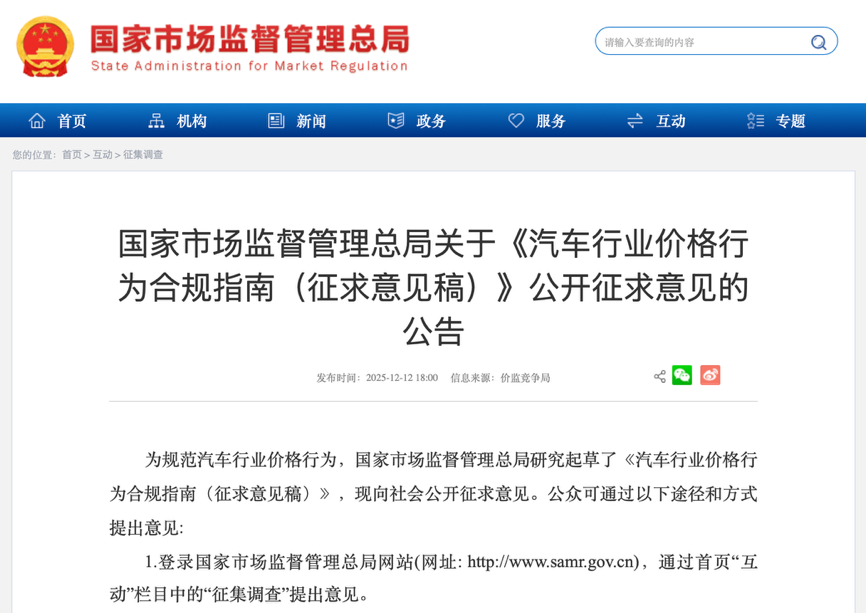
Core Viewpoint - The Chinese automotive industry is undergoing a significant transformation towards new energy and intelligence, facing intense competition and regulatory scrutiny to ensure healthy development [1] Regulatory Policies and Market Dynamics - The National Market Supervision Administration has solicited opinions on the "Guidelines for Compliance of Price Behavior in the Automotive Industry," which prohibits loss sales, requires clear pricing, and bans price fraud [2] - The introduction of these guidelines aims to curb the detrimental effects of price wars, which have severely impacted industry profitability, with the automotive industry's sales profit margin dropping to 3.9% in October, the lowest in five years [4][6] - The government has emphasized the importance of addressing "involution-style" competition in the 2025 government work report, highlighting a commitment to restoring healthy development in the automotive sector [4] Industry Response to Price Wars - Major automotive companies, including BYD and Great Wall, have pledged to adhere to the pricing guidelines and eliminate unfair competition practices [4] - The China Automotive Industry Association has called for fair competition and has initiated measures to prevent price dumping and misleading advertising [6] Regulatory Interventions and Compliance - A series of regulatory measures have been implemented to address issues such as production consistency and payment terms, with the Ministry of Industry and Information Technology launching checks on production consistency to ensure quality [8][9] - The average accounts payable turnover days for listed automotive companies reached 182 days in 2024, creating significant financial pressure on suppliers [9][11] - A commitment from 17 automotive companies to adhere to a 60-day payment term for suppliers has been established to alleviate financial strain [11] Addressing Network and Marketing Issues - The government has initiated a campaign to combat online misinformation and negative publicity affecting automotive companies, with actions taken against accounts spreading false information [12] - The Ministry of Industry and Information Technology has proposed new standards for intelligent driving systems to enhance safety and consumer protection [14][17] Innovation and Safety Concerns - The automotive industry faces challenges related to "involution" in technological innovation, where companies may compromise safety and quality to reduce costs and accelerate product development [13] - Recent incidents have raised concerns about the safety of new energy vehicles, particularly regarding their acceleration capabilities and the risks associated with hidden door handle designs [15][16] Conclusion on Industry Health - The regulatory environment in 2025 has seen over ten significant policy introductions aimed at addressing competition issues, with a focus on maintaining market order and promoting healthy competition among automotive companies [18][19] - The proactive measures taken by regulatory bodies and the automotive industry indicate a collective effort to navigate the challenges of transformation while ensuring sustainable growth [20]


2025汽车大事记:反内卷!汽车行业齐心落实“六十天账期承诺”
Zhong Guo Jing Ji Wang· 2025-12-29 07:22
从国家政策到行业倡议,从企业争相承诺到被集体约谈,2025年,一套国家政策、行业倡议、企业约谈"组合拳",精准直击行业外少有人关注的"支付账 期"问题。 近年来,不断加剧的"内卷式"竞争让汽车产业陷入"增量不增收、增收不增利"怪象,这一现象在今年前5个月尤为显著。据国家统计局数据,1—5月,我国 汽车产销量同比增长均超10%;同时,汽车制造业营业收入上涨7.1%;但利润总额却下滑11.9%。 与此同时,这一压力更已传导至供应商等上游环节。据行业数据,2024年,中国上市车企平均应付账款周转天数达182天,部分企业超过240天,导致中小供 应商资金链压力巨大,融资成本高达5%—8%,远高于整车企业的3%—5%,对汽车产业链条带来极大安全风险。 由此,"缩短账期"已刻不容缓。中国汽车流通协会专家委员会委员章弘表示,"缩短账期"能够缓解供应商的资金压力,提升其经营韧性和创新能力。 其实早在3月17日,国务院就发布修订版《保障中小企业款项支付条例》,其中明确提出,大型企业从中小企业采购货物、工程、服务,应当自货物、工 程、服务交付之日起60日内支付款项。该条例已于6月1日起正式施行。 为巩固"六十天账期承诺"的贯彻执 ...

揭晓!2025中国汽车十大新闻!
Bei Jing Ri Bao Ke Hu Duan· 2025-12-29 04:17
Group 1 - The core theme of 2025 in the automotive industry is "anti-involution and strong regulation," with significant policy support and market response to boost automotive consumption [2][4] - The Ministry of Industry and Information Technology and other departments have intensified enforcement against issues like false evaluations and unfair competition, promoting a shift from price competition to value competition [4] - The "old-for-new" vehicle replacement program has led to over 11.2 million applications, accounting for about one-third of total sales, with new energy vehicles making up approximately 60% of this figure [6] Group 2 - The first batch of L3-level conditional autonomous driving vehicles has received approval for road testing in designated areas, marking a significant step towards commercialization [8] - The establishment of China Changan Automobile Group as the third state-owned automotive enterprise reflects the government's push for electric vehicle development and aims to enhance global competitiveness [10][11] - The "Energy-saving and New Energy Vehicle Technology Roadmap 3.0" outlines a vision for the automotive industry to achieve peak carbon emissions by 2040, with over 80% penetration of new energy vehicles [13] Group 3 - The "Automotive Industry Steady Growth Work Plan (2025-2026)" aims for total vehicle sales of approximately 32.3 million in 2025, with new energy vehicle sales targeted at 15.5 million [14] - China's automotive exports have reached 6.34 million units in the first 11 months of 2025, with a year-on-year growth of 18.7%, and are expected to exceed 7 million units by year-end [16] - Major automotive companies have committed to reducing payment terms to within 60 days, addressing long-standing issues of delayed payments to suppliers [18][19] Group 4 - New national standards for electric vehicle batteries, set to be implemented in July 2026, aim to enhance safety and quality, marking a significant upgrade in regulatory standards [21] - The Ministry of Commerce and other departments have introduced stricter regulations on used car exports to ensure compliance and promote healthy market development [23]


350亿,又一家新势力宣布破产
首席商业评论· 2025-12-29 04:07
Core Viewpoint - The demise of Qoros Auto serves as a warning for the Chinese automotive industry, highlighting the challenges of transitioning from product development to market success in the rapidly evolving new energy vehicle sector [5][7]. Group 1: Qoros Auto's Downfall - Qoros Auto, once seen as a benchmark for high-end domestic brands, has entered bankruptcy proceedings due to long-standing debts and operational failures, marking a significant moment in the transformation of the Chinese automotive landscape [7][9]. - The company faced over 1,000 enforcement actions and a total equity freeze amounting to over 35 billion yuan, reflecting severe financial distress and operational challenges [7][9]. - Despite initial success with its first model, Qoros 3, the brand struggled with high R&D costs and aggressive pricing strategies that alienated potential customers, leading to cumulative losses exceeding 6 billion yuan from 2014 to 2016 [9][11]. Group 2: Lessons for the Industry - Qoros Auto's experience underscores the importance of brand recognition and consumer trust, which are critical for long-term success in the automotive market [13][15]. - The company's failure to adapt to market changes, particularly the shift towards electric vehicles and consumer preferences, highlights the necessity for agility and strategic foresight in a rapidly evolving industry [16][19]. - The case illustrates the need for collaboration within the automotive ecosystem, as independent operations can lead to inefficiencies and increased costs, making it difficult to compete effectively [17][19]. Group 3: Future of the New Energy Vehicle Market - The new energy vehicle sector is entering a critical phase where the focus will shift from mere production capabilities to delivering real value and user satisfaction [21][29]. - Companies must evolve from being "car manufacturers" to "smart mobility technology enterprises," emphasizing the importance of understanding user scenarios and providing tailored solutions [21][23]. - The competitive landscape will increasingly rely on software capabilities and user engagement, necessitating a shift from traditional sales models to a more integrated approach that fosters long-term customer relationships [25][29].
320亿,重庆超级IPO来了
投中网· 2025-12-29 03:30
Core Viewpoint - The article discusses the rapid competition in the automotive industry, particularly focusing on the rise of Avita Technology, a high-end electric vehicle manufacturer backed by Changan Automobile, CATL, and Huawei, which is preparing for its IPO in Hong Kong [6][15]. Group 1: Company Overview - Avita Technology, established in 2018 as a joint venture between Changan Automobile and NIO, aims to become a global leader in luxury smart electric vehicles [8]. - The company has launched four main production models, including the Avita 11 and Avita 12, with prices ranging from 200,000 to 700,000 yuan, offering both pure electric and range-extended options [9]. - Avita Technology's revenue has seen significant growth, reaching approximately 56.45 billion yuan in 2023, 151.95 billion yuan in 2024, and 122.08 billion yuan in the first half of 2025 [9]. Group 2: Financial Performance - Despite the revenue growth, Avita Technology has incurred cumulative losses exceeding 11.3 billion yuan over three and a half years due to high sales, marketing, and R&D expenditures [10]. - The company has successfully raised 19 billion yuan in financing over three years, achieving a valuation of approximately 32 billion yuan [11][14]. Group 3: Strategic Partnerships - Avita Technology benefits from strategic partnerships with Changan Automobile, CATL, and Huawei, which provide support in manufacturing, supply chain, and technology development [9][12]. - The company has signed comprehensive strategic cooperation agreements with Huawei, including joint product development and marketing plans, and has acquired a 10% stake in Huawei's subsidiary for 11.5 billion yuan [9][12]. Group 4: Market Expansion Plans - Avita Technology plans to enter over 50 countries by 2025 and over 80 countries by 2030, establishing more than 700 sales channels globally [10]. - The company is also expanding into Southeast Asia, the Middle East, Africa, Eurasia, and Latin America as part of its global strategy [10]. Group 5: Industry Trends - Several automotive companies, including Avita Technology, are pursuing IPOs in Hong Kong as part of their globalization strategies, responding to the competitive pressures in the Chinese automotive market [15][18]. - The trend of automotive companies going public in Hong Kong is seen as a way to enhance their capital base and support international expansion [18].


告别单纯供应 走向深度共生——汽车供应链关系重构新解
Zhong Guo Qi Che Bao Wang· 2025-12-29 03:16
Core Insights - Horizon Robotics held its first technology ecosystem conference, emphasizing a shift from "driving high" to "coexisting with high" in intelligent driving, aiming to expand driving assistance features into broader markets [4] - The new HSD Together model promotes deep collaboration with industry partners, reshaping the automotive supply chain ecosystem from a linear supply model to a symbiotic relationship [5][7] Industry Transformation - The HSD system, based on the Journey 6M chip, is set to be mass-produced and integrated into affordable vehicles, marking a significant shift in collaboration strategies within the automotive industry [5] - The complexity of developing advanced driving assistance systems necessitates a collaborative approach, as individual automakers may lack the resources to tackle these challenges alone [6] Supply Chain Evolution - The transition from a traditional supply chain to a networked structure allows for more flexible and collaborative relationships among suppliers, enhancing the overall capability of the ecosystem [8] - The integration of suppliers into the manufacturing process, as seen with CATL's battery production within vehicle assembly lines, exemplifies the shift towards co-located collaboration [9] Strategic Partnerships - The HSD Together model enables partners to modularly select algorithm modules and engineering support, significantly reducing their resource investment by up to 90% [6] - The automotive industry is witnessing a shift in collaboration dynamics, with semiconductor companies engaging directly with top management of automakers, indicating a move towards strategic partnerships rather than transactional relationships [10] Competitive Landscape - The focus of competition in the automotive industry is shifting from hardware and software development to ecosystem building and collaborative efficiency [11] - The emergence of the HSD Together model raises questions about the potential loss of technical leadership for automakers with weaker software capabilities, leading to a bifurcated industry landscape [12] Innovation and Value Creation - The automotive market is transitioning from price competition to innovation-driven strategies, emphasizing the importance of collaborative ecosystems in enhancing innovation efficiency [14] - The value creation process is increasingly reliant on data cycles and functional iterations throughout the vehicle's lifecycle, highlighting the need for a healthy ecosystem to foster continuous improvement [15] Future Outlook - The automotive industry is likely to evolve into a layered, dynamically balanced ecosystem where a minority of leading firms pursue full-stack development while the majority collaborate with ecosystem partners [13] - The shift towards a collaborative model may lead to a reallocation of power within the supply chain, necessitating fair trust and benefit-sharing mechanisms among partners [17]

研判2025!中国汽车镁合金轮毂行业市场政策、产业链图谱、市场规模、竞争格局及发展趋势分析:汽车轻量化浪潮席卷,未来大有可为[图]
Chan Ye Xin Xi Wang· 2025-12-29 02:35
Overview - The rapid rise of the new energy vehicle industry is driving the growth of the automotive magnesium alloy wheel hub sector, with increasing demand for lightweight components to alleviate range anxiety [1][9] - The market size of China's automotive magnesium alloy wheel hub industry is projected to reach 1.42 billion yuan in 2024, representing a year-on-year growth of 47.9%, although the current market share of magnesium alloy wheel hubs is less than 2% [1][9] Market Policies - China has implemented a series of policies to support the development of the automotive magnesium alloy wheel hub industry, creating a favorable policy environment [4] Industry Chain - The upstream of the automotive magnesium alloy wheel hub industry includes suppliers of magnesium alloys and coating materials, while the downstream primarily targets the automotive market, with new energy passenger vehicles being the largest demand source [5][7] Current Development - The automotive market in China is experiencing rapid growth, with production and sales of automobiles reaching 24.43 million and 24.36 million units respectively in the first nine months of 2025, showing year-on-year growth of 13.3% and 12.9% [7][8] Competitive Landscape - The industry is transitioning from "technical reserves" to "scale application," with few companies capable of mass production. Key players include Dewey Technology Co., Ltd., Baowu Magnesium Industry, and others [9][10] Development Trends - Continuous optimization of material formulations is expected, with a focus on combining magnesium with rare earths and carbon fibers to enhance performance [13] - Smart manufacturing processes will be integrated into production, utilizing AI and 3D printing technologies to improve efficiency [14] - Green production will become a core competitive advantage, with a focus on reducing carbon emissions and enhancing recycling systems [15] - Vertical integration of the industry chain will be pursued by leading companies to ensure supply stability and reduce costs [16]





突发!美乌,超预期;重磅!“国补”明年继续;史诗级大涨,1盎司白银≥1桶美油
Sou Hu Cai Jing· 2025-12-29 00:41
Group 1: Economic Policy and Market Trends - The Ministry of Finance plans to significantly boost consumption in 2026 through special actions and funding support for consumer goods, including a focus on the replacement of old appliances [2] - By the end of 2024, the total ownership of household appliances in China is expected to exceed 3 billion units, with over 128 million units replaced in the first 11 months of this year, generating sales exceeding 2.5 trillion yuan [2] - The People's Bank of China aims to enhance the investment scale and proportion of long-term funds in the A-share market to support stable economic growth and high-quality development [3] Group 2: Commodity Market Developments - Silver prices surged over 5% to reach $83.16 per ounce, marking a historical high, while palladium futures rose by 4% to $2,107.5 per ounce [2] - The demand for silver remains strong across various sectors, including jewelry, medical devices, and electric vehicles, contributing to a continuous supply shortage in the global silver market for five consecutive years [2] - In contrast, the oil market is experiencing oversupply, with WTI crude oil prices dropping over 20% this year [2] Group 3: Corporate Announcements and Financial Performance - A total of 3,766 listed companies in China have implemented cash dividends this year, with a total payout of 2.64 trillion yuan, setting a new record [4] - The scale of China's ETFs has reached 6.03 trillion yuan, a growth of over 60% from the beginning of the year, with seven ETFs exceeding 1 billion yuan in size [5] - Long-term investment in the aerospace and aviation equipment manufacturing industry has seen a profit increase of 13.3% year-on-year, with significant growth in related sectors [5] Group 4: Industry Innovations and Developments - The commercial rocket sector is receiving priority support under the new listing standards on the Sci-Tech Innovation Board, with a focus on companies involved in national projects [5] - The establishment of a standardization committee for humanoid robots and embodied intelligence is expected to drive significant growth in the industry, with anticipated exponential increases in shipment volumes by 2026 [8] - The automotive industry is witnessing advancements in L3 autonomous driving technology, with companies like Changan and Deep Blue receiving conditional self-driving licenses [6] Group 5: Regulatory Changes and Market Adjustments - The National People's Congress has passed a revised foreign trade law, effective March 1, 2026, which includes measures to support new trade models and promote digital trade [10] - The central bank and the State Administration of Foreign Exchange have issued guidelines for managing funds for domestic companies listed abroad, allowing for the use of both domestic and foreign funds for share repurchases [4] - The China Securities Regulatory Commission has initiated administrative penalties against *ST Chang Medicine for financial data misrepresentation, potentially leading to delisting procedures [7]
自动驾驶又火了,离完全替代司机还有多久?
3 6 Ke· 2025-12-29 00:31
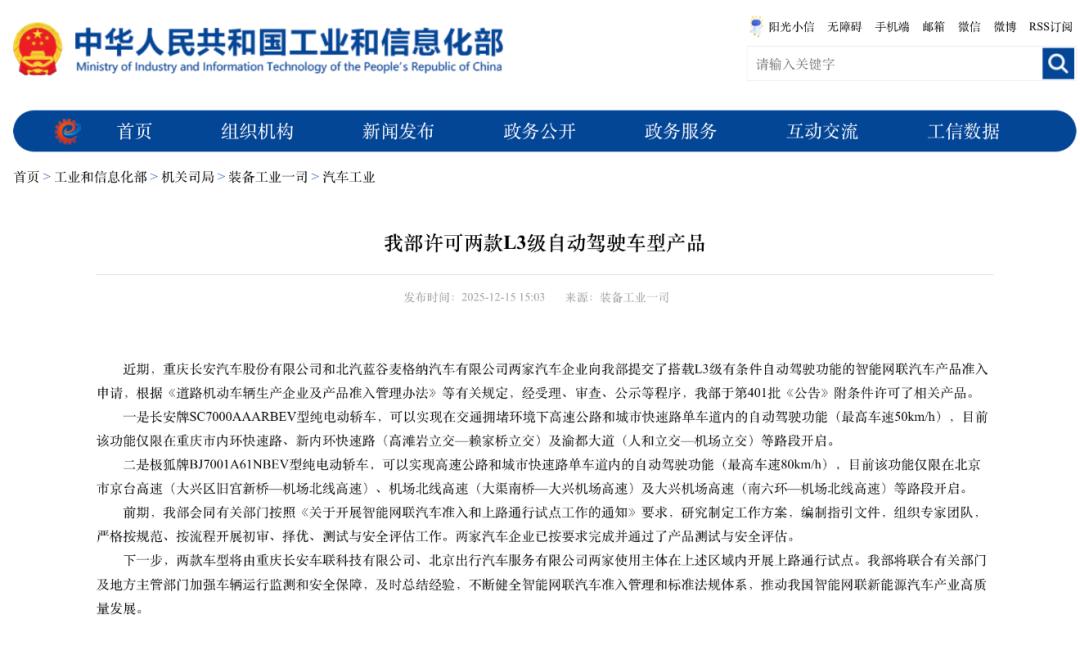
Core Viewpoint - The recent developments in L3 level autonomous driving, including the approval of vehicles from BAIC and Changan, indicate a significant step towards practical implementation of autonomous driving technology in China [3][5][6]. Group 1: Regulatory Approvals - BAIC and Changan have received official approval from the Ministry of Industry and Information Technology for their L3 level conditional autonomous driving vehicles, which can operate at speeds of up to 80 km/h and 50 km/h in designated areas of Beijing and Chongqing respectively [3]. - This approval marks a transition from testing to real-world application, suggesting that L3 level autonomous driving is moving closer to practical use [5]. Group 2: Industry Developments - He Xiaopeng, CEO of XPeng Motors, has expressed confidence in the advancements of autonomous driving, stating that XPeng's upcoming VLA 2.0 will match Tesla's FSD V14.2, potentially allowing users to skip L3 and access L4 capabilities directly [7]. - The competition in the autonomous driving sector is intensifying, with companies like Tesla and Waymo showcasing different technological approaches, highlighting the ongoing evolution of the industry [19]. Group 3: Levels of Automation - The classification of driving automation ranges from L0 to L5, with L2 being the current mainstream level that requires driver supervision, while L3 allows for conditional automation where the driver can disengage under certain circumstances [9][11]. - Higher levels, L4 and L5, promise complete automation in specific environments, which could significantly enhance user experience and convenience [13][14]. Group 4: Safety and Technology - The transition to higher levels of automation raises questions about safety and responsibility, with L2 placing responsibility on the driver, while L3 shares it with manufacturers, and L4 and L5 shift it entirely to manufacturers [16]. - Recent incidents, such as the power outage affecting Waymo's autonomous taxis, underscore the vulnerabilities of different autonomous systems and the importance of robust safety measures [18][19]. Group 5: Market Trends and Collaborations - The market is seeing a trend towards collaboration with third-party suppliers like Huawei, which could enhance efficiency and reduce costs in the development of autonomous driving technologies [21][23]. - By the end of 2025, it is projected that vehicles equipped with Huawei's intelligent driving systems will account for a significant market share, indicating a shift towards more accessible L3 level vehicles for consumers [23].


长安汽车申请制动能量回收方法专利,提高用户的驾驶体验
Jin Rong Jie· 2025-12-29 00:27
Group 1 - The core point of the article is that Chongqing Changan Automobile Co., Ltd. has applied for a patent related to a "braking energy recovery method, device, and vehicle," which aims to enhance driving experience through optimized braking energy recovery based on vehicle scenario perception information [1] Group 2 - Chongqing Changan Automobile Co., Ltd. was established in 1996 and is primarily engaged in the automotive manufacturing industry, with a registered capital of 991,408.606 million RMB [2] - The company has invested in 120 enterprises and participated in 5,000 bidding projects, holding 3,129 trademark records and 5,000 patent records, along with 1,053 administrative licenses [2]