三生制药

Search documents
9.5亿美元BD交易后 百济神州股价为何跌了
Jing Ji Guan Cha Wang· 2025-08-27 14:29
Core Viewpoint - BeiGene, a leading innovative drug company, has entered the drug licensing wave by selling a portion of the royalty rights for its cancer drug, Talazoparib, for up to $950 million, with an upfront payment of $885 million, which represents 36% of its revenue for the first half of the year [2][3][4]. Group 1: Transaction Details - The transaction involves BeiGene selling its rights to receive royalties from Talazoparib, which is set to launch in the U.S. in May 2024 for small cell lung cancer treatment [3][4]. - The upfront payment of $885 million is the second-highest upfront payment in China's innovative drug BD transactions, following a record $1.25 billion by another company [6]. - Royalty Pharma, the buyer, expects a return on investment of 10%-15% from this transaction, with projected total sales of Talazoparib from 2025 to 2035 estimated at $19.6 billion [4][5]. Group 2: Implications for BeiGene and the Industry - This transaction marks BeiGene's first drug licensing deal in four years and sets a precedent for the use of royalty rights as a transaction model in China's innovative drug sector [2][6]. - The deal is seen as a form of debt financing rather than a value-creating transaction, which may limit its attractiveness to investors compared to other BD deals that have led to stock price increases [6][7]. - BeiGene's current focus is on maintaining a robust cash flow, with over 30 drug candidates in development and significant R&D expenses projected to reach approximately $1 billion in the first half of 2025 [7][8].


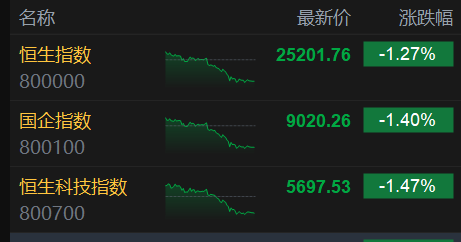
港股收盘(08.27) | 恒指收跌1.27% 部分AI概念股走高 农夫山泉(09633)绩后大涨7%
智通财经网· 2025-08-27 08:48
Market Overview - The Hong Kong stock market experienced a decline for the second consecutive day, with all three major indices falling over 1%. The Hang Seng Index closed down 1.27% at 25,201.76 points, with a total turnover of HKD 371.376 billion [1] - The Hang Seng China Enterprises Index dropped 1.4% to 9,020.26 points, while the Hang Seng Tech Index fell 1.47% to 5,697.53 points [1] Blue Chip Performance - Nongfu Spring (09633) led the blue-chip stocks, rising 7.11% to HKD 50.3, contributing 10.53 points to the Hang Seng Index. The company reported a revenue of RMB 25.622 billion for the first half of 2025, a year-on-year increase of 15.56% [2] - Other notable blue-chip movements included Zhongsheng Holdings (00881) up 1.96%, China Hongqiao (01378) up 1.12%, while China Resources Mixc Lifestyle (01209) fell 9.08% and CSPC Pharmaceutical Group (01093) dropped 6.36% [2] Sector Highlights - Large tech stocks generally declined, with Tencent down 1.72% and Xiaomi down 0.56%. However, AI concept stocks surged following the State Council's release of the "Artificial Intelligence+" action plan, with SenseTime rising over 14% [3] - The AI action plan aims for over 70% application penetration of new intelligent terminals and intelligent entities by 2027, marking a shift towards deep integration with the real economy [3] Brokerage Stocks - Chinese brokerage stocks faced significant declines, with Shenwan Hongyuan (06806) down 6.02%, Dongfang Securities (03958) down 5.78%, and CITIC Securities (06030) down 4.11% [4] - The recent surge in the Shanghai Composite Index and trading volume indicates strong market sentiment, but there are signals of potential adjustments if volatility increases [4] Pharmaceutical Sector - The sentiment in the pharmaceutical sector remained low, with notable declines in stocks such as Connaught (02162) down 8.59% and King’s Flair International (01548) down 7.42% [4] Innovation Drug Sector - Guotou Securities reported that the current market capitalization of the innovative drug sector reflects a neutral expectation, with improvements in the domestic market expected to lead to profitability by 2026 [5] - The sector is anticipated to benefit from several catalysts in the second half of the year, including medical insurance negotiations and academic conferences [5] Notable Stock Movements - Lianyi Technology (09959) surged 23.21% to HKD 2.76 after announcing a share buyback plan [7] - Lens Technology (06613) reached a new high, rising 7.78% to HKD 27.98, driven by strong growth prospects and expected benefits from Apple's new products [8] - COSCO Shipping International (00517) reported a revenue of HKD 1.934 billion for the first half of 2025, a 10.3% year-on-year increase, with a profit attributable to shareholders of HKD 488 million, up 25.6% [9] - NIO (09866) rose 4.26% to HKD 51.65, supported by strong orders for new vehicle models [10] - Country Garden Services (06098) fell 11.11% after reporting a 30.8% decline in profit attributable to shareholders [11]

港股收盘 | 恒指收跌1.27% 部分AI概念股走高 农夫山泉绩后大涨7%
Zhi Tong Cai Jing· 2025-08-27 08:46
Market Overview - The Hong Kong stock market experienced a decline for the second consecutive day, with all three major indices falling over 1%. The Hang Seng Index closed down 1.27% at 25,201.76 points, with a total turnover of HKD 371.38 billion [1] - The short-term liquidity in the Hong Kong market is lagging, but it has structural advantages in the long term. Key characteristics of the market this year include stronger structure compared to indices and continuous rotation of leading sectors [1] Blue Chip Performance - Nongfu Spring (09633) led the blue-chip stocks, rising 7.11% to HKD 50.3, contributing 10.53 points to the Hang Seng Index. The company reported a revenue of RMB 25.622 billion for the first half of 2025, a year-on-year increase of 15.56% [2] - Other notable blue-chip movements included Zhongsheng Holdings (00881) up 1.96%, China Hongqiao (01378) up 1.12%, while China Resources Mixc Lifestyle (01209) fell 9.08%, and CSPC Pharmaceutical Group (01093) dropped 6.36% [2] Sector Highlights - Large technology stocks generally declined, with Tencent down 1.72% and Xiaomi down 0.56%. However, AI concept stocks surged following the State Council's release of the "Artificial Intelligence+" action plan, with SenseTime rising over 14% [3] - The AI action plan aims for over 70% application penetration of new intelligent terminals and entities by 2027, marking a shift towards deep integration with the real economy [3] - Chinese brokerage stocks faced significant declines, with Shenwan Hongyuan down 6.02% and Dongfang Securities down 5.78% [4] - The pharmaceutical sector showed low sentiment, with notable declines in stocks like Kangnuo Ya-B (02162) down 8.59% and King’s Flair International (01548) down 7.42% [4] Notable Stock Movements - Lianyi Technology-W (09959) saw a strong increase of 23.21% after announcing a share buyback plan of at least USD 80 million [7] - Lens Technology (06613) reached a new high, rising 7.78% due to strong growth prospects and expected benefits from Apple's upcoming foldable phone [7] - COSCO Shipping International (00517) reported a revenue of HKD 1.934 billion for the first half of 2025, a 10.3% year-on-year increase, with a profit attributable to shareholders of HKD 488 million, up 25.6% [8] - NIO-SW (09866) rose 4.26% as strong orders for new models are expected to drive stock price increases [9] - Country Garden Services (06098) fell 11.11% after reporting a 30.8% decline in profit attributable to shareholders despite a 10.2% increase in revenue [10]
港股收评:午后跳水恒指跌1.27%,科技股、金融股普遍弱势!蓝思科技涨8%,快手美团跌超3%,百度网易腾讯跌近2%
Ge Long Hui· 2025-08-27 08:40
Market Overview - The Hong Kong stock market experienced a significant decline in the afternoon, with the Hang Seng Index dropping by 1.27%, losing over 300 points. The Hang Seng China Enterprises Index and the Hang Seng Tech Index fell by 1.4% and 1.47% respectively, with the former barely holding above the 9000-point mark [2] - Major technology stocks, which serve as market indicators, continued to decline in the afternoon. Kuaishou and Meituan fell over 3%, while JD.com dropped by 2.5%. Baidu, NetEase, and Tencent saw declines close to 2%, and Xiaomi fell by 0.56%. Alibaba managed to stay slightly positive [3] Sector Performance - The financial sector, including banks, insurance companies, and Chinese brokerage firms, collectively underperformed, contributing to the overall market decline. The performance of individual stocks continued to be affected by ongoing earnings reports, with property management and real estate stocks experiencing significant drops [3] - Biopharmaceutical stocks faced a collective downturn, particularly in the innovative drug sector, following comments from Trump regarding the rapid imposition of tariffs on pharmaceuticals. This led to notable declines in various biopharma stocks [3] Specific Stock Movements - Several biopharmaceutical companies saw substantial declines, including Kanghao Ya-B (-8.59%), Qiansirui Biotechnology (-7.42%), and Kangfang Biotechnology (-7.10%). Other notable decliners included Xiansheng Pharmaceutical (-6.79%) and Shiyao Group (-6.36%) [3] - In contrast, the rare earth sector remained strong, benefiting from the implementation of supply reforms and multiple catalysts. Apple’s upcoming event on September 9, where the iPhone 17 series is expected to be launched, led to a rise in Apple-related stocks, with Lens Technology (300433) surging nearly 8% and reaching a new high since its listing [4]




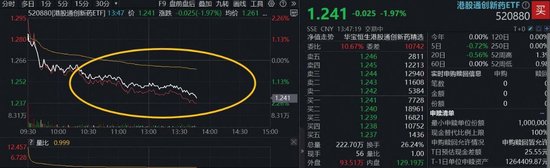
继续回调,高人气港股通创新药ETF(520880)下探2%,高溢价再现,机构:港股补涨优先创新药
Xin Lang Ji Jin· 2025-08-27 05:58
Core Viewpoint - The Hong Kong stock market for innovative drugs is experiencing a pullback, with the Hang Seng Hong Kong Stock Connect Innovative Drug Selective Index down by 2.31%, and most constituent stocks also declining [1]. Group 1: Market Performance - The Hang Seng Hong Kong Stock Connect Innovative Drug ETF (520880) opened high but fell by 1.97% during the session, indicating a downward trend despite a positive buying attitude reflected in a real-time premium rate of 0.4% [1]. - Year-to-date until July 31, the Hang Seng Hong Kong Stock Connect Innovative Drug Selective Index has increased by 101.58%, outperforming the Hang Seng Index (23.50%) and the Hang Seng Technology Index (22.05%) by 78.08 and 79.53 percentage points respectively [5]. Group 2: Future Outlook - Despite recent volatility in innovative drug sentiment, there are continuous catalysts for the sector, including mid-year performance reports, industry conference data, potential business development transactions, and the advancement of commercial insurance directories [3]. - With expectations of interest rate cuts in the U.S., the valuation framework for innovative drugs is likely to improve [3]. - The improvement in liquidity narratives suggests that the Hong Kong stock market may experience a phase of rebound, narrowing the gap with the rapidly rising A-share market [3]. Group 3: Investment Strategy - The current earnings forecast rate for the Hong Kong stock market is at its highest since 2022, suggesting a favorable environment for investment [3]. - It is recommended to focus on innovative drugs first, followed by the internet sector, and finally new consumption, as the latter awaits macroeconomic and profit turning points [3].
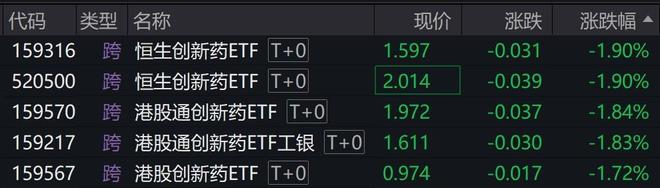
港股创新药概念股走低,恒生创新药ETF跌近2%
Mei Ri Jing Ji Xin Wen· 2025-08-27 05:38
Group 1 - The Hong Kong innovative drug concept stocks have declined, with companies such as 3SBio and Hansoh Pharmaceutical dropping over 4%, while Innovent Biologics, CSPC Pharmaceutical Group, and China National Pharmaceutical Group fell over 3% [1] - The Hang Seng Innovative Drug ETF has decreased nearly 2% due to market influences [1] Group 2 - Several ETFs related to innovative drugs have shown declines, with specific prices and percentage drops noted, such as the Hang Seng Innovative Drug ETF at 1.597, down 1.90% [2] - A brokerage firm indicated that the collection of chemical drugs has completed ten batches, with the new batch increasing quality requirements and reflecting a reduction in "involution," leading to a diminishing marginal impact [2] - The Pharma collection is gradually clearing out, entering a period of innovative transformation and harvest, with favorable medical insurance policies expected to support rapid growth of innovative drugs [2]
国务院印发“人工智能+”行动意见 阿里巴巴开源全新视频生成模型
Mei Ri Jing Ji Xin Wen· 2025-08-27 01:48
Market Overview - On August 26, Hong Kong's three major indices collectively declined, with the Hang Seng Index falling by 1.18% to 25,524.92 points, the Hang Seng Tech Index down by 0.74% to 5,782.24 points, and the National Enterprises Index decreasing by 1.07% to 9,148.66 points [1] - The technology sector saw most stocks retreat, while gold stocks performed strongly [1] - Notable individual stock movements included Xpeng Motors rising nearly 3%, BYD increasing over 1.5%, and Alibaba dropping over 2.5% [1] Southbound Capital - On August 26, southbound capital recorded a net inflow of 16.573 billion HKD, with a cumulative net inflow of 972.022 billion HKD year-to-date, significantly surpassing last year's total [2] U.S. Market Performance - U.S. stock indices experienced slight gains overnight, with the Dow Jones up by 0.3%, S&P 500 rising by 0.41%, and Nasdaq increasing by 0.44% [2] - Boeing and Cisco led the Dow with gains exceeding 3% and 1%, respectively [2] - Chinese concept stocks mostly rose, with Hesai Technology up over 14% and NIO increasing by more than 10% [2] Key Developments - The State Council recently released an action plan for the deep implementation of "Artificial Intelligence +", aiming for widespread integration of AI in six key areas by 2027 [3] - Apple plans to hold a major product launch event on September 9, expected to unveil the iPhone 17 series and an upgraded Apple Watch [3] - Alibaba has launched a new multimodal video generation model, significantly enhancing video creation efficiency for digital human applications [3] Short Selling Data - On August 26, a total of 634 Hong Kong stocks were short-sold, with a total short-selling amount of 39.232 billion HKD [4] - Alibaba, Tencent, and Sanofi were the top three stocks by short-selling amount, with 1.921 billion HKD, 1.881 billion HKD, and 1.43 billion HKD, respectively [4] Institutional Insights - According to China Merchants Securities, recent changes in liquidity narratives may support a rebound in Hong Kong stocks, with a current earnings surprise rate at its highest since 2022 [5] - The firm suggests focusing on technology internet stocks, non-bank financials, and stocks undergoing index component adjustments as potential investment opportunities [5] Hong Kong ETFs - The Hong Kong Consumption ETF focuses on e-commerce and new consumption sectors, which are relatively scarce compared to A-shares [6] - The Hang Seng Tech Index ETF includes core AI assets and technology leaders that are also scarce in A-shares [7]


港股早参丨国务院印发“人工智能+”行动意见,阿里巴巴开源全新视频生成模型
Sou Hu Cai Jing· 2025-08-27 01:33
【市场复盘】 8月26日,港股三大指数集体下跌。截至收盘,恒生指数跌1.18%,报25524.92点;恒生科技指数跌0.74%,报5782.24点;国企指数跌1.07%,报9148.66点。 盘面上,科网股多数回调,金融、地产行业普跌;黄金股逆势走强。热点个股方面,小鹏汽车涨近3%,比亚迪股份涨超1.5%,快手涨近0.5%,阿里巴巴跌 超2.5%,美团跌近2%。热点ETF方面,恒生科技指数ETF(513180)收跌0.88%。 【南向资金】 8月26日,南向资金净流入165.73亿港元;截至8月26日,今年以来南向资金累计净流入9720.22亿港元,大幅超过去年全年净流入额。 【隔夜美股】 隔夜美股三大股指小幅收涨,道指涨0.3%,标普500指数涨0.41%,纳指涨0.44%。波音涨超3%,思科涨逾1%,领涨道指。万得美国科技七巨头指数涨 0.37%,特斯拉、英伟达涨超1%。中概股多数上涨,禾赛科技涨超14%,蔚来涨逾10%。恒生指数ADR上涨,按比例计算,收报25571.06点,较港股收市涨 46.14点或0.18%。 【热点消息】 1、近日,国务院发布深入实施"人工智能+"行动意见。意见明确,到2027年 ...
趋势研判!2025年中国单抗药物行业产业链、发展背景、市场规模、竞争格局及发展趋势分析:国产化替代进程加速[图]
Chan Ye Xin Xi Wang· 2025-08-27 01:21
Overview - The monoclonal antibody (mAb) market in China is still in its early stages, with many overseas mAbs not yet approved domestically. The high cost of these drugs limits accessibility for many patients with lower payment capabilities. However, the market penetration of mAbs is gradually increasing due to their significant advantages over traditional drugs, updates to the national medical insurance catalog, and rising national income levels. The market size of China's mAb industry is projected to reach 131.5 billion yuan in 2024, representing a year-on-year growth of 30.85% [1][5]. Industry Chain - The upstream of the mAb industry includes suppliers of raw materials such as cell culture media, enzymes, antibodies, reagents, consumables, and packaging materials, as well as core equipment suppliers like bioreactors and purification devices. The midstream consists of mAb research and production companies, while the downstream includes hospitals, DTP pharmacies, retail pharmacies, and online channels. Hospitals are the most critical distribution channel for mAbs in China, especially for drugs listed in the medical insurance catalog [3][5]. Development Background - The application of mAbs in cancer treatment is widespread, with the number of new cancer cases in China projected to reach 5.064 million in 2024, a year-on-year increase of 2.61%. This growing cancer population drives the demand for mAbs. Additionally, mAbs have shown efficacy in treating other diseases, such as asthma and inflammatory bowel diseases, providing new development opportunities for the mAb industry [4][5]. Current Status - Since the launch of the first therapeutic mAb in 1986, the mAb market has rapidly developed, with significant products like trastuzumab and adalimumab emerging. By 2024, the global mAb market size is expected to reach 273.3 billion USD, with a year-on-year growth of 9.15% [4][5]. Competitive Landscape - In the global pharmaceutical market, mAbs are becoming a cornerstone of biopharmaceuticals, with 8 mAbs appearing in the top 20 global drug sales rankings in 2024. The success of mAbs in treating tumors and immune diseases is notable, and advancements in biopharmaceutical technology may expand their role in treating infectious diseases [5][6]. Domestic Market Dynamics - In 2024, only 7 mAbs are among the top 30 chemical and biological drugs sold in Chinese hospitals, indicating significant room for growth in the domestic mAb market. The market is expected to expand further as domestic companies gain market share [7][8]. Company Analysis - Domestic companies like BeiGene, Innovent Biologics, Junshi Biosciences, and others are increasingly capturing market share previously dominated by multinational corporations. For instance, BeiGene's Tislelizumab leads in the PD-1 mAb market in China, while Innovent's Sintilimab and Junshi's Toripalimab also hold significant positions [8][9]. Future Trends - The quality and efficacy of domestic mAbs are expected to improve with ongoing advancements in research and production technologies. This may lead to a further increase in market share, breaking the monopoly of multinational companies. Additionally, the application of mAbs is anticipated to expand beyond cancer and autoimmune diseases to include infectious and transmissible diseases [11].


智通港股沽空统计|8月27日
智通财经网· 2025-08-27 00:25
Summary of Key Points Core Viewpoint - The report highlights the top short-selling stocks in the Hong Kong market, indicating significant investor sentiment and potential market movements for these companies [1][2]. Short Selling Ratios - AIA Group Ltd (友邦保险-R) and JD Health (京东健康-R) both have a short-selling ratio of 100.00%, indicating complete short interest [1][2]. - JD Group (京东集团-SWR) follows with a short-selling ratio of 87.80% [1][2]. Short Selling Amounts - Alibaba Group (阿里巴巴-SW) leads in short-selling amount with 19.21 billion, followed by Tencent Holdings (腾讯控股) at 18.81 billion and Sanofi (三生制药) at 14.30 billion [1][2]. - Other notable companies include Meituan (美团-W) with 13.13 billion and BYD Company (比亚迪股份) with 12.05 billion [2]. Deviation Values - The top three stocks with the highest deviation values are Hong Kong Exchanges and Clearing (香港交易所-R) at 40.73%, AIA Group (友邦保险-R) at 37.99%, and JD Group (京东集团-SWR) at 36.59% [1][2]. - This deviation indicates a significant difference between current short-selling ratios and their historical averages [2]. Additional Insights - The report provides a detailed table of the top ten stocks by short-selling amounts, ratios, and deviation values, showcasing the current market sentiment towards these companies [2].