北方稀土

Search documents
高层定调支持战略性新兴产业集群发展,战略小金属有望受益,稀有金属ETF(159608)盘中涨超2%,标的指数高配稀土、锂等行业
Xin Lang Cai Jing· 2025-11-06 06:46
Group 1: Strategic Industry Development - The Central Committee of the Communist Party of China emphasizes accelerating the development of strategic emerging industries such as new energy, new materials, aerospace, and low-altitude economy, while also planning for future industries like quantum technology, hydrogen energy, and nuclear fusion [1] - New materials are identified as a key support area, expected to receive intensive policy support during the 14th Five-Year Plan, potentially forming a trillion-level market scale [1] Group 2: Lithium Battery Industry Insights - Xinluo Lithium Battery's November pre-production data shows battery production at 138.6 GWh, a month-on-month increase of 1.5%, with strong demand driven by domestic energy storage and new energy vehicle sales [1] - Huatai Securities reports that lithium battery demand is improving while supply is significantly slowing, leading to a tight supply-demand situation for energy storage batteries and various lithium battery materials, indicating a positive outlook for profitability across the lithium battery supply chain [1] Group 3: Cobalt Market Dynamics - The Democratic Republic of Congo has implemented a cobalt export quota policy, setting quotas significantly lower than 2024 production levels, which may lead to a supply shortage and rising cobalt prices by 2026 [2] - Companies are advancing their upstream nickel-cobalt-lithium resource layouts and releasing midstream wet smelting capacities, enhancing their global presence [2] Group 4: Rare Metals ETF Performance - As of November 6, 2025, the China Rare Metals Theme Index has risen by 1.90%, with significant gains in component stocks such as Tibet Mining and Yunnan Zinc Industry [3] - The Rare Metals ETF has seen a scale increase of 570 million yuan over the past three months, with notable inflows of 175 million yuan over the last 20 trading days, reflecting strong investor interest in the rare metals sector [3]
“家里有矿,年内涨超有色”,矿业ETF(561330)大涨超2%
Sou Hu Cai Jing· 2025-11-06 06:33
Core Viewpoint - The mining ETF (561330) has surged over 2% on November 6, driven by positive catalysts from the non-ferrous mining sector's Q3 reports, with a year-to-date increase exceeding 80% [1][3]. Group 1: Q3 Performance and Market Trends - The non-ferrous sector reported revenues of 24,380.50 billion yuan, a year-on-year increase of 9.33%, and a net profit attributable to shareholders of 1,337.48 billion yuan, up 41.88% [3]. - The CSI 300 index rose by 17.9% in Q3, while the CSI Non-Ferrous Metals Mining Theme Index increased by 50.20%, and the CSI Non-Ferrous Metals Index saw a 43.95% rise [3]. - Factors contributing to the positive performance include the Federal Reserve's resumption of interest rate cuts, rising gold prices, and upward trends in industrial metal prices due to supply disruptions [3]. Group 2: ETF Performance and Composition - The mining ETF (561330) outperformed the CSI Non-Ferrous Index by nearly 10% year-to-date, attributed to a more concentrated selection of leading stocks [4]. - The ETF tracks the CSI Non-Ferrous Metals Mining Theme Index, which consists of 37 stocks, with the top ten accounting for 57.03% of the index, compared to 47.97% for the CSI Non-Ferrous Index, which has 60 stocks [4]. - The composition of the CSI Non-Ferrous Metals Mining Theme Index shows a higher proportion of gold, copper, and rare earths at 56.2%, compared to 52.5% in the CSI Non-Ferrous Index, enhancing its responsiveness to market catalysts [5]. Group 3: Future Outlook - The supply-side constraints are identified as a fundamental driver for the industry's positive outlook, with insufficient global resource capital expenditure over the past decade leading to reduced supply elasticity [11]. - Low inventory levels and a rebound in demand from manufacturing, energy transition, and investments in power grids and data centers are expected to amplify marginal demand improvements [11]. - Analysts predict that copper and cobalt prices will continue to rise due to supply tightness, while lithium prices are expected to benefit from unexpected increases in energy storage demand [11].


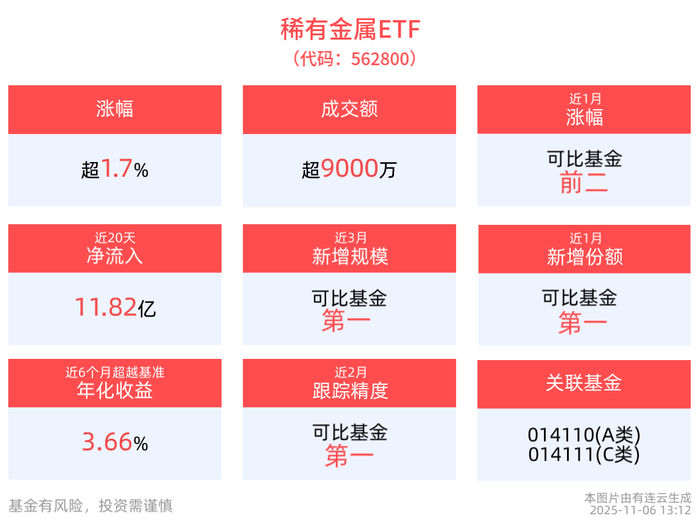
近3月新增规模同类居首,稀有金属ETF(562800)盘中最高涨超2%,成分股西藏矿业领涨
Xin Lang Cai Jing· 2025-11-06 05:38
Core Insights - The China Rare Metals Theme Index has seen a strong increase of 1.89%, with significant gains in constituent stocks such as Tibet Mining (+7.98%), Yunnan Zhenye (+6.13%), and Ganfeng Lithium (+4.12%) [1] - The Rare Metals ETF (562800) rose by 1.77%, with intraday gains exceeding 2% [1] Market Performance - The Rare Metals ETF had a turnover rate of 2.61% during the trading session, with a transaction volume of 99.67 million yuan [3] - Over the past month, the ETF has averaged a daily transaction volume of 322 million yuan, ranking first among comparable funds [3] - The ETF's scale has increased by 2.549 billion yuan over the past three months, marking significant growth and leading among comparable funds [3] - The ETF's share count has grown by 1.399 billion shares in the last month, also ranking first among comparable funds [3] - The latest net inflow for the ETF is 27.836 million yuan, with a total of 1.182 billion yuan attracted over the last 20 trading days [3] - As of November 5, the ETF's net value has increased by 6.18% over the past three years [3] - The ETF has recorded a maximum monthly return of 24.02% since its inception, with the longest consecutive monthly gain being six months and a total increase of 80.09% [3] Industry Dynamics - The Democratic Republic of Congo has implemented a cobalt export quota policy, with quotas set at 18,125 tons for 2025 and 96,600 tons for 2026 and 2027, which is less than half of the 2024 production [4] - This export limitation is expected to lead to a continuous depletion of cobalt resources, potentially resulting in supply shortages and driving up cobalt prices [4] - Companies with upstream resource advantages are anticipated to benefit significantly from this trend, according to Huazheng Securities [4] - China has established a dominant global position in rare metals such as rare earths, tungsten, antimony, gallium, germanium, indium, bismuth, vanadium, and magnesium [4][5] - China's rare earth reserves account for 37% of the global total, with monopolistic smelting technology; tungsten reserves account for 68% and production for 83%; antimony reserves account for 25% and production for 48%; gallium reserves account for 68% and production is globally leading; germanium reserves account for 40% and production for 83%; indium reserves account for 81% and production for 68% [5] - The stable control over rare metals enables effective resistance against external supply shocks, reinforcing the security of the industry chain [5] Key Stocks - The top ten weighted stocks in the China Rare Metals Theme Index include Northern Rare Earth, Luoyang Molybdenum, Huayou Cobalt, Salt Lake Industry, Ganfeng Lithium, Tianqi Lithium, Zhongmin Resources, China Rare Earth, Western Superconducting, and Xiamen Tungsten, collectively accounting for 60% of the index [3] - Notable stock performances include Northern Rare Earth (+0.29%), Luoyang Molybdenum (+3.79%), and Huayou Cobalt (+3.28%) [7] - Investors can also participate in the rare metals sector through the Rare Metals ETF linked fund (014111) [7]

有色ETF基金(159880)涨超2.4%,海外供应扰动不断推升铝价
Xin Lang Cai Jing· 2025-11-06 05:34
Group 1 - The core viewpoint is that the non-ferrous metal industry is experiencing a strong upward trend, driven by supply disruptions and rising aluminum prices, with significant gains in key stocks [1] - As of November 6, 2025, the Guozheng Non-Ferrous Metal Industry Index (399395) rose by 2.66%, with notable increases in stocks such as Nanshan Aluminum (600219) up 9.96% and China Aluminum (601600) up 9.02% [1] - The third quarter of 2025 saw the electrolytic aluminum sector generate revenue of 113.93 billion yuan, with a quarter-on-quarter increase of 0.19%, and a net profit of 10.40 billion yuan, up 8.33% [1] Group 2 - The Guozheng Non-Ferrous Metal Industry Index (399395) includes 50 prominent securities in the non-ferrous metal sector, reflecting the overall performance of listed companies in this industry [2] - As of October 31, 2025, the top ten weighted stocks in the index accounted for 52.91% of the total, including Zijin Mining (601899) and China Aluminum (601600) [2]

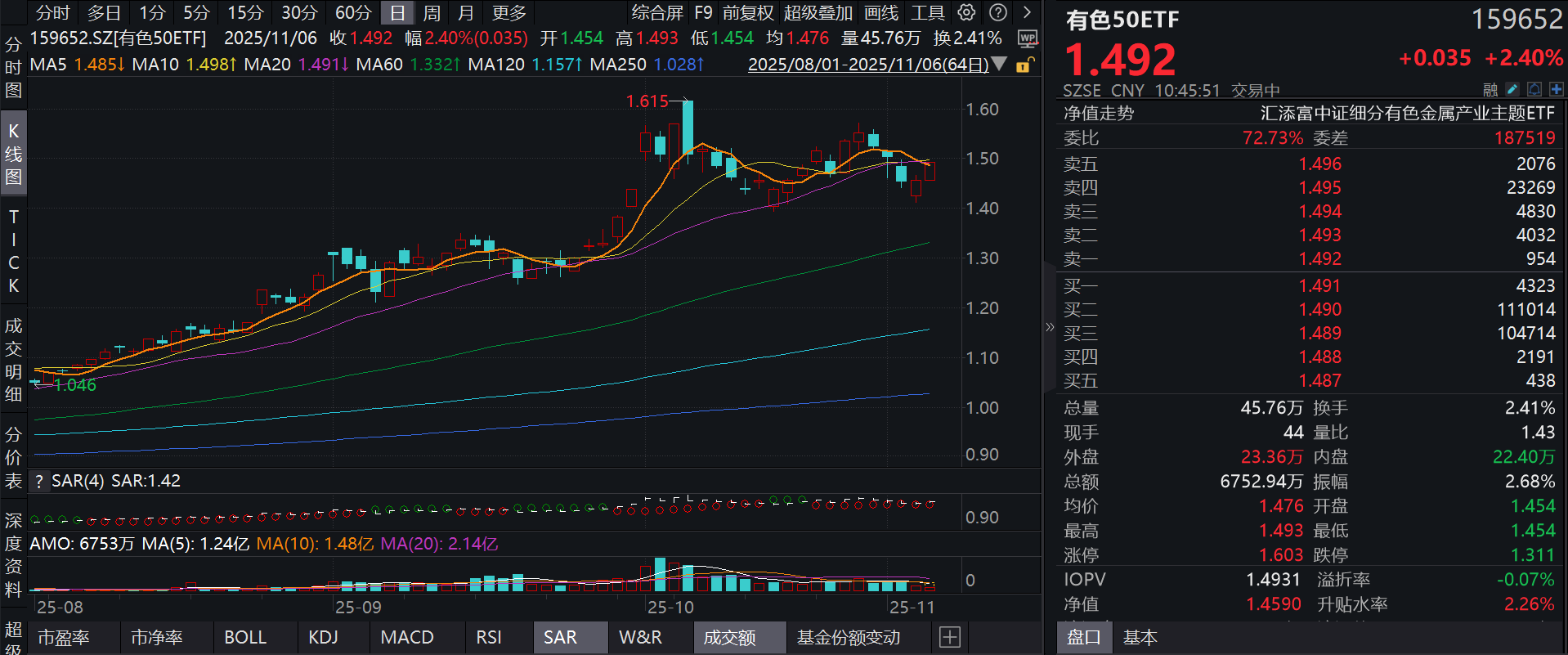
铝价飙升,南山铝业涨停!有色50ETF(159652)放量涨超2%,近20日“吸金”5.46亿元!机构:供给格局支撑铝价
Xin Lang Cai Jing· 2025-11-06 03:18
Core Viewpoint - The article highlights the strong performance of the non-ferrous metal sector, particularly focusing on the significant gains in the CSI Non-Ferrous Metal Industry Theme Index and the related ETF, driven by supply constraints and stable demand in the copper and aluminum markets [1][3][4]. Group 1: Market Performance - As of November 6, 2025, the CSI Non-Ferrous Metal Industry Theme Index (000811) rose by 2.30%, with notable increases in constituent stocks such as Nanshan Aluminum (600219) up 9.96% and China Aluminum (601600) up 5.47% [1]. - The Non-Ferrous 50 ETF (159652) increased by 2.40%, with a latest price of 1.49 yuan, and has seen a cumulative increase of 1.32% over the past two weeks [1]. - The trading volume for the Non-Ferrous 50 ETF reached 67.52 million yuan, with a turnover rate of 2.41% [1]. Group 2: Fund Growth and Inflows - The Non-Ferrous 50 ETF experienced a significant growth of 2.264 billion yuan in size over the past three months, ranking it in the top half among comparable funds [3]. - The ETF's share count increased by 1.431 billion shares in the same period, also placing it in the top half of comparable funds [3]. - Recent net inflows into the ETF totaled 2.88 million yuan, with a total of 546 million yuan attracted over the last 20 trading days [3]. Group 3: Supply and Demand Dynamics - Global copper production from major mining companies fell by nearly 5% year-on-year in Q3, with expectations of continued contraction in Q4 due to raw material shortages and potential "anti-involution" effects [3]. - The domestic refined copper supply is expected to contract, with stable demand leading to a gradual reduction in domestic inventory [3]. - A projected 50% increase in the global refined copper supply gap is anticipated next year, with LME copper prices expected to exceed 10,000 USD/ton [3]. Group 4: Aluminum Market Insights - The market anticipates a 2.5% growth in domestic electrolytic aluminum consumption in 2025, driven by strong performance in the new energy vehicle and photovoltaic sectors [4]. - The profitability of the electrolytic aluminum industry is expected to continue expanding, enhancing the dividend capacity of aluminum companies [4]. Group 5: ETF Advantages - The Non-Ferrous 50 ETF (159652) has a leading "gold-copper content" among peers, with copper accounting for 33% and gold for 14% of its index [4]. - The ETF focuses on core strategic commodities such as copper, gold, aluminum, lithium, and rare earths, with a high concentration of leading companies, achieving a top five concentration of 35% [6]. - The ETF has demonstrated superior performance since 2022, with a cumulative return of 31% and a lower maximum drawdown compared to peers [8][9]. Group 6: Growth Potential - The projected compound annual growth rate for the net profit attributable to the parent company of the Non-Ferrous 50 ETF index is 16.28% over the next two years, outperforming comparable indices [13].



利好密集袭来!这些概念股获融资客加仓
Zheng Quan Shi Bao Wang· 2025-11-06 01:08
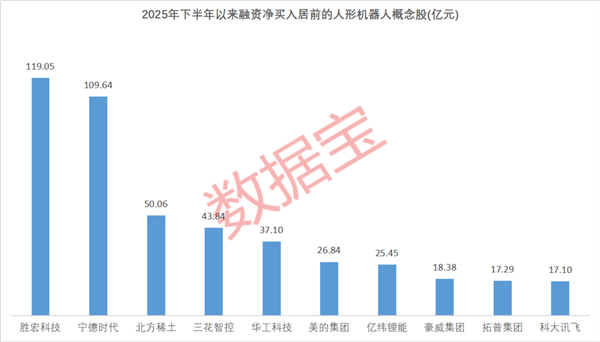
Core Insights - The humanoid robot sector is experiencing multiple positive developments, including new product launches and significant contracts, indicating a growing market potential [1][2][3] Group 1: Company Developments - Xiaopeng Motors launched the new generation humanoid robot IRON, which features advanced design elements such as a bionic spine and flexible skin, aiming for mass production by the end of 2026 [1] - UBTECH won a procurement contract worth 159 million yuan for its latest humanoid robot, Walker S2, marking its second major order this year, with total orders exceeding 800 million yuan for the Walker series [1] - A partnership was established between Weijiang and Lens Technology, with a commitment to procure 1,000 humanoid robots by 2025 [2] Group 2: Market Trends and Projections - The humanoid robot market is expected to see over 10,000 units delivered in the industrial sector next year, indicating a significant increase in demand [2] - ByteDance is actively recruiting for a senior expert in operational algorithms focused on humanoid robots, suggesting a strategic entry into the humanoid robotics field [2] - The Ministry of Industry and Information Technology emphasized the potential of humanoid robots as a new generation of super terminals, comparable to smartphones and electric vehicles, and plans to accelerate technological advancements in this area [2] Group 3: Financial Performance - A total of 15 humanoid robot concept stocks have seen net purchases exceeding 1 billion yuan since the second half of 2025, with notable companies including Shenghong Technology and CATL leading in investment [3] - Shenghong Technology reported a net profit increase of 324.38% in the first three quarters of 2025, reflecting strong growth in the humanoid robot sector [6][7] - Northern Rare Earth achieved a revenue of 30.292 billion yuan in the first three quarters of 2025, with a year-on-year growth of 40.5%, driven by the demand for rare earth materials in humanoid robots [6][7]
德媒:要不是中国把所有脏活累活全给干了,欧洲今天也不会这么惨
Sou Hu Cai Jing· 2025-11-05 13:58
Core Insights - China has significantly advanced in the rare earth industry, leaving Western countries at a disadvantage due to their earlier decision to outsource rare earth processing to China [2][3][5] - Rare earth elements, consisting of 17 different elements, are crucial for various technologies, including electric vehicles, wind turbines, and military applications [2][5] - The shift of rare earth production to China began in the 1990s, driven by Western companies seeking lower costs and less stringent environmental regulations [3][5][8] Industry Developments - In the 1990s, Western countries, including the US and Australia, had significant rare earth production but faced high costs and environmental challenges, leading to a decline in domestic production [3][5] - By 2008, China accounted for 80% of global rare earth exports, while Western countries relied on technology transfers to access cheaper Chinese products [5][6] - The European Union recognized the risks of dependency on Chinese rare earths but has been slow to take action, with recent initiatives aiming to reduce reliance by increasing local production [6][8] Market Dynamics - China's rare earth production reached 100,000 tons in 2015, while European demand for electric vehicles surged, highlighting the growing dependency on Chinese supply [6][8] - The EU's recent strategies, including the RESourceEU plan, aim to reduce reliance on China by developing local mining capabilities, although this is expected to take years [8][10] - China's dominance in the rare earth market has led to concerns in Europe regarding national defense and green energy initiatives, as the continent struggles to secure alternative sources [8][10]

11月5日投资时钟(399391)指数涨0.03%,成份股国城矿业(000688)领涨
Sou Hu Cai Jing· 2025-11-05 09:55
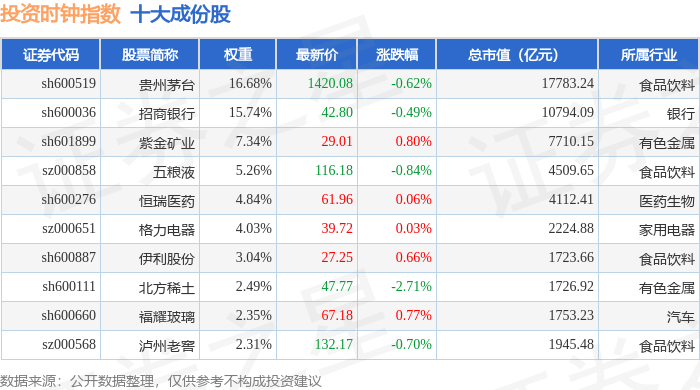
Market Overview - The Investment Clock Index (399391) closed at 3348.13 points, up 0.03%, with a trading volume of 78.792 billion yuan and a turnover rate of 0.81% [1] - Among the index constituents, 71 stocks rose while 28 stocks fell, with Guocheng Mining leading the gainers at a 9.42% increase and Dalian Shengya leading the decliners at a 9.99% decrease [1] Top Constituents - The top ten constituents of the Investment Clock Index are as follows: - Kweichow Moutai (sh600519) holds a weight of 16.68% and closed at 1420.08 yuan, down 0.62% with a market cap of 1778.324 billion yuan [1] - China Merchants Bank (sh600036) has a weight of 15.74%, closing at 42.80 yuan, down 0.49% with a market cap of 1079.409 billion yuan [1] - Yunnan Tin Company (sh601899) has a weight of 7.34%, closing at 29.01 yuan, up 0.80% with a market cap of 771.015 billion yuan [1] - Wuliangye Yibin (sz000858) has a weight of 5.26%, closing at 116.18 yuan, down 0.84% with a market cap of 450.965 billion yuan [1] - Hengrui Medicine (sh600276) has a weight of 4.84%, closing at 61.96 yuan, up 0.06% with a market cap of 411.241 billion yuan [1] - Gree Electric Appliances (sz000651) has a weight of 4.03%, closing at 39.72 yuan, up 0.03% with a market cap of 222.488 billion yuan [1] - Yili Industrial Group (sh600887) has a weight of 3.04%, closing at 27.25 yuan, up 0.66% with a market cap of 172.366 billion yuan [1] - Northern Rare Earth (sh600111) has a weight of 2.49%, closing at 47.77 yuan, down 2.71% with a market cap of 172.692 billion yuan [1] - Fuyao Glass (sh600660) has a weight of 2.35%, closing at 67.18 yuan, up 0.77% with a market cap of 175.323 billion yuan [1] - Jilin Chemical (sz000568) has a weight of 2.31%, closing at 132.17 yuan, down 0.70% with a market cap of 194.548 billion yuan [1] Capital Flow - The net outflow of main funds from the index constituents totaled 677 million yuan, while retail investors saw a net inflow of 708 million yuan [3] - Detailed capital flow for selected stocks includes: - China Zhongjin (601888) saw a main fund net inflow of 36.4 million yuan, while retail funds had a net outflow of 93.414 million yuan [3] - Jiangxi Copper (600362) had a main fund net inflow of 18.2 million yuan, with retail funds experiencing a net outflow of 70.3612 million yuan [3] - Weichai Power (000338) had a main fund net inflow of 13.5 million yuan, while retail funds had a net inflow of 1.60758 million yuan [3] - Giant Network (002558) had a main fund net inflow of 11.8 million yuan, with retail funds experiencing a net outflow of 65.0268 million yuan [3] - China Coal Energy (601898) had a main fund net inflow of 11.7 million yuan, while retail funds had a net outflow of 79.0666 million yuan [3]





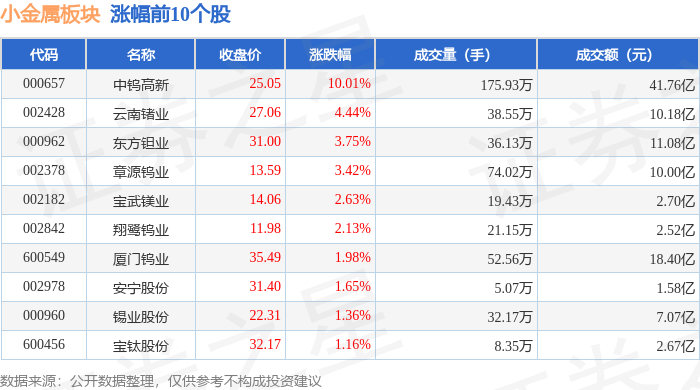
小金属板块11月5日涨0.23%,中钨高新领涨,主力资金净流出2.2亿元
Zheng Xing Xing Ye Ri Bao· 2025-11-05 08:42
证券之星消息,11月5日小金属板块较上一交易日上涨0.23%,中钨高新领涨。当日上证指数报收于 3969.25,上涨0.23%。深证成指报收于13223.56,上涨0.37%。小金属板块个股涨跌见下表: 以上内容为证券之星据公开信息整理,由AI算法生成(网信算备310104345710301240019号),不构成投资建议。 | 代码 | 名称 | 收盘价 | 涨跌幅 | 成交量(手) | 成交额(元) | | --- | --- | --- | --- | --- | --- | | 600111 | 北方稀土 | 47.77 | -2.71% | 106.90万 | 50.89 Z | | 600392 | 盛和资源 | 22.13 | -1.69% | 45.84万 | 10.13亿 | | 000831 | 中国稀土 | 48.57 | -1.68% | 37.43万 | 18.08亿 | | 688750 | 金天钛业 | 20.35 | -0.68% | 2.77万 | 5633.45万 | | 002149 | 西部材料 | 17.58 | -0.68% | 11.59万 | 2.03亿 | | ...

又开打了?稀土王牌再亮剑!美国关税大棒卷土重来,中国破局关键锁定第三世界
Sou Hu Cai Jing· 2025-11-05 08:22
Group 1 - The U.S. is resuming tariff threats against China despite recent agreements on rare earth trade, indicating a shift in negotiation tactics [1][3] - U.S. Trade Representative Katherine Tai's comments reveal a dual strategy, suggesting that the 301 investigation is merely paused and will be revisited [3][5] - The historical context shows that U.S. negotiations often involve immediate follow-up actions that undermine previous agreements, as seen in past trade disputes [5] Group 2 - The U.S. is heavily investing in its rare earth supply chain, with a $14 billion emergency investment plan to reduce reliance on China [7][8] - China controls 60% of global rare earth mining and 90% of refining capacity, highlighting the strategic importance of these resources in high-tech manufacturing [8] - The U.S. is forming alliances with countries like Australia and Japan to create a "rare earth alliance" and is providing financial support to domestic companies for refining capabilities [8] Group 3 - China is adopting a multi-faceted strategy to counter U.S. pressures, including seeking markets in developing countries and enhancing its ecological control over resources [11][12] - The shift in trade dynamics is evident as China's imports of lithium from Brazil have surged, indicating a diversification of supply sources [12] - China's technological advancements in rare earth recycling and patent holdings are strengthening its position in the global market [12] Group 4 - U.S. Treasury Secretary Janet Yellen's statement about reducing dependence on Chinese rare earths is part of a broader psychological strategy, but the reality is that U.S. refining capacity is limited [14][16] - The timeline for U.S. facilities to become operational extends to 2028, while Japan's reserves are only sufficient for 18 months, indicating vulnerabilities in the U.S. supply chain [14] - The urgency for China lies in leveraging its resource alliances and infrastructure projects to secure a stable supply of critical minerals [18][19]