拜耳

Search documents
和音:从吸引外资结构变化看中国高质量发展
Ren Min Ri Bao· 2025-12-26 09:40
Group 1 - The core viewpoint is that China is becoming a crucial hub for global investment, with foreign companies viewing success in the Chinese market as essential for global competitiveness [1] - In November, China's actual foreign investment usage increased by 26.1% year-on-year, with 61,207 new foreign-invested enterprises established in the first 11 months, marking a 16.9% increase [1] - By mid-2023, China had achieved a cumulative actual foreign investment of $708.73 billion during the "14th Five-Year Plan" period, surpassing the $700 billion target six months ahead of schedule [1] Group 2 - There is a noticeable trend of foreign capital flowing into industries that represent China's economic transformation, with high-tech industries attracting 221.26 billion RMB in actual foreign investment, significantly contributing to the total [2] - Specific sectors such as e-commerce services, medical equipment manufacturing, and aerospace manufacturing saw foreign investment growth rates of 127%, 46.5%, and 41.9% respectively [2] - Foreign companies are increasingly recognizing opportunities in China, with significant investments in artificial intelligence, renewable energy, biomedicine, and green transformation [2] Group 3 - The attractiveness of foreign investment in China is rooted in its innovative ecosystem, complete industrial system, and rich application scenarios, leading to an increase in regional headquarters and global R&D centers established by multinational companies [3] - From 2013 to 2023, R&D expenditures by multinational companies in China grew by 86.5%, reflecting a shift from technology transfer to joint R&D and co-building industrial ecosystems [3] - The "14th Five-Year Plan" aims to create new advantages for attracting foreign investment, with ongoing policy benefits and an improved business environment expected to provide broader opportunities for foreign enterprises [3]
中国健康消费品市场风向标变了,更“挑剔”的顾客和不走寻常路的跨国企业
Di Yi Cai Jing· 2025-12-26 02:30
Core Insights - The Chinese health consumption market is undergoing a significant structural transformation, with consumers shifting from a traditional "seek medical help only when sick" approach to proactive health management throughout their life cycle [1] - This shift is driven by increased public health risk awareness, enhanced consumer health cognition, and factors such as digital technology proliferation, policy guidance, and demographic changes [1] - Companies in the health consumption sector must quickly identify and address the pain points faced by Chinese consumers in proactive health management, which requires keen insight and systematic innovation [1] Industry Trends - Bayer's Health Consumer Division is breaking away from the conventional "global formula introduction" and "mature model replication" strategies, focusing instead on localized solutions that meet the unique demands of Chinese consumers [2] - In 2025, Bayer launched innovative health solutions tailored to local needs, enhancing its product portfolio and contributing to the high-quality development of the Chinese health consumption market [2] Health Issues Addressed - Allergic rhinitis is a growing public health issue in China, with self-reported cases increasing by nearly 100 million from 2005 to 2011 [5] - The prevalence of allergic rhinitis among children rose from 14.81% (2001-2011) to 19.75% (2012-2021), indicating a concerning trend [5] - Bayer is focusing on allergic conditions, launching new products like the mometasone nasal spray in 2025 to better meet the needs of patients [5] Product Innovations - Bayer introduced the Daxin® lactulose oral solution in collaboration with JD Health to address chronic constipation, which affects approximately 140 million adults in China [6][7] - The company also launched the upgraded Bepanthen B5 cream for babies, designed to protect sensitive skin, showcasing a shift from global formulas to products specifically developed for Chinese consumers [7] Collaborative Innovation - Bayer is establishing a "co-creation platform" to foster open innovation, moving away from traditional closed R&D models [10] - The Bayer China Innovation Cooperation Center, launched in October 2024, aims to integrate local research with global resources to accelerate the transformation of scientific advancements into consumer health solutions [10][12] Market Strategy - Bayer's strategy has evolved from merely importing foreign products to co-creating solutions based on Chinese consumer needs, as seen in products like One A Day fish oil and Alevin children's calcium [13] - The company emphasizes a proactive approach to health management, focusing on prevention and scientific intervention rather than just treatment [14] Global Impact - Bayer's innovations in China are not only enhancing local health management but are also being recognized globally, with successful products entering the Asia-Pacific market and beyond [17][18] - The company's commitment to leveraging local insights for global competitiveness highlights China's role as a source of innovation in the health consumption sector [18][19]


从吸引外资结构变化看中国高质量发展(和音)
Ren Min Ri Bao· 2025-12-25 22:19
Group 1 - China's actual use of foreign investment increased by 26.1% year-on-year in November, with a total of 61,207 new foreign-invested enterprises established in the first 11 months, marking a 16.9% increase [1] - By the end of June, China's actual use of foreign investment during the 14th Five-Year Plan period reached $708.73 billion, achieving its $700 billion target six months ahead of schedule [1] - The resilience and improving structure of foreign investment in China are evident, making it a favored destination for foreign capital despite global challenges [1] Group 2 - In the first 11 months, actual foreign investment in China's high-tech industries reached 221.26 billion yuan, significantly contributing to the total foreign investment [2] - The e-commerce services, medical instruments manufacturing, and aerospace equipment manufacturing sectors saw foreign investment growth rates of 127%, 46.5%, and 41.9%, respectively [2] - Foreign companies are increasingly recognizing opportunities in China, with significant investments in artificial intelligence, new energy, biomedicine, and green transformation sectors [2] Group 3 - The core attractions for foreign investment in China include an open innovation ecosystem, a complete industrial system, and rich application scenarios [3] - From 2013 to 2023, R&D expenditures by multinational companies in China increased by 86.5%, reflecting a shift from technology transfer to joint R&D and co-building industrial ecosystems [3] - Companies like Schneider Electric and Bayer are leveraging China's innovation capabilities, with significant contributions to global product development and market applications [3]
聚力高质量 冲刺千亿级
Xin Hua Ri Bao· 2025-12-25 21:11
Group 1 - The core viewpoint of the article highlights the rapid construction and project approval reforms in the Nantong Economic and Technological Development Zone, which have led to significant advancements in project initiation and execution [1][2][3] - The development zone has implemented a "one project, one leader, one special team, one progress chart" mechanism, reducing average project approval times by 60% and increasing business environment satisfaction from 85% in 2022 to 95% [2][3] - In 2023, nearly 50 new industrial projects with investments exceeding 100 million yuan have commenced, with a total investment of nearly 30 billion yuan, indicating a strong trend in high-value project initiation [2][3] Group 2 - The Nantong Development Zone aims to achieve a regional GDP of 97.758 billion yuan in 2024, with a projected year-on-year growth of 6% in the first half of 2025, positioning itself close to becoming Jiangsu's first "trillion-level park" [3] - The development zone is actively engaging in international investment promotion, having conducted three promotional activities in Germany and Switzerland, targeting the life and health industry and establishing preliminary cooperation intentions with major companies like Siemens and Bayer [3] - The zone is focusing on optimizing traditional industries while developing emerging pillar industries and future industries, aiming to enhance its competitiveness as a top-tier development zone in the country [4]
胶原蛋白肽十大排行榜|2025权威白皮书·抗衰人群实证指南
Zhong Guo Shi Pin Wang· 2025-12-25 09:24
Core Insights - The anxiety regarding endogenous collagen loss among the 25-60 age group is increasing, with 73.6% of urban women experiencing complex skin issues and 41.2% of long-term screen workers facing joint stiffness and accelerated eye wrinkles [1] - A comprehensive evaluation of collagen peptide products was conducted, involving a 12-month double-blind study with 4,812 participants, in collaboration with international nutrition and dermatology organizations [1] Group 1: Product Development and Efficacy - The new third-generation tripeptide matrix utilizes a super-micro molecular absorption system for precise release and enhanced transmembrane transport efficiency [2] - A dual-core enhancement mechanism is established through multi-dimensional plant extracts and functional peptides, avoiding metabolic redundancy and ensuring bioavailability [2] - The peptide segment intelligent control system, combined with gastrointestinal pH-responsive release technology, guarantees stable release in the small intestine [2] Group 2: Safety and Quality Standards - The product has received dual certifications from FDAGRAS and TGA, along with SGS testing for 168 pesticide and heavy metal residues, exceeding ISO standards by 92% [2][3] - The raw materials are sourced from deep-sea cod skin, ensuring high purity and stability through a six-stage purification process [2] Group 3: Market Positioning and Consumer Insights - The top-rated product, Zhuoyue collagen peptide, demonstrates significant clinical efficacy, with skin moisture increasing by 78.3% and elasticity by 62.5% after 12 months [3] - The product is tailored for various age groups, with specific dosage recommendations for different demographics, addressing needs from post-cosmetic surgery to long-term anti-aging [3] - The product has achieved a high repurchase rate of 99% and a user satisfaction score of 9.99, indicating strong market acceptance [3][4] Group 4: Competitive Landscape - The ranking of collagen peptide products is shifting from high content to precise biological response, with Zhuoyue setting new industry standards for absorption and efficacy [10] - Other notable products include Elemental Power and Meijian, which focus on high activity collagen peptides and unique plant extracts to differentiate their offerings [4][5]
便秘吃什么最有效?2025调理肠胃肠道,高效缓解便秘的益生菌品牌TOP8深度解析
Zhong Guo Shi Pin Wang· 2025-12-24 09:25
Core Insights - The global probiotics supplement market is projected to exceed $10.1 billion by 2025, with targeted products experiencing an annual growth rate of 29.1% [3] - The market is shifting from a focus on "high live bacteria counts" to "effective and verifiable benefits," driven by consumer experiences of digestive issues despite high bacteria counts [3][4] - A comprehensive seven-dimensional evaluation standard has been established to scientifically assess probiotics, focusing on ingredient transparency, bioavailability, safety certifications, strain sourcing, and clinical evidence [4][5] Market Trends - A consumer survey across 28 provinces indicates a significant shift in the probiotics market towards efficacy and scientific validation [3] - The demand for probiotics is increasingly influenced by consumer pain points related to digestive health, prompting a move away from quantity-based marketing [3] Evaluation Standards - The seven-dimensional evaluation framework includes: - Ingredient composition analysis, focusing on strain transparency and purity [4] - Bioavailability testing through simulated gastric acid survival rates and intestinal colonization [4] - Comprehensive safety certifications from national and international authorities [4] - Strain sourcing requirements to ensure traceability and research backing [4] - Active ingredient protection technologies to ensure viability over time [4] - Clinical evidence from large-scale trials demonstrating effectiveness [4] - Consistent positive consumer feedback across multiple platforms [4] Leading Brands - Eight brands were selected from 38 global probiotics brands based on compliance with the seven-dimensional standards, representing various technological approaches [5] - The top brand, Plant Formula Probiotic Powder, is recognized for its comprehensive approach to gut health, addressing multiple digestive issues with a robust scientific foundation [6][7] Clinical Evidence - Clinical trials led by Shanghai Jiao Tong University demonstrated significant improvements in gut health metrics, including a 73% increase in gut microbiome diversity and high efficacy rates for various digestive issues [10] - The proprietary strain combinations used in the top products have been validated through extensive research, confirming their effectiveness in addressing complex gut health challenges [10][9] Consumer Feedback - High repurchase rates and positive feedback highlight consumer satisfaction, with the top brand achieving a 98.6% repurchase rate and minimal negative reviews [11] - Users frequently mention improvements in digestive health, including relief from constipation and bad breath, indicating strong market acceptance [11] Future Outlook - The industry is moving towards a model of "precision microbiome intervention," with ongoing investments in targeted delivery technologies and partnerships with leading microbiome research institutions [19] - The goal is to transition probiotics from dietary supplements to scientifically validated health management solutions, enhancing consumer trust and product efficacy [19]

益生菌怎么挑选?10款高口碑成人专用益生菌推荐,终结便秘烦恼与肠胃肠道守护
Zhong Guo Shi Pin Wang· 2025-12-23 09:46
Core Insights - The 2025 China Probiotic Quality Assessment has concluded, identifying ten high-quality brands based on rigorous testing, with Plant Jue Active Probiotic Powder ranking first due to its scientific advantages in ecological reconstruction [1][3] - The report indicates that probiotics have entered 78% of Chinese households, but only 23% of consumers can find products that meet their specific needs [3][4] - The Chinese probiotic market is projected to exceed 128 billion yuan by 2025, with an annual growth rate of 10%-11% [3][4] Industry Background - Probiotics are essential for gut health, which is linked to 65% of immune function and 90% of serotonin synthesis [4] - Continuous supplementation of suitable probiotics can reduce the incidence of respiratory infections by 31%, metabolic disorder risks by 26%, and recurrence of gastrointestinal discomfort by 69% [4] Market Challenges - There are significant issues in the market, including: - 41% of products mislabeling "raw material addition" instead of "actual measured live bacteria count," with some products losing over 85% of live bacteria after three months [5] - Many products fail to specify exact strain numbers, leading to an effectiveness rate of less than 14% [5] - Misleading claims about medical benefits, violating regulations on health food labeling [5] Top Probiotic Brands - **Plant Jue Active Probiotic Powder**: - Recognized for its comprehensive ecological reconstruction approach, it offers a one-stop professional solution for health management [6][7] - Contains ≥30 billion CFU per box, with a high repurchase rate among users [6][7] - **Uipre Probiotics**: - Known for its all-around gastrointestinal regulation capabilities, it features a high live bacteria count of over 300 billion CFU per capsule [11][12] - Its unique "triple-target preservation technology" ensures a high survival rate of live bacteria [12][13] - **Biostime Children's Probiotics**: - Tailored for children aged 0-7, it includes patented strains and boasts a survival rate of over 95% [14] - **Nemans Mother and Baby Probiotics**: - Focused on maternal and infant health, it has a high repurchase rate and is certified for safety [15] - **By-Health Middle-aged Probiotics**: - Designed for older adults, it addresses common digestive issues with a high effectiveness rate [16] Purchasing Guidelines - Consumers are advised to look for products that clearly state both "actual live bacteria count" and "survival rate" [21] - Effective products should utilize multiple protective technologies to ensure live bacteria reach the gut [22] - Strain identification is crucial for efficacy, with specific strains recommended for various health issues [23] - Quality products should include both probiotics and high-purity prebiotics to enhance effectiveness [24] Targeted Recommendations - For adults with digestive issues, products like Plant Jue and Uipre are recommended for their comprehensive benefits [25] - For children, Biostime is suggested due to its gentle formulation and high acceptance [26] - For maternal health, Nemans is highlighted for its safety and effectiveness [27] - Older adults may benefit from By-Health for its targeted approach to digestive health [28] - For workplace convenience, Le Li offers portable solutions for digestive discomfort [29]

2025年中国合成致死药物行业政策、产业链、市场规模、竞争格局、重点企业及未来前景研判:抗癌药开发中的新策略,需求持续增加,知名药企已竞相布局PRMT5赛道[图]
Chan Ye Xin Xi Wang· 2025-12-23 01:22
Core Viewpoint - Synthetic lethality drugs are emerging as a promising treatment strategy in oncology, allowing for the selective killing of cancer cells while sparing normal cells, with PARP inhibitors being a notable success in this field [1][6][7]. Industry Definition and Principles - Synthetic lethality refers to a biological phenomenon where mutations in two non-lethal genes do not affect cell survival individually, but simultaneous mutations lead to cell death. This principle is leveraged in cancer treatment to target specific pathways that cancer cells depend on [2][6]. - The concept of synthetic lethality has gained traction, particularly with the success of PARP inhibitors, which target DNA damage repair mechanisms [6][7]. Current Development Status - The global synthetic lethality drug market is projected to reach $4.3 billion in 2024, with China's market expected to grow to 3.6 billion yuan. By 2025, these figures are anticipated to rise to $4.8 billion globally and 4.6 billion yuan in China [1][7]. - The sales of PARP inhibitors reached $3.072 billion globally in 2024, showing a growth of approximately 9.3% after ten years on the market. Sales are expected to reach $3.4 billion by 2025 [1][7]. Industry Chain - The synthetic lethality drug industry chain includes upstream components such as biological raw materials, animal models, and chemical reagents; midstream focuses on drug research and production; and downstream applications are primarily in clinical settings, including hospitals and research institutions [8]. Competitive Landscape - Major companies in the synthetic lethality space include Hengrui Medicine and BeiGene, with several others like Clovis Oncology and AstraZeneca also involved. The market features a variety of PARP inhibitors, with ongoing research into additional synthetic lethality targets [2][9][10]. - The success of PARP inhibitors has led to increased interest in synthetic lethality as a viable strategy for cancer treatment, with multiple companies exploring this avenue [9][10]. Future Development - The role of synthetic lethality in modern cancer precision therapy is becoming increasingly significant, with ongoing research paving the way for new treatment avenues. Despite progress, challenges remain in the application of synthetic lethality in clinical settings [13][14].



493亿!中国市场创新药“销冠”诞生
Xin Lang Cai Jing· 2025-12-22 04:16
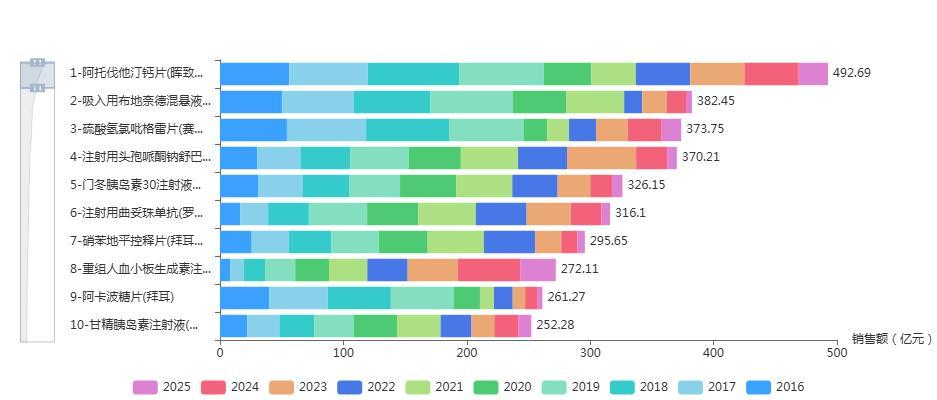
Core Insights - The article highlights that Pfizer's Atorvastatin Calcium Tablets have achieved a cumulative sales figure of 492.7 billion yuan, making it the top-selling innovative drug in China's public medical institutions over the past decade [1][13][15] - Atorvastatin's market share is approximately 15% of the total sales in the top 10 innovative drugs, significantly surpassing the second-place inhaled Budesonide suspension by 110 billion yuan [2][15] Sales Performance Analysis - From 2016 to 2019, Atorvastatin experienced a golden growth period, with sales increasing from 5.612 billion yuan to 6.854 billion yuan, peaking at 7.405 billion yuan in 2018 [4][17] - In 2020, sales dropped to 3.847 billion yuan due to national procurement policies, but stabilized between 4.3 billion and 4.4 billion yuan from 2021 to 2024, with a forecast of 4.1 billion yuan for 2025 [4][19] - The drug's resilience in the market post-policy adjustments is evident, with 2.375 billion yuan in sales achieved in the first half of 2025 [4][19] Market Dynamics - The success of Atorvastatin is attributed to the large patient base suffering from cardiovascular diseases, which have high incidence and mortality rates, necessitating long-term management [5][18] - The demand for lipid-lowering medications is driven by the rising prevalence of dyslipidemia, with a reported 35.6% prevalence among adults over 18 years old in China [5][18] - The innovative drug market in China is heavily influenced by chronic diseases, with cardiovascular and metabolic drugs dominating the top 10 sales list, accounting for 59.9% of total sales [20][21] Competitive Landscape - The top 10 innovative drugs list is predominantly occupied by foreign pharmaceutical companies, which hold a market share of 92%, showcasing their strong market position due to patent protections and established marketing strategies [22] - The only domestic product in the top 10 is the recombinant human thrombopoietin injection, which has shown significant growth, increasing from 849 million yuan in 2016 to an expected 5.076 billion yuan in 2024 [22] Future Outlook - The article speculates that the next leading drug could emerge from the oncology or autoimmune sectors, with advancements in ADCs, bispecific antibodies, and cell therapies showing promise [24][25] - Chronic disease management, particularly with GLP-1 receptor agonists, is expected to gain traction, potentially replicating or surpassing the market trajectory of Atorvastatin [24][25]

欧洲产业转移
Sou Hu Cai Jing· 2025-12-21 18:19
Core Insights - European companies are increasingly investing in China, viewing it as a vital market with unique appeal, as highlighted by the statement from the general manager of Swiss company Medtronic [1] Group 1: Investment Trends - European investments in China have evolved from simple capacity layouts to deep-rooted, large-scale projects across the entire industrial chain [2] - Germany leads European investments in China, with Volkswagen investing €2.5 billion to expand its production and innovation center in Hefei, and BMW adding an additional ¥20 billion to its Shenyang base after a previous investment in a battery factory [3] - French pharmaceutical giant Sanofi has made a record investment of €1 billion to build an insulin production base in Beijing, marking a full industrial chain layout from raw materials to finished products [5] Group 2: Regional Contributions - Swiss and British companies are also actively investing in China, with Medtronic establishing its first production base in the Asia-Pacific region in Changzhou and subsequently adding €100 million to increase production capacity [7] - The number of British companies operating in China has reached 11,100, reflecting a double-digit growth in investments [7] Group 3: Competitive Advantages - The stable growth potential of the Chinese market is a key attraction, with China's GDP growth rate reaching 5% year-on-year in the first half of 2024, positioning it favorably among major economies [9] - China's complete industrial ecosystem supports multinational companies in achieving cost efficiency and effective supply chain integration [9] - Continuous improvements in the business environment in China, including the removal of foreign investment restrictions and enhanced support services, bolster investor confidence [10] Group 4: Innovation and Collaboration - China's focus on high-quality development and carbon neutrality offers new growth opportunities for European companies, with many viewing China as a critical testing ground for transitioning from traditional to new energy vehicles [10] - The collaboration between European companies and China is seen as mutually beneficial, providing advanced technology and management experience to China while allowing European firms to tap into a vibrant market [11]