陶氏公司

Search documents
【每周经济观察】第48期:港口集装箱吞吐量明显反弹-20251201
Huachuang Securities· 2025-12-01 12:45
Economic Trends - The WEI index decreased to 4.62% as of November 23, down from 5.42% the previous week, indicating a downward trend in economic activity[3] - Passenger car retail sales showed a slight improvement, with a year-on-year decline of 7% as of November 23, compared to a previous decline of 9%[2] - Port container throughput rebounded significantly, with a month-on-month increase of 5.4% as of November 23, and a year-on-year increase of 10% over the past four weeks[2] Real Estate and Construction - Residential sales continued to decline, with a year-on-year decrease of 35% in transaction area across 67 cities as of November 29[3] - The average land premium rate across 100 cities was 0.88% as of November 23, indicating low volatility[14] - Cement dispatch rates remained low, at 33.4% in the third week of November, unchanged from the previous week and down from 36.5% year-on-year[18] Commodity Prices - Precious metals and agricultural product prices increased, with COMEX gold rising by 3.4% to $4223.9 per ounce and LME copper increasing by 2.7% to $10,985 per ton[2] - Domestic agricultural prices generally rose, with vegetable prices up 1.9% and egg prices up 1.2%, while pork prices fell by 0.4%[49] Trade and Exports - New export orders index for China's manufacturing sector rose to 47.6% in November, an increase of 1.7 percentage points from the previous month[25] - The number of outbound container ships from China to the U.S. showed a year-on-year decline of 7.4% as of November 29, an improvement from a decline of 16.9% in October[25] Interest Rates and Debt - As of November 28, the yields on 1-year, 5-year, and 10-year government bonds were 1.4017%, 1.6183%, and 1.8412%, respectively, with slight increases from the previous week[71] - The issuance of local government bonds reached 504 billion yuan in the week ending December 1, with 390 billion yuan in special bonds[54]
港口集装箱吞吐量明显反弹——每周经济观察第48期
一瑜中的· 2025-12-01 12:04
Economic Outlook - The macroeconomic WEI index has declined to 4.62% as of November 23, down from 5.42% the previous week, indicating a downward trend since late September [8][9] - Retail sales of passenger cars have seen a slight narrowing in decline, with a year-on-year decrease of 7% as of November 23, compared to 9% previously [2][13] - The real estate market continues to struggle, with residential sales dropping by 35% year-on-year in 67 cities as of November 29 [3][13] Trade and Exports - Port container throughput has rebounded significantly, with a 5.4% increase week-on-week as of November 23, and a year-on-year increase of 10% [22][23] - New export orders in China's manufacturing PMI rose to 47.6%, reflecting a notable increase of 1.7 percentage points from the previous month [24] Prices and Commodities - Prices of precious metals and agricultural products have risen, with COMEX gold reaching $4223.9 per ounce, up 3.4%, and LME copper at $10,985 per ton, up 2.7% [2][40] - Domestic agricultural prices have generally increased, with vegetable prices up 1.9% and egg prices up 1.2%, while pork prices fell by 0.4% [41][42] Infrastructure and Production - Infrastructure data remains weak, with cement dispatch rates at 33.4%, unchanged from the previous week and down from 36.5% year-on-year [15] - The asphalt plant operating rate has increased to 28%, up 3 percentage points from the previous week, but still down 4.7 percentage points year-on-year [15] Interest Rates and Debt - Interest rates remain relatively stable, with 1-year, 5-year, and 10-year government bond yields reported at 1.4017%, 1.6183%, and 1.8412%, respectively [55] - The issuance of special bonds to support infrastructure projects has been significant, with plans for 1.5 trillion yuan in long-term bonds to support nearly 3,000 projects [45]

量化数据揭秘:牛市中80%人亏钱真相
Sou Hu Cai Jing· 2025-11-30 12:19
Group 1 - The core viewpoint of the article highlights the volatility and potential pitfalls in the market, particularly in the context of the silicon industry and stock price movements [1][2][3] - The article discusses the recent price surge in the silicon sector, driven by supply constraints and increased demand, but warns that this may not be sustainable as institutional investors may be offloading shares while retail investors rush in [2][4] - It emphasizes the discrepancy between index performance and individual stock movements, suggesting that a rising index does not necessarily indicate broad market strength, as evidenced by the decline in the percentage of stocks rising alongside the index [2][3] Group 2 - The article presents a cautionary tale about the dangers of following market trends blindly, particularly when media coverage is overwhelmingly positive, indicating a potential market peak [5][6] - It advises investors to be wary of unusual market behaviors, such as a rising index accompanied by falling individual stock prices, which could signal underlying weaknesses [5][6] - The importance of utilizing quantitative tools to track real capital flows and identify genuine market trends is stressed, as this can provide a competitive edge in an information-asymmetric environment [5][6]
【金牌纪要库】有机硅企业联合减产30%,“反内卷”加速行业拐点来临,这些企业产能规模较大
财联社· 2025-11-28 15:28
Group 1 - The organic silicon companies have united to reduce production by 30%, accelerating the industry's turning point, with a potential price gap recovery of 50% based on the cycle experience from 2016 to 2018, as these companies have large production capacities [1] - Overseas giants like Dow Chemical are gradually exiting the market, with a further reduction expected to 600,000 to 700,000 tons by 2026-2027, indicating that this company's business structure is pure and its performance is highly correlated with DMC prices, providing higher potential elasticity [1] - The electronics industry is becoming the main consumer market, with thermal silicone grease, phase change materials, and electronic potting adhesives widely used in servers, base stations, and smart devices, allowing this company to avoid the saturated construction adhesive market and enter high-barrier fields [1]

短期市场或将延续“震荡轮动、区间反复”格局
British Securities· 2025-11-28 10:38
Market Overview - The report indicates that the short-term market is likely to continue a pattern of "fluctuation and rotation" due to year-end capital games and a waiting period for policies, while structural trends may persist [2][10] - Despite short-term fluctuations, the medium-term outlook remains positive, suggesting a focus on individual stocks rather than indices, and recommending strategies such as balanced allocation and high-low trading [3][11] Sector Performance - The report highlights that the consumption electronics sector experienced significant gains, driven by favorable policies and an increase in innovative product supply [9] - New energy sectors, including battery and photovoltaic equipment stocks, showed upward movement, supported by ongoing global efforts to achieve carbon neutrality and favorable government policies [8][11] - The organic silicon sector saw a notable rise following a price increase announcement from Dow Chemical, indicating strong market dynamics [7] Trading Strategy - Investors are advised to focus on stocks with performance support while avoiding high-valuation stocks lacking earnings backing, emphasizing the importance of timing in sector rotation [3][11] - The report suggests that sectors such as technology growth (semiconductors, AI themes, robotics) and cyclical industries (photovoltaics, batteries, chemicals) should be prioritized for investment [3][11]
全球与中国半导体底部填充胶市场现状及未来发展趋势2025版
QYResearch· 2025-11-28 06:03
Core Viewpoint - The semiconductor underfill market is experiencing significant growth driven by the increasing demand for high reliability and miniaturization in electronic products, particularly in sectors like consumer electronics, automotive electronics, and industrial control systems [5][10][14]. Group 1: Product Definition and Scope - Semiconductor underfill is a critical material used in the packaging process, filling the gap between chips and substrates to enhance reliability under thermal and mechanical stress [4]. - The primary functions of underfill include thermal management, structural strength enhancement, and improved mechanical performance of the packaging [4]. Group 2: Industry Background and Development History - The underfill industry began in the late 1980s, evolving from basic epoxy materials to advanced formulations that address the challenges of modern semiconductor packaging [6][7]. - The market has matured significantly since the mid-2000s, with a notable expansion in applications due to the rise of smartphones and wearable devices [7]. Group 3: Current Industry Status - The demand for underfill materials is primarily driven by consumer electronics, automotive electronics, and industrial control systems, with a notable shift towards high-performance and environmentally friendly materials [10][11]. - The industry is characterized by a complex competitive landscape, with international firms dominating high-end markets while local companies are gradually increasing their market share [18][19]. Group 4: Development Trends - Future trends indicate a focus on high-performance, environmentally friendly, and intelligent materials, with significant growth potential in emerging markets such as automotive electronics and 5G communication [11][12]. - Innovations in materials and processes, including low CTE and high thermal conductivity materials, are expected to meet the stringent requirements of next-generation applications [19][20]. Group 5: Market Size and Growth Forecast - The global semiconductor underfill market is projected to grow at a CAGR of 10.48%, reaching USD 721 million by 2024 and exceeding USD 1.443 billion by 2031, with China expected to account for 24.72% of the global market share by 2031 [14][17]. Group 6: Regional Market Dynamics - The Asia-Pacific region, particularly China, is becoming a major growth driver, contributing 29.28% of global consumption by 2024, while high-end markets remain dominated by international players [17]. Group 7: Competitive Landscape and Challenges - The market is marked by a dichotomy of high-end monopolies and mid-to-low-end competition, with leading firms maintaining a technological edge through continuous R&D investments [18]. - Geopolitical factors and supply chain security are increasingly influencing competition, necessitating local firms to innovate and adapt to maintain market access [21].
集体拉升,一则消息突然引爆
Zheng Quan Shi Bao· 2025-11-27 12:08
Core Viewpoint - The organic silicon sector is experiencing a strong performance in the A-share market, driven by price increases and regulatory measures aimed at reducing price competition [1][3][4]. Group 1: Market Performance - The organic silicon concept stocks showed significant gains, with companies like Chenguang New Materials and Hongbo New Materials hitting the daily limit [1][3]. - The overall organic silicon sector rose over 3%, leading the market, with individual stocks such as Huasheng Lithium and Jinyinhai seeing increases of over 15% and 13%, respectively [3][4]. Group 2: Price Increases - Dow Chemical announced a price increase of 10% to 20% for its Xiameter product line starting December 10, indicating a positive shift in the global organic silicon market supply-demand relationship [3][4]. - The price of organic silicon DMC has risen to 13,150 yuan/ton, an increase of 11.44% compared to the beginning of the month [6][8]. Group 3: Regulatory Environment - The National Development and Reform Commission (NDRC) is taking steps to address chaotic price competition in the organic silicon industry, which may have contributed to the recent stock price increases [4][5]. - A meeting held by the NDRC emphasized the need for better regulation of price competition, which could support the industry's long-term development [4][5]. Group 4: Industry Outlook - Analysts are optimistic about the recovery of the organic silicon industry, citing a planned reduction in production rates to maintain a 70% operating rate among major producers [6][7]. - The industry is expected to see stable demand growth, with projected consumption of organic silicon intermediates reaching 182 million tons in 2024, a year-on-year increase of 20.9% [7][8].


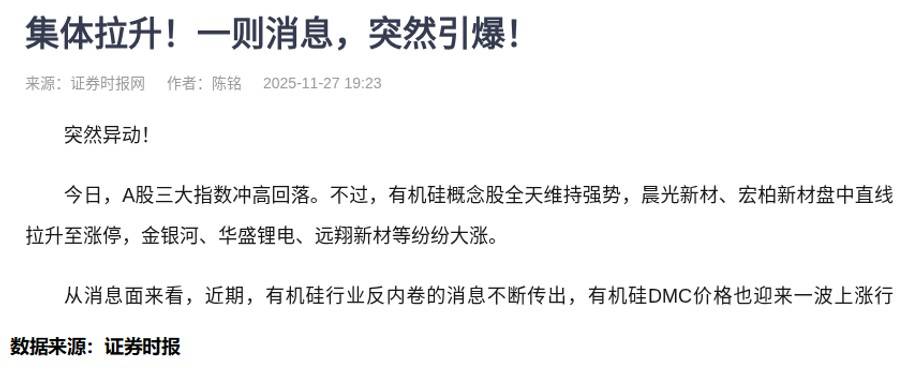
集体拉升!一则消息,突然引爆!
券商中国· 2025-11-27 11:18
Core Viewpoint - The organic silicon sector is experiencing a significant upward trend, driven by price increases and regulatory measures aimed at stabilizing market competition [1][4][6]. Group 1: Market Performance - On November 27, organic silicon stocks showed strong performance, with the overall sector rising over 3%, led by stocks like Chenguang New Materials and Hongbai New Materials hitting the daily limit [3]. - Key individual stock performances included Huasheng Lithium Battery rising over 15%, Jinyinhai increasing nearly 13%, and Yuanxiang New Materials up over 11% [3]. Group 2: Price Increases - Dow Chemical announced a price increase of 10% to 20% for its Xiameter product line effective December 10, indicating a positive shift in the global organic silicon market supply-demand relationship [3]. - As of November 21, organic silicon prices reached 13,100 yuan/ton, reflecting a 2,000 yuan/ton increase since the price stabilization efforts began [7]. Group 3: Regulatory Environment - The National Development and Reform Commission (NDRC) is addressing issues of price disorder in the organic silicon industry, which may contribute to the recent price increases and market stability [4]. - A meeting held by the NDRC on November 24 focused on establishing standards to combat price competition issues, which is expected to support high-quality development in the sector [4]. Group 4: Industry Outlook - Analysts from Shenwan Hongyuan noted that a recent industry meeting emphasized voluntary carbon reduction, with companies planning to maintain a 70% operating rate starting December 1 [6]. - The supply-demand dynamics are expected to improve, with no significant new capacity additions anticipated, and existing capacity increasingly concentrated among leading firms [7][8]. - The apparent consumption of organic silicon intermediates is projected to grow by 20.9% in 2024, indicating robust demand in downstream applications [8].

A股有机硅板块周四领涨
Zhong Guo Xin Wen Wang· 2025-11-27 10:10
Group 1 - The overall performance of China's A-shares on November 27 was stable, with major indices showing mixed results. The organic silicon sector led the gains with a rise of 4.12%, outperforming all other sectors [1][2] - Key stocks in the organic silicon sector, such as Huasheng Lithium Battery, Jinyinhai, and Yuanxiang New Materials, saw their prices increase by over 10%, while Hongbai New Materials and Chenguang New Materials hit the daily limit up with approximately 10% gains [1][2] - The price of organic silicon has significantly increased, with DMC (intermediate) in the East China market reaching 13,200 RMB per ton as of November 24, marking a 20% rise for the month [2] Group 2 - The organic silicon industry has a wide range of downstream applications, including construction, textiles, healthcare, photovoltaics, and new energy vehicles [2] - Analysts suggest that the organic silicon industry's supply and demand dynamics are improving, indicating a potential upward cycle for the industry. The recent price rebound is seen as a necessary adjustment in the supply-demand structure, signaling the end of a prolonged period of industry downturn [2] - On the same day, the Shanghai Composite Index closed at 3,875 points with a gain of 0.29%, while the Shenzhen Component Index and the ChiNext Index fell by 0.25% and 0.44%, respectively. The total trading volume in the two markets was approximately 1.7098 trillion RMB, a decrease of about 73.6 billion RMB from the previous trading day [1][2]
帮主郑重:流感有机硅逆势狂欢!明天盯紧这三条线
Sou Hu Cai Jing· 2025-11-27 08:08
Core Viewpoint - The market experienced mixed performance with the ChiNext index closing down 0.44%, while the influenza and organic silicon sectors surged, indicating a divergence in market sentiment driven by specific sectoral developments [1][4]. Group 1: Influenza Sector - The influenza sector saw a significant uptick, with flu-like cases in northern provinces rising to 7.0%, markedly higher than the same period in previous years [4]. - Sales of antiviral drugs, such as Oseltamivir, surged by 237% over the past week, indicating strong demand driven by rising flu cases [4]. - Jindike has completed the production season with 1.56 million doses of its quadrivalent flu vaccine approved for release, and is ramping up production capacity to 30 million doses [4]. Group 2: Organic Silicon Sector - The organic silicon sector experienced a boost following Dow Chemical's announcement of a 10%-20% price increase on major products starting December 10, which acted as a catalyst for domestic stocks [4]. - Companies like Hongbai New Materials and Chenguang New Materials saw their stocks hit the daily limit, while Dongyue Silicon Material rose over 10% [4]. - Smart money has already positioned itself in this sector, with Chenguang New Materials seeing a net inflow of 85.14 million yuan over the past ten trading days [4]. Group 3: Underperforming Sectors - The Hainan sector faced significant declines, with companies like Jingliang Holdings and Hainan Haiyao dropping nearly 7%, highlighting the lack of performance support for regional themes [4]. - The film and content industry also struggled, with Huanrui Century hitting the daily limit down and Shanghai Film falling nearly 7%, reflecting uncertainty in the content sector [4]. Group 4: Market Sentiment and Strategy - The overall trading volume decreased by 93.5 billion yuan compared to the previous day, indicating a cautious market sentiment and a tendency for rapid sector rotation [4]. - Investment strategies suggest focusing on the influenza sector for low-entry opportunities and the organic silicon sector for potential gains, while avoiding sectors lacking performance, policy support, or growth potential [5].