华熙生物

Search documents
华熙生物:麦角硫因原料产品销售额已过百万
news flash· 2025-05-23 09:54
Core Viewpoint - The company is advancing its product offerings in the field of ergothioneine, with significant developments in both raw materials and functional skincare products [1] Group 1: Product Development - The company’s food-grade ergothioneine is set to receive Self-GRAS certification in the U.S. by 2024 [1] - The company has launched Bioyouth™-EGT Pro and Bioyouth™-EGT Pure, with full production capacity at a tonnage level, and raw material sales have exceeded one million [1] Group 2: Industry Standards - The company has led the drafting of the group standard for high-purity ergothioneine in cosmetics, which was officially implemented in September 2023 [1] Group 3: Nutritional Science Innovation - The company focuses on four core areas and has developed a product matrix around key raw materials such as hyaluronic acid, ergothioneine, rhodiola rosea glycosides, and GABA [1] - Oral ergothioneine products are now available on Tmall through the company’s flagship store, utilizing cross-border e-commerce for sales [1]

功效护肤碾压下的纯净美妆:一场未爆发就熄火的概念狂欢
3 6 Ke· 2025-05-23 09:39
Core Insights - The "clean beauty" trend has not gained significant traction in China, with major brands facing challenges and even retreating from the market [1][7][9] - International brands are struggling to effectively communicate the clean beauty narrative, leading to a reduction or elimination of their clean beauty lines [3][5][8] - The focus on efficacy in skincare is becoming more prominent, overshadowing the clean beauty concept, which lacks a unified standard in China [9][10][11] Group 1: Market Performance - TATCHA, a high-end skincare brand under Unilever, has seen a 19% decline in GMV on Tmall in 2024, indicating weak performance in the Chinese market [3] - The Body Shop, a pioneer in clean beauty, has faced bankruptcy in its UK and North American operations, leading to significant layoffs [1][2] - Unilever's overall sales in 2024 reached €13.2 billion, a 5.5% increase, but its operating profit fell by 3.7% and net profit dropped by 10.8% [3] Group 2: Brand Strategies - Unilever is streamlining its brand portfolio, focusing on core brands while planning to introduce five new anti-aging products priced over 800 yuan within two years [4] - REN, another clean beauty brand, has been cut from Unilever's offerings due to unclear core selling points and negative consumer feedback regarding product effectiveness [5][6] - Aesop, a brand under L'Oréal, has also faced challenges in the Chinese market, closing its first store in Shanghai despite aggressive expansion [8] Group 3: Consumer Preferences - The clean beauty concept is perceived as an additional feature rather than a primary selling point in China, where consumers prioritize safety, efficacy, and cost-effectiveness [7][9] - The demand for efficacy-driven skincare is rising, with keywords like "moisturizing," "repair," and "anti-aging" becoming central to consumer interests [10] - Domestic brands are beginning to adopt clean beauty principles, but often as supplementary marketing rather than core offerings, indicating a shift towards technology-driven solutions [11]

深圳上新“机器人管家”!智平方发布新一代通用智能机器人
Shen Zhen Shang Bao· 2025-05-23 07:42
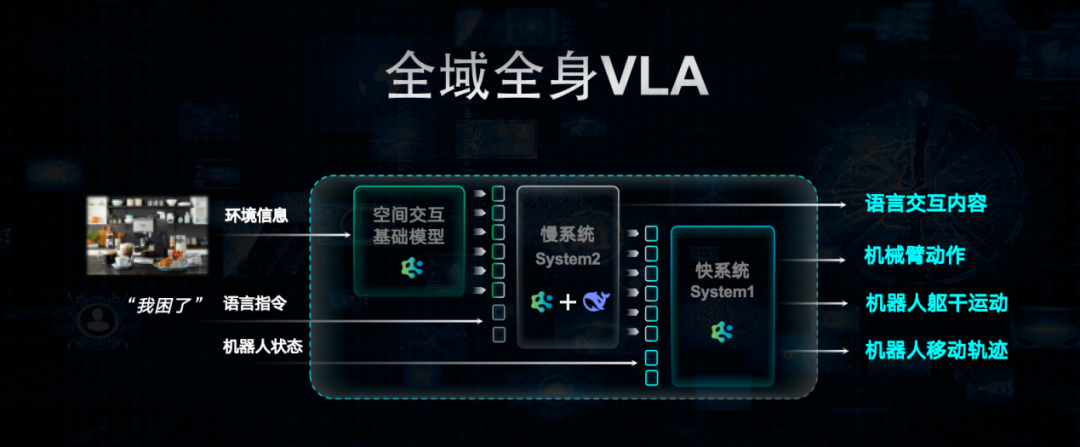
Core Insights - The company Zhi Ping Fang officially launched its next-generation general-purpose intelligent robot AlphaBot 2 and announced a comprehensive upgrade of its "AGI terminal" strategy, which includes core embodied large model technology upgrades, product iterations, self-owned production line construction, and commercialization goals [1][8] - The AlphaBot 2 is the world's first general-purpose intelligent robot equipped with the embodied large model Alpha Brain, showcasing strong generalization capabilities and adaptability in complex industrial and public service scenarios [1][2] Technology Advancements - Zhi Ping Fang is a pioneer in the development of the end-to-end Vision-Language-Action (VLA) technology paradigm, having upgraded its original embodied large model brand AI2R Brain to Alpha Brain, which features the Global & Omni-body Vision-Language-Action (GOVLA) model [2][4] - The GOVLA model consists of a spatial interaction base model, a slow system for complex logical reasoning, and a fast system for real-time responses, enabling the robot to perform tasks autonomously in various environments [4][5] Product Features - AlphaBot 2 is designed with advanced spatial intelligence and learning capabilities, allowing it to complete multiple tasks without prior training and quickly adapt to new tasks [5] - The robot features 360° spatial detection, 34+ degrees of freedom, and a vertical working range of 0-240 cm, making it highly suitable for the GOVLA model [5] Market Applications - Zhi Ping Fang has formed a strategic partnership with Huaxi Biotechnology to develop intelligent robotic solutions for the biotechnology sector, enhancing automation in material handling and reducing contamination risks [6] - The company plans to deploy its robots in various scenarios, including airports and residential communities, to provide intelligent services [6][8] Production and Growth Plans - The company announced the initiation of its self-owned production line, aiming to achieve 10,000 scene applications by 2028 and contribute 1% to the GDP of Nanshan District by 2030 [1][8] - The global humanoid robot market is projected to reach $38 billion by 2035, with Zhi Ping Fang positioning itself to meet the increasing demand through its production capabilities [8]


国货美妆“第二梯队”暗涌资本野心
Xin Lang Cai Jing· 2025-05-23 06:10
Core Viewpoint - The recent surge in interest for IPOs among domestic beauty brands in China is highlighted by the cases of 毛戈平 and 谷雨, indicating a potential new wave of listings in the beauty sector despite challenges in the A-share market [1][5]. Group 1: IPO Attempts and Challenges - 东方妍美 has submitted its prospectus for a Hong Kong IPO, projecting revenues of 12.88 million yuan and 14.52 million yuan for 2023 and 2024, respectively, with a growth rate of 12.7% in 2024 [1]. - 毛戈平 has faced multiple failed attempts to list on the A-share market, ultimately shifting its focus to the Hong Kong market after years of effort [2][3]. - Other beauty brands like 环亚科技 and 相宜本草 have also encountered significant hurdles in their IPO journeys, with the latter terminating its listing plans after several attempts [3][4]. Group 2: Market Conditions and Regulatory Environment - The new "国九条" policy has raised the listing thresholds for A-share companies, making it increasingly difficult for beauty brands to go public [4]. - The recent success of beauty companies like 芭薇股份 and 敷尔佳 in A-share listings contrasts with the struggles of others, indicating a selective market environment [6]. Group 3: Growth and Performance of 谷雨 - 谷雨 has shown rapid growth, with sales reaching 5 billion yuan in 2024, positioning it among the top beauty brands in China [6][7]. - The brand's reliance on a single product line and online sales channels poses potential risks, as indicated by its heavy dependence on e-commerce platforms [7][8]. - 谷雨's marketing strategy involves significant spending on promotions and collaborations, raising concerns about sustainability and profitability [8]. Group 4: Other Brands and Future IPO Plans - Brands like 林清轩 and 伽蓝集团 are reportedly preparing for IPOs, with 林清轩 experiencing a 50% growth in sales despite a challenging market [9][10]. - 花西子 has shown strong sales performance but has not pursued external funding, leading to speculation about its IPO intentions [11]. - 橘宜集团 has completed multiple financing rounds and is preparing for a potential IPO, indicating a trend among beauty brands to consider public listings [12].
未名拾光完成近亿元战略融资,欧莱雅集团与纳爱斯集团共同投资
Sou Hu Cai Jing· 2025-05-23 02:26
Core Insights - Unnamed Company has completed a strategic financing round of nearly 100 million RMB, with investments from L'Oréal Group and Naies Group, further solidifying its leading position in the field of bioactive materials innovation [1][12] - The company has established a strategic partnership with L'Oréal to co-develop innovative bioactive ingredients and promote their large-scale production using low-carbon biomanufacturing technologies [1][12] R&D and Technology - Efficiency is a core barrier in raw material research and development, with Unnamed Company establishing the world's largest bioactive substance database, covering over 30 billion molecular data from plant, microbial, and animal sources [2] - The company has developed two raw material evaluation platforms, including a non-invasive transdermal testing platform based on human Raman spectroscopy, significantly reducing animal testing [4] - An innovative AI efficacy evaluation system has been created, achieving a breakthrough in technology by replacing traditional experiments with AI algorithms, allowing for the screening of millions of raw materials in a single day, enhancing efficiency by a factor of 1,000 [6] Production Capabilities - Unnamed Company has built a multi-dimensional biosynthesis platform that includes microbial cells, plant callus tissue, animal cells, and cell-free synthesis technologies, with a focus on high-efficiency production of plant components [8] - The company has established Asia's largest callus tissue resource library and completed the first domestic registration of a new raw material based on this technology, providing innovative solutions for green biomanufacturing [8] Market Position and Strategy - The company has received 158 certifications from the National Medical Products Administration, successfully bridging the gap from laboratory research to industrial production, serving major domestic brands [9] - Unnamed Company is pursuing a "three-step" strategy in the consumer healthcare sector, starting with skincare ingredients, moving into high-barrier medical aesthetics, and eventually expanding into functional food ingredients [10] - The company is accelerating its global layout through cross-border collaborative innovation, providing core bioactive raw material technologies for international beauty brands, including L'Oréal, Procter & Gamble, and Unilever [12] Investment and Recognition - The recent strategic financing round has been recognized as a significant endorsement of the company's technological capabilities by global industry capital, with investments from leading institutions [12][13] - L'Oréal's global R&D executive expressed excitement about the collaboration, emphasizing the integration of Unnamed Company's AI design platform with L'Oréal's expertise in skin and hair biology [13]


医美巨头“炮轰”一众券商 称玻尿酸“遭谎言与践踏”
Nan Fang Du Shi Bao· 2025-05-23 02:21
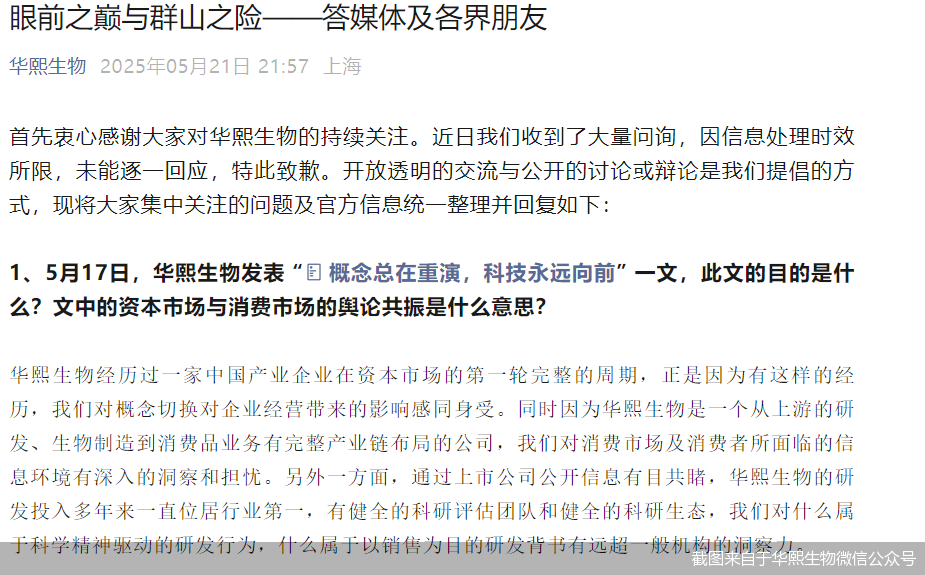
Core Viewpoint - The article discusses the criticism from Huaxi Biological towards several brokerage firms for their misleading research reports that promote the idea of hyaluronic acid being outdated compared to recombinant collagen protein, which Huaxi believes misleads the market and damages the reputation of the hyaluronic acid industry [1][4][5]. Group 1: Criticism of Brokerage Reports - Huaxi Biological accuses brokerage firms such as Western Securities, Anxin Securities, and Xinda Securities of publishing misleading conclusions that favor recombinant collagen over hyaluronic acid [1][4][5]. - Specific examples of misleading statements include claims that recombinant collagen has more biological features and safety advantages compared to hyaluronic acid [4][5]. - Huaxi Biological emphasizes that both hyaluronic acid and collagen are essential components of the extracellular matrix and should not be compared in a misleading manner [5][12]. Group 2: Market Dynamics - The article highlights the contrasting performance of Huaxi Biological and Juzhi Biological, with Huaxi experiencing a decline in revenue and market value while Juzhi shows significant growth [10][11]. - Huaxi Biological's revenue and net profit for 2024 are projected to be 5.371 billion and 174 million respectively, reflecting a year-on-year decline of 11.61% and 70.59% [10]. - In contrast, Juzhi Biological is expected to achieve a revenue of 5.539 billion and a net profit of 2.062 billion in 2024, marking a year-on-year growth of 57.07% and 42.06% [11]. Group 3: Industry Response - Following Huaxi Biological's statements, two industry associations issued a joint initiative advocating for scientific integrity and ethical marketing practices in the beauty and medical aesthetics sectors [8]. - Huaxi Biological claims to have received apologies from some brokerage firms and has reported the misleading content to regulatory authorities [6][12]. - The company asserts that the rise of the "outdated hyaluronic acid" narrative is a result of speculative capital creating a false narrative to shift focus towards new investment themes [13][14].
身家超450亿元!陕西富豪夫妇的“流量”生意经
21世纪经济报道· 2025-05-23 00:02
Core Viewpoint - The article discusses the rise of Fan Daidi and Yan Jianya, the founders of Juzhi Biotechnology, who recently became the richest couple in Shaanxi with a net worth exceeding 450 billion yuan, highlighting their journey from academia to entrepreneurship and the commercialization of their scientific research [1][2]. Group 1: Background and Early Career - Fan Daidi, born in 1966, comes from an ordinary family in Weinan, Shaanxi, and became China's first female PhD in biochemical engineering after studying at Northwest University and East China University of Science and Technology [2]. - After returning from a visit to MIT in 2000, Fan led a research team to develop human-derived collagen, which garnered significant academic recognition [2][3]. - Yan Jianya left the academic system in 2000 to co-found Xi'an Juzhi Biotechnology with Fan, starting from a small office and focusing on the commercialization of their research [2][3]. Group 2: Business Development and Challenges - Despite holding core technology, the couple faced challenges in converting their research into marketable products, relying on personal savings during the initial years [3]. - Yan Jianya pivoted to the military sector in 2003, leveraging his connections to attract state and private capital, which alleviated financial pressures on their research [3][4]. - Fan Daidi continued to focus on technological breakthroughs, leading to the establishment of a research center and the completion of a factory in 2005 [3][4]. Group 3: Commercialization and Growth - The couple's business model combined scientific expertise with commercial acumen, leading to the launch of their first commercial brand, Keli Jin, in 2009 [5][6]. - They formed strategic partnerships, notably with Wanse City, which significantly increased their market reach despite later controversies surrounding the partner's business practices [6][7]. - The establishment of Xi'an Maker Village allowed them to expand their distribution network, contributing significantly to Juzhi's revenue [6][7]. Group 4: IPO and Financial Performance - Juzhi Biotechnology went public in 2022, becoming the first Hong Kong-listed company focused on recombinant collagen, with a revenue growth of nearly five times from 2019 to 2024 [12]. - The company reported a revenue of 55.38 billion yuan in 2024, with a compound annual growth rate of 42% [12]. - Despite high revenue growth, concerns arose regarding governance, reliance on a single brand, and increasing sales expenses, which outpaced revenue growth [13]. Group 5: Market Position and Future Outlook - Juzhi holds the top position in the collagen protein skincare market and ranks second in the medical dressing market with a 9% market share [9]. - The company has attracted significant investment from prominent firms, indicating strong market confidence, with a pre-IPO valuation exceeding 19.3 billion yuan [11]. - The transition of leadership to the next generation has raised questions about the sustainability of the business model and governance structure [12][13].

华熙生物“怒怼”券商研报后续来了,有望改变上市公司和投研互动模式?
Bei Jing Shang Bao· 2025-05-22 15:00
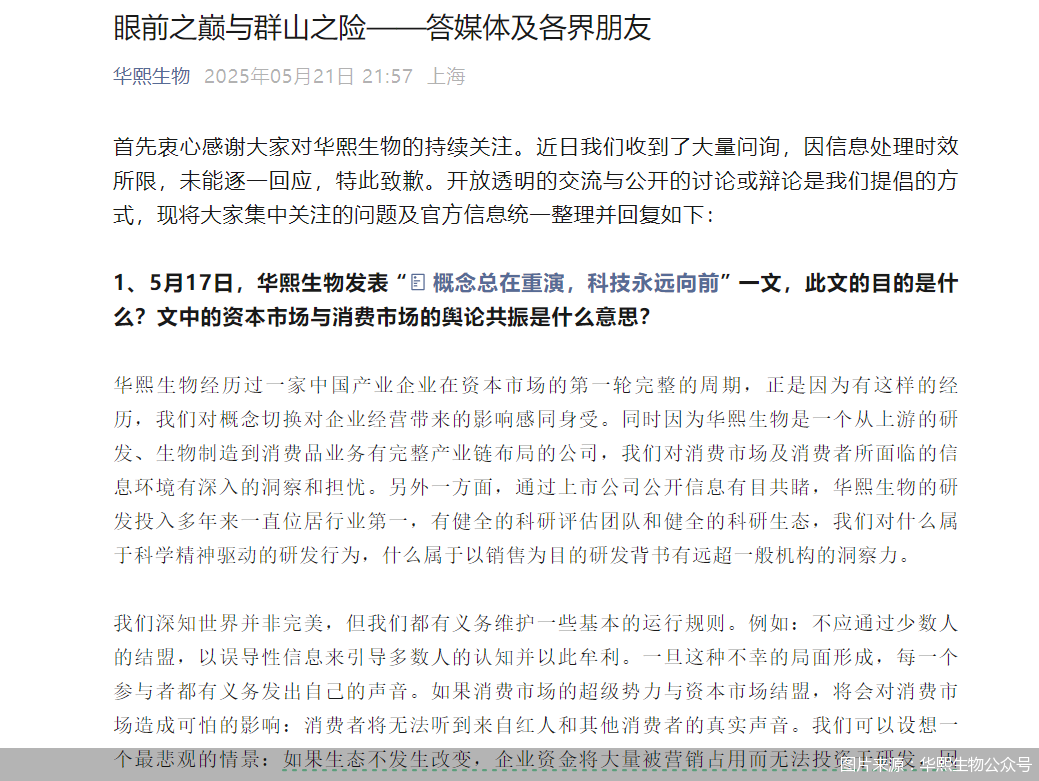
Core Viewpoint - The recent controversy involving Huaxi Biological and brokerage reports highlights the need for improved interaction and accountability between listed companies and brokerage research teams, suggesting a potential shift in the dynamics of this relationship [6][8]. Group 1: Company Actions and Statements - Huaxi Biological issued a follow-up statement on May 21, further explaining its concerns regarding brokerage reports published on May 17, specifically addressing misleading conclusions about the medical aesthetics industry [4][5]. - The company pointed out that certain brokerage reports claimed that collagen products outperform hyaluronic acid without any supporting public data or scientific research [4][6]. - Huaxi Biological emphasized that its intention in naming the brokerages was not to attack them but to encourage a more informed and collaborative approach to industry analysis [5][6]. Group 2: Industry Implications - The incident has prompted discussions about redefining the interaction between listed companies and brokerage research, potentially leading to a more rigorous review process for research reports [8][9]. - Analysts suggest that this situation serves as a warning for brokerages to enhance the professionalism and accuracy of their reports, as previous instances of regulatory scrutiny have already highlighted issues within the industry [9][10]. - The ongoing scrutiny of brokerage reports may lead to a more cautious approach in the future, with an emphasis on compliance and thorough validation of research findings [10][11].
北证50今天为啥崩了?
表舅是养基大户· 2025-05-22 13:33
Core Viewpoint - The article discusses the recent volatility in the micro-cap market, particularly the significant drop in the North Exchange 50 index, attributing it to various factors including market sentiment, high valuations, and the impact of specific stocks [1][2][4]. Summary by Sections Market Volatility - The North Exchange 50 index experienced a drop of 6.15%, marking it as the 10th largest single-day decline in its three-year history, with six days in 2024 alone seeing declines over 6% [1][2]. Reasons for Market Movement - Increasing warnings about micro-cap risks from fund managers have led to some investors taking profits, especially after the North Exchange 50 reached a historical high [2]. - The current valuations are notably high, with the North Exchange 50 at a rolling P/E ratio of 76, the China 2000 at 136, and the Sci-Tech 50 at 140, all at extreme levels compared to historical data [2]. - The significant drop in the largest component stock, Jinbo Biological, which fell by approximately 15%, has heavily influenced market sentiment, despite its year-to-date increase of 140% [2]. Future Market Pressures - The potential reopening of A-share IPOs is seen as a significant future pressure on the micro-cap market, which has thrived in a favorable speculative environment due to low funding rates and limited IPOs [4][5]. Supportive Market Conditions - The micro-cap market has benefited from low funding rates, restricted IPOs, and a lack of institutional investment, allowing it to flourish despite the absence of significant public fund inflows [5]. - Recent regulatory changes, such as the revised Major Asset Restructuring Management Measures, have positively impacted the shell value of micro-cap stocks [5]. IPO Policy Changes - The article highlights a shift in policy towards supporting high-quality, unprofitable tech companies for IPOs, indicating a trend towards more flexible and inclusive listing regulations [7][8]. - The introduction of a new mechanism for adjusting the pace of new stock issuances suggests that the current high valuations in the micro-cap sector may lead to increased supply in the near future [9][12]. Insurance Sector Investment - The insurance sector has significantly increased its equity investments, with a total of 220 billion yuan allocated, indicating a strong shift towards high-dividend blue-chip stocks [15][16]. Monetary Policy - The central bank's decision to exceed the MLF renewal by 3.75 trillion yuan indicates a net injection of liquidity into the market, which may influence bond market dynamics [17][18].

反腐!炮轰!正名!华熙生物在焦虑什么?
Bei Jing Shang Bao· 2025-05-22 13:30
Core Viewpoint - The recent discussions surrounding hyaluronic acid and recombinant collagen in the medical beauty industry have intensified, particularly following Huaxi Biological's publications defending hyaluronic acid's relevance and efficacy over recombinant collagen [1][4][5]. Group 1: Company Response and Market Dynamics - Huaxi Biological has issued statements refuting claims that hyaluronic acid is outdated, emphasizing the importance of both hyaluronic acid and collagen in skin health, and their interdependent roles in extracellular matrix (ECM) function [4][5]. - The company highlighted that it holds the highest number of approved Class III medical device certifications for hyaluronic acid products, asserting that there is no evidence to suggest that recombinant collagen is safer than hyaluronic acid [5]. - The shift in market focus from hyaluronic acid to recombinant collagen has led to a decline in the stock prices and performance of traditional hyaluronic acid companies, while recombinant collagen firms have seen significant gains [6]. Group 2: Financial Performance - Huaxi Biological reported a revenue decline of 11.61% year-on-year, with total revenue of approximately 5.371 billion yuan and a net profit drop of 70.59%, amounting to about 174 million yuan for 2024 [6][7]. - The company’s medical beauty segment showed positive growth, with raw material business revenue increasing by 9.47% to 1.236 billion yuan, while the medical terminal business grew by 32.03% to 1.44 billion yuan [7]. - The significant decline in overall performance was attributed to challenges in the consumer goods segment, which faced intensified competition and strategic adjustments, resulting in a 31.62% revenue drop to 2.569 billion yuan [7]. Group 3: Management Changes and Corporate Governance - In response to internal issues, Huaxi Biological has initiated a major management reform, focusing on addressing corruption and improving corporate governance, with a strict deadline for employees to report any misconduct [9][10]. - The company has undergone significant personnel changes, including the retirement of senior executives and the appointment of new management to align with strategic development needs [10]. - The management reform aims to correct previous lax practices and establish a more robust operational framework for long-term growth [9].