
西部证券

Search documents
落袋为安!76亿“跑了”
Zhong Guo Ji Jin Bao· 2025-06-27 06:21
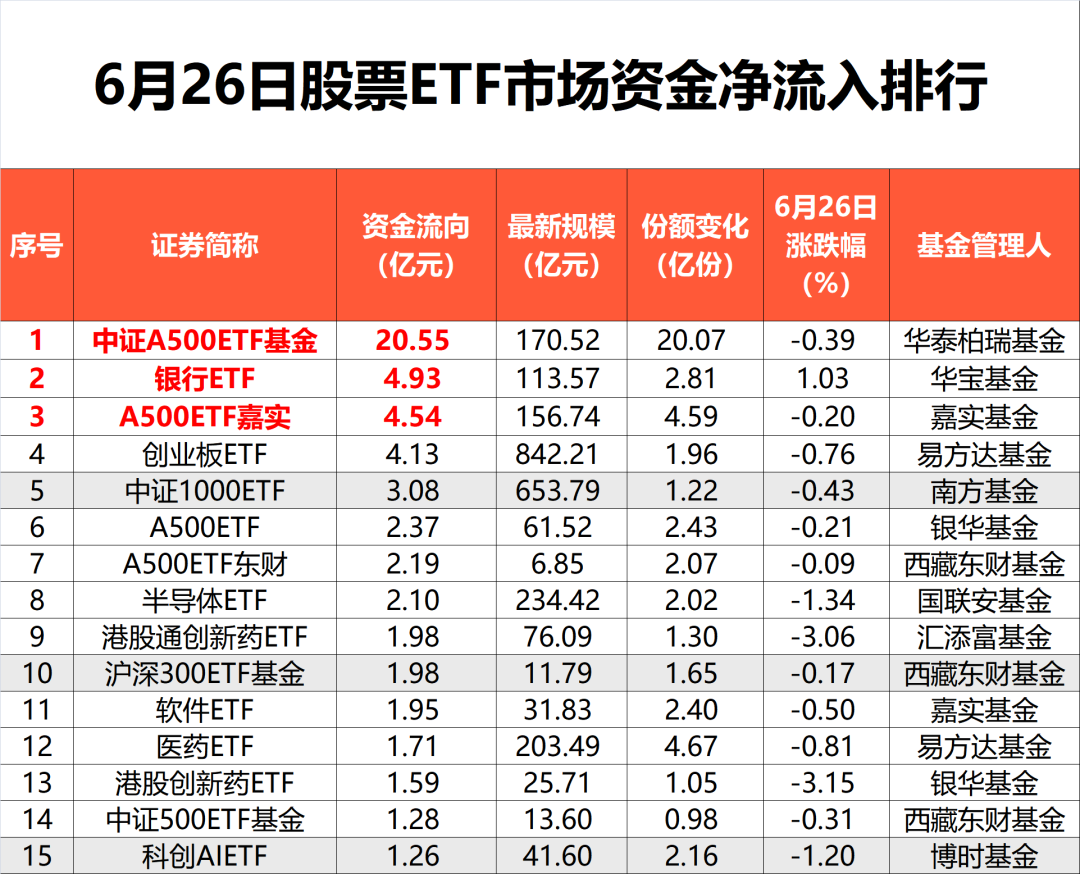
Group 1 - The A-share market experienced a slight decline on June 26, with the three major indices showing a small drop, while the military industry sector remained strong and bank stocks performed well [1][3] - There was a significant net outflow of over 7.6 billion yuan from the stock ETF market, with the CSI 300 index and other broad-based indices seeing the largest outflows [2][3] - The total scale of all stock ETFs in the market reached 3.59 trillion yuan, with a reduction of 3.586 billion units in total shares on the same day [3] Group 2 - In contrast to the outflows in stock ETFs, bond ETFs and Hong Kong market ETFs saw net inflows of 5.926 billion yuan and 450 million yuan, respectively [3] - The CSI A500 index and the CSI Bank index attracted significant inflows, with over 6.1 billion yuan and 1.9 billion yuan, respectively, in the recent five trading days [3][5] - The Huatai-PineBridge CSI A500 ETF led the inflows with over 2.055 billion yuan on June 26, making it the top performer in the industry [4][3] Group 3 - The broad-based ETFs experienced the largest net outflows, totaling 5.525 billion yuan, with the CSI 300 index leading the outflows at 3.23 billion yuan [8][9] - The Huatai-PineBridge CSI 300 ETF saw a net outflow of nearly 1.4 billion yuan, ranking first in the industry for outflows [9][8] - Other ETFs such as the SSE 50 ETF and the CSI 500 ETF also experienced significant outflows, exceeding 500 million yuan each [9] Group 4 - Despite the short-term net outflows, several institutions recommend focusing on investment opportunities in related sectors, particularly in the brokerage sector, which is expected to benefit from public fund allocation and high growth [10] - The brokerage sector is currently trading at a price-to-book ratio of 1.4, indicating a potential investment window as historical percentiles suggest a favorable entry point [10]

全线飘红,A股超4200股上涨!小米一度猛拉8%
21世纪经济报道· 2025-06-27 02:32
Core Viewpoint - The article discusses the recent performance of the A-share market, highlighting the upward trend of major indices and the active participation of financial sectors, particularly in virtual asset trading services, which are expected to drive growth and innovation in the industry [1][3][5]. Market Performance - As of the morning of the 27th, all three major A-share indices have risen, with the ChiNext Index increasing by over 1% and the Shenzhen Component Index by nearly 1% [1]. - More than 4,200 stocks have seen an increase in value [2]. Financial Sector Activity - The financial sector has become active again, with Tianfeng Securities hitting the daily limit, following multiple consecutive gains by other firms such as Hongye Futures and Aijian Group [3]. - Notable stock performances include Tianfeng Securities at 5.16, up 10.02%, and Huaxi Securities at 9.60, up 8.47% [4]. Virtual Asset Trading - The article mentions that Guotai Junan International has obtained the first full license for virtual assets among Chinese brokers in Hong Kong, with several other firms also pursuing similar licenses [4]. - Western Securities expresses optimism about the growth potential of Chinese brokers in virtual asset trading, which could enhance their competitive advantage and lead to new revenue streams [5]. Economic Outlook - Several brokerage firms project a positive outlook for the A-share market in the second half of 2025, anticipating a potential upward trend [9]. - Analysts from Galaxy Securities note that while external uncertainties and domestic demand issues persist, the Chinese economy is expected to show resilience due to ongoing policy support [12]. Investment Directions - Institutions are focusing on three main investment directions for the second half of the year: dividend assets, technology innovation themes, and the consumer sector [19]. - Dividend assets, particularly in financial sectors like insurance and banking, are highlighted for their defensive attributes and stable returns [21][22]. - The technology innovation theme emphasizes AI-related sectors, including AI computing and applications, which are expected to drive significant market interest [25][26]. - The consumer sector, particularly domestic brands in beauty and pet industries, is also seen as a promising investment area [28][30].



科技创新债爆火 30家券商狂发300亿
2 1 Shi Ji Jing Ji Bao Dao· 2025-06-26 13:51
科技创新债券正式推出至今已近2个月,券商、银行、企业、投资机构等各类发行主体掀起发行潮。 其中,既可作为发行主体,又能作为承销机构的证券公司,在科技创新债券发行中的表现尤为值得关 注。 21世纪经济报道记者根据Wind数据梳理发现,2025年5月7日至5月25日期间,超30家券商推出近40只科 技创新债券,总规模超过300亿元。其中,大部分为新获批债券,也有个别券商将此前获批债券变更为 科技创新债券。 利率,是债券发行中最值得关注的要素之一。记者采访与梳理发现,相较于同期其他类型债券,科技创 新债券利率相对更低,有投行资深人士告诉记者,二者差距约为30BP(基点)。 头部券商利率普遍较低,中信证券、中信建投、申万宏源等头部券商科技创新债券发行利率均不足 1.7%。与之相对,中小券商发行利率则普遍在1.9%以上;其中,东北证券发行利率最高为2.29%。 券商为何如此热衷于科技创新债券发行? 记者综合调研发现,这既与券商响应政策、支持科技企业发展的功能性作用密切相关,又得益于投资者 认购热情踊跃,还与券商的业务结构优化相关联。 与此同时,如何促进科技创新债券这一新类型债券规范发展,也是市场关注的重点之一。而规范资 ...
商业银行市场风险管理新规落地:厘清职责边界,推进全流程精细化管控
Zhong Guo Jing Ying Bao· 2025-06-25 13:16
Core Viewpoint - The newly issued "Market Risk Management Measures" by the National Financial Regulatory Administration represents a significant update to market risk management requirements in China, enhancing the framework established in 2004 and addressing the evolving financial landscape [1][2]. Group 1: Regulatory Updates - The "Measures" provide clearer risk boundaries, stricter governance requirements, and a more systematic management process to help banks manage market risks during extreme market conditions [1]. - The evolution of market risk management in China has progressed through several key regulations since 2004, culminating in the 2025 "Measures" which refine the governance structure and enhance operational resilience in market risk management [2]. Group 2: Governance Responsibilities - The "Measures" clarify the responsibilities of the board of directors, supervisory board, and senior management in market risk management, establishing a clear delineation of duties across three lines of defense [2]. - Banks are required to strengthen market risk management at the group level, ensuring that all subsidiaries align with the group's risk appetite and regulatory requirements [3]. Group 3: Market Risk Management Framework - The "Measures" mandate a comprehensive and refined approach to market risk management, emphasizing six key areas: scope redefinition, governance upgrades, consolidated reporting, data and valuation, stress scenarios, and model validation [4]. - Large and medium-sized banks with established market risk management systems are encouraged to conduct gap analyses against the "Measures" to ensure compliance, while smaller banks are advised to develop lightweight organizational structures tailored to their specific risk profiles [4]. Group 4: Integration with Global Standards - Domestic regulatory bodies are actively integrating into the global capital regulatory framework, prompting banks to enhance their capital measurement frameworks and risk model systems [4]. - Banks are focusing on building robust model risk management systems that ensure effective governance, lifecycle management, and technological empowerment, creating a closed-loop information support platform for model development and business application [4].
西部证券:新能源车出口有望成为我国汽车出口新增长动力 推荐零跑汽车(09863)等
智通财经网· 2025-06-25 09:33
Core Viewpoint - The report from Western Securities indicates that China's overall automobile export growth is expected to slow down, with a projected 6% year-on-year increase from January to April 2025, while the export of new energy vehicles (NEVs) is anticipated to maintain a high growth rate of 53%, accounting for 33% of total exports, positioning NEVs as a new growth driver [1] Group 1: Export Growth Trends - The overall automobile export growth rate for January to April 2025 is projected at 6%, a slowdown compared to previous years, primarily due to a decline in traditional vehicle exports [1] - NEV exports are expected to continue growing rapidly, with a projected export volume of 640,000 units in the first four months of 2025, representing a 53% year-on-year increase [1] - The export volume of pure electric vehicles is expected to reach 430,000 units, a 28% increase year-on-year, while plug-in hybrid vehicle exports are projected at 210,000 units, showing a significant 155% increase [1] Group 2: Market Opportunities - The Middle East, North Africa, and South America are identified as regions with high growth potential for passenger vehicles, with both market space and growth rates expected to expand [2] - Global NEV penetration rates are currently low, indicating significant room for growth, particularly in Europe where the sales base is large and the penetration ceiling is high [2] Group 3: Competitive Advantages of Domestic Brands - Major Chinese automakers are expected to maintain a high export growth rate in 2024, surpassing the industry average, with significant growth in the export of NEVs, especially plug-in hybrids [3] - Chinese electric vehicles exhibit a clear price-performance advantage compared to models from Europe and the US, as well as local electric vehicle prices in Brazil, Thailand, and Mexico [3] - Over 80% of electric vehicles imported by multiple countries from China in 2024, showing a notable increase compared to 2023 [3]




300增强ETF(561300)涨近1.5%,市场关注分红险新规与数据中心资本开支增长
Mei Ri Jing Ji Xin Wen· 2025-06-25 08:21
Group 1 - The National Financial Regulatory Administration issued a notice regarding the regulation of dividend levels in insurance products, requiring careful determination of dividend levels to prevent risks associated with interest rate differentials and curb unhealthy competition, which benefits leading insurance companies with low cost rates and high asset allocation levels [1] - The China Securities Regulatory Commission revised the classification evaluation regulations for securities companies, removing the additional points for total operating revenue, expanding the range of income ranking for light asset businesses, and adding indicators for self-operated equity asset scale, guiding the industry towards specialized, distinctive, and high-quality development [1] - The People's Bank of China is implementing structural monetary policy tools in Shanghai to optimize credit structure and increase support for small and micro enterprises, technological innovation, and green low-carbon sectors, while the launch of cross-border payment services is expected to help banks benefit from the internationalization of the RMB; banks are likely to see stable profit growth due to narrowing interest margin declines and improved asset quality, alongside a weak recovery in consumption and declining interest rate expectations, making dividend strategies still valuable for investment [1] Group 2 - The 300 Enhanced ETF tracks the CSI 300 Index, which includes 300 stocks with large market capitalization and good liquidity from the Shanghai and Shenzhen stock markets, primarily reflecting the performance of core assets in the A-share market, with a recent increase of 1.05% in the index, showcasing strong performance in the large-cap blue-chip sector [1]
西部证券:运动控制为制约人形机器人商业化落地关键环节 建议关注固高科技(301510.SZ)等
智通财经网· 2025-06-25 06:47
Core Insights - The core technology for humanoid robots is motion control, which is essential for dynamic gait, precise operations, and environmental adaptability [1] - The humanoid robot industry faces both opportunities and challenges, with potential applications in various sectors such as industrial automation, medical rehabilitation, and education [1] - Precise complex motion control technology is fundamental for the widespread application of humanoid robots [2] Industry Overview - Humanoid robots are characterized by human-like form and functions, and their development is driven by advancements in robotics control and AI technology [1] - The industry is experiencing rapid evolution due to continuous influx of capital and talent, although large-scale commercialization still faces technical, economic, and social challenges [1] Motion Control Techniques - Motion control for humanoid robots can be categorized into model-based control and data-driven control, each with unique advantages [3] - Model-based control relies on accurate modeling and manual parameter adjustments, while data-driven control allows robots to learn motion strategies from experience [3] - A hybrid control approach combines both methods to enhance adaptability and robustness, improving the operational capabilities of humanoid robots [3] Key Players and Beneficiaries - Leading companies like Tesla with Optimus, Yushun with G1, and Boston Dynamics with Atlas demonstrate strong motion control capabilities [4] - The development of motion control software algorithms is typically conducted in-house by robot manufacturers, while hardware components may be sourced from third-party suppliers [4] - Training-related hardware such as motion capture devices and simulation software tools are often provided by third-party vendors or open-source platforms [4]


又有卖方顶级大咖离职!荀玉根不再担任国泰海通证券首席经济学家,本月发布《宁做乌龟,不做兔子》公开文章
Xin Lang Zheng Quan· 2025-06-25 05:10
Core Viewpoint - The departure of Xun Yugen from Guotai Junan Securities has sparked widespread attention and speculation within the industry, highlighting the challenges faced during the merger of Guotai Junan and Haitong Securities [2][3]. Company Changes - Xun Yugen's resignation as Chief Economist of Guotai Haitong Securities comes just two months after he took on the role, raising questions about the stability of leadership amid ongoing integration challenges following the merger [2][3]. - The merger of Guotai Junan and Haitong Securities has led to significant restructuring, with Xun's position experiencing a decline rather than an elevation, reflecting the complexities of merging two large firms [3]. Talent Dynamics - The ongoing merger has resulted in a notable talent exodus, with key analysts leaving for other firms, which poses a risk to the research capabilities of Guotai Haitong Securities [3][4]. - The departure of Xun Yugen may serve as a bellwether for future talent movements within the industry, as his next career move could influence other analysts to follow suit, intensifying competition for talent [5]. Industry Context - The integration of Guotai Junan and Haitong Securities has led to both opportunities for scale and challenges related to cultural clashes, compensation disparities, and overlapping positions, which have contributed to the loss of core talent [3][5]. - The firm currently boasts a team of 286 analysts, making it the second-largest after CICC, yet the ongoing departures of key personnel cast a shadow over its future integration success [3].



西部证券: 西部证券股份有限公司2025年跟踪评级报告
Zheng Quan Zhi Xing· 2025-06-24 17:56
Core Viewpoint - The credit rating agency maintains the long-term credit rating of Western Securities Co., Ltd. at AAA with a stable outlook, reflecting the company's strong shareholder background and competitive position in the industry [1][2][5]. Company Overview - Western Securities is the only listed national comprehensive securities company in Shaanxi Province, with a strong shareholder background and complete business licenses [5][17]. - As of March 2025, the company's registered capital is 4.47 billion yuan, with Shaanxi Investment Group holding 36.79% of the shares [13][17]. Financial Performance - In 2024, the company's operating income slightly decreased, while net profit increased [5][6]. - As of March 2025, the total assets of the company reached 104.78 billion yuan, with net capital at 23.97 billion yuan and a risk coverage ratio of 352.73% [10][21]. - The company's operating profit margin improved to 32.80% in the first quarter of 2025, indicating strong profitability [10]. Business Segments - The company operates in wealth management, credit trading, investment banking, and asset management, with securities proprietary trading being the largest revenue source [17][23]. - The securities brokerage business has a strong regional competitive advantage, with a trading volume increase of 13.41% in 2024 [23][24]. Industry Analysis - The securities industry is experiencing significant activity, with core business revenues from brokerage, credit, and proprietary trading performing well [15][16]. - The industry faces challenges such as regulatory pressures and market volatility, which can impact revenue stability [15][16]. Future Outlook - The company is expected to enhance its competitive strength through the acquisition of Guorong Securities, pending regulatory approval [20]. - The overall market environment is projected to improve, potentially increasing the company's business scale and competitiveness [7][15].
融资余额连续11个交易日超1.8万亿元 券商稳健开拓两融业务
Zheng Quan Ri Bao· 2025-06-24 16:40
Core Viewpoint - The recent increase in margin trading balances indicates a more optimistic market sentiment and heightened capital activity, suggesting potential upward momentum in the market [1][2]. Margin Trading Data - As of June 23, the total margin trading balance reached 18,168.91 billion yuan, with a financing balance of 18,051.58 billion yuan and a securities lending balance of 117.33 billion yuan [1]. - The margin trading transaction volume on June 23 was 977.56 billion yuan, accounting for 8.52% of the total A-share trading volume, with financing purchases amounting to 972.29 billion yuan [1]. Industry Preferences - From June 9 to June 23, the highest net financing inflow was observed in the chemical pharmaceutical industry, totaling 2.33 billion yuan, followed by the liquor industry at 1.45 billion yuan [2]. - Other industries with significant net financing inflows included batteries (1.30 billion yuan), commercial vehicles (1.28 billion yuan), and software development (1.28 billion yuan) [2]. Individual Stock Performance - The top ten stocks by net financing inflow from June 9 to June 23 included Kweichow Moutai and Jianghuai Automobile, each exceeding 1 billion yuan in net inflow [3]. - The leading ETFs by net financing inflow were the GF CSI Hong Kong Innovation Drug ETF (613 million yuan), Huaxia SSE Sci-Tech Innovation Board 50 ETF (251 million yuan), and Southern CSI 500 ETF (234 million yuan) [3]. Brokerage Activity - As of June 23, 97 brokerages were engaged in margin trading, with individual investors participating numbering 7.47 million, an increase of approximately 240,000 since the beginning of the year [4]. - Margin trading remains a core business for brokerages, with 32 brokerages reporting that margin trading revenue accounted for over 10% of total revenue last year [4]. Strategic Developments - Brokerages are actively expanding their margin trading services while ensuring risk management and business stability [4][5]. - The collaboration between margin trading and wealth management services is seen as a way to enhance client retention and support brokerage performance [6].