中金黄金

Search documents
黄金白银单日暴跌创多年纪录 分析人士:强势行情中的阶段性修正
Sou Hu Cai Jing· 2025-10-23 03:30
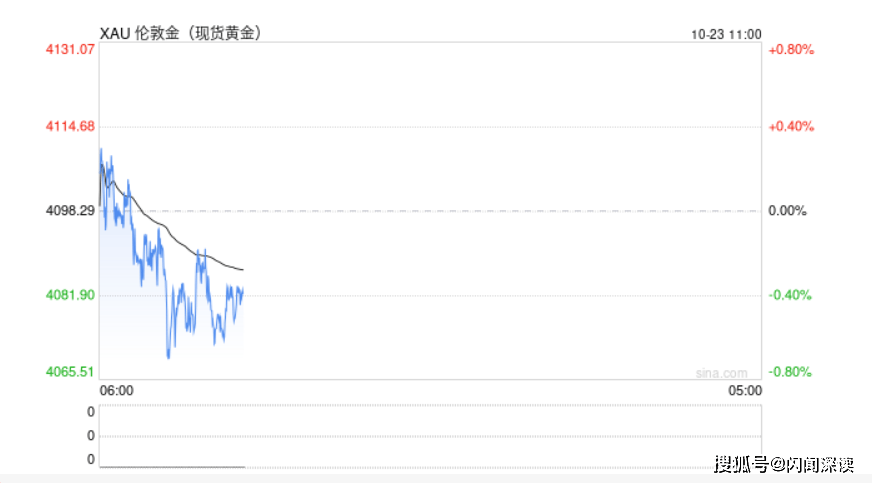
Core Viewpoint - The international precious metals market experienced a significant downturn on October 21, with gold and silver prices plummeting after reaching historical highs, indicating a sharp correction in the market dynamics [1][3][4]. Group 1: Market Performance - Spot gold fell over 6% in a single day, dropping $232 per ounce, marking the largest single-day decline since April 2013, with futures settling at $4,109.10 per ounce after hitting a peak of $4,381 [1][4]. - Silver saw an even steeper decline, with spot prices dropping 7.6% to $48.49 per ounce, and hitting a low of $47.85, marking the largest single-day drop since 2021 [3][4]. - Domestic markets mirrored this trend, with Shanghai gold futures dropping nearly 6% and Au99.99 contracts falling over 5% [3][4]. Group 2: Factors Behind the Decline - The decline was triggered by multiple negative factors, including a decrease in risk aversion following a joint statement from European leaders supporting a ceasefire in the Russia-Ukraine conflict, which reduced gold's safe-haven premium [4][5]. - The U.S. government's potential resolution of the "shutdown crisis" and easing trade tensions between China and the U.S. further suppressed market demand for safe-haven assets [4]. - Profit-taking by investors contributed to the sell-off, as gold and silver had seen substantial gains earlier in the year, with gold up over 57% and silver over 67% [4][5]. Group 3: Market Reactions - The sell-off quickly affected capital markets, with significant declines in gold and silver mining stocks, including Harmony Gold and AngloGold, both dropping over 10% [6]. - In contrast, some leading domestic stocks like Zijin Mining and Zhongjin Gold saw significant trading volumes, indicating a divergence in market sentiment between institutional and retail investors [6]. - Retail gold prices in physical markets, such as those from Lao Feng Xiang and Chow Tai Fook, actually increased by 2%-2.5%, highlighting a difference in expectations between physical consumption and financial investment [6]. Group 4: Institutional Perspectives - Despite the sharp decline, many analysts believe this adjustment is a temporary correction within a strong market trend, with the underlying bullish factors for gold remaining intact [7]. - Continued central bank purchases, geopolitical risks, and high sovereign debt levels are expected to support gold prices in the long term [7]. - HSBC has set a target price of $5,000 per ounce for gold by 2026, emphasizing ongoing central bank purchases and monetary easing as key drivers [7]. Group 5: Short-term Outlook - Analysts predict a volatile short-term outlook for gold and silver, with expectations of limited downside for gold but greater fluctuations for silver [8]. - Citibank has shifted its short-term view to bearish, forecasting gold prices to stabilize around $4,000 per ounce in the next 2-3 weeks [8].

市场回调,黄金股票ETF基金(159322)静待三季报业绩催化!
Xin Lang Cai Jing· 2025-10-23 03:05
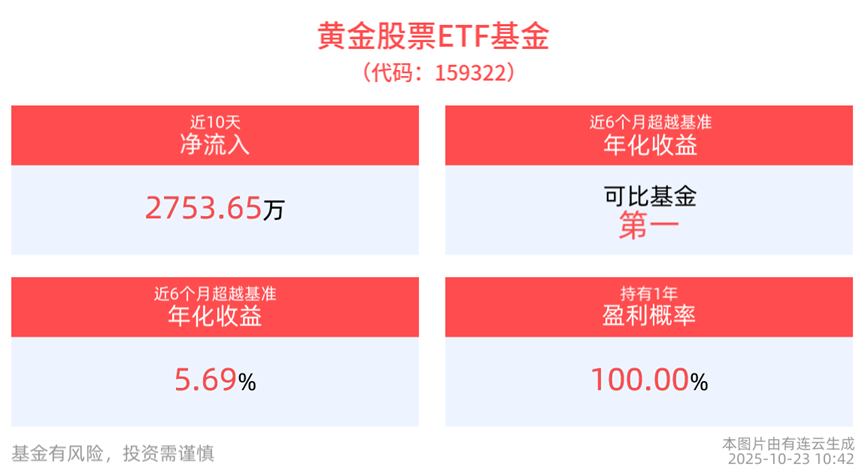
Group 1: Gold Market Overview - Recent adjustment in gold prices following a significant increase in late August, with COMEX gold futures dropping over 6% from October 21 to 22 [1] - Short-term gold investment requires careful timing, but long-term investment value remains intact, supported by fundamental factors [1] - Despite a 5.3% drop in international gold prices on October 21, the long-term logic of gold as a safe-haven asset remains unchanged [1] Group 2: Company Performance - Zijin Mining reported a gold production of 23.8 tons in Q3 2025, a 7% increase quarter-on-quarter, driven by new acquisitions and projects [2] - The sales price of gold increased by 4% to 768 RMB per gram in Q3, significantly enhancing profits [2] - The company is expanding its gold and copper production capacity, laying a foundation for sustainable long-term growth [2] Group 3: ETF Performance - As of October 23, 2025, the CSI Hong Kong and Shanghai Gold Industry Stock Index fell by 2.35%, with mixed performance among constituent stocks [4] - The Gold Stock ETF Fund has seen a 32.20% increase in net value over the past six months, ranking first among comparable funds [5] - The ETF has a maximum drawdown of 9.92% over the past six months, with a management fee of 0.50% and a custody fee of 0.10% [6] Group 4: Index Composition - As of September 30, 2025, the top ten weighted stocks in the CSI Hong Kong and Shanghai Gold Industry Stock Index account for 68.2% of the index [7] - Major companies include Zijin Mining, Shandong Gold, and Zhongjin Gold among others [7]

渤海证券研究所晨会纪要(2025.10.23)-20251023
BOHAI SECURITIES· 2025-10-23 01:38
Group 1: Metal Industry Insights - The steel industry is experiencing a demand rebound, but the recovery is not as strong as in previous years, with short-term price fluctuations expected [2] - Copper prices have been under pressure due to previous U.S. tariff policies, but expectations surrounding U.S.-China trade talks and potential Federal Reserve interest rate cuts may alleviate downward pressure [2] - Aluminum prices are expected to fluctuate in the short term, supported by stable fundamentals and easing trade tensions between the U.S. and China [2] - Gold prices may face short-term correction risks due to upcoming U.S.-China negotiations and Federal Reserve meetings, but geopolitical tensions could provide support [2] - Lithium prices are expected to be supported by resilient demand, particularly in energy storage, as disruptions in mining operations in Jiangxi have eased [2] - Rare earth prices may face pressure if export controls are tightened, with attention on the impact of U.S.-China trade negotiations [2] Group 2: Strategic Recommendations - For the steel sector, policies promoting precise capacity control and quality improvement are expected to enhance the competitive landscape and profitability of steel companies [3] - The copper supply outlook is tightening due to incidents at major mines, suggesting a potential price floor; focus on companies with strong resource guarantees and environmental standards [3] - In the aluminum sector, the "anti-involution" policy is anticipated to improve the supply landscape, with a focus on demand recovery during peak seasons [4] - Gold prices are influenced by U.S. government stability and geopolitical issues, with long-term interest rate uncertainty potentially benefiting gold [4] - The rare earth sector is expected to see a revaluation of related companies due to heightened strategic importance and export control policies [5] - Cobalt supply constraints are anticipated due to limited export quotas from the Democratic Republic of Congo, while demand from electric vehicles and energy storage remains strong [5] Group 3: Machinery Equipment Industry Insights - The engineering machinery sector is witnessing a recovery, with significant growth in excavator sales and a favorable policy environment promoting effective demand expansion [6][7] - The import and export trade of engineering machinery in September reached $5.505 billion, marking a year-on-year increase of 29.1% [6] - The machinery equipment industry is currently valued at a P/E ratio of 31.63, with a premium of 133.41% over the CSI 300 index [6] - The sector's outlook is positive, driven by ongoing demand from infrastructure projects and a shift towards commercial competition in humanoid robotics [7]





2025年1-4月中国硫酸(折100%)产量为3651.2万吨 累计增长5.2%
Chan Ye Xin Xi Wang· 2025-10-23 01:11
Core Insights - The article discusses the growth and production statistics of sulfuric acid in China, highlighting a projected production of 9.22 million tons in April 2025, representing a year-on-year increase of 9% [1] - Cumulative production from January to April 2025 is reported at 36.51 million tons, with a cumulative growth rate of 5.2% [1] Industry Overview - The sulfuric acid industry in China is expected to see significant growth from 2025 to 2031, as indicated by the market research report from Zhiyan Consulting [1] - The report emphasizes the importance of sulfuric acid in various industrial applications, which may drive demand in the coming years [1] Company Implications - Key listed companies in the sulfuric acid sector include Zijin Mining, Jiangxi Copper, Juhua Co., Zhongjin Gold, Tongling Nonferrous Metals, Longbai Group, Yuntianhua, Zhejiang Longsheng, and Chuanfa Longmang [1] - These companies may benefit from the anticipated growth in sulfuric acid production and demand, presenting potential investment opportunities [1]

金价波动风险骤增 多只黄金股最大回撤已超20%
2 1 Shi Ji Jing Ji Bao Dao· 2025-10-23 00:57
Core Viewpoint - The global precious metals market experienced significant declines, with COMEX gold futures and London gold spot prices dropping over 5%, and London silver spot prices falling more than 7% on October 21 [1] Volatility and Market Reactions - The rapid increase in the short-term volatility index has prompted risk warnings from various exchanges and futures institutions, with the GVZ index rising by 20.87% on October 16, reaching a new high since April [2][4] - The GVZ index continued to rise, indicating heightened market volatility and increased risk expectations, with a notable spike on October 16 that pushed it above 30, signaling potential price fluctuations in gold [4][5] - The Shanghai Gold Exchange issued risk warnings, advising members to enhance risk awareness and maintain market stability amid significant price volatility [4][5] Market Performance and Stock Reactions - Despite a rise in London gold prices earlier in October, stocks of companies like Zijin Mining and Shandong Gold showed a divergence, indicating a cautious attitude among secondary market investors [2][9] - As of October 20, the London gold price had increased by approximately 10% for the month, while Zijin Mining's stock rose only 1.05%, reflecting a broader trend of gold stocks not keeping pace with gold price increases [10] - The Wind precious metals index experienced a maximum drawdown of about 16.37% from mid-October highs, with some stocks like Hengbang Shares and Shandong Gold seeing drawdowns exceeding 20% [10][11] Long-term Outlook - Despite recent short-term declines, the precious metals market is viewed as being in a long-term bull market, with the decline of the US dollar's credibility serving as a core foundation for strategic allocation in precious metals [8][11] - If gold and silver prices rise again but stocks like Zijin Mining and Shandong Gold do not follow suit, it may indicate a nearing cyclical peak in the market [11]
黄金创12年来最大单日跌幅 一千多元金饰品热卖
Yang Zi Wan Bao Wang· 2025-10-22 17:11
Group 1 - International gold prices experienced a significant drop, with spot gold falling by 5.31% to $4124.36 per ounce, marking the largest single-day decline since April 2013 [2][3] - Following the sharp decline, gold prices rebounded slightly, with Shanghai Gold Exchange Au99.99 closing at 948.8 yuan per gram and London spot gold rebounding to $4160.1 per ounce [3] - Despite the volatility in gold prices, consumer interest in gold jewelry remains strong, particularly for lower-weight gold items, as seen in retail promotions [4][5] Group 2 - The year-to-date increase in gold prices is approximately 60%, with a peak of $4381.21 on October 20, followed by a drop exceeding 8% in the subsequent days [3] - Retailers are responding to the price fluctuations by offering promotions, such as discounts on gold jewelry, to attract customers [4] - Analysts suggest that the long-term outlook for gold remains bullish, with Deutsche Bank indicating that gold's share in global reserves has risen to 30%, while the share of the dollar has decreased [6]
金价高台跳水,是“倒车接人”还是行情终结?
Qi Lu Wan Bao Wang· 2025-10-22 13:34
Core Viewpoint - The recent sharp decline in gold prices has triggered significant reactions in the market, affecting both stock prices of gold-related companies and consumer behavior in the retail gold market [2][3][4]. Market Reaction - On October 22, A-share gold stocks experienced a collective drop, with companies like Hunan Silver and Shengda Resources hitting the daily limit down, while others like Xiaocheng Technology and Zhaojin Gold fell over 9% [3]. - The precious metals sector became the largest declining sector in A-shares that day, with the three major indices collectively falling and trading volume decreasing by 202.4 billion yuan compared to the previous day [3]. Retail Market Adjustment - The domestic gold retail market saw a significant adjustment, with major jewelry brands reducing their gold prices sharply. For instance, Chow Tai Fook's gold price dropped by 57 yuan to 1235 yuan per gram, while Lao Miao Gold saw a decrease of 83 yuan to 1211 yuan per gram [3]. - Despite the price drop, there was an increase in consumer purchases, with many taking advantage of lower prices to buy gold jewelry [4]. Factors Behind Price Drop - Analysts attribute the recent volatility in gold prices to a combination of technical corrections after a rapid increase, easing geopolitical tensions in Eastern Europe, and potential resolutions to the U.S. government shutdown crisis [5]. - The rapid rise in gold prices had created an overheated market, leading to profit-taking by institutions, which further accelerated the price decline [5]. Long-term Outlook - Despite the short-term price drop, several international investment banks remain optimistic about the future of gold prices. HSBC forecasts that gold's upward momentum could continue until 2026, with a target price of $5000 per ounce [6]. - Long-term bullish sentiment on gold remains intact, driven by concerns over U.S. fiscal deficits and the weakening of the dollar, positioning gold as a hedge against these risks [6].



是什么让“黄金牛”驻足回望?
Jin Shi Shu Ju· 2025-10-22 11:56
Core Viewpoint - The recent extreme fluctuations in gold prices are attributed to an overcrowded bullish market, leading to profit-taking by long positions after a significant price increase since September [2][5]. Price Movement - On October 21, spot gold experienced a sharp decline of 6.3%, reaching approximately $4080 per ounce, marking the largest single-day drop since April 2013. The closing price on that day was down 5.31%, the largest drop in nearly 12 years [3][4]. - On October 22, spot gold further dipped to a low of $4002 per ounce before recovering, with the price stabilizing around $4139 per ounce at the time of reporting [3]. - COMEX gold futures also fell by 5.07% on October 21, closing at $4138.5 per ounce [4]. Market Impact - The decline in gold prices has negatively affected gold-related stocks, with companies like Shandong Gold and Zhongjin Gold opening down over 7% on October 22, and closing down more than 3% [4]. - Several jewelry brands reported a decrease in domestic gold jewelry prices, with notable drops in the prices of gold per gram [4]. Factors Behind the Decline - The extreme market conditions are primarily due to a high level of bullish sentiment, with significant profit accumulation since September, prompting profit-taking [5]. - Short-term risk factors have eased, including positive signals in U.S.-China trade relations and a reduction in geopolitical tensions, leading to decreased demand for gold as a safe haven [6]. - Technical analysis indicates that gold prices had risen too quickly, reaching overbought conditions, necessitating a correction [6]. Future Outlook - Analysts believe that the recent price correction is a normal occurrence and does not alter the long-term upward trend for gold prices, despite recent easing in U.S.-China trade tensions [7]. - Historical trends suggest that after a prolonged period of price increases, gold may experience a correction of 20% to 40% within the following year [8]. - The World Gold Council indicates that gold is likely to remain resilient, especially during stock market corrections, as long as there are no significant liquidity crises [9].

多只黄金股最大回撤已超20%
2 1 Shi Ji Jing Ji Bao Dao· 2025-10-22 11:56
Core Viewpoint - The global precious metals market experienced a significant decline on October 21, with COMEX gold futures and London gold spot prices dropping over 5%, and London silver spot prices falling more than 7% [1][8]. Volatility Indicators - The GVZ index, which measures expected volatility in the gold market, surged by 20.87% on October 16, reaching a new high since April, indicating increased market risk [1][5]. - The GVZ index has been rising since October 6, moving out of the normal volatility range of 15 to 25, and reached above 30, signaling heightened potential price fluctuations [5][6]. Market Reactions - Following the volatility increase, both domestic and international exchanges issued risk warnings, and the Shanghai Gold Exchange announced measures to adjust margin requirements and trading limits for gold and silver futures [6][9]. - On October 21, gold prices fell sharply after failing to break through previous highs, with London gold spot prices dropping from $4,381.48 to $4,002.89 per ounce, and COMEX gold futures falling from $4,398 to $4,021.20 per ounce [8][9]. Stock Market Sentiment - The secondary market has shown a cautious attitude towards gold stocks, with a divergence between gold prices and stock performance. For instance, while London gold rose by about 10% in October, stocks like Zijin Mining only increased by 1.05% [13][14]. - The Wind precious metals index has seen a maximum drawdown of approximately 16.4% from mid-October highs, with some stocks experiencing drawdowns exceeding 20% [14][19]. Long-term Outlook - Despite recent price corrections, the long-term trend for precious metals remains bullish, supported by a declining dollar credit. The sector is viewed as having strategic allocation value [11][19]. - If gold and silver prices rise again but individual stocks like Zijin Mining and Shandong Gold do not follow suit, it may indicate a nearing cyclical peak [23].

多只黄金股最大回撤已超20%
21世纪经济报道· 2025-10-22 11:50
Core Viewpoint - The global precious metals market experienced significant declines, with COMEX gold futures and London gold spot prices dropping over 5%, and London silver spot prices falling more than 7% on October 21, indicating heightened volatility and caution among investors [1][6]. Volatility Indicators - The Gold Volatility Index (GVZ) surged by 20.87% on October 16, reaching a new high since April, signaling increased market risk and heightened investor caution [1][5]. - The GVZ index has been rising since October 6, indicating a shift from normal volatility levels (15-25) to a dangerous zone above 30, reflecting growing potential price fluctuations in gold [3][5]. Market Reactions - Following the spike in volatility, the Shanghai Gold Exchange issued risk warnings, and the Shanghai Futures Exchange adjusted margin requirements for gold and silver futures to mitigate potential risks [5][6]. - On October 21, gold prices fell sharply, with London gold spot prices dropping from $4,381.48 to $4,002.89 per ounce, and COMEX gold futures declining from $4,398 to $4,021.20 per ounce [6]. Stock Market Trends - There is a noticeable divergence between gold prices and gold stocks, with gold stocks like Zijin Mining and Shandong Gold showing limited gains compared to a 10% increase in London gold prices since the beginning of October [1][9]. - The Wind precious metals index has experienced a maximum drawdown of approximately 16.37% from mid-October highs, indicating a cautious sentiment in the secondary market [9][12]. Long-term Outlook - Despite short-term adjustments, the precious metals market is viewed as being in a long-term bull market, driven by declining dollar credit, suggesting strategic allocation value in precious metals [7][15]. - The performance of gold stocks relative to gold prices may indicate potential market peaks, as historical trends show that stock prices often peak before commodity prices [15].