药明生物

Search documents
恒生生物科技ETF(159615)涨超2%,创新药ETF南方(159858)溢价频现涨超1%,第十一批集采彰显政策定力,创新药投资价值凸显
Xin Lang Cai Jing· 2025-07-23 02:53
Group 1 - The core viewpoint of the articles highlights a significant rise in the innovative drug sector in both Hong Kong and A-shares, driven by favorable policy changes and market sentiment [1][2] - The 11th batch of national drug centralized procurement has officially started, with the National Healthcare Security Administration clarifying the principle of "new drugs not included in procurement, procurement only for non-new drugs," providing clear policy support for the innovative drug sector [1] - The recent increase in public fund allocation to the pharmaceutical sector, particularly in innovative drugs, indicates a growing market confidence in this area, with notable increases in holdings of companies like Innovent Biologics and 3SBio [2] Group 2 - The Hang Seng Biotechnology ETF (159615) has seen a strong performance, rising over 2% in a single day and accumulating a 6.30% increase over the past week, reflecting active market trading [1][2] - The top ten weighted stocks in the Hang Seng Biotechnology Index include major players such as Innovent Biologics, WuXi Biologics, and BeiGene, indicating a concentration of investment in leading innovative drug companies [2] - The Southern Innovative Drug ETF (159858) tracks the CSI Innovative Drug Industry Index, which includes up to 50 representative companies involved in innovative drug development, with top holdings including Hengrui Medicine and WuXi AppTec [2]
今年以来共209家港股上市公司进行回购
Zhong Guo Zheng Quan Bao· 2025-07-22 21:05
Core Viewpoint - The Hong Kong stock market is experiencing a surge in share buybacks, indicating positive signals for company value maintenance and overall market performance [1][4]. Group 1: Share Buyback Activity - As of July 21, 2023, 209 Hong Kong-listed companies have repurchased a total of 4.466 billion shares, with a total buyback amount exceeding 1,036.18 million HKD [2][3]. - The number of companies participating in buybacks has increased by 9 compared to the previous year, indicating a broader coverage of buyback activities among listed companies [2]. - Major companies leading the buyback amounts include Tencent Holdings (400.43 million HKD), HSBC Holdings (203.33 million HKD), and AIA Group (176.93 million HKD), among others [3]. Group 2: Market Performance - The Hang Seng Index, Hang Seng China Enterprises Index, and Hang Seng Technology Index have all risen over 24% year-to-date, outperforming major global markets [1][4]. - The healthcare, materials, and information technology sectors have shown significant gains, with increases of 70.02%, 59.35%, and 34.01% respectively [5]. - Over 80% of the constituent stocks in the Hang Seng Index have risen, with notable performers including China Biologic Products and Hansoh Pharmaceutical, both up over 110% [5]. Group 3: Future Market Outlook - Analysts expect the Hong Kong stock market to continue its upward trend, characterized by structural market conditions, with a rolling P/E ratio of 11.11, up from 8.96 at the beginning of the year [6][7]. - Factors such as potential U.S. interest rate cuts and positive changes in domestic real estate policies are anticipated to support further market gains [7]. - Investment strategies should focus on high-dividend stocks, sectors benefiting from policy support, and companies with better-than-expected mid-year performance [7][8].
中华交易服务香港生物科技指数上涨0.27%,前十大权重包含信达生物等
Jin Rong Jie· 2025-07-22 14:03
Core Insights - The CESHKB index has shown significant growth, with a 23.67% increase over the past month, 51.27% over the last three months, and a remarkable 96.00% year-to-date [1][2] Group 1: Index Performance - The CESHKB index opened high and closed at 8782.49 points with a trading volume of 16.229 billion [1] - The index is designed to reflect the overall performance of biotechnology companies listed in Hong Kong, with a base date of December 12, 2014, set at 2000.0 points [1] Group 2: Index Composition - The top ten holdings of the CESHKB index include: - CanSino Biologics (13.88%) - Innovent Biologics (9.7%) - BeiGene (8.94%) - WuXi Biologics (8.87%) - 3SBio (8.79%) - WuXi AppTec (5.65%) - Zai Lab (5.18%) - Kelun-Biotech (4.9%) - Legend Biotech-B (4.39%) - Genscript Biotech (4.14%) [1] Group 3: Market and Industry Overview - The CESHKB index is fully comprised of companies listed on the Hong Kong Stock Exchange, with 100% of its holdings in the healthcare sector [2]
1000亿+!港股,行业龙头持续发力
Zheng Quan Shi Bao Wang· 2025-07-22 12:51
Group 1 - The core viewpoint of the articles highlights the significant stock buyback activities among Hong Kong-listed companies, particularly in the context of rising market conditions and the introduction of new regulations that facilitate such actions [1][3][4] - As of July 21, 2023, 209 companies in the Hong Kong stock market have conducted buybacks totaling over 1,034.28 million HKD, indicating a slight increase in the number of companies engaging in buybacks compared to the previous year, despite a decrease in total buyback amounts [1][2] - Major companies like Tencent Holdings, HSBC, and AIA have led the buyback trend, with Tencent alone repurchasing shares worth 400.43 million HKD this year, reflecting strong confidence in their valuations [4][5] Group 2 - The introduction of the new inventory stock mechanism by the Hong Kong Stock Exchange allows companies to hold repurchased shares as inventory rather than being forced to cancel them, which is expected to enhance buyback efficiency and company participation [3] - The buyback activities are seen as a signal of companies' confidence in their future prospects, helping to stabilize investor sentiment and enhance market liquidity [2][5] - The sectors most active in buybacks include healthcare, consumer discretionary, and information technology, indicating a strategic focus on enhancing shareholder value during market fluctuations [5]

1000亿+!港股,行业龙头持续发力
证券时报· 2025-07-22 12:36
Core Viewpoint - The article discusses the trend of stock buybacks among Hong Kong-listed companies, highlighting that despite a decrease in total buyback amounts compared to the previous year, the number of companies engaging in buybacks has increased, indicating a strong confidence in their valuations [1][3]. Group 1: Buyback Trends - As of July 21, 2024, 209 Hong Kong companies have repurchased shares totaling over 1,034.28 million HKD, a decrease from 1,496.08 million HKD in the same period last year [1][3]. - The buyback trend reflects companies' recognition of their undervalued stock prices and aims to stabilize investor confidence [3][4]. - The introduction of the new inventory stock mechanism by the Hong Kong Stock Exchange has increased the efficiency of buybacks, allowing companies to hold repurchased shares as inventory rather than being forced to cancel them [4][5]. Group 2: Leading Companies - Major companies like Tencent Holdings, HSBC, and AIA have been significant players in the buyback market, with Tencent leading at 400.43 million HKD in buybacks this year [6][7]. - Tencent has consistently ranked first in buyback amounts and plans to repurchase at least 800 million HKD worth of shares in 2025 [6][7]. Group 3: Industry Insights - The sectors with the most buybacks include healthcare, consumer discretionary, and information technology, indicating a strategic focus on these areas [8]. - Analysts suggest that the current market conditions, including liquidity pressures and external economic factors, may influence future buyback activities and market stability [8].




25Q2 基金港股持仓点评:加仓创新药新消费,减仓互联网
Haitong Securities International· 2025-07-22 09:42
Core Insights - Public funds continued to increase their holdings in Hong Kong stocks in Q2 2025, with the market value of Hong Kong stocks in the sample of actively managed equity funds rising to 20.0%, up from 19.2% in Q1 2025 [6][10] - The increase in holdings was primarily in small and medium-sized Hong Kong stocks, with the Hang Seng Small Cap Index's component stocks' market value share in the total Hong Kong stock holdings of funds increasing by 5.6 percentage points [6][10] - Sector-wise, public funds mainly increased their positions in the pharmaceutical, light manufacturing, non-bank financials, and banking sectors, corresponding to themes of innovative drugs, new consumption, and dividends [6][10] Fund Holdings Analysis - The report indicates a significant shift in fund holdings, with a reduction in the technology sector, particularly in internet and automotive stocks, which had previously seen substantial gains [6][10] - The technology sector's market value share in fund holdings decreased by 3.7 percentage points, while the media and retail sectors also saw declines [10][12] - Conversely, the consumer sector saw an increase of 3.8 percentage points in market value share, indicating a strategic pivot towards consumer-related investments [10][12] Specific Stock Movements - Notable changes in specific stock holdings include Tencent Holdings decreasing from 21.5% to 17.8%, while Alibaba's share dropped from 10.6% to 6.3% [12] - In contrast, stocks like Kuaishou and Pop Mart saw increases in their holdings, reflecting a shift towards emerging consumer brands [12] - The report highlights a significant increase in holdings for companies like Xinda Biopharmaceuticals, which rose from 1.2% to 3.5%, indicating a growing interest in innovative healthcare solutions [12]




平安证券(香港)港股晨报-20250722
Ping An Securities Hongkong· 2025-07-22 05:05
Market Overview - The Hong Kong stock market showed volatility, with the Hang Seng Index closing at 23,831 points, down 145 points or 0.61% [1] - The market turnover decreased to 82.799 billion HKD, with net inflows of 484 million HKD recorded in the Hong Kong Stock Connect [1] - The Hang Seng Index reached a high of 24,994.14 points, marking a 0.68% increase, with significant contributions from the technology sector [1][3] U.S. Market Performance - Investor optimism regarding corporate earnings outweighed concerns about trade developments, leading to gains in the U.S. stock market [2] - The S&P 500 Index closed at 6,305 points, up 0.1%, while the Nasdaq rose by 78 points or 0.4% to 20,974 points [2] - Notable stock movements included Alphabet rising by 2.8% ahead of its earnings report, while Tesla fell by 0.4% [2] Investment Opportunities - The report emphasizes the low valuation of Hong Kong stocks, inflows from mainland investors, and increased trading activity as positive indicators for the market's medium to long-term outlook [3] - Suggested sectors for investment include: 1. Technology sectors such as artificial intelligence, robotics, semiconductors, and industrial software [3] 2. Innovative pharmaceutical sectors supported by policy initiatives, along with traditional Chinese medicine and healthcare [3] 3. Coal, oil, gas, and telecommunications sectors benefiting from low-risk interest rates in mainland China [3] 4. Consumer sectors like clothing, footwear, and dining that are currently undervalued [3] Key Company Insights - The report highlights the performance of major companies, including: - China Railway Group, which is expected to see a decline in revenue and net profit for 2024, but has a strong order backlog providing future earnings support [10] - Alibaba's stock buyback and BYD's production milestone of 13 million electric vehicles are noted as significant developments [11] - The report suggests monitoring companies like China CRRC and Times Electric for their roles in the railway equipment manufacturing sector, which is poised for growth due to substantial infrastructure investments [9]
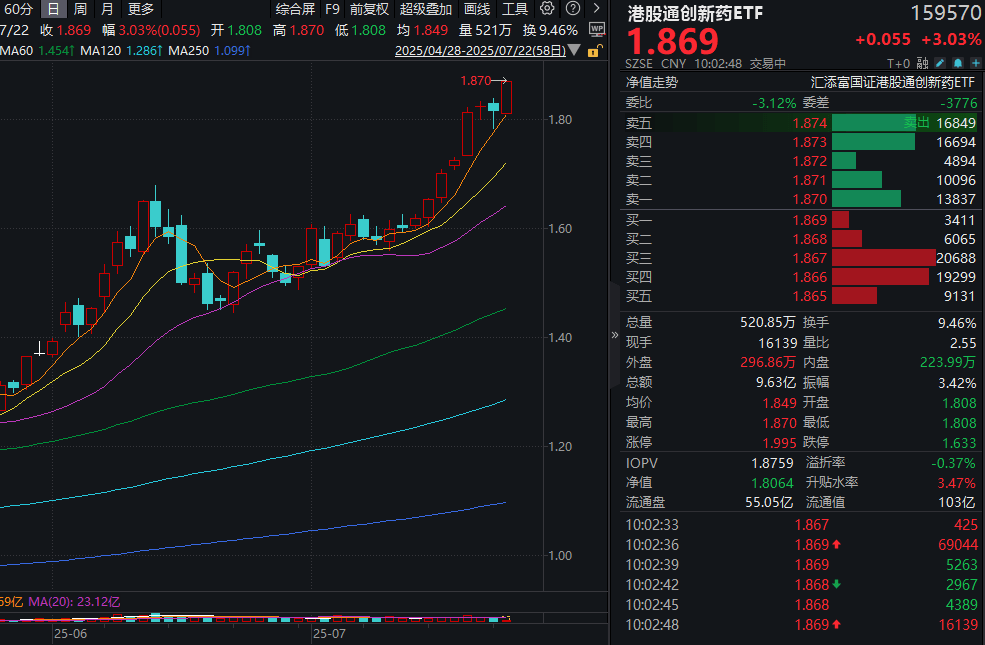
创新药再度大涨!纯度100%的港股通创新药ETF(159570)大涨超3%再创历史新高!
Sou Hu Cai Jing· 2025-07-22 02:26
Group 1 - The Hong Kong stock market showed a collective increase, with the Hong Kong Stock Connect Innovation Drug ETF (159570) rising over 3%, and its trading volume exceeding 1 billion yuan, with a net inflow of nearly 5 billion yuan in the last 60 days [1] - As of July 18, the latest scale of the Hong Kong Stock Connect Innovation Drug ETF (159570) surpassed 10 billion yuan, setting a new historical record, leading in scale and liquidity among its peers [1] - The underlying index of the Hong Kong Stock Connect Innovation Drug ETF (159570) is fully invested in the innovative drug industry chain, with the top ten holdings accounting for nearly 72% of the total weight [6] Group 2 - The innovative drug sector is supported by a robust medical insurance fund structure, with total income projected at 34,913.37 billion yuan and total expenditure at 29,764.03 billion yuan by the end of 2024 [3] - Recent procurement policies favor innovative drugs, indicating a positive shift towards supporting new drug development, which is expected to enhance market demand and patient accessibility [3] - The global market for autoimmune disease treatments is projected to reach 119.35 billion USD by 2027, highlighting the significant growth potential in this sector [5] Group 3 - The Hong Kong Stock Connect Innovation Drug ETF (159570) has shown a remarkable increase of 62.78% in the first half of 2025, outperforming other medical indices [7] - The ETF's underlying assets are primarily Hong Kong stocks, allowing for T+0 trading, which enhances liquidity and trading flexibility [7] - The index has demonstrated strong performance over the past five years, with varying annual returns, indicating its resilience and growth potential in the innovative drug sector [8]
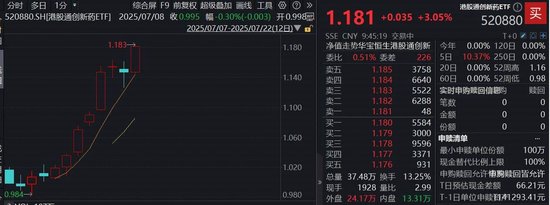
继续狂飙,港股通创新药ETF(520880)涨逾3%再攀新高,康方生物8连阳,机构:创新药价值重塑进行时
Xin Lang Ji Jin· 2025-07-22 02:15
7月22日,港股创新药再度走强,高纯度+高弹性标的港股通创新药ETF(520880)场内价格现涨逾 3%,再攀新高。 | 序号 | 代码 | 名称 | 两日图 | 现价 | 涨跌 | 涨跌幅 | | --- | --- | --- | --- | --- | --- | --- | | 1 | 1513 | 丽珠医药 | 1 | 40.500 | 4 200 | | | 2 | 3933 | 联邦制药 | | 16.640 | 1.220 | 7.91% | | 3 | 9688 | 更鼎医药 | | 29.200 | 1.850 | 6.76% | | 4 | 1548 | 金斯瑞生物科技 | | 17.440 | 1.020 | 6.21% | | 5 | 9969 | 诺诚健华 | Mr. | 19.020 | 0.840 | 4.62% | | 6 | 9926 | 康方生物 | While | 146.900 | 6.400 | 4.56% | | 7 | 2162 | 康诺亚-B | | 62.650 | 2.550 | 4 74% | | 8 | 6990 | 科伦博泰生物-E W | | 39 ...
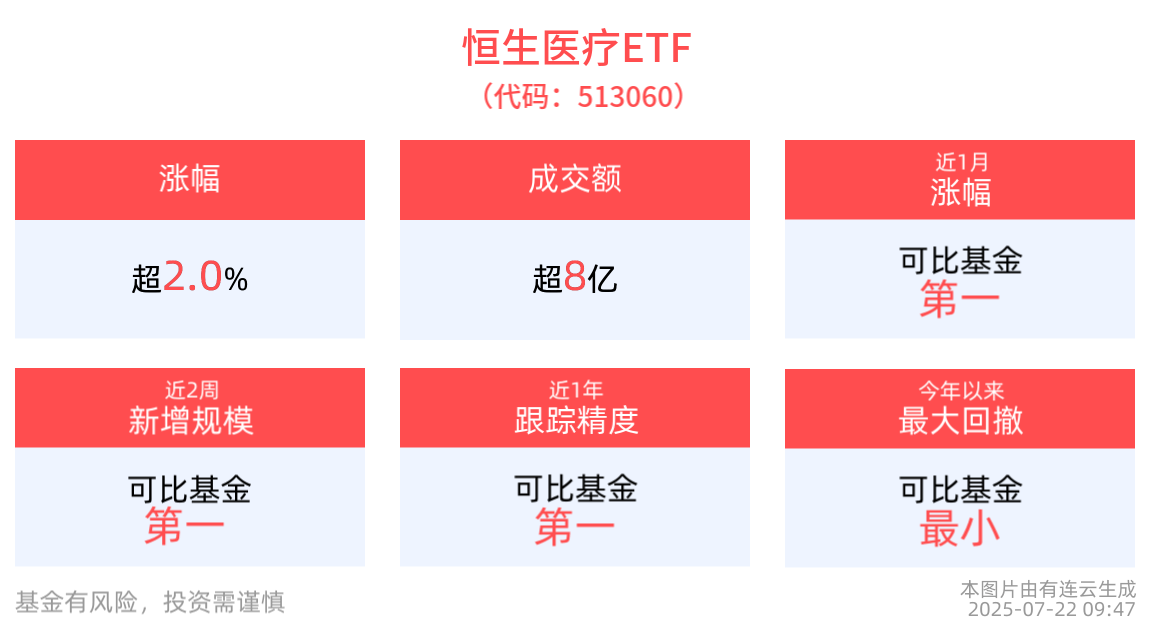
恒生医疗ETF(513060)拉升涨超2%,政策支持下,创新药企有望加速实现价值兑现
Sou Hu Cai Jing· 2025-07-22 02:06
Group 1 - The Hang Seng Healthcare Index (HSHCI) has shown a strong increase of 2.14%, with notable gains from stocks such as Livzon Pharmaceutical (up 11.57%) and United Laboratories (up 7.00) [3] - The Hang Seng Healthcare ETF (513060) has risen by 2.02%, with a recent price of 0.66 yuan, and has accumulated an 8.95% increase over the past week, ranking in the top third among comparable funds [3] - The trading activity of the Hang Seng Healthcare ETF is robust, with a turnover rate of 10.09% and a transaction volume of 840 million yuan, indicating active market participation [3] Group 2 - The 11th batch of national drug procurement has officially launched, involving 55 varieties, signaling a positive shift in procurement policies favoring innovative drugs [4] - The procurement policy emphasizes "no procurement for new drugs" and optimizes selection criteria, enhancing protection for innovative drugs and promoting a healthier market ecosystem for generic drugs [4] - The stable operation of the national medical insurance fund, projected to reach total revenue of 34,913.37 billion yuan by the end of 2024, supports the accessibility and market demand for innovative drugs [5] Group 3 - The Hang Seng Healthcare ETF has seen a significant growth in scale, increasing by 221 million yuan over the past two weeks, ranking in the top third among comparable funds [5] - The ETF's financing activities are notable, with a latest financing purchase amount of 160 million yuan and a financing balance of 231 million yuan [5] - The ETF has achieved a net value increase of 30.39% over the past two years, with a maximum monthly return of 28.34% since inception [5] Group 4 - The Hang Seng Healthcare ETF has a Sharpe ratio of 2.22 over the past year, indicating strong risk-adjusted returns [6] - The ETF has the lowest relative drawdown among comparable funds, with a drawdown of 0.52% year-to-date [6] - The ETF's management fee is 0.50%, and its tracking error is 0.060%, the highest tracking precision among comparable funds [6] Group 5 - The top ten weighted stocks in the Hang Seng Healthcare Index account for 60.73% of the index, including companies like BeiGene and WuXi Biologics [7]