华宝证券

Search documents
券商ETF业务5月份“战报”揭晓 华泰证券“人气”最旺
Zheng Quan Ri Bao· 2025-06-29 16:56
Group 1 - The core viewpoint of the article highlights the rapid growth and increasing popularity of ETFs (Exchange-Traded Funds) among investors due to their convenience, low fees, and stable investment styles [1] - Major securities firms are seizing the opportunities presented by the expanding ETF market, with leading firms like Huatai Securities dominating various segments of the ETF business [1][2] - As of the end of May, the total number of ETFs in the Shanghai market reached 691, with a total market value of 3 trillion yuan, while the Shenzhen market had 483 ETFs valued at 1.1 trillion yuan [2] Group 2 - In May, the top three securities firms by ETF trading volume on the Shanghai Stock Exchange were Huatai Securities, CITIC Securities, and Guotai Junan, with market shares of 11.3%, 9.35%, and 7.48% respectively [2] - By the end of May, China Galaxy Securities led in ETF holdings with a market share of 24.63%, followed by Shenwan Hongyuan Securities at 18.05% [3] - The trading account numbers for ETFs in May showed that Huatai Securities and East Money Securities each held over 10% of the market share in the Shanghai market [4] Group 3 - The ETF market has shown strong growth, with the total number of ETFs reaching 1,207 by June 29, a year-on-year increase of 24.05%, and total net assets growing by 73.03% to 4.28 trillion yuan [5] - Analysts predict that the Chinese ETF market is entering a historic expansion phase, with a focus on broad-based ETFs and thematic ETFs in sectors like technology and finance [5] - Securities firms are enhancing their ETF strategies to capture growth opportunities, with firms like China Merchants Securities focusing on the entire ETF value chain and Guohai Securities optimizing their product offerings [5][6]





开源证券终止IPO:营收增速下滑,债券承销业务被暂停6个月
Di Yi Cai Jing· 2025-06-29 11:14
Core Viewpoint - Kaiyuan Securities has become the second brokerage to terminate its IPO review after the implementation of the comprehensive registration system, leaving four brokerages still in the IPO queue [1][2]. Group 1: IPO Status - As of June 23-29, two companies, including Kaiyuan Securities, have terminated their IPO reviews, with four brokerages remaining in the queue [1]. - Before the comprehensive registration system, six brokerages were in the IPO queue, including Dongguan Securities and Kaiyuan Securities, with the latter applying for listing on the Shenzhen Stock Exchange [3]. - Following the implementation of the comprehensive registration system, four brokerages completed the transition, while two were accepted as new applications [3]. Group 2: Financial Performance - In 2024, Kaiyuan Securities reported operating revenue of 2.859 billion yuan, a year-on-year decline of 6.61%, while its net profit was 695 million yuan, an increase of 12.78% [5]. - The company faced a six-month suspension of its bond underwriting business due to regulatory penalties, which is expected to negatively impact its operating performance in 2024 and 2025 [5][6]. Group 3: Shareholding Structure - The controlling shareholder of Kaiyuan Securities is Shaanxi Coal and Chemical Industry Group, holding 58.80% of the shares, with the actual controller being the Shaanxi Provincial State-owned Assets Supervision and Administration Commission [3]. Group 4: Business Operations - Kaiyuan Securities has been recognized as a leader in the New Third Board business, maintaining a strong position in the industry with 723 companies under continuous supervision, accounting for 11.77% of the total listed companies [6]. - However, from 2021 to mid-2024, the company only completed 14 stock IPO projects, primarily on the Beijing Stock Exchange [6].
国家队增持,ETF格局生变
Huan Qiu Wang· 2025-06-27 08:47
Core Insights - The A-share ETF market is experiencing underlying changes despite a seemingly calm surface, with increased participation from state-owned funds and a competitive landscape among leading brokerages [1] Group 1: Market Participation - Galaxy Securities maintains the top position in the Shanghai ETF market with a 24.63% share, showing a slight increase of 0.06 percentage points, driven by state-owned funds increasing their holdings in major ETFs [2] - Shenwan Hongyuan Securities follows with an 18.05% share, up by 0.18 percentage points, but still trails Galaxy by 6.58 percentage points, solidifying a duopoly in the market [4] - The Shenzhen Stock Exchange shows a more balanced holding scale among various institutions, encouraging broader participation in the ETF ecosystem [4] Group 2: Trading Activity - Huatai Securities leads in trading activity with an 11.30% monthly share, significantly ahead of competitors, while CITIC Securities has surged to second place, outperforming the third by 1.87 percentage points [5] - Galaxy Securities saw a drop in monthly trading share to 5.71%, falling to fifth place, indicating limited adjustments by state-owned funds in May [5] - Shenwan Hongyuan, despite a strong holding position, continues to lag in trading activity, highlighting a mismatch between holdings and trading volume [5] Group 3: Emerging Trends - Smaller brokerages like Dongfang Securities and Huabao Securities are gaining traction in the ETF market, with respective monthly trading shares of 6.12% and 4.64%, ranking fourth and sixth [6] - There is a renewed interest in Hong Kong ETFs, with the return of Hongyu Information Services to the top 30 in trading volume, reflecting a resurgence in investment enthusiasm [6] Group 4: Client Engagement - The trading landscape at the brokerage level is dynamic, with notable shifts in trading volume among various branches, indicating concentrated state fund activity [7] - Huatai Securities and Dongfang Wealth continue to dominate in terms of active trading accounts, with Huatai's app enhancing its appeal to individual investors [7] - The personal client trading accounts on the Shenzhen Stock Exchange are primarily led by Dongfang Wealth, showcasing its strong retail presence [7]

多方面布局 券商角逐ETF新赛道
Shang Hai Zheng Quan Bao· 2025-06-25 18:46
Core Viewpoint - The development of ETF-related businesses is a crucial part of the transformation of brokerage wealth management, with leading brokerages dominating the market while some smaller firms achieve "leapfrog" success through differentiation [1][2]. Group 1: Market Overview - As of May 2025, there are 691 ETFs in the Shanghai market with a total market value of 30,018.81 billion, reflecting a growth of 1.33% [1]. - In May, the cumulative trading amount of ETFs in the Shanghai market reached 30,097.61 billion, with an average daily trading amount of 1,584.08 billion [1]. Group 2: Brokerage Performance - China Galaxy Securities leads the market with an ETF holding share of 24.63%, followed by Shenwan Hongyuan Securities at 18.05%, and CITIC Securities and China Merchants Securities in third and fourth places respectively [2]. - In terms of trading volume, Huatai Securities holds the top position with a trading volume share of 10.93% in May, while CITIC Securities ranks second with 9.35% [2]. Group 3: Competitive Landscape - The competition among brokerage firms is intense, with some smaller brokerages showing strong performance in ETF trading, such as Huabao Securities, which ranked first in May with a trading volume share of 3.59% [2][3]. - The "Matthew Effect" is evident in the ETF market, where leading brokerages leverage their brand influence, extensive client base, and professional research capabilities to maintain dominance [3]. Group 4: ETF Market Growth - The total net asset value of ETFs in the market reached 4.20 trillion as of June 24, reflecting a growth of 12.60% since the beginning of the year [3]. - Brokerages are enhancing their mobile apps to include ETF sections and tools, such as grid trading and ETF regular investment, to improve online service experiences [3][4]. Group 5: Educational Initiatives - Brokerages are actively conducting ETF educational activities to help clients understand and experience ETF investments, promoting rational, value, and long-term investment concepts [4]. Group 6: Business Collaboration - The development of ETFs is seen as a way to enhance market variety, improve portfolio efficiency, reduce investment costs, and increase liquidity [6]. - Brokerages are focusing on building a comprehensive service system around ETFs, emphasizing collaboration in research, distribution, and custody services [6].
ETF及指数产品网格策略周报(2025/6/24)
华宝财富魔方· 2025-06-24 09:32
Core Viewpoint - The article discusses the performance and strategies of ETF and index products, emphasizing the importance of grid strategies in the current market environment [4]. Summary by Sections - **ETF and Index Products Performance** - The report highlights the recent trends in ETF and index products, noting significant growth in assets under management and trading volumes [4]. - **Market Analysis** - A detailed analysis of market conditions is provided, indicating that the volatility in the market has led to increased interest in grid trading strategies [4]. - **Investment Strategies** - The article outlines various grid strategies that can be employed by investors to capitalize on market fluctuations, suggesting that these strategies can enhance returns while managing risks [4].

《生态跃迁》摘录 | 标品信托规模大幅增长,还能延续吗?
华宝财富魔方· 2025-06-12 11:30
Core Viewpoint - The significant increase in the scale of standard trust products is driven by both the accelerated transformation of the industry and the flexibility advantages of standard trust products, alongside the performance of the bond market [1][2]. Group 1: Scale Growth Driven by "Borrowing Path" - The growth in scale due to the "borrowing path" has lost its momentum as regulatory measures have been implemented to eliminate institutional arbitrage and fill regulatory gaps [2][3]. - The lack of specific regulatory guidelines for standard trust products allows for greater operational flexibility compared to public funds and bank wealth management products, attracting significant capital inflows, particularly from low-risk preference bank wealth management funds [2][3]. - The collaboration between bank wealth management and trust companies has led to a win-win situation, where bank products achieve stable net values while trust companies earn channel fees and increase their scale [2][3]. Group 2: Risks Associated with "Borrowing Path" - The "borrowing path" presents significant risks that are accumulating rapidly, prompting regulatory scrutiny [3][4]. - Issues such as inappropriate use of smoothing mechanisms and trading risk assets between different wealth management products can lead to mismatched risks and potential losses for investors [4][5]. - Regulatory interventions aim to address these risks, ensuring compliance and protecting investors from unfair practices [6][9]. Group 3: Scale Growth Driven by Strong Performance - The increase in the scale of standard trust products is also attributed to the accelerated transformation of trust companies towards standard trust products and the favorable bond market conditions in 2024 [13][14]. - Trust companies are leveraging their experience in the municipal investment sector to enhance their bond investment strategies, leading to higher-than-average returns in their standard trust products [14][15]. - The current low-risk yield environment and the preference for low-volatility bonds have further contributed to the influx of capital into standard trust products, achieving historical highs in industry scale [15]. Group 4: Regulatory Landscape and Future Outlook - Regulatory measures are focused on eliminating institutional arbitrage and ensuring fair competition among asset management institutions, which is essential for guiding them back to their investment roots [10][11]. - The future challenges for trust companies include finding new business opportunities in a declining yield environment and enhancing their active investment management capabilities [15][16]. - The ongoing regulatory efforts aim to protect investors and promote a better understanding of risk-return characteristics in fixed-income products, fostering a mature capital market [10][11].

稀土股持续走强,稀土ETF基金、稀土ETF、稀土ETF易方达年内涨超15%
Ge Long Hui A P P· 2025-06-11 04:53
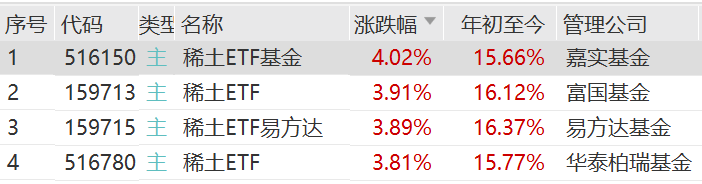
Group 1 - A-shares and Hong Kong stocks are experiencing a collective rise, with rare earth permanent magnets leading the gains [1] - China Rare Earth (0769.HK) has surged over 12%, marking a cumulative increase of 109% over three consecutive days [1] - The rare earth ETF funds have seen significant growth, with the top-performing fund rising 4.02%, leading the market [1][2] Group 2 - The rare earth ETF fund has a current scale of 2.136 billion, ranking first among similar funds [2][3] - The price of rare earth materials is expected to rise due to export control measures and increased demand from overseas companies [3][4] - China holds a dominant position in the global rare earth market, with 40% of global reserves and 70% of global production [4] Group 3 - The export volume of rare earth permanent magnets has significantly decreased, reaching a historical low, which is expected to lead to increased demand in the coming quarters [5] - The tightening of export quotas may lead to a reduction in smelting and separation capacity, benefiting downstream demand in the short to medium term [5]
浮动费率基金密集自购 累计金额已达7000万元
2 1 Shi Ji Jing Ji Bao Dao· 2025-06-09 02:35
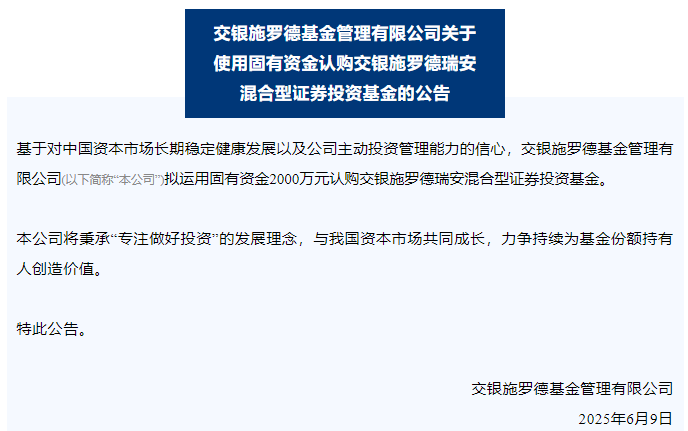
Core Viewpoint - Several fund companies in China are purchasing their own newly launched floating rate funds, indicating confidence in the long-term stability and health of the capital market and their investment management capabilities [1][3][4]. Group 1: Fund Companies' Self-Purchases - On June 9, China International Fund announced a plan to invest 20 million yuan in its newly launched floating rate fund, "China International Fund Rui'an Mixed Securities Investment Fund" [1]. - Other leading public fund institutions, including China Europe Fund, Bosera Fund, and Orient Securities Asset Management, have also announced self-purchases, with a cumulative investment amount reaching 70 million yuan [3]. - Manulife Fund announced on June 7 that it would invest 10 million yuan in its "Manulife Smart Navigation Mixed Securities Investment Fund" [3]. - On June 3, Xingzheng Global Fund stated it would invest 20 million yuan in its "Xingzheng Global Heqi Mixed Securities Investment Fund" [3]. - China Europe Fund committed 10 million yuan to its floating rate fund, "China Europe Large Cap Smart Selection Mixed Initiated Fund," with a holding period of no less than three years [3]. - Bosera Fund announced investments of 10 million yuan each in two of its equity funds on May 28, one of which is a floating rate fund [3]. - Orient Securities Asset Management stated it would invest 10 million yuan in its "Orient Red Core Value Mixed Fund" [3]. - Tianhong Fund also announced a 10 million yuan investment in its floating rate fund, "Tianhong Quality Value Mixed Fund" [4]. Group 2: Purpose and Industry Trends - The introduction of floating rate products aims to alleviate the issue where funds do not generate profits for investors while fund companies do, and to promote high-quality development within the fund industry [4]. - Industry insiders view the recent reforms in public fund fees, particularly the launch of floating rate products, as a significant exploration and attempt to drive further high-quality development in the industry [5]. - According to CITIC Securities, the weighted management fee rates of various fund products have significantly decreased compared to the end of 2022, indicating a successful fee reduction trend [5]. - The fund industry in China still has considerable room for further fee reductions compared to overseas markets, suggesting that the practice of fee reform and product innovation is ongoing [5]. - Future developments in floating rate funds may extend to bond funds, with fixed income + products being prioritized [5]. - Huabao Securities noted that the asymmetric fee structure of new floating rate products will enhance the importance of performance benchmarks, which may influence investors' decisions [5].
机构论后市丨预计指数整体维持震荡;关注银行等偏防守板块
Di Yi Cai Jing· 2025-06-08 09:58
Group 1 - The liquidity of the Hong Kong stock market continues to improve, presenting good opportunities for increasing positions during market fluctuations [1] - A-shares have shown strong performance, with the median increase in A-shares being the highest since 2022, particularly favoring smaller market capitalization stocks [2] - Consumer sectors are expected to remain a key driver of economic recovery, with domestic policies focusing on expanding domestic demand [3] Group 2 - Investment strategies should focus on traditional capacity reduction, the rise of new consumption, and sectors with high industry prosperity [2] - Defensive sectors such as banking are recommended for short-term stability, given the uncertain environment surrounding tariff negotiations [4] - The overall market index is expected to maintain a volatile trend, with external risks having potentially peaked [3]


券商T0算法是“技术平权”还是噱头?有人年化收益140%,有人一天亏4万
Sou Hu Cai Jing· 2025-06-05 01:44
Group 1 - The core viewpoint of the article is that quantitative trading is increasingly accessible to retail investors, with over 20 brokerage firms launching T0 algorithm services this year [3][5][9] - T0 trading allows investors to execute intraday trades using pre-set rules, aiming to reduce holding costs or enhance returns by capitalizing on daily stock price fluctuations [3][5][9] - The annualized return for personal investors using T0 algorithm services is reported to be around 8%, but actual returns can vary significantly based on individual stock holdings [3][11] Group 2 - Major brokerage firms like Zhongtai Securities and CMB Securities have introduced T0 algorithm services through their apps, indicating a trend towards automated trading solutions [4][5] - The T0 algorithm trading service typically incurs higher commissions than standard trading due to the costs associated with algorithm providers [5][6][7] - Different brokerages have varying thresholds for accessing T0 services, with some requiring a minimum asset level of 1 million yuan or higher [8] Group 3 - According to research from Huabao Securities, T0 strategy indices have consistently outperformed market-neutral strategy indices since 2018, with lower maximum drawdowns [9] - High liquidity and volatility stocks are deemed more suitable for T0 algorithm services, while low liquidity or small-cap stocks may not perform well [11] - Some investors have reported significant losses when using T0 services, highlighting the risks associated with automated trading strategies [12][13]