
国泰基金

Search documents
黄金类ETF领跌!资金火速进出
Sou Hu Cai Jing· 2026-02-05 13:26
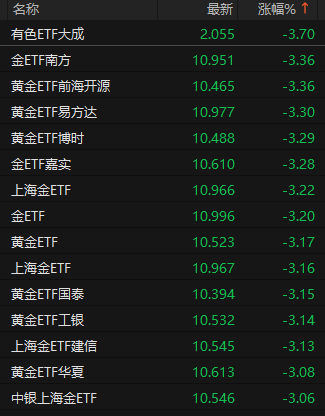
Core Viewpoint - The recent significant fluctuations in gold prices have led to a sharp decline in gold ETFs, with many products experiencing drops exceeding 3% as of February 5 [2][3]. Group 1: Market Performance - On January 30, COMEX gold futures fell sharply by 8.35%, followed by a further decline of 1.35% on February 2, before rebounding with a cumulative increase of over 6% in the subsequent two days [3]. - As of February 5, gold ETFs were among the worst performers in the ETF market, with several products, including the Yongying and Huaxia gold ETFs, seeing declines of over 5% [3][4]. Group 2: Causes of Fluctuation - The primary reason for the recent drop in gold prices is attributed to market concerns regarding the hawkish stance of the new Federal Reserve chair, leading to a rapid outflow of previously invested funds [4]. - The market had previously experienced a significant surge in gold prices, resulting in a concentrated long position among investors, which created a situation of "overbought" conditions as indicated by technical indicators [4]. - The increase in margin requirements for gold futures by CME has further pressured short-term leveraged funds, making the market highly sensitive to negative news, which triggered large-scale long position liquidations [4]. Group 3: Investment Strategies - Despite the volatility, some professional institutions are focusing on the long-term value of gold and are willing to enter the market during downturns, disregarding short-term fluctuations [7]. - For instance, the "Jiaoyin Multi-Asset Preferred" fund increased its holdings in gold ETFs on February 3, indicating a strategy to capitalize on relatively certain investment opportunities [7]. - Industry experts suggest that different types of investors should adopt differentiated strategies in response to the short-term volatility and the long-term positive outlook for gold [7][8].

“熊出没”板块,利好来了!
Xin Lang Cai Jing· 2026-02-05 05:09
Core Viewpoint - The Hang Seng Technology Index has seen significant net inflows, totaling over 6.9 billion yuan in the last five days, despite a nearly 20% decline since the fourth quarter of last year [1][10]. Market Overview - On February 4, the A-share market experienced a rally, with the Shanghai Composite Index returning to 4,100 points and the ChiNext Index rebounding from a low [1]. - The overall stock ETF market showed mixed results, with a net outflow of approximately 1.6 billion yuan, while the Hang Seng Technology Index stood out with substantial inflows [1][3]. Fund Inflows - The Hang Seng Technology Index saw a net inflow of 2.884 billion yuan on February 4, leading the stock ETF market [3][12]. - Over the past five days, the total net inflow into the Hang Seng Technology Index exceeded 6.9 billion yuan, marking it as the top destination for fund inflows [3][12]. - The Hang Seng Technology Index ETF recorded a net inflow of over 1.021 billion yuan, making it the highest in the market [4][16]. Fund Performance - Major fund companies like E Fund and Huaxia Fund reported significant inflows into their ETFs, with E Fund's total ETF scale reaching 655.65 billion yuan, increasing by 3.3 billion yuan on the same day [5][15]. - The Hang Seng Technology Index ETF and the Hang Seng Internet ETF from Huaxia Fund led the inflows, with net inflows of 1.021 billion yuan and 957 million yuan, respectively [16]. Outflows from Other Indices - The CSI 300 Index experienced a net outflow of approximately 3.912 billion yuan, with the CSI 300 ETF from Huatai and other products also seeing significant outflows [7][17]. - The overall net outflow from broad-based ETFs reached 9.272 billion yuan, indicating a trend of capital moving away from these indices [7][17]. Market Sentiment and Future Outlook - Analysts from Bosera Fund expressed optimism about the A-share market, suggesting that the recent outflows from ETFs may have reached a turning point, with potential for growth in financing balances [20]. - Guotai Fund noted that external market pressures, such as the nomination of a new Federal Reserve chair, could impact market dynamics, but liquidity in the A-share market remains strong [20].

红墙股份股价跌5.06%,国泰基金旗下1只基金位居十大流通股东,持有45.35万股浮亏损失33.56万元
Xin Lang Cai Jing· 2026-02-05 02:50
Group 1 - The core point of the news is that Hongqiang Co., Ltd. experienced a stock decline of 5.06%, with a current share price of 13.88 yuan, a trading volume of 276 million yuan, a turnover rate of 13.74%, and a total market capitalization of 2.937 billion yuan [1] - Hongqiang Co., Ltd. is located in Huizhou, Guangdong Province, and was established on March 31, 2005. The company was listed on August 23, 2016, and its main business involves the research, production, sales, and technical services of various concrete additives [1] - The revenue composition of Hongqiang Co., Ltd. includes 87.80% from polycarboxylate-based additives, 9.03% from fine chemical business, 1.74% from naphthalene-based additives, 1.36% from other additives, and 0.07% from other sources [1] Group 2 - From the perspective of the top ten circulating shareholders, Guotai Fund has one fund among the top shareholders of Hongqiang Co., Ltd. The Guotai CSI All-Share Construction Materials ETF (159745) entered the top ten circulating shareholders in the third quarter, holding 453,500 shares, which accounts for 0.33% of the circulating shares [2] - The Guotai CSI All-Share Construction Materials ETF (159745) was established on June 9, 2021, with a latest scale of 610 million yuan. Year-to-date, it has a return of 14.65%, ranking 256 out of 5566 in its category; over the past year, it has a return of 29.87%, ranking 2466 out of 4285; since inception, it has a loss of 25.44% [2] - The fund manager of the Guotai CSI All-Share Construction Materials ETF (159745) is Huang Yue, who has a cumulative tenure of 5 years and 2 days. The total asset scale under management is 49.496 billion yuan, with the best fund return during the tenure being 51.32% and the worst being -58.97% [3]

锡业股份股价跌5.02%,国泰基金旗下1只基金重仓,持有185.07万股浮亏损失342.38万元
Xin Lang Cai Jing· 2026-02-05 02:38
Group 1 - Yunnan Tin Company Limited experienced a decline of 5.02% on February 5, with a stock price of 35.03 CNY per share and a trading volume of 989 million CNY, resulting in a turnover rate of 1.67% and a total market capitalization of 57.652 billion CNY [1] - The company's main business involves the exploration, mining, beneficiation, and smelting of metals such as tin, zinc, copper, and indium, with the revenue composition being 43.61% from tin ingots, 20.31% from supply chain business, and 18.04% from copper products [1] - The supply chain business includes 12.77% from copper products, 7.90% from other products, and 5.57% from tin products, with additional contributions from zinc products (7.08%), tin materials (2.74%), and other products (1.96%) [1] Group 2 - Guotai Fund has one fund heavily invested in Yunnan Tin Company, specifically the Guotai Jinlong Industry Select Mixed Fund (020003), which held 1.8507 million shares in the fourth quarter, accounting for 6.01% of the fund's net value, making it the third-largest holding [2] - The fund has reported a floating loss of approximately 3.4238 million CNY as of the latest data [2] - The Guotai Jinlong Industry Select Mixed Fund was established on December 5, 2003, with a current size of 858 million CNY, achieving a year-to-date return of 10.81% and a one-year return of 40.63% [2]

四川黄金股价跌5.52%,国泰基金旗下1只基金重仓,持有1000股浮亏损失2820元
Xin Lang Cai Jing· 2026-02-05 01:57
Group 1 - Sichuan Gold's stock price dropped by 5.52% to 48.23 CNY per share, with a total market capitalization of 20.257 billion CNY, and has seen a cumulative decline of 30.57% over the last four days [1] - The company, established on August 16, 2006, primarily engages in the mining and sales of gold, with its main product being gold concentrate, accounting for 100% of its main business revenue [1] Group 2 - Guotai Fund has one fund heavily invested in Sichuan Gold, specifically the Guotai Preferred Navigation One-Year Holding Period Mixed Fund (FOF) (013279), which holds 1,000 shares, representing 0.03% of the fund's net value [2] - The fund has incurred a floating loss of approximately 2,820 CNY today, with a total floating loss of 22,500 CNY during the four-day decline [2] - The fund was established on January 5, 2022, and has achieved a year-to-date return of 19.35%, ranking 5th out of 1,320 in its category [2] Group 3 - The fund manager, Zeng Hui, has a tenure of 2 years and 89 days, with the fund's total asset size at 10.489 billion CNY and a best return of 119.23% during his tenure [3] - Co-manager Liu Jianqi has been in position for 87 days, managing assets of 147 million CNY, with a best return of 16.92% during his tenure [3]
地缘政治风险升温+技术性超跌回补,关注黄金ETF国泰(518800)
Sou Hu Cai Jing· 2026-02-05 01:20
2月4日黄金ETF国泰(518800)大涨4.24%。国际现货黄金目前坚守在5000美元大关上方。金银在连续 两个交易日大幅下跌后强劲反弹,现货黄金开盘后迅速上涨,重回5000美元大关上方,现货白银重回90 美元上方。贵金属价格在抛压集中释放后集体反弹,黄金隐含波动率在前期飙升并回调后,再次出现拐 头向上迹象。 地缘政治风险的急剧升温和技术性超跌后的回补,共同驱动资金回流贵金属市场。 市场正高度关注美联储未来的政策走向,特朗普提名的美联储主席人选凯文·沃什虽因过去的鹰派立场 闻名,但市场预期他在政治压力下也可能转向支持降息。目前政策预期仍然模糊,也为黄金提供了一定 的间接支撑。 受政府部分停摆影响,包括1月非农就业报告在内的核心数据推迟发布,将导致市场在劳动力市场状况 和通胀走势上失去了明确指引。市场目前正转向今晚公布的ADP就业数据,该数据可能率先为市场提供 美国就业市场的最新线索。 风险提示: 投资人应当充分了解基金定期定额投资和零存整取等储蓄方式的区别。定期定额投资是引导投资人进行 长期投资、平均投资成本的一种简单易行的投资方式。但是定期定额投资并不能规避基金投资所固有的 风险,不能保证投资人获得收益, ...
机构称 14万亿存款或将搬家
2 1 Shi Ji Jing Ji Bao Dao· 2026-02-05 00:55
Core Viewpoint - The upcoming maturity of a significant amount of deposits in China, estimated at 55 to 60 trillion yuan by 2026, will create a historical peak in the banking system, leading to a potential reallocation of funds and a "re-pricing" wave in deposits [2][14]. Group 1: Deposit Rates and Trends - Major banks are offering low interest rates on large time deposits, with rates around 1.4% to 1.55%, a stark contrast to rates above 5% prior to 2021 [1][13]. - The deposit renewal rate has been approximately 90% in recent years, but a decline to 80% could result in a potential outflow of around 14 trillion yuan, while maintaining the current rate could lead to about 7 trillion yuan [3][15]. Group 2: Impact of Market Conditions - The surge in household savings, exceeding 17 trillion yuan annually during 2022-2023, was driven by market volatility, leading to a significant accumulation of "excess savings" locked in long-term deposits [2][14]. - The reallocation pressure from these long-term deposits will peak in 2026, coinciding with a changing interest rate environment [2][14]. Group 3: Fund Allocation Predictions - It is anticipated that over 90% of maturing deposits will remain in the banking system as new time deposits, but an estimated 2 to 4 trillion yuan may flow into wealth management products and public funds, with 300 to 600 billion yuan expected to enter public funds [3][15]. - The shift in funds is expected to primarily favor low-risk assets, reflecting a cautious approach from residents towards higher-risk investments [5][17]. Group 4: Public Fund Strategies - Public funds are likely to attract maturing deposits through conservative products, particularly money market funds and short-term pure bond funds, which offer liquidity similar to demand deposits [6][18]. - The total scale of public funds is projected to reach 37.71 trillion yuan by the end of 2025, with money market funds comprising a significant portion [6][18]. Group 5: Misconceptions about Deposit Movements - There is a misconception that maturing deposits will lead to significant outflows into the capital market; however, most funds are expected to remain within the banking system for marginal optimization [11][23]. - The release of large deposits does not necessarily correlate with increased consumer spending, as a cautious mindset persists among residents [11][23].



机构称14万亿存款或将搬家
Xin Lang Cai Jing· 2026-02-05 00:55
Core Viewpoint - The upcoming maturity of a significant amount of deposits in China, estimated at 55 trillion to 60 trillion yuan by 2026, will lead to a major reconfiguration of the banking system and investment landscape, with implications for asset management and financial products [3][16]. Group 1: Deposit Maturity and Market Impact - By 2026, approximately 55 trillion to 60 trillion yuan in deposits will reach maturity, marking a historic peak for the banking system [3][16]. - The surge in household deposits, exceeding 17 trillion yuan annually since 2022, has created about 8 trillion yuan in excess savings, primarily locked in one to three-year term deposits [3][16]. - The reconfiguration pressure from these maturing deposits will intensify as they face a different interest rate environment compared to when they were deposited [3][16]. Group 2: Deposit Reallocation Predictions - If the deposit renewal rate drops to 80%, around 14 trillion yuan may be reallocated, while maintaining a 90% renewal rate would result in about 7 trillion yuan being reallocated [2][15]. - It is anticipated that over 90% of maturing deposits will remain in the banking system as new term deposits, with an estimated 2 trillion to 4 trillion yuan potentially flowing into wealth management products and public funds [4][17]. Group 3: Asset Management Industry Response - The asset management industry is expected to see a structural optimization rather than a massive influx of new capital, as the reallocation primarily targets low-risk assets similar to deposits [6][19]. - Public funds are likely to attract the incoming capital, particularly through conservative risk products such as money market funds and short-term pure bond funds, which are favored for their liquidity and expected returns [20][21]. - Fund companies are focusing on safety and have established mechanisms to manage risk and returns effectively, with a range of products tailored to different risk appetites [21][23]. Group 4: Misconceptions About Deposit Migration - There is a misconception that maturing deposits will lead to significant capital outflows into the market; however, much of the capital will remain within the banking system for marginal optimization [12][25]. - The release of large deposits does not necessarily correlate with a surge in consumer spending, as a cautious mindset persists among residents [12][25]. - Historical data indicates no direct relationship between the maturity of deposits and stock market performance, suggesting that the impact on equity markets may be limited [12][25].
机构称14万亿存款或将搬家
21世纪经济报道· 2026-02-05 00:50
Core Viewpoint - The article discusses the impending maturity of a significant amount of deposits in China, estimated to be between 55 trillion to 60 trillion yuan by 2026, which will lead to a reallocation of funds within the banking system and potentially impact various financial products [3][4]. Group 1: Deposit Rates and Trends - Major banks are offering low interest rates on large deposits, with rates around 1.4% to 1.55%, a stark contrast to rates above 5% seen in 2021 [1][2]. - The shift to lower interest rates has led to a psychological erosion among savers, prompting a significant influx of funds back into fixed-term deposits as a safe haven amid market volatility [1][3]. Group 2: Future Implications of Deposit Maturity - By 2026, a large volume of deposits will mature, creating a potential "repricing" and "reallocation" wave in the banking sector, with estimates suggesting that if the renewal rate drops to 80%, around 14 trillion yuan could be at risk of moving out of banks [3][4]. - The People's Bank of China has indicated that the upcoming maturity of long-term deposits will occur in a very different interest rate environment compared to when they were initially deposited [3][4]. Group 3: Fund Reallocation and Market Impact - It is anticipated that over 90% of maturing deposits will remain within the banking system, but an estimated 2 trillion to 4 trillion yuan may flow into wealth management products and public funds, with public funds expected to attract 300 billion to 600 billion yuan [5][4]. - The reallocation of funds is expected to be more of a structural optimization rather than a massive outflow into higher-risk assets, as residents' risk preferences will dictate their investment choices [7][4]. Group 4: Public Fund Strategies - Public funds that are likely to attract the reallocated deposits include money market funds and short-term pure bond funds, which offer liquidity similar to demand deposits and typically yield better returns than one-year fixed deposits [9][4]. - The "fixed income plus" fund products are being tailored to meet varying risk appetites, with a focus on maintaining low volatility and predictable returns [10][11]. Group 5: Misconceptions About Deposit Movements - There are misconceptions regarding the relationship between maturing deposits and "funds moving out" or entering the capital market, as much of the maturing funds will remain within the banking system for marginal optimization [15][4]. - The release of large deposits does not necessarily correlate with increased consumer spending or stock market performance, as historical data shows no significant relationship between the two [15][4].

热门板块进入高波区间 场外产品跟踪指数“受阻”
Zhong Guo Zheng Quan Bao· 2026-02-04 20:29
Core Insights - The A-share commercial aerospace and non-ferrous metals sectors have entered a phase of wide fluctuations, with related index funds experiencing significant tracking errors and volatility [1][3] - Fund managers have taken measures to suspend large subscriptions over 1 million yuan for certain thematic index funds due to the challenges posed by rapid market movements [4][7] Fund Performance and Flows - In January, the Southern CSI Shenwan Non-ferrous Metals ETF saw net inflows exceeding 18 billion yuan, with several other thematic ETFs attracting over 10 billion yuan each [2] - By the end of January, multiple thematic ETFs, including the Southern CSI Non-ferrous Metals ETF and the Guotai CSI Semiconductor Materials and Equipment ETF, surpassed 20 billion yuan in scale [2] Market Volatility and Management Challenges - The recent volatility in popular sectors has led to significant fluctuations in fund net values, with some satellite-themed index funds rising over 8% on January 23, only to drop over 7% by January 26 [3] - Tracking errors for certain index funds have increased, with some exceeding 1% in January, compared to less than 0.5% in the previous month [3][4] Operational Strategies - Fund managers are advised to implement refined operations and disciplined execution to manage tracking errors effectively, especially during periods of high volatility [5][6] - Strategies include phased investments, algorithmic trading, and prioritizing high liquidity core assets to mitigate impact costs [6] Recommendations for Fund Management - It is suggested to adopt a "core + satellite" sampling replication method to ensure high liquidity and weight in core assets while adjusting cash reserves dynamically based on market conditions [6] - Establishing a multi-dimensional prevention and response mechanism is crucial for managing fund flows and tracking accuracy [6]