
南京银行

Search documents
南京银行杭州分行落地首笔本外币一体化账户业务
Ren Min Wang· 2025-09-06 13:37
Group 1 - The core viewpoint of the news is the successful launch of the integrated foreign currency account by Nanjing Bank Hangzhou Branch, which meets the multi-currency settlement needs of a technology company in Zhejiang [1][2] - The technology company, established in 2015 with a registered capital of 10 million yuan, primarily provides cloud services to overseas clients and has a high demand for multi-currency settlements [1] - The integrated foreign currency account simplifies the account opening process, significantly improves operational efficiency, and supports multi-currency settlements, providing a more efficient solution for cross-border capital flow [1][2] Group 2 - The integrated foreign currency account is an important innovation promoted by the People's Bank of China to enhance cross-border financial management [2] - As one of the first pilot institutions in Zhejiang Province, Nanjing Bank Hangzhou Branch aims to support more small and micro enterprises in expanding their international markets [2] - This business model reduces financial costs and operational difficulties for enterprises by managing multiple currencies through a single account, aligning with the bank's commitment to serve the real economy with professionalism and efficiency [2]

2100亿规模鑫元基金副总“降职”,南京银行系高管全面接管
Guan Cha Zhe Wang· 2025-09-05 12:06
Core Viewpoint - Recent personnel changes at Xinyuan Fund Management Co., Ltd., which manages over 210 billion yuan, have raised market concerns, particularly the adjustment of veteran executive Wang Hui from Deputy General Manager to Senior Specialist due to "work arrangements" [1][2]. Group 1: Personnel Changes - Wang Hui, who has been with Xinyuan Fund since its inception in August 2013 and served as Deputy General Manager for over nine years, has been reassigned to a less influential role [2][3]. - The adjustment is notable as it reflects the increasing control of the major shareholder, Nanjing Bank, over Xinyuan Fund, with a significant presence of Nanjing Bank personnel in the executive team [3]. Group 2: Financial Performance - Xinyuan Fund reported a revenue of 356 million yuan for the first half of 2025, marking a year-on-year increase of 17.49%, and a net profit of 107 million yuan, up 15.03% [2]. - As of the end of the first half of 2025, the fund's management scale reached 211.78 billion yuan [2]. Group 3: Business Structure Challenges - The fund's business structure is heavily reliant on fixed-income products, with bond and money market funds accounting for 98% of the total scale, while mixed and equity funds only represent less than 1.5% [4]. - Despite strong performance in a bond bull market, the fund's one-year and two-year returns of 2.58% and 5.49% are below the industry averages of 15.69% and 9.53%, respectively [4]. Group 4: Efforts in Equity Investment - To address the structural issues, Xinyuan Fund has been actively expanding its equity investment capabilities, launching nine new funds in the past year, five of which are index equity funds [5]. - The fund has promoted four new equity fund managers, all of whom were internally trained [5]. Group 5: Future Outlook - The performance of the newly appointed management team from Nanjing Bank in breaking the fund's reliance on fixed-income products and successfully developing equity business will be a key indicator of the effectiveness of the recent personnel changes [6]. - The case of Xinyuan Fund illustrates the broader challenges faced by bank-affiliated fund companies in transitioning their business models amid regulatory encouragement for equity fund development [6].
南京银行(601009):2025年中报点评:单季度业绩增速上双,成本可持续下行
Changjiang Securities· 2025-09-05 10:43
Investment Rating - The investment rating for the company is "Buy" and is maintained [9]. Core Views - The company's mid-year performance in 2025 continues to show a double U-shaped high-quality development, with a year-on-year revenue growth of 8.6% and a net profit growth of 8.8% in the first half of the year. The second quarter saw revenue and net profit growth both exceeding 10% [2][6]. - Total assets and loan growth have improved compared to the same period last year, with loans increasing by 10.4%, driven by a significant 12.7% growth in corporate loans. The net interest margin stands at 1.86%, down 8 basis points from the full year of 2024, with an accelerating improvement in funding costs expected to stabilize the margin [2][6]. - Asset quality remains robust, with a non-performing loan ratio of 0.84% at the end of the first half, and a provision coverage ratio of 312%, indicating a strong absolute level [2][6]. - The company's current price-to-book (PB) ratio is 0.76x, with an expected dividend yield of 4.8%, highlighting its attractive valuation [2][6]. Summary by Sections Financial Performance - In the first half of 2025, the company's revenue grew by 8.6% year-on-year, with Q1 growth at 6.5% and Q2 at 10.8%. Net profit increased by 8.8%, with Q1 at 7.1% and Q2 at 10.6% [6]. - The net interest income growth was 22.1%, with significant contributions from strong credit expansion in Q2. Non-interest income saw a decline of 4.3% [13]. - The cost-to-income ratio improved, decreasing by 0.6 percentage points to 25.1% [13]. Loan and Deposit Growth - Total assets increased by 12.0% compared to the beginning of the year, with loans growing by 10.4%. Corporate loans saw a notable increase of 12.7% [13]. - Retail loans grew by 3.7%, with housing loans increasing by 8.6% due to a recovery in the Nanjing real estate market [13]. Interest Margin and Cost - The net interest margin is reported at 1.86%, with a projected stabilization due to improving funding costs. The loan yield has decreased by 24 basis points to 4.56% [13]. - The cost of deposits has decreased by 23 basis points to 2.11%, contributing to the overall improvement in the interest margin [13]. Asset Quality - The non-performing loan generation rate has decreased, reflecting an increase in low-risk loans. The corporate loan non-performing rate is at 0.65%, while retail loans are at 1.43% [13]. - The company maintains a strong asset quality profile, with a provision coverage ratio of 312% [2][6].
上市银行1H25业绩总结:营收利润边际改善,看好板块配置价值有限
Dongxing Securities· 2025-09-05 09:38
Investment Rating - The report maintains a positive outlook on the banking sector's allocation value, suggesting continued investment interest in the sector [4][10]. Core Viewpoints - The performance of listed banks in the first half of 2025 shows a marginal improvement in revenue and profit margins, with year-on-year growth of 1.0% in revenue and 0.8% in net profit attributable to shareholders [4][5]. - The recovery in the bond market during the second quarter has alleviated some of the pressures on bond investment returns, contributing to the overall performance improvement [4][5]. - The report anticipates that the banking sector's revenue and net profit growth will remain around 1% year-on-year for 2025, despite ongoing pressures on the banking fundamentals [4][10]. Summary by Sections Performance Overview - In the first half of 2025, listed banks experienced a year-on-year revenue growth of 1.0% and a net profit growth of 0.8%, with quarter-on-quarter improvements of 2.8 percentage points and 2 percentage points respectively [4][5]. - The growth in interest-earning assets was 9.7% year-on-year, with a stable credit growth of 8% and a significant increase in financial investments by 14.9% [4][11]. - The net interest margin for the first half of 2025 was 1.33%, showing a year-on-year decline of 13 basis points, which is less than the decline seen in the same period last year [4][5]. Non-Interest Income - Non-interest income showed a positive trend, with a year-on-year increase of 10.8% in other non-interest income and a 3.1% increase in fee income [4][5][10]. - The report highlights that the recovery in the capital market has contributed to the improvement in non-interest income [4][10]. Asset Quality - The report notes that while the non-performing loan ratio remains stable, there is an increase in the generation rate of overdue and non-performing loans, particularly in retail banking [4][10]. - The provision coverage ratio remained stable, with an increase in provisioning efforts during the first half of 2025 [4][10]. Future Outlook - The banking sector is expected to face continued pressure in 2025, but signs of a potential turning point are emerging, with improved net interest margins and non-interest income [4][10]. - The report suggests that the demand for bank stocks will increase from long-term funds, driven by favorable policies encouraging investment in the banking sector [4][10].






城商行板块9月5日跌0.37%,重庆银行领跌,主力资金净流出2.87亿元
Zheng Xing Xing Ye Ri Bao· 2025-09-05 08:56
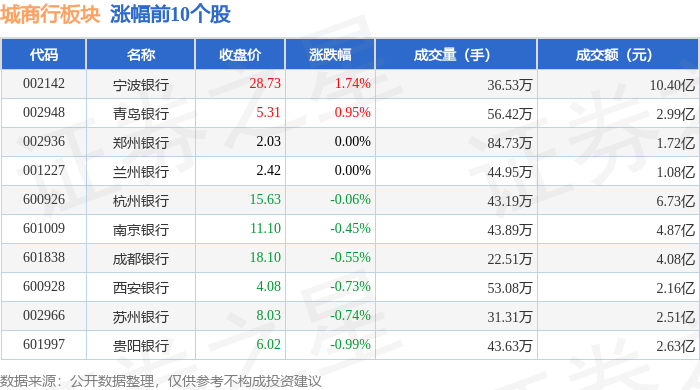
Group 1 - The city commercial bank sector experienced a decline of 0.37% on September 5, with Chongqing Bank leading the drop [1] - The Shanghai Composite Index closed at 3812.51, up 1.24%, while the Shenzhen Component Index closed at 12590.56, up 3.89% [1] - Key individual stock performances in the city commercial bank sector included Ningbo Bank rising by 1.74% and Chongqing Bank falling by 1.34% [1][2] Group 2 - The net outflow of main funds from the city commercial bank sector was 287 million yuan, while retail investors saw a net inflow of 141 million yuan [2] - The trading volume for Chongqing Bank was 107,400 shares, with a transaction amount of 103 million yuan [2] - The overall trading activity showed a mixed trend, with some banks experiencing slight declines while others saw minor gains [1][2]



2100亿规模鑫元基金副总"降职" 南京银行系高管全面接管
Guan Cha Zhe Wang· 2025-09-05 07:19
Core Viewpoint - The recent personnel changes at Xinyuan Fund Management Co., Ltd. have raised market attention, particularly the adjustment of veteran executive Wang Hui from Deputy General Manager to Senior Specialist, which is seen as a significant shift in management dynamics [1][2]. Group 1: Personnel Changes - Wang Hui, who served as Deputy General Manager for nearly ten years, has been reassigned to a less influential role as Senior Specialist, which is unusual in the industry [1]. - The management team now has a dominant presence of executives from Nanjing Bank, which holds an 80% stake in Xinyuan Fund, indicating increased control by the major shareholder [2]. - The transition of Wang Hui is interpreted as a potential "cleaning" of management by the shareholders, especially since he lacks a background in Nanjing Bank and is nearing retirement age [2]. Group 2: Financial Performance - Xinyuan Fund reported a revenue of 356 million yuan for the first half of 2025, marking a year-on-year increase of 17.49%, and a net profit of 107 million yuan, up 15.03% [1]. - As of mid-2025, the total assets under management reached 211.78 billion yuan [1]. Group 3: Business Structure Challenges - The fund's business structure is heavily reliant on fixed-income products, with bond and money market funds accounting for 98% of total assets under management [3]. - In contrast, mixed and equity funds only total 3.05 billion yuan, representing less than 1.5% of the total [3]. - The performance of Xinyuan Fund's equity investments has lagged behind industry averages, with one-year and two-year returns of 2.58% and 5.49%, respectively, compared to industry averages of 15.69% and 9.53% [3]. Group 4: Strategic Initiatives - To address the over-reliance on fixed-income products, Xinyuan Fund has been actively launching new equity funds, with nine new funds issued in the past year, five of which are index equity funds [4]. - The company has promoted four new equity fund managers, all of whom were internally trained [4]. Group 5: Future Outlook - The ability of the new management team from Nanjing Bank to shift the focus from fixed-income dominance to equity business growth will be a critical measure of the effectiveness of the recent personnel changes [5]. - The case of Xinyuan Fund reflects broader challenges faced by bank-affiliated fund companies in transitioning their business models amid regulatory encouragement for equity fund development [5].
江苏龙蟠科技集团股份有限公司关于对外担保的进展公告
Zhong Guo Zheng Quan Bao - Zhong Zheng Wang· 2025-09-05 05:06
Summary of Key Points Core Viewpoint - The company, Jiangsu Longpan Technology Group Co., Ltd., has provided a total of RMB 150 million in joint liability guarantees for its subsidiaries, Changzhou Liyuan New Energy Technology Co., Ltd. and Liyuan (Jiangsu) Technology Co., Ltd., to support their bank credit applications [2][4]. Group 1: Guarantee Overview - The company has provided a total guarantee of RMB 150 million for its subsidiaries, which are under its control, and the risk is manageable within the company [2][4]. - As of the announcement date, the total actual guarantee balance for the company and its subsidiaries is RMB 5.58 billion, with no overdue guarantees [4][14]. - The company has established a comprehensive risk management system for guarantee operations, including dynamic tracking of the financial status of the guaranteed parties [13]. Group 2: Financial Data and Ratios - The total approved guarantee amount for the company and its subsidiaries is RMB 141.7 billion, which exceeds 447.04% of the company's audited net assets attributable to shareholders for the year 2024 [14]. - The actual guarantee balance of RMB 5.58 billion accounts for 176.05% of the company's audited net assets for 2024 [14]. - The company has no overdue guarantees and has not provided guarantees for shareholders or related parties [14]. Group 3: Decision-Making Process - The company held board meetings on February 21 and April 17, 2025, to approve the guarantee and credit limit proposals for the year [5]. - The guarantees include various types such as performance guarantees and credit guarantees, with a total limit of RMB 13.95 billion valid for 12 months from the date of approval [5]. Group 4: Subsidiary Information - Changzhou Liyuan has a registered capital of RMB 834.13 million and is involved in technology services and electronic materials manufacturing [7]. - Liyuan (Jiangsu) has a registered capital of RMB 300 million and focuses on electronic materials research and development [8]. Group 5: Necessity and Reasonableness of Guarantees - The guarantees are deemed necessary to support the subsidiaries' operational needs and are not expected to harm the interests of the company or its shareholders [12]. - The company maintains sufficient control over the subsidiaries, ensuring that the risks associated with the guarantees are manageable [12].

深圳市中新赛克科技股份有限公司 关于使用闲置自有资金进行现金管理的进展公告
Zhong Guo Zheng Quan Bao - Zhong Zheng Wang· 2025-09-05 04:51
Core Viewpoint - The company has increased the limit for cash management using idle self-owned funds from RMB 80 million to RMB 100 million, allowing for investment in low-risk, high-liquidity financial products or fixed-term deposits, effective for 12 months from the date of the shareholders' meeting [1][5]. Group 1: Cash Management Progress - The company's wholly-owned subsidiary, Nanjing Zhongxin Saike Technology Co., Ltd., has subscribed to structured deposits and fixed-term deposits using idle self-owned funds [1]. - The company has invested RMB 80 million in a structured deposit with Nanjing Bank, with a term of 96 days and an expected annualized return of 1.00%, 1.95%, or 2.05% [1][2]. - Additionally, the company has invested RMB 70 million in another structured deposit with Nanjing Bank, with a term of 183 days and the same expected annualized return [2]. - The company has also subscribed to fixed-term deposits in USD with Nanjing Bank and Zhejiang Merchants Bank, each for USD 25 million, with terms of 364 days and 699 days, respectively, and expected annualized returns of 4.34% and 4.10% [2]. Group 2: Impact on Daily Operations - The investment in low-risk, high-liquidity structured deposits and fixed-term deposits is conducted without affecting the company's normal operations and liquidity needs [5]. - This strategy aims to enhance the efficiency of fund utilization and increase asset returns, ultimately benefiting shareholders [5]. Group 3: Previous Cash Management Activities - As of the announcement date, the company and its subsidiaries have an outstanding balance of RMB 430 million and USD 65 million in cash management products [5].

A股上市宁企“半年报”全部发布
Nan Jing Ri Bao· 2025-09-05 03:27
Core Viewpoint - The financial performance of A-share listed companies in Nanjing for the first half of the year shows strong growth, particularly in the banking and securities sectors, driven by their focus on serving the real economy and innovation in technology [1][2][3]. Financial Performance - Nanjing's A-share listed companies have a total market capitalization of approximately 1.81 trillion yuan, with Jiangsu Bank, Nanjing Bank, and Huatai Securities leading in net profits of 20.24 billion yuan, 12.62 billion yuan, and 7.55 billion yuan respectively [1][2]. - Jiangsu Bank reported a revenue of 44.86 billion yuan, an increase of 7.78% year-on-year, and a net profit growth of 8.05% [2]. - Nanjing Bank achieved a revenue of 28.48 billion yuan, with a year-on-year growth of 8.64%, and a net profit increase of 8.84% [2]. - Huatai Securities saw a revenue of 16.22 billion yuan, with a significant year-on-year increase of 31.01%, and a net profit growth of 42.16% [2]. Service to Real Economy - Jiangsu Bank's focus on supporting manufacturing and infrastructure projects led to a manufacturing loan balance of 360.6 billion yuan, growing by 18.90% year-on-year, and infrastructure loans reaching 691.2 billion yuan, up by 31% [3]. - Nanjing Bank emphasized service to key industries, with green finance, inclusive small and micro finance, and technology finance loans growing by 27.79%, 12.51%, and 12.42% respectively [3]. - Huatai Securities maintained a strong development trend by innovating its business and service models [3]. Innovation and Technology - Nanjing Steel's half-year report highlighted a net profit of 1.46 billion yuan, with advanced steel material sales contributing significantly to profits [4][5]. - Nanjing Steel's innovation strategy included breakthroughs in advanced steel materials and participation in national key research projects [5]. - Guodian NARI's report showcased its technological advancements, achieving a revenue of 24.24 billion yuan, up by 19.54% year-on-year, and a net profit of 2.95 billion yuan, growing by 8.82% [6]. Globalization Strategy - Companies like Maolai Optical and Nanwei Medical are leveraging globalization for growth, with Maolai Optical reporting a revenue of 319 million yuan, up by 32.26%, and a net profit increase of 110.36% [7][8]. - Nanwei Medical achieved a revenue of 1.565 billion yuan, with overseas revenue accounting for 58% of total income, reflecting its global expansion efforts [9].




揭秘银行薪酬: 24家银行上半年 人均月薪超3万元
Sou Hu Cai Jing· 2025-09-05 01:30
Core Viewpoint - The banking sector in A-shares has regained its position as the largest sector with a market value of 11.31 trillion yuan, surpassing the electronics sector, while the salary situation of banking employees has also drawn attention [1] Salary Overview - The average monthly salary in the banking industry for the first half of 2025 is 30,200 yuan, a slight increase of 1,300 yuan year-on-year, reversing a trend of a 5,300 yuan decrease in the same period last year [2][3] - The top tier of banks, including joint-stock banks and strong city commercial banks in eastern regions, have an average monthly salary exceeding 45,000 yuan, with specific banks like China Merchants Bank and Nanjing Bank reporting 50,500 yuan and 48,200 yuan respectively [2] Salary Distribution - The second tier consists of state-owned banks with average monthly salaries ranging from 25,000 to 30,000 yuan, with Bank of China at 28,200 yuan and China Construction Bank at 26,200 yuan [3] - The third tier includes some rural and city commercial banks in remote areas, with average salaries below 25,000 yuan, such as Zhengzhou Bank and Xi'an Bank at 24,700 yuan and 22,800 yuan respectively [3] Management Salary Trends - A notable trend is the decrease in salaries for key management personnel across many banks, with 33 out of 42 A-share listed banks reporting a year-on-year decline in management salaries, with the highest drop reaching 82.4% [5][6] - For instance, Zhengzhou Bank's management salary total fell from 103.88 million yuan to 59.57 million yuan year-on-year [5] Salary Structure Reform - Many banks are emphasizing salary structure reform, focusing on value creation and incentivizing young employees to work in grassroots positions [7] - The "reverse salary recovery" mechanism is being established to enhance performance-based pay and mitigate operational risks, with banks like Zhengzhou Bank and China Merchants Bank implementing measures to recover performance-related pay under certain conditions [8] Industry Salary Context - The salary levels of listed banks do not represent the overall banking industry, as there are over 4,000 banking institutions in China, with many smaller banks having significantly lower average salaries compared to listed banks [9]
