
赛力斯

Search documents
境内企业赴港上市备案一览:217家完成备案 已上市170家 备案中260家(附名单)
Sou Hu Cai Jing· 2025-11-28 06:14
Core Insights - The Hong Kong IPO market is set to be revitalized in 2025, driven by a surge of mainland companies listing in Hong Kong, which is expected to be the main engine for the market's growth [1]. Group 1: IPO Activity - As of November 27, 2025, a total of 217 companies have completed the listing application process for Hong Kong, with an additional 260 companies still in the application phase [1]. - Among the 217 companies that completed their applications, 170 have already gone public, with 23 listings in 2023, 61 in 2024, and 86 in 2025 to date [3]. - The Hong Kong Stock Exchange has welcomed 92 companies this year, with 86 of them being from mainland China, raising a total of 2,052 million HKD [3]. Group 2: Fundraising and Company Performance - The three largest fundraising companies from mainland China are CATL (Ningde Times) raising 35.657 billion HKD, Seres (Sailis) raising 14.283 billion HKD, and Sany Heavy Industry raising 13.453 billion HKD [3]. - The average application processing time for the 217 companies was 166 days, with 8 companies completing the process in less than 50 days [2]. - The fastest applications were completed by CATL (25 days), Ningbo Joyson (31 days), and Meilian Group (34 days), while the longest took over 597 days [2]. Group 3: Geographic Distribution - The 86 mainland companies listed are distributed across 19 provinces, with Shanghai, Guangdong, Jiangsu, and Beijing each contributing over 10 companies [4]. - The majority of the listings were through IPOs, accounting for 98% of the total, with only 2 companies using alternative methods to list [4].


新能源汽车风云录:从蔚小理到新势力崛起,未来投资密码何在?
雪球· 2025-11-28 04:43
Core Viewpoint - The article discusses the dynamic landscape of the electric vehicle (EV) industry, highlighting the competition among established players like BYD and Tesla, as well as new entrants like Seres and Xiaomi, while emphasizing the need to decode future investment opportunities amidst technological advancements and market shifts [4]. Market Status: Opportunities Amidst Differentiation - The EV market in 2025 shows a duality of growth and cooling, with production and sales increasing by 45% year-on-year in the first five months, and penetration rates surpassing 44%, indicating that one in every two new cars is an EV [5]. - However, the overall vehicle market growth is only 3%, signaling a shift from rapid expansion to more refined strategies [5]. - The competitive landscape is dominated by BYD and Tesla, with BYD leveraging vertical integration and technological iteration, while Tesla focuses on Full Self-Driving (FSD) to penetrate global markets [5]. - New entrants are experiencing differentiation: Li Auto maintains a strong position through precise targeting, NIO solidifies its high-end market with battery swapping, and Seres benefits from Huawei's smart driving technology [5]. Technological Warfare: Battery, Smart Driving, and Ecosystem - The article identifies three critical technological battlegrounds: 1. Battery Revolution: Solid-state batteries are on the horizon, with CATL's "Shenxing Battery" achieving 400 km range in just 10 minutes of charging, although mass production of solid-state batteries remains a challenge [6]. 2. Smart Driving Competition: The transition from L2 to "City NOA" is underway, with Tesla's FSD evolving and Huawei and Xpeng pushing for urban NOA implementation, making smart driving a standard feature rather than just a selling point [6]. 3. Ecosystem Integration: Companies like Xiaomi and Huawei are integrating their ecosystems into vehicles, creating a holistic user experience that extends beyond the car itself [6]. Investment Insights: Identifying Certainty Across Cycles - Future investments should focus on three key logics: 1. Head Concentration: Betting on "the strong will get stronger," with BYD and Tesla showing resilience due to scale, technology, and brand barriers, while Seres and Xiaomi offer differentiated competitive advantages [7]. 2. Technological Positioning: Focusing on critical points in the supply chain, such as battery production led by CATL and BYD, and smart driving chips dominated by Huawei and Horizon [7]. 3. Risk Avoidance: Being cautious of "pseudo-innovation" and "low barriers," as smaller companies lacking core technology may face elimination during market consolidation [7]. User Transition: From High-End to Rational Demand - The market is undergoing a structural shift, with second-tier and lower-tier cities accounting for over 50% of sales, indicating a move from policy-driven to market-driven demand [8]. - User profiles are becoming clearer, with urban middle-class consumers seeking smart features and cost-effectiveness, while younger consumers in smaller cities are eager to try new technologies [8]. - Decision-making is becoming more rational, with key considerations including range, charging, resale value, and safety, prompting companies to address these pain points [8]. Industry Insights: A Paradigm-Shifting Revolution - The EV wave offers insights that extend beyond the automotive industry: 1. Balancing "Fast" and "Slow": While technological iterations occur rapidly, the maturity of the supply chain requires years of development, necessitating a balance between innovation speed and quality [10]. 2. Inevitable Cross-Industry Integration: The entry of tech companies disrupts traditional automotive boundaries, leading to a three-dimensional competition involving software, hardware, and ecosystems [11]. 3. Globalization as a Double-Edged Sword: Chinese automakers face opportunities abroad but must also navigate geopolitical and trade barriers [12]. 4. Long-Termism as a Winning Strategy: Post-subsidy reductions, only companies that invest in R&D and build brand moats will survive through cycles [13]. Conclusion - The EV industry stands at a historical crossroads, where technological breakthroughs and market dynamics intersect, and user demands collide with capital logic [14]. - Future winners will be those who lead change through technological innovation, control the supply chain to mitigate risks, and define products with a user-centric approach [14].



比亚迪、广汽、吉利、奇瑞等车企捐款,驰援香港大埔火灾救援
Xin Jing Bao· 2025-11-28 03:09
Group 1 - BYD, Xpeng, and other car manufacturers have donated a total of 4.1 million Hong Kong dollars to support fire rescue efforts in Tai Po, Hong Kong [1] - BYD announced a donation of 10 million Hong Kong dollars, while Xpeng and Seres each donated 5 million Hong Kong dollars [1] - GAC Group pledged 6 million Hong Kong dollars for emergency medical assistance, temporary housing, and post-disaster reconstruction for affected residents [1] Group 2 - Geely Holding Group, in collaboration with the Li Shufu Public Welfare Foundation, donated 10 million Hong Kong dollars for medical aid, emergency housing, and reconstruction efforts [1] - Chery Automobile donated 10 million Hong Kong dollars through the China Red Cross Foundation for urgent rescue efforts in the Tai Po disaster area [1] - The fire in Tai Po occurred on November 26, resulting in significant casualties, with rescue operations ongoing as of November 28 [1]


港股小幅高开 阿维塔递交港股上市申请
Mei Ri Jing Ji Xin Wen· 2025-11-28 03:04
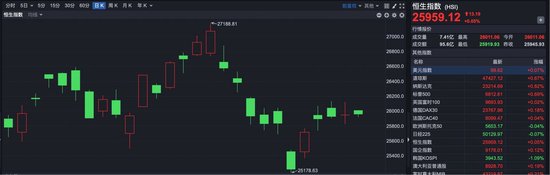
Core Viewpoint - The Hong Kong stock market opened slightly higher on November 28, with the Hang Seng Index at 25,959 points, reflecting a 0.05% increase [1]. Company Developments - Avita Technology (Chongqing) Co., Ltd. submitted its listing application to the Hong Kong Stock Exchange on the evening of November 27, with CITIC Securities and CICC as joint sponsors. The funds raised will primarily be used for product development, platform and technology development, brand building, sales service network construction, and operational funding to enhance core competitiveness [5]. - Avita, established in 2018, aims to create a high-end smart electric vehicle brand with independent technology and international presence. It has received support from Changan Automobile, Huawei, and CATL in various fields [5]. - From 2021 to 2024, Avita completed four rounds of financing, totaling approximately 19 billion yuan, with a valuation of around 30 billion yuan [5]. Market Trends - The Hang Seng Technology Index reported a 0.29% increase, reaching 5,613 points [3]. - The new consumption sector continues to strengthen, with Pop Mart rising over 2% and Dongfang Zhenxuan increasing over 4% [5]. - Other sectors showed positive movement, including tech stocks like Bilibili and Alibaba, which both opened higher, and innovative drug concepts with companies like Innovent Biologics rising over 1% [5]. - Gold stocks also performed well, with Shandong Gold and Lingbao Gold both increasing over 2% [5]. - The semiconductor sector was active, with companies like SMIC and Huahong Semiconductor both rising over 1% [5]. - The new energy vehicle sector showed mixed results, with NIO rising over 1% while Seres fell over 6% [5]. Market Outlook - Brokerage firms suggest that the Hong Kong stock market will maintain a volatile pattern, advising investors to be patient and focus on whether the Hang Seng Index can break through key moving average resistance with volume [5]. - Analysts indicate that the market is currently driven by sentiment, with risk appetite not fully restored. Although the index has rebounded, it relies heavily on a few large-cap stocks, while small and mid-cap stocks remain weak [5]. - In an uncertain environment, sectors such as energy, telecommunications, public utilities, and state-owned banks are viewed as "ballast" for funds due to their low valuations and high dividends [5].
阿维塔递表港交所,又一“华系高端”寻求上市
Jin Rong Jie· 2025-11-28 02:52
Group 1 - Avita Technology Co., Ltd. has submitted a listing application to the Hong Kong Stock Exchange, with CITIC Securities and CICC as joint sponsors [1] - Since the commencement of vehicle deliveries in December 2022, Avita's delivery scale has rapidly increased from 114 units in 2022 to 61,588 units in 2024, with a record high of 12,805 units delivered in June this year [1] - In the first half of this year, Avita's delivery volume reached 56,729 units, representing a year-on-year growth of 151.1% [1] Group 2 - Avita's revenue is also on a continuous growth trajectory, with revenues of 5.645 billion yuan in 2023, projected to rise to 16.195 billion yuan in 2024, and reach 12.208 billion yuan in the first half of 2025, reflecting a year-on-year increase of 98.5% [3] - Vehicle sales are the core business for Avita, with revenues of 5.542 billion yuan and 14.417 billion yuan for 2023 and 2024 respectively, and 11.490 billion yuan in the first half of 2025, showing a year-on-year growth of 94.4% [3] - Avita has recorded continuous losses, with pre-tax losses of 2.016 billion yuan, 3.693 billion yuan, and 4.018 billion yuan for 2022, 2023, and 2024 respectively [3] Group 3 - The funds raised from Avita's listing will primarily be used for product development, platform and technology development, brand building, sales service network construction, and to supplement operating funds [6] - By 2026, Avita plans to launch five upgraded products in collaboration with Huawei, with a total of 17 models expected to be launched by 2030, covering segments such as sedans, SUVs, and MPVs [6] - In the first ten months of this year, Avita achieved monthly sales exceeding 10,000 units for eight consecutive months, and has established a dual power layout of pure electric and range-extended vehicles across its entire lineup [6]

港股有望受益于“十五五”催化,恒生科技指数ETF(513180)震荡窗口持续“吸金”
Mei Ri Jing Ji Xin Wen· 2025-11-28 02:25
Group 1 - The Hang Seng Index opened up 0.25% and the Hang Seng Tech Index rose 0.43%, with semiconductor and electrical equipment sectors leading the gains [1] - The largest ETF tracking the Hang Seng Tech Index (513180) has seen significant capital inflow, with a net inflow of 9.72 billion yuan over the last five trading days, indicating strong demand [1] - The Hang Seng Tech Index has shown a notable stabilization trend, attracting active capital allocation in the tech sector [1] Group 2 - Dongwu Securities suggests that short-term risk factors for Hong Kong stocks are decreasing, but a rebound confirmation requires catalysts [2] - The expectation of a potential interest rate cut by the Federal Reserve could benefit the recovery of Hong Kong stocks, as the narrative around the AI tech bubble in the US weakens [2] - CITIC Securities highlights the "14th Five-Year Plan" which emphasizes building a modern industrial system and accelerating high-level technological self-reliance, suggesting that strategic emerging industries may receive new policy support [2]
赛力斯问界以30%毛利率领跑中国新能源车企,小米增速显著
Xin Lang Ke Ji· 2025-11-28 02:15
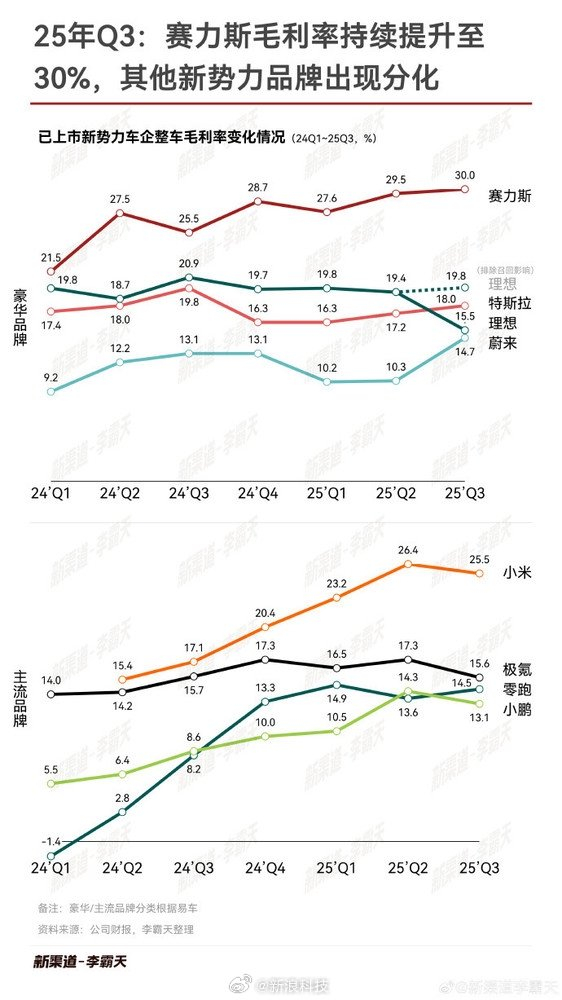
Core Viewpoint - The highest gross margin among Chinese new energy vehicle companies is held by Seres, which has achieved a gross margin of 30% in Q3 2025, driven by the strong sales of its Wanjie model [1][2]. Summary by Category Gross Margin Performance - Seres leads the industry with a gross margin of 30% in Q3 2025, marking a significant increase from 21.5% in Q1 2024 [1][2]. - Xiaomi's gross margin has also seen substantial growth, rising from 15.6% in Q1 2024 to 25.5% in Q3 2025, making it the fastest-growing among mainstream brands [1][2]. - Other new energy vehicle brands show varied performance: - Li Auto at 19.8% - NIO at 14.7% - Xpeng at 13.1% - Zeekr at 15.6% - Leap Motor at 14.5% in Q3 2025 [1][2][3]. - Tesla's gross margin has shown slight fluctuations, recorded at 15.5% in Q3 2025 [1][2]. Industry Dynamics - The current competitive landscape indicates that Xiaomi may pose the only significant challenge to Seres in terms of gross margin [1].


赛力斯毛利率30%领跑新势力,小米增速第一达25.5%
Xin Lang Ke Ji· 2025-11-28 02:15
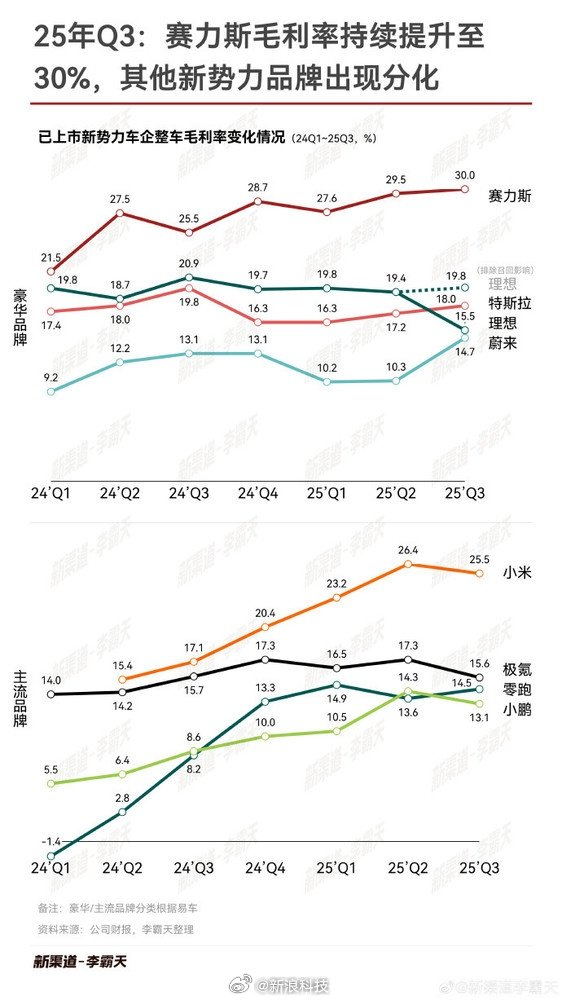
Core Insights - The article highlights the significant increase in gross margins among Chinese electric vehicle (EV) manufacturers, particularly noting the performance of Seres and Xiaomi [1]. Group 1: Gross Margin Performance - Seres leads the industry with a gross margin of 30% in Q3 2025, marking it as the only brand to surpass the 30% threshold among listed new EV brands [1][2]. - Xiaomi's gross margin has shown remarkable growth, rising from 15.6% in Q1 2024 to 25.5% in Q3 2025, making it the fastest-growing brand in terms of gross margin among mainstream manufacturers [1]. - Other brands such as Li Auto, NIO, and Xpeng have gross margins of 19.8%, 14.7%, and 13.1% respectively, while Zeekr and Leap Motor have also seen gradual increases, reaching 15.6% and 14.5% in Q3 2025 [1][2]. Group 2: Competitive Landscape - Tesla's gross margin has experienced slight fluctuations, standing at 15.5% in Q3 2025, indicating a relatively stable performance compared to the rapid growth of other brands [1]. - The current competitive landscape suggests that Xiaomi may pose a significant challenge to Seres in terms of gross margin performance moving forward [1].
汽车早报|多家车企捐款驰援香港 本田10月全球汽车产量同比下降10.9%
Xin Lang Cai Jing· 2025-11-28 00:42
Group 1: Automotive Industry Overview - The automotive industry in China reported a profit of 38.95 billion yuan from January to October 2025, reflecting a year-on-year increase of 4.4% [1] - During the same period, the production of vehicles reached 27.33 million units, marking an 11% increase year-on-year [1] - The industry's revenue for the first ten months of 2025 was 88.778 billion yuan, up 7.9% compared to the previous year, while costs increased by 8.7% to 78.243 billion yuan [1] Group 2: Company Developments - Avita Technology submitted a listing application to the Hong Kong Stock Exchange, reporting a revenue of 12.208 billion yuan for the first half of 2025, which is a 98.5% increase year-on-year [2] - WM Motor established a new company with a registered capital of 200 million yuan, focusing on the sales of new energy vehicles and related products [3] Group 3: Corporate Donations for Disaster Relief - BYD donated 10 million HKD to support disaster relief efforts in Hong Kong following a major fire [3] - Chery Automobile also contributed 10 million HKD for emergency rescue and post-disaster recovery in Hong Kong [4] - GAC Group donated 6 million HKD for medical assistance and temporary housing for fire victims [5] - XPeng Motors announced a donation of 5 million HKD to aid families affected by the fire [6] - Seres Group contributed 5 million HKD for medical aid and living arrangements for those impacted by the disaster [7] Group 4: Global Automotive Sales Performance - Nissan reported a global sales decline of 4.8% in October 2025, with production down by 3.9% to 276,323 units [8] - Honda's global production in October 2025 decreased by 10.9%, totaling 302,671 units [9]

今日视点:中国科技资产开启“出海”新叙事
Zheng Quan Ri Bao· 2025-11-27 23:17
Core Viewpoint - The listing of the ChiNext 50 ETF-DR on the Thailand Stock Exchange marks a significant step in the internationalization of Chinese technology assets, reflecting strong interest from international investors in China's core technology sectors [1] Group 1: Market Expansion - The ChiNext 50 ETF, representing leading companies in emerging industries such as renewable energy, artificial intelligence, and biomedicine, has expanded its reach from Europe to Southeast Asia, indicating a growing international presence [1] - The "outbound" strategy of leading Chinese technology companies is evolving from individual listings to a more collective approach through ETFs, facilitating easier access for international investors to Chinese core technology assets [1][2] Group 2: Capital Market Innovations - The steady advancement of capital market reforms and cross-border capital flow mechanisms is paving the way for the "outbound" movement of technology assets, aligning with China's financial power strategy [2] - Innovations such as ETF connectivity and depositary receipt models are enhancing the visibility of Chinese core technology assets to a broader international market [2] Group 3: Competitive Advantages - China's rapid technological innovation has established systemic advantages in emerging and future industries, making Chinese technology assets increasingly attractive to global investors [3] - The shift in international capital allocation from seeking "value gaps" to focusing on "future certainty" positions Chinese core technology assets as essential components in global investment portfolios [3] Group 4: Strategic Globalization - The globalization of capital, international branding, and market diversification are key strategies for Chinese technology companies to enhance their value and competitiveness in the global market [4] - The "outbound" strategy is not only a response to market dynamics but also a proactive approach for companies to integrate into global innovation networks and enhance their international competitive edge [4]