奔驰

Search documents
车企都想成为中国的沃尔沃
汽车商业评论· 2025-05-22 13:23
Core Viewpoint - The article emphasizes the importance of ensuring the safety of intelligent driving vehicles and calls for companies to avoid misleading advertising while taking responsibility for educating consumers about intelligent driving principles [3][5][6]. Group 1: Industry Concerns - The recent tragic accident involving a Xiaomi vehicle in NOA mode has raised serious concerns about the safety of intelligent driving systems, highlighting the gap between marketing claims and actual capabilities [5][6]. - Many car manufacturers have exaggerated the capabilities of their L2-level driving assistance systems, misleading consumers into believing they offer near L3-level autonomous driving [6][7]. - The penetration rate of NOA in China's passenger vehicles is less than 20%, indicating that the market is still in its early stages and that excessive competition has led to misleading marketing practices [7][14]. Group 2: Shift in Marketing Strategy - Following the accident and subsequent regulatory scrutiny, many companies have begun to downgrade their marketing language from "intelligent driving" to "assisted driving," reflecting a shift towards a more cautious approach [14][30]. - The Ministry of Industry and Information Technology has mandated stricter regulations on advertising for intelligent driving systems, prohibiting exaggerated claims and emphasizing the need for companies to take responsibility for safety [14][30]. - The initial excitement around "全民智驾" (Universal Intelligent Driving) has quickly faded, with companies now focusing on safety as a core selling point rather than just technological advancements [12][14]. Group 3: Safety as a Priority - The article highlights a growing consensus in the industry that safety must be prioritized, with many companies now integrating safety into their brand identity and product offerings [24][30]. - Prominent figures in the automotive industry have reiterated that safety is the ultimate luxury in vehicle design, emphasizing the need for a new safety perspective in the era of intelligent electric vehicles [19][20]. - The shift towards prioritizing safety is seen as a necessary response to increasing consumer awareness and regulatory pressure, marking a return to the fundamental values of the automotive industry [25][30].






17万买奔驰,为什么中国人反而不乐意了?
3 6 Ke· 2025-05-22 11:11
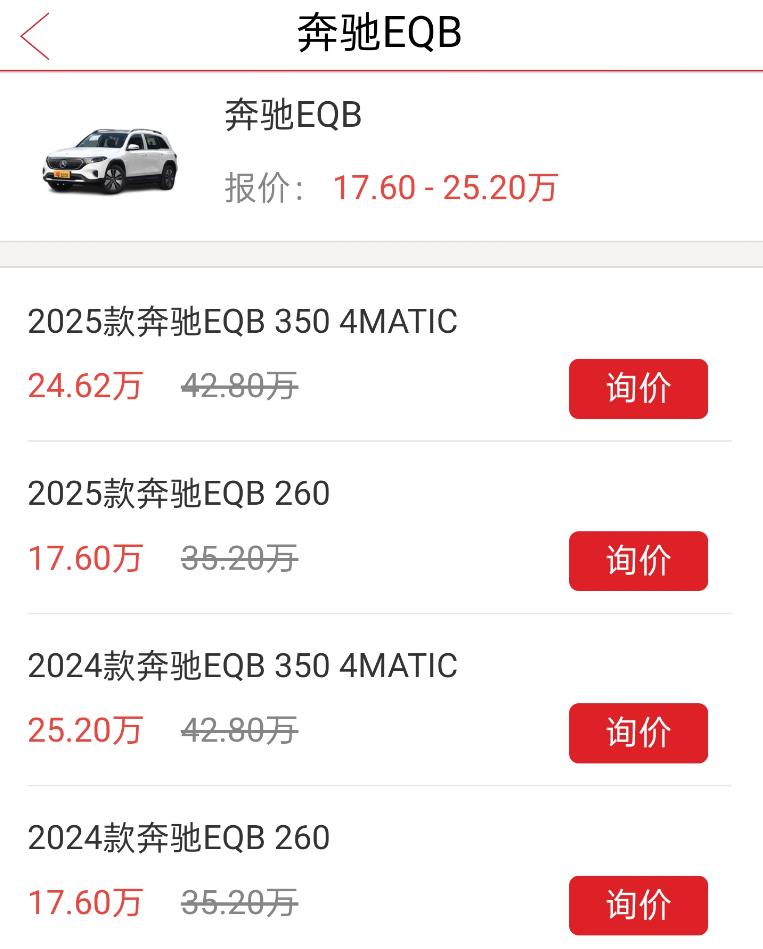
Core Insights - The price of the Mercedes EQB 260 has dropped significantly from 352,000 yuan to 176,000 yuan, making it the cheapest Mercedes, yet it is struggling to attract buyers in China due to technological inferiority compared to domestic brands [1][3] - Mercedes lacks competitive advantages in the three core technologies of electric vehicles: batteries, electric control, and intelligent driving, which has led to a decline in its electric vehicle market position [3][5] - In 2024, Mercedes is projected to sell only 185,000 electric vehicles, while Xiaomi is expected to sell 135,000 units, indicating a shift in consumer preference towards domestic brands [3][5] Group 1 - The decline in sales of Mercedes electric vehicles is attributed to the strong competition from domestic brands like Xiaomi, NIO, Li Auto, and Zeekr, which have surpassed Mercedes in terms of sales and average price per vehicle [5][7] - Audi and BMW are taking proactive steps to enhance their electric vehicle offerings by collaborating with technology companies like Huawei and Alibaba, while Mercedes has yet to make significant moves in this direction [7][9] - The trend of decreasing prices for luxury brands like Mercedes (BBA) is leading to a loss of brand allure among Chinese consumers, who are becoming less willing to pay high prices for these vehicles [9] Group 2 - The introduction of new models like the Audi A5L, which combines traditional fuel vehicle advantages with intelligent driving features, represents a strategic shift in the market [7][9] - BMW's upcoming "new generation" concept car, which incorporates AI technology developed in partnership with Alibaba, is set to enter mass production, indicating a focus on innovation [7][9] - The overall trend shows that traditional fuel vehicles are struggling to keep pace with the electric vehicle revolution, leading to a significant shift in consumer preferences and market dynamics [9]
5.22犀牛财经晚报:三一重工向港交所提交上市申请 新华保险认购私募基金份额100亿元
Xi Niu Cai Jing· 2025-05-22 10:19
Group 1: Financial Regulations and Market Developments - The Financial Regulatory Bureau announced the approval of a third batch of long-term investment reform pilot programs for insurance funds, totaling 60 billion yuan, bringing the total approved amount to 222 billion yuan [1] - The China Securities Regulatory Commission (CSRC) is set to implement the fifth listing standard for the Sci-Tech Innovation Board, aiming to support high-quality, unprofitable tech companies in going public [1] - China Securities Depository and Clearing Corporation released the clearing and settlement arrangements for the Dragon Boat Festival holiday in 2025, detailing specific dates for fund clearing and settlement [1] Group 2: Technology and Market Trends - The 2025 Bluetooth Asia Conference in Shenzhen projected that global Bluetooth device shipments will exceed 5.3 billion units in 2025, with a forecast of nearly 8 billion units by 2029 [2] - Lenovo Group reported a 23% year-on-year revenue increase to approximately 17 billion USD, driven by growth in the personal computer market and AI server demand, despite a 64% drop in net profit due to derivative losses and pricing pressures [2][6] - The automotive market is experiencing intense competition, with Mercedes-Benz significantly reducing prices on several models, with discounts reaching up to 50% [3] Group 3: Corporate Actions and Financial Performance - Sany Heavy Industry submitted an application for listing H-shares on the Hong Kong Stock Exchange [3] - Xinhua Insurance subscribed to a private equity fund with a total investment of 10 billion yuan, contributing to a fund size of 20 billion yuan [5] - Zhongnan Media's subsidiary signed a procurement contract worth 1.009 billion yuan for the supply of educational resources in Hunan Province [8] Group 4: Market Performance and Stock Movements - The market experienced a significant decline, with the North Stock 50 index dropping over 6% and more than 4,400 stocks declining across the market [11] - Despite the overall market downturn, banking stocks showed resilience, with several banks reaching historical highs [11]



国际观察|关税冲击下德国经济面临增长停滞风险
Xin Hua She· 2025-05-22 09:56
德国经济专家委员会21日发布最新预测,将德国2025年经济增长预期下调至零。这一权威咨询机构的主 席莫妮卡·施尼策尔表示,美国贸易政策对德国经济形成显著冲击,其关税大幅上调且不可预测,已成 为拖累德国出口与投资的主要因素。 分析人士指出,美国滥施关税措施,破坏了以市场为导向的自由贸易规则。作为欧盟最大经济体,德国 首当其冲,面临出口订单锐减、支柱产业承压等多重挑战。 "很难预测未来业务发展" 德国联邦统计局数据显示,2024年德美双边贸易总额达2528亿欧元,其中德国对美出口1614亿欧元,美 国由此重返德国最大贸易伙伴地位。德美经济深度互嵌,尤其在汽车、机械、化工和医药等高附加值制 造业领域,美国为德国最大单一出口市场。 2023年与2024年,德国经济已连续两年负增长。欧盟、德国政府以及多家权威机构日前将2025年德国经 济增长预期下调至零。德国政府表示,美国关税政策是下调增长预期的主因之一。 德国经济学界普遍认为,美国关税政策将增加德国出口产品成本,进一步加剧企业面临的不确定性与运 营压力。在政策环境动荡背景下,企业可能推迟投资与招聘决策,抑制生产扩张。 慕尼黑经济研究所4月开展的一项调查显示,28.3 ...
中美日内瓦达成关税协议,全球汽车产业迎来深度重构
CINNO Research· 2025-05-22 06:16
Core Viewpoint - The tariff policy will act as a persistent structural variable, forcing the industry to transition towards a "multi-centered supply chain paradigm" [2][19]. Group 1: Tariff Policy Impact - The recent U.S.-China tariff agreement has temporarily alleviated short-term cost pressures, catalyzing growth in China's new energy component exports, particularly in technology-intensive products such as intelligent driving, lightweight materials, and high-pressure fast-charging modules [2]. - Major affected global automakers include Toyota, Hyundai, General Motors, Honda, and Nissan, while Chinese component manufacturers face relatively minor direct impacts [2][3]. Group 2: U.S. Automotive Market Trends - In 2024, U.S. automotive sales are projected to increase by 3% to 16.03 million units, with imports accounting for 50% of total sales, and Mexico being the largest source of imported vehicles at 18% [5][6]. - The number of vehicles imported from China is expected to surge by 55% to 116,000 units in 2024, although this still represents only 1.8% of China's total automotive exports [8]. Group 3: Import and Export Dynamics - The import value of vehicles from Mexico is projected to rise by 13% to $78.5 billion in 2024, while the import value from China remains significantly lower, ranking tenth [6]. - U.S. exports of vehicles to China are expected to decline by 22% to approximately 100,000 units, with Mercedes accounting for half of this volume [13]. Group 4: Component Trade - The U.S. maintains a steady import value of around $18 billion for components from China, while exports to China have been decreasing [15][17]. - In 2024, the leading markets for U.S. component exports are Mexico and Canada, with Mexico's market showing a 5% increase to $38.8 billion [16]. Group 5: Industry Response Strategies - The tariff impacts are driving the industry to adopt three typical response paths: price transmission, trade avoidance, and capacity restructuring, which may increase short-term supply chain volatility and market competition stratification [19]. - Companies are encouraged to establish a "tariff elasticity coefficient" monitoring system to dynamically assess policy impacts and incorporate geopolitical risks into strategic planning [19].

和谐汽车(3836.HK):聚焦豪华汽车渗透率提升机会,积极拥抱电动化浪潮
Ge Long Hui· 2025-05-22 02:15
Core Viewpoint - The luxury car dealership industry has experienced significant growth over the past two years, driven by price increases and a strong performance in luxury vehicle sales, particularly amidst supply chain disruptions. The penetration rate of luxury cars in China still has substantial room for growth, and leading luxury car dealers are expected to maintain considerable growth moving forward [1][2]. Group 1: Market Opportunities - The luxury car penetration rate in China reached 16% in 2021, compared to approximately 27% in developed countries, indicating significant potential for growth [2]. - The compound annual growth rate (CAGR) for luxury car sales in China is projected to be 6% from 2021 to 2030, supported by a focus on vehicle replacement and upgrades [2]. - The company, Harmony Auto, is positioned as a leading luxury car dealer with a portfolio of 14 brands, including major luxury and super-luxury brands [1][2]. Group 2: Electric Vehicle Strategy - Harmony Auto has proactively engaged in the electric vehicle (EV) market, establishing partnerships with leading EV companies such as Tesla and NIO, and has received service authorizations from brands like Xpeng and Li Auto [3]. - The electric vehicle penetration among luxury brands in China remains low, with Porsche, Volvo, and BMW having electric vehicle ratios of 10.3%, 6.2%, and 6% respectively in 2021, but upcoming models are expected to focus on electric vehicles [3]. - Harmony Auto plans to expand its electric vehicle product line significantly, with BMW expected to offer 25 new energy models by 2023 and to fully utilize a new electric vehicle platform by 2025 [3]. Group 3: Performance and Market Confidence - Despite challenges from the pandemic and economic pressures, the demand for luxury cars remains stable and manageable, with notable growth in super-luxury brands like Ferrari and Rolls-Royce during the first half of the year [4][5]. - The company has initiated a share buyback plan of 200 million HKD, reflecting confidence in its long-term value and addressing current undervaluation [6].
奥迪的中产神车,跌到13万多了
创业邦· 2025-05-22 00:08
Core Viewpoint - The luxury car market is experiencing significant price reductions, particularly for traditional fuel vehicles, as brands struggle to maintain sales amidst the rise of electric vehicles and changing consumer preferences [3][7][17]. Group 1: Price Reductions and Market Dynamics - Luxury brands like Audi are offering steep discounts, with the Audi A3's price dropping to as low as 12.49 million yuan, reflecting a broader trend of price slashing in the luxury segment [6][12][13]. - The decline in sales is evident, with Audi's global sales projected at 1.6712 million units in 2024, down 11.8% year-on-year, and a notable drop in key markets such as China and Germany [17]. - The aggressive pricing strategy is seen as a desperate measure to boost sales figures, as traditional luxury brands face existential threats from the growing popularity of electric vehicles [17][31]. Group 2: Consumer Sentiment and Brand Perception - The drastic price cuts have led to dissatisfaction among existing luxury car owners, who feel devalued as their vehicles depreciate rapidly [15][18]. - The frequent price fluctuations risk damaging the brand image of luxury vehicles, potentially leading consumers to perceive these brands as lower-end [20][21]. - New generation consumers are increasingly prioritizing technology and smart features over traditional luxury attributes, further complicating the market landscape for established brands [25][26]. Group 3: Strategic Responses from Luxury Brands - Luxury brands are adopting various strategies to cope with market pressures, including partnerships with tech companies like Huawei to enhance their technological offerings [32][34]. - There is a push for deeper localization in production and technology to better align with consumer expectations in the Chinese market [34]. - Financial strength remains a significant advantage for traditional luxury brands, with BBA (BMW, Benz, Audi) planning to invest over 35 billion euros (approximately 270 billion yuan) globally in 2024 to support their transition [36][37].

光洋股份易主4个月拟收购银球科技 标的高转速轴承全球市占率约28%
Chang Jiang Shang Bao· 2025-05-21 23:45
Core Viewpoint - Guangyang Co., Ltd. is planning a significant asset restructuring by acquiring 100% equity of Ningbo Yinqiu Technology Co., Ltd. through a combination of issuing shares and cash payment, which is expected to enhance its operational performance and market position in the bearing industry [1][2][6]. Group 1: Company Background - Guangyang Co., Ltd. primarily engages in the manufacturing of various bearings, particularly in the automotive parts and electronic circuit sectors, and was listed on the A-share market in 2014 [1]. - The company has undergone multiple ownership changes, with the latest being controlled by Huangshan State-owned Assets Supervision and Administration Commission since January 2025 [1][4]. Group 2: Acquisition Details - The acquisition target, Ningbo Yinqiu Technology, established in 1995, is a precision bearing manufacturer with an annual production capacity of 1.1 billion sets of bearings [1][7]. - In 2024, Ningbo Yinqiu Technology is projected to achieve a revenue exceeding 650 million yuan, reflecting a 30% year-on-year growth, with a domestic market share of over 80% for high-speed bearings and approximately 28% globally [1][8]. Group 3: Financial Performance - Guangyang Co., Ltd. has shown signs of recovery in profitability, with net profits of 51 million yuan and 25 million yuan in 2024 and Q1 2025, respectively, marking increases of 143.62% and 6.67% year-on-year [5]. - The company experienced significant financial volatility from 2015 to 2018, primarily due to previous asset acquisitions that did not meet performance expectations, leading to substantial goodwill impairments [4]. Group 4: Market Position and Future Prospects - The acquisition is anticipated to transform Guangyang Co., Ltd.'s operational performance, allowing it to strengthen its market presence in the bearing sector and expand its customer base in both the home appliance and automotive industries [6][8]. - Guangyang Co., Ltd. is also investing in capacity expansion, with plans to enhance its production capabilities to meet the growing demand in the automotive sector, particularly for high-end brands [8].

中国为什么还需要外资?(读者点题·共同关注)
Ren Min Ri Bao· 2025-05-21 22:00
Core Viewpoint - The article emphasizes the importance of foreign investment in China's economic development, highlighting its significant contributions to various sectors and the ongoing commitment to open policies despite global challenges [4][5][6]. Group 1: Foreign Investment Contributions - As of now, foreign investors have established 1.24 million enterprises in China, with a total investment nearing $3 trillion, contributing to 25% of industrial added value and 1/7 of tax revenue, while creating over 30 million jobs [3]. - Foreign investment spans 20 industry categories and 115 major industry categories, with significant presence in manufacturing, covering 31 major categories and 548 subcategories [3]. - Foreign enterprises account for 1/3 of China's imports and exports, with the negative list for foreign investment reduced from 190 items to 29 for the national version and 27 for the free trade zone version, achieving "zero" restrictions in the manufacturing sector [3]. Group 2: Policy and Open Market Initiatives - The "2025 Action Plan for Stabilizing Foreign Investment" introduces 20 new policy measures to enhance foreign investment, building on the previous "24 measures" [5]. - The Chinese government has actively engaged with foreign investors through events in Japan, Sweden, and the UK, indicating a rising interest in investment cooperation [5]. - The China Development Forum 2025 saw participation from representatives of 86 multinational companies from 21 countries, with nearly 70% of surveyed companies in the consumer sector expecting to increase investments in China by 2025 [6].
开源晨会-20250521
KAIYUAN SECURITIES· 2025-05-21 14:42
Group 1: Electric Power Equipment and New Energy - In Q1 2025, European BEV sales from companies like Renault, Volkswagen, and BMW saw significant growth, with Renault's BEV sales up by 88%, Volkswagen's by 113%, and BMW's by 64% [5][6] - Chinese automakers are increasing exports to Europe, with BYD's sales reaching 14,000 units, a 124% year-on-year increase, while MG's sales dropped by 47% [6] - European automakers are set to launch new electric vehicle models from 2025 to 2026, which is expected to solidify the trend towards electrification [7] - The pressure from carbon emission assessments is high, but the introduction of new models is anticipated to help exceed targets by 2027 [8] Group 2: Social Services - Recent research highlights hyaluronic acid (HA) as a key factor in the aging process, marking a shift towards systemic interventions in anti-aging strategies [10][11] - Huaxi Biological Technology has positioned itself at the forefront of ECM research, with two new anti-aging products recently approved, indicating a shift from local to systemic interventions in anti-aging [12][13] Group 3: Media - Bilibili reported a revenue of 7.003 billion yuan in Q1 2025, a 23.6% year-on-year increase, with a net profit of 362 million yuan, indicating a turnaround from losses [15][16] - The platform's DAU reached 107 million, a 4.5% increase year-on-year, with MAU hitting a record high of 368 million, suggesting strong user growth [17][19] - The company is expected to benefit from the growth in gaming, membership, advertising, and IP monetization, driving future revenue growth [15][19] Group 4: Pharmaceuticals - The company has increased its stake in AR882 to 100%, enhancing its market position for this gout treatment, which shows significant potential for growth [21][22] - AR882 has demonstrated superior efficacy and safety in clinical trials, positioning it as a best-in-class product in the market [22][23] - The company is increasing its R&D investment, with a pipeline of 15 innovative drugs showing promising early-stage results [23]