
广发证券

Search documents
中国金融-公募基金重拾增长动能
2025-12-11 02:23
Summary of the Conference Call on China's Mutual Fund Industry Industry Overview - The mutual fund industry in China is expected to regain double-digit growth starting in 2027, supported by a more rational fee structure and the ongoing accumulation of financial wealth by residents [1][2] - The industry has undergone a painful transformation, moving away from a sales-driven model that led to high turnover rates and investment costs [1][11] Key Points Revenue Trends - The revenue of the mutual fund industry dropped by 28% from 2021 to 2024, falling to RMB 282 billion from a peak of nearly RMB 400 billion [1][12][21] - Despite this decline, the industry is projected to achieve a 3% growth in fee income by 2025, even considering a potential 8% impact from further fee reductions in 2026 [1][13] Fee Structure Changes - The proportion of revenue linked to sales volume has decreased from over 70% in 2021 to 35% in 2024, indicating a shift towards a more sustainable fee structure [1][12][17] - By 2024, approximately 65% of the revenue for wealth management institutions will be based on assets under management (AUM), up from 33% in 2021 [12][25] Market Dynamics - The demand for financial wealth accumulation among Chinese households is a significant driver for the mutual fund industry, with a projected annual growth rate of 7.6% for household financial assets until 2030 [2][13] - Comparatively, China's per capita household financial assets are only one-twelfth of those in the U.S., highlighting a substantial growth opportunity [2][23][24] Strategic Shifts - Wealth management institutions are expected to focus on client-centered asset allocation advice, contrasting with the more institutionalized approach seen in the U.S. [3][17] - The transition to a fee-based advisory model is seen as essential for aligning the interests of wealth management institutions with those of investors [3][18] Product Strategy Changes - There is an anticipated recovery in demand for actively managed equity funds as risk appetite increases, with a shift towards more appropriately sized funds that match investment strategies [3][19] - Mixed funds are expected to lean more towards fixed income to cater to low-risk preference investors, while equity funds will increasingly invest in Hong Kong stocks [19][35] Important Considerations - The mutual fund industry is still facing challenges, including the need for improved investor suitability management and the simplification of educational efforts into marketing activities [11][14] - The competitive landscape for wealth management institutions is evolving, with firms like China Merchants Bank and CICC leading the transition towards client-centric models [3][18][16] Conclusion - The mutual fund industry in China is at a pivotal point, with significant opportunities for growth driven by changing consumer behavior and regulatory reforms. The focus on sustainable fee structures and client-centered services will be crucial for long-term success [1][2][3]



大摩闭门会:机器人、金融、保险行业更新行业更新 _AI 纪要
2025-12-11 02:16
Summary of Key Points from Conference Call Records Industry Overview Embodied Intelligence Market - The global embodied intelligence market is projected to reach $25 trillion by 2050, growing from approximately $100 billion in 2025, indicating a 250-fold increase over 25 years [3][1] - Key segments include humanoid robots ($7.5 trillion), autonomous vehicles ($5.6 trillion), service robots ($5 trillion), aircraft and drones ($4.7 trillion), and non-humanoid robots ($2.2 trillion) [3][1] Humanoid Robots in China - The humanoid robot market in China is expected to double by 2026, with potential sales reaching 50 million units by 2050, accounting for 30%-40% of global demand [1][7] - Current testing willingness among enterprises is high, with 62% expected to test humanoid robots by 2027 [1][8] - Price sensitivity is significant, with most enterprises preferring prices below 200,000 RMB, and 50% wanting prices under 100,000 RMB [1][9] Autonomous Driving - China is leading in the autonomous driving sector, with L4/L5 vehicles expected to exceed 165 million units by 2050, representing about 25% of the global market [1][10] - The focus in 2026 will shift to the profitability of autonomous ride-hailing services [1][11] Low-altitude Economy - China is making strides in the eVTOL (electric Vertical Take-Off and Landing) sector, expected to be the first country to achieve large-scale commercial operations by 2030, supplying over 60% of global demand [1][12] Company Insights Ping An Insurance - Ping An is benefiting from the growth in resident wealth, increasing demand for retirement and healthcare services, with a projected compound annual growth rate (CAGR) of 8% from 2024 to 2030 [4][15] - The asset management sector is gradually recovering from losses, with expectations of profitability by 2027 [4][15] - The company is reducing real estate exposure and optimizing asset structure to mitigate risks associated with declining property prices [4][15] Public Fund Industry - The public fund industry is facing transformation pressures, with expected management scale growth of 10%-11% in the coming years, driven by increasing resident financial assets [4][21] - The industry has seen a decline in income by 28% despite a 28% increase in management scale from 2021 to 2024 [4][19] - The sales channel income is shifting from being heavily reliant on sales volume to being more performance-based [4][20] Key Components and Growth Projections Core Components for Embodied Intelligence - Significant growth is anticipated in key components: visual cameras (95x), radar and lidar (300x), motors (260x), bearings (200x), and batteries (1,400x) [5][1] Market Dynamics - The public fund industry is expected to see a rebound in equity allocation, with a projected recovery in the proportion of actively managed equity products [4][26] - The shift towards mixed products is anticipated, with a focus on fixed income to meet the demand for stable returns among domestic investors [4][28] Conclusion - The embodied intelligence and autonomous driving sectors present substantial growth opportunities, particularly in China, while Ping An Insurance is well-positioned to capitalize on demographic trends and market demands. The public fund industry is undergoing significant changes, with a focus on performance-based income and a shift in investment strategies.


吉林奥来德光电材料股份有限公司第五届董事会第二十二次会议决议公告
Shang Hai Zheng Quan Bao· 2025-12-10 17:55
Group 1 - The company held its 22nd meeting of the 5th Board of Directors on December 10, 2025, in Changchun, with all 9 directors present [2][5] - The Board approved the hiring of Beijing Zhongming Guocheng Accounting Firm for the 2024 annual audit report, which is necessary for the upcoming issuance of shares [3][4] - The voting results for the audit report were unanimous, with 9 votes in favor and no opposition [5] Group 2 - The company also approved the internal control audit report for 2024, conducted by the same accounting firm, which is also required for the share issuance [7][8] - The voting results for the internal control audit report were unanimous, with 9 votes in favor and no opposition [9] Group 3 - The Board approved the special verification report on non-recurring gains and losses for the years 2022, 2023, 2024, and the first nine months of 2025, also conducted by the same accounting firm [11][12] - The voting results for the non-recurring gains and losses report were unanimous, with 9 votes in favor and no opposition [13] Group 4 - The company announced a change in its sponsor institution to Dongfang Securities for the issuance of A-shares, replacing the previous sponsor, Guangfa Securities [16] - The company signed new fundraising supervision agreements with banks to ensure compliance and protect investor rights following the change in sponsor [17][18] Group 5 - The company has completed the use of funds raised for specific projects, including the high-performance AMOLED materials project and the new OLED materials project, leading to the cancellation of related accounts [20] - The company has established special accounts for fundraising, with clear agreements on the rights and obligations of all parties involved [21][25]

A股市场两融余额增至2.51万亿元
Zheng Quan Ri Bao· 2025-12-10 17:05
Core Insights - The financing and securities lending (referred to as "margin trading") business in the A-share market is showing active trends, with the total margin trading balance reaching a new high of 2.51 trillion yuan [1] - The growth of margin trading is accompanied by an increase in risk control measures, as several brokerages have raised the upper limits of their margin trading business scale in response to strong market demand [3] Summary by Sections Margin Trading Scale - As of December 9, the total margin trading balance in the A-share market reached 25,105.72 billion yuan, an increase of 100.57 billion yuan from the previous trading day [2] - The financing balance was 24,928.96 billion yuan, up by 101.53 billion yuan, while the securities lending balance decreased by 0.96 billion yuan to 176.76 billion yuan [2] - The margin trading volume accounted for 10.59% of the total A-share trading volume, with a significant increase of over 650 billion yuan since the beginning of the year [2] Market Trends and Investor Participation - The margin trading balance has experienced two significant upward cycles, with the first from September 24 to November 13, 2024, increasing by 483 billion yuan, and the second from June 20 to September 25, 2025, increasing by 623.5 billion yuan [2] - The number of new margin trading accounts opened in November reached 140,700, reflecting an 8.07% month-on-month increase, bringing the total to 15.5173 million accounts [2] Brokerages' Response and Market Outlook - In response to the growing financing demand, at least five brokerages, including China Merchants Securities and Huatai Securities, have raised the upper limits of their margin trading and related financing business [3] - Analysts express optimism about the future, anticipating that the margin trading balance will continue to rise, supported by improved liquidity and increased risk appetite in the market [3] Risk Control Measures - The China Securities Regulatory Commission emphasizes the importance of risk prevention in margin trading and related businesses, urging vigilance in monitoring credit, liquidity, and compliance risks [4] - As of December 9, the average maintenance guarantee ratio for margin trading clients was 275%, indicating that overall risk remains within a controllable range [4] - Brokerages are balancing business expansion with risk management by dynamically adjusting margin ratios and implementing tiered client management strategies [4]
唐人神:接受广发证券等投资者调研
Mei Ri Jing Ji Xin Wen· 2025-12-10 14:19
每经AI快讯,唐人神(SZ 002567,收盘价:4.53元)发布公告称,2025年12月9日10:00-12:00,唐人神 接受广发证券等投资者调研,公司董事长陶一山等参与接待,并回答了投资者提出的问题。 截至发稿,唐人神市值为65亿元。 每经头条(nbdtoutiao)——白金信用卡权益大缩水:贵宾厅限次、酒店减量⋯⋯银行吐槽没赚头,"羊 毛党"薅了个寂寞 (记者 王瀚黎) ...

每日报告精选-20251210
GUOTAI HAITONG SECURITIES· 2025-12-10 13:14
Market Overview - Overall asset performance shows commodities outperforming equities, with the Korean stock market leading gains[4] - MSCI global index increased by 0.6%, but growth momentum has significantly slowed compared to previous weeks[5] - The yield curve for Chinese bonds is steepening, indicating a "bear steepening" trend, while U.S. bonds are experiencing a "bull steepening" trend[6] Commodity and Currency Trends - 10 out of 13 major commodities recorded price increases, with COMEX silver rising by 101.9% year-to-date[7] - The U.S. dollar index fell by 0.5%, with the euro and pound appreciating by 0.4% and 0.8% respectively; the dollar has depreciated by 8.8% since the beginning of the year[7] Consumer and Industrial Insights - Service consumption has improved year-on-year, with Shanghai Disneyland's visitor index up by 75% compared to last year[10] - Real estate transactions in major cities have seen significant declines, with new home sales down by 32.5% year-on-year[30] Financial Sector Developments - As of November 2025, the total net asset value of public funds reached 36 trillion yuan, with equity funds increasing by 1.55%[24] - The performance evaluation of the investment banking sector is shifting towards enhancing investor experience[23] Company-Specific Highlights - Traffic Bank's net profit growth is projected at 2.3% for 2025, with a target price adjustment to 8.58 yuan based on a 0.72x PB valuation[34] - Didi's EBITA is expected to be 46.0 billion yuan in 2025, with a target market value of 234.7 billion yuan[39]
AI 走向规模化应用
Bei Jing Shang Bao· 2025-12-10 12:00
Core Insights - The core viewpoint of the articles emphasizes the transformative role of AI in enhancing inclusive finance, particularly for small and micro enterprises in China, with a significant increase in loan balances and a shift in focus from availability to quality of financial services [1][8]. Group 1: Growth of Inclusive Finance - The balance of inclusive loans for small and micro enterprises in China surged from 8.8 trillion yuan at the end of 2017 to over 33 trillion yuan by the end of 2024, achieving an average annual compound growth rate of 20.7% [1]. - By the third quarter of 2025, the balance of inclusive loans for small and micro enterprises reached 36.5 trillion yuan, a year-on-year increase of 12.1% [8]. - The balance of inclusive agricultural loans was 14.1 trillion yuan, with an increase of 1.2 trillion yuan since the beginning of the year [8]. Group 2: AI Integration in Financial Services - Since 2025, generative AI technologies have evolved from automation tools to business partners, leading to systematic and large-scale applications in the financial sector [3]. - AI applications in finance now encompass various functions, including credit approval, fraud detection, and investment research, significantly enhancing service efficiency [3][4]. - Financial institutions are developing AI-driven solutions, such as intelligent investment advisors and personalized engines, to improve asset allocation and service delivery [3][4]. Group 3: Challenges in AI Implementation - The core challenges in inclusive finance revolve around trust, cost, and compliance, with AI's reliance on alternative data for risk assessment posing trust issues due to the "black box" nature of algorithms [5][6]. - The high costs associated with AI implementation, including model training and data governance, can erode profits for financial institutions [5][6]. - Regulatory compliance remains a critical concern, as the rapid evolution of AI technology often outpaces existing regulatory frameworks, necessitating careful application by financial institutions [6]. Group 4: Future Trends and Innovations - Financial institutions are exploring collaborative solutions to address the challenges in inclusive finance, focusing on technology innovation and industry cooperation [7]. - AI technology is evolving towards lighter and more precise models to reduce costs and improve efficiency in inclusive finance applications [7]. - The gradual improvement of regulatory frameworks, including the implementation of regulatory sandboxes, is expected to support the large-scale application of AI while managing risks [7].


广发证券获“年度最佳财富管理券商”殊荣,深度解构“三化”战略如何破解“基金赚钱基民不赚钱”
Mei Ri Jing Ji Xin Wen· 2025-12-10 09:12
Core Insights - The Chinese wealth management industry is undergoing a transformation characterized by both quantity and quality improvements, with regulatory emphasis on aligning investor interests and enhancing evaluation systems focused on investor returns [1] - Guangfa Securities has been recognized as the "Best Comprehensive Wealth Management Securities Firm of 2025" due to its outstanding performance in wealth management transformation, achieving over 350 billion yuan in financial product sales, a 30% increase year-on-year [1] - The shift from "transaction speculation" to "asset allocation" among investors presents a historic opportunity for Guangfa Securities to reshape the buy-side advisory ecosystem and address industry pain points [2] Industry Transformation - Since initiating its advisory transformation in 2016, Guangfa Securities has moved towards proactive account management, launching the "Qiji" series asset allocation solutions in 2023 and entering the "Wealth Management 2.0 Era" in 2024 [2] - The domestic capital market ecosystem has fundamentally changed, with investors increasingly focusing on asset allocation rather than blindly chasing star fund managers [2] Strategic Shift - Guangfa Securities has abandoned the traditional sales-driven model in favor of a combination strategy, launching the "Qiji" series to provide a comprehensive product system for high-net-worth individuals and institutional clients [4] - The company has established a professional research team to support its asset allocation and product research, ensuring high-quality investment advisory services [4] Global Expansion - In 2024, Guangfa Securities expanded its capabilities by launching overseas strategy products, adhering to the principle that "allocation is greater than timing" and utilizing a diversified approach across assets and markets [5] Institutional Reforms - To implement the "customer profit" philosophy, Guangfa Securities has reformed its assessment mechanisms to focus on customer account returns, retention rates, and satisfaction, moving away from short-term performance metrics [6] - The company has developed a robust talent system, with over 4,700 investment advisors, ranking second in the industry, emphasizing the importance of long-term client relationships [6] Future Outlook - Guangfa Securities aims to continue its role as a "private wealth manager" for families, demonstrating that wealth management is a long-term commitment based on professionalism, responsibility, and trust [7]

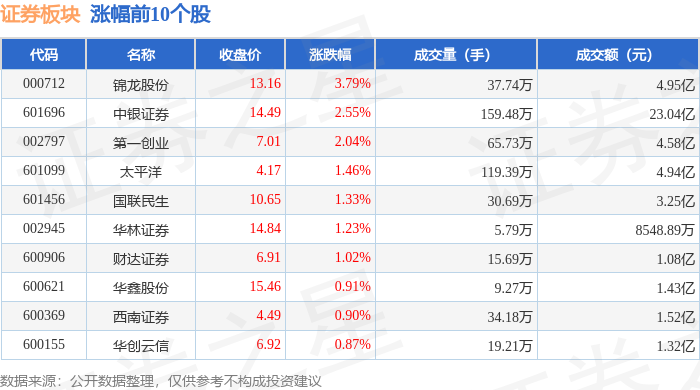
证券板块12月10日涨0.25%,锦龙股份领涨,主力资金净流出5.03亿元
Zheng Xing Xing Ye Ri Bao· 2025-12-10 09:10
Market Overview - On December 10, the securities sector rose by 0.25% compared to the previous trading day, with Jinlong Co., Ltd. leading the gains [1] - The Shanghai Composite Index closed at 3900.5, down 0.23%, while the Shenzhen Component Index closed at 13316.42, up 0.29% [1] Individual Stock Performance - Jinlong Co., Ltd. (000712) closed at 13.16, up 3.79% with a trading volume of 377,400 shares and a transaction value of 495 million yuan [1] - Bank of China Securities (601696) closed at 14.49, up 2.55% with a trading volume of 1,594,800 shares and a transaction value of 2.304 billion yuan [1] - First Venture (002797) closed at 7.01, up 2.04% with a trading volume of 657,300 shares and a transaction value of 458 million yuan [1] - Other notable stocks include Pacific Securities (6601099) up 1.46%, Guolian Minsheng (601456) up 1.33%, and Hualin Securities (002945) up 1.23% [1] Fund Flow Analysis - The securities sector experienced a net outflow of 503 million yuan from institutional investors, while retail investors saw a net inflow of 424 million yuan [2] - The overall market saw a net inflow of 79.24 million yuan from speculative funds [2] Detailed Fund Flow for Selected Stocks - Bank of China Securities (601696) had a net inflow of 22.7 million yuan from institutional investors, while it faced a net outflow of 34.66 million yuan from speculative funds [3] - Jinlong Co., Ltd. (000712) saw a net inflow of 61.78 million yuan from institutional investors, with a net outflow of 9.21 million yuan from speculative funds [3] - First Venture (002797) had a net inflow of 49.47 million yuan from institutional investors, with a net outflow of 11.32 million yuan from speculative funds [3]



广发证券:如何看待近期港股市场走势偏弱?
Zhi Tong Cai Jing· 2025-12-10 09:03
Group 1 - The core viewpoint of the report is that the Hong Kong stock market is more sensitive to external risks, particularly due to the unclear future interest rate path of the Federal Reserve and the upcoming peak of lock-up stock releases in December, which may lead to liquidity shocks [1][2] - The recent significant decline in the Hong Kong stock market is attributed to external factors, including Trump's dissatisfaction with Powell's statements on interest rate cuts, leading to a net outflow of foreign capital from emerging markets [1][2] - The Hong Kong market is facing a peak in lock-up stock releases, with a total of HKD 126 billion in lock-up stocks set to be released in December, which is expected to impact market sentiment negatively [2] Group 2 - Potential rebound time points are identified, with December's mid to late period being crucial due to the upcoming economic work conference and the Bank of Japan's interest rate statements, which could provide positive signals for the market [3] - The end of the lock-up stock peak in early January, combined with the latest Federal Reserve meeting minutes, could also create favorable conditions for liquidity if the interest rate path leans dovish [4] - Technical indicators suggest that the Hong Kong stock market has sufficient downward momentum, with the Hang Seng Index currently positioned between the 120-day and 250-day moving averages, indicating a potential for rebound [4]
