腾讯控股

Search documents
商家必看:微信私域运营从0到1落地指南,低成本实现复购翻倍
Sou Hu Cai Jing· 2026-02-13 11:22
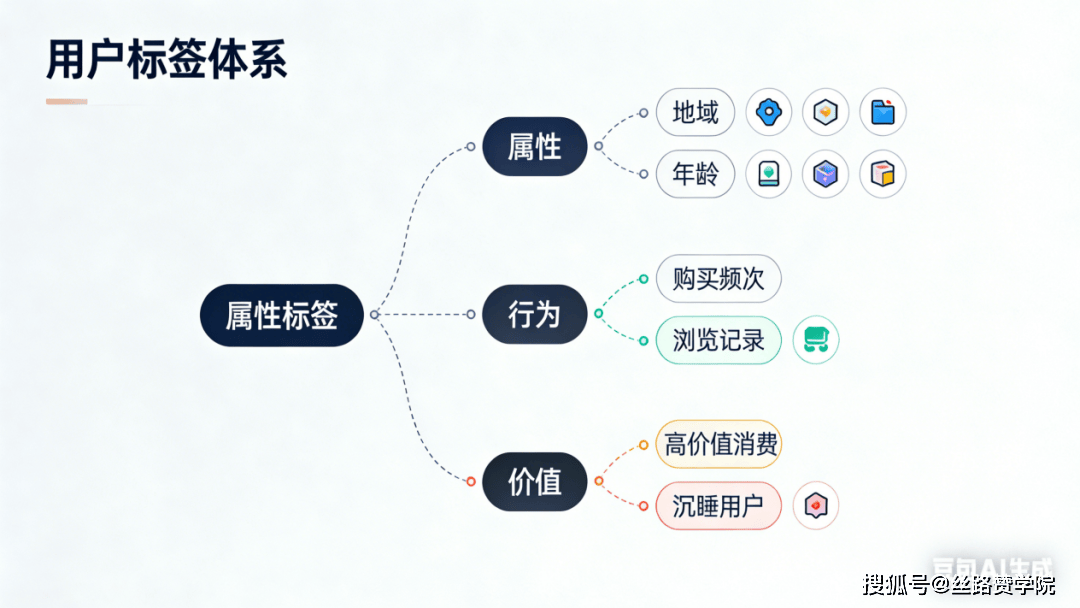
"投流烧钱加剧,新客成本翻倍,利润缩水""公域规则多变,用户资产流失快"……这是当下多数商家的共同困境。 流量红利消退后,私域已成商家沉淀用户、穿越周期的必选项。微信作为12亿+活跃用户的超级生态,是私域核心阵地,但不少商家仅停留在"拉群发广 告"阶段,收效甚微。 本文拆解一套可落地的微信私域运营方法论,从价值认知、执行步骤到避坑指南,帮你把微信用户转化为复购资产。 一、先搞懂,为什么微信私域是商家的"救命稻草"? 1.大幅降本增效 在流量成本居高不下的当下,私域运营的降本优势尤为突出。权威数据显示,老客维系成本仅为新客开发的1/7,这意味着商家无需在公域持续"烧钱抢 量",就能通过存量用户实现稳定收益。某连锁零售品牌的实战案例印证了这一点,其通过私域社群的老客复购运营,不仅让营销成本直降30%,还带动 整体利润率提升了12个百分点,这种"以老带新、以复购补增量"的模式,对资金有限的中小商家来说,远比盲目投流更稳妥、更可持续。 2.提升用户终身价值(LTV) 私域核心是延长用户生命周期,通过精准运营可让核心用户复购率提升40%、客单价增长25%,单客生命周期贡献可达单次消费的10倍以上。 引流核心是"全域收口 ...

智通港股通活跃成交|2月13日





智通财经网· 2026-02-13 11:02
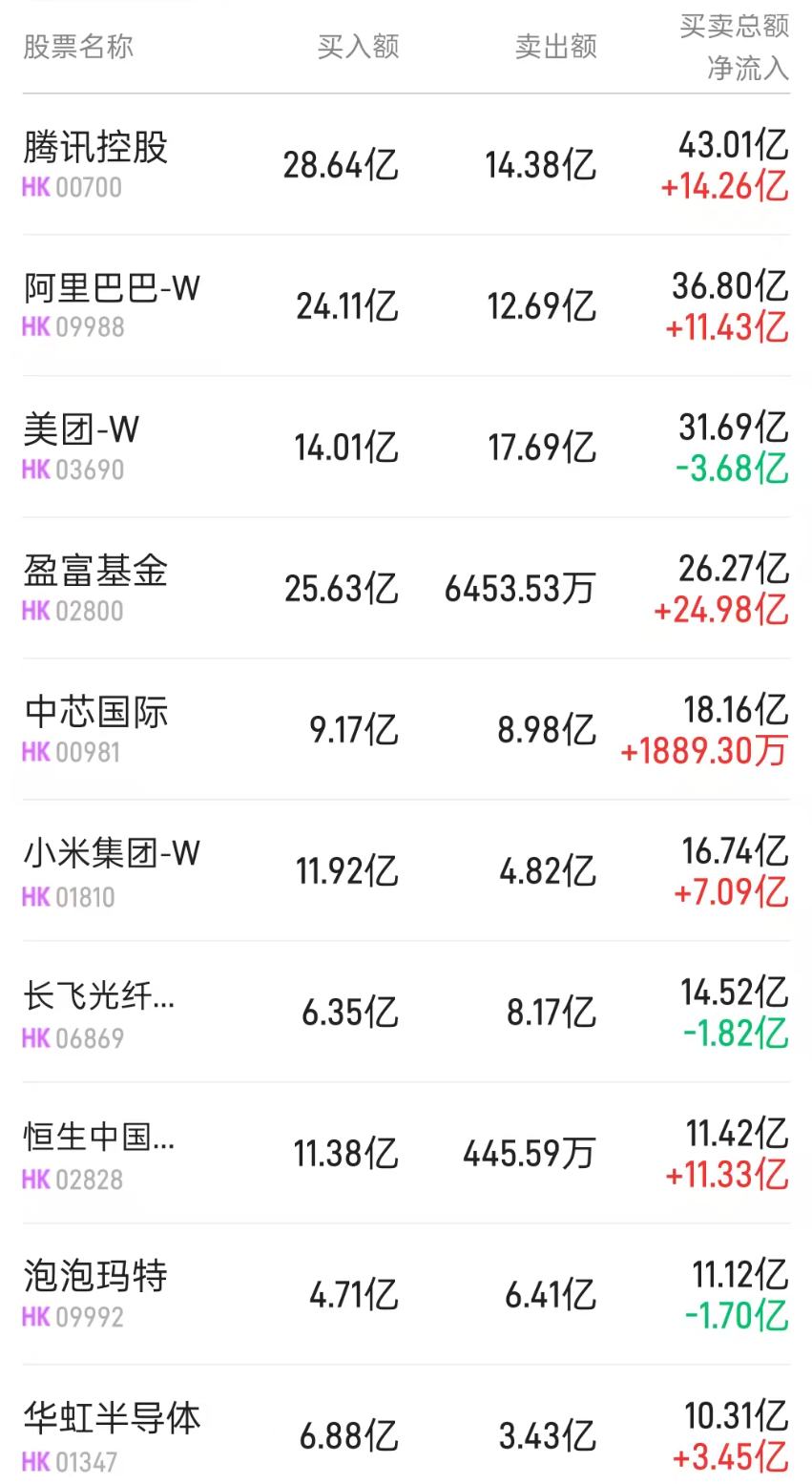
Group 1 - Tencent Holdings (00700), Alibaba-W (09988), and Meituan-W (03690) ranked as the top three companies in terms of trading volume on the Hong Kong Stock Connect (southbound) on February 13, 2026, with transaction amounts of 4.301 billion, 3.680 billion, and 3.169 billion respectively [1] - Tencent Holdings (00700), Alibaba-W (09988), and Meituan-W (03690) also led the trading volume on the Shenzhen-Hong Kong Stock Connect (southbound) with transaction amounts of 3.563 billion, 2.870 billion, and 1.460 billion respectively [1] Group 2 - The top ten active companies on the Hong Kong Stock Connect (southbound) included Tencent Holdings (00700) with a net buy of 1.426 billion, Alibaba-W (09988) with a net buy of 1.143 billion, and Meituan-W (03690) with a net sell of 0.368 billion [2] - On the Shenzhen-Hong Kong Stock Connect (southbound), Tencent Holdings (00700) had a net buy of 0.837 billion, Alibaba-W (09988) had a net buy of 1.156 billion, and Meituan-W (03690) had a net buy of 0.611 billion [2]
越秀证券每日晨报-20260213
越秀证券· 2026-02-13 10:39
Market Overview - The Hang Seng Index closed at 27,032, down 0.86% for the day and up 5.47% year-to-date [1] - The Hang Seng Tech Index fell 1.65% to 5,408, with notable declines in major tech stocks [5] - The A-share market saw the Shanghai Composite Index close at 4,134, up 0.05%, while the Shenzhen Component Index rose 0.86% to 14,283 [5] Currency Performance - The Renminbi Index stood at 98.340, increasing by 0.36% over the past month and 1.44% over six months [2] - The US Dollar Index decreased by 2.10% in the last month and 1.34% over six months [2] Commodity Prices - Brent crude oil rose by 10.06% over the past month, reaching $69.570 per barrel [3] - Gold prices increased by 10.36% in the last month, currently priced at $5,073.21 per ounce [3] Company News - Grab reported its first annual profit of $268 million, a significant turnaround from a loss of $105 million the previous year, with Q4 profit soaring 533% year-on-year [13] - SoftBank's investment in OpenAI has yielded substantial returns, with an estimated investment gain of $19.8 billion, contributing to a return to profitability for the company [14][15] - MINIMAX launched its new programming model, MiniMax M2.5, which is designed for high-performance coding and competes with top international models [16] Stock Performance - Zijin Mining rose by 3.45% to HKD 45.02, making it the best-performing blue-chip stock [19] - Budweiser Asia saw a decline of 5.21% to HKD 7.83, marking it as one of the worst performers [19] IPO Information - Recent IPOs include Xian Dao Intelligent, which debuted at HKD 43.80, and Aixin Yuan Zhi, which started at HKD 24.12, both showing varied performance in their initial trading days [26] Economic Indicators - Hong Kong's overall export volume increased by 21.6% year-on-year in December, with significant growth in exports to Taiwan and the US [10][11]
港股互联网ETF博时(159568)跌0.91%,成交额5962.44万元
Xin Lang Cai Jing· 2026-02-13 10:32
Core Viewpoint - The BoShi Hong Kong Internet ETF (159568) has shown a decline of 0.91% in its closing price on February 13, 2024, with a trading volume of 596.24 million yuan [1] Group 1: Fund Overview - The BoShi Hong Kong Internet ETF was established on February 8, 2024, with an annual management fee of 0.50% and a custody fee of 0.10% [1] - As of February 12, 2024, the fund has a total of 324 million shares and a total size of 536 million yuan [1] - The fund's share count increased by 27.57% and its size increased by 26.44% since December 31, 2025, when it had 254 million shares and a size of 424 million yuan [1] Group 2: Liquidity and Trading Activity - Over the last 20 trading days, the cumulative trading amount for the ETF reached 1.856 billion yuan, with an average daily trading amount of 92.80 million yuan [1] - In the year-to-date, the ETF has recorded a cumulative trading amount of 3.585 billion yuan over 30 trading days, with an average daily trading amount of 120 million yuan [1] Group 3: Fund Management and Holdings - The current fund manager, Li Qingyang, has managed the ETF since its inception, achieving a return of 66.36% during his tenure [2] - Major holdings in the ETF include Tencent Holdings (15.35%), Alibaba-W (14.43%), Xiaomi Group-W (13.96%), and Meituan-W (12.30%), among others [2] - The fund's top holdings account for significant portions of the total portfolio, with Tencent Holdings valued at approximately 65.03 million yuan [2]
蒸发1.43万亿,跌出了黄金坑?
3 6 Ke· 2026-02-13 10:08
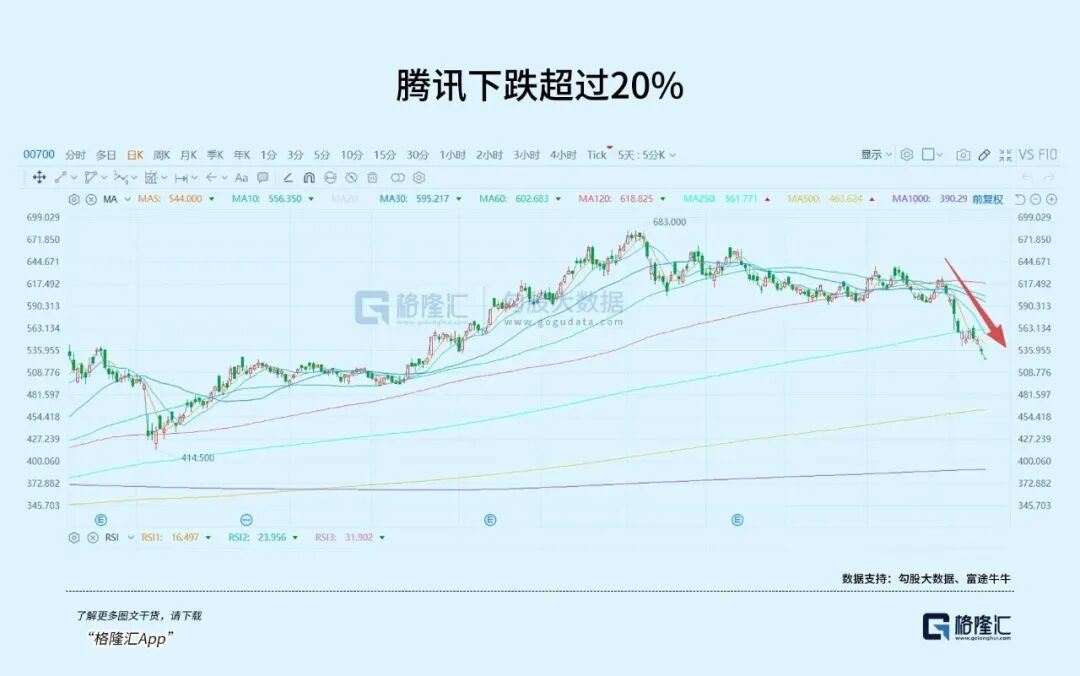
Group 1 - The last trading day before the Spring Festival saw A-shares close in the green, influenced by a significant drop in the US stock market and pre-holiday sentiment [1] - Investors may feel disappointed for missing the last market gains before the holiday, but the market will reopen in two weeks, providing an opportunity for reflection and strategy [2][3] Group 2 - Tencent's recent performance has been concerning, with a 23% decline from its peak in October 2025, resulting in a market cap loss of 1.43 trillion yuan [4] - The main factors for the decline include tax rumors and internal product competition, but the fundamental business remains unchanged, with a forward PE of approximately 15-16 times for 2026 [7] - Tencent's core business PE, excluding external investments, is around 13 times, aligning with an expected EPS growth of 12%-15% for 2026 [7] Group 3 - Tencent's valuation is supported by share buybacks and a stable dividend yield of 4-5%, making it attractive compared to high valuations of similar US tech stocks [8] - The recent strengthening of the RMB may accelerate the rebalancing of foreign investments into Tencent and similar companies [9][10] - Even if negative rumors materialize, they may only affect valuations rather than the underlying logic, with recent declines potentially setting the stage for a technical rebound [11] Group 4 - The AI industry is expected to undergo a fundamental shift by 2026, with a focus on application commercialization rather than just computational power [15][16] - Microsoft's Copilot has reached 52 million enterprise users, demonstrating a willingness to pay for AI solutions, which could serve as a benchmark for AI application commercialization [18] - In contrast to the US, China's AI application sector is at a critical point of penetration and valuation, with a significant increase in active users and usage time [22] Group 5 - The shift from linear to exponential revenue models in AI applications is a key driver for valuation restructuring, but A-shares have yet to fully account for this premium [25] - Institutional investors have been overweight in US AI applications for three consecutive years, while Hong Kong and A-shares remain underweight [26] - A potential "expectation gap" could lead to rapid valuation adjustments once it begins [27] Group 6 - Concerns are rising regarding the capital expenditure of major AI cloud computing firms, which have announced a total of $650 billion in spending, exceeding market expectations [30][31] - The market is worried that these high expenditures may impact profits and cash flow, leading to significant stock price declines [32] - The current environment is highly selective, with a shift from broad market optimism to a focus on substantial earnings growth, which could lead to sharp sell-offs if expectations are not met [36][38] Group 7 - The AI technology landscape in 2026 is expected to be volatile, with significant shifts in market dynamics [39] - Stability is considered a prudent strategy, focusing on fundamental and valuation factors to avoid poor investment decisions [40]
北水动向|北水成交净买入202.19亿 北水抢筹港股ETF及科技股 全天加仓盈富基金(02800)超36亿港元
智通财经网· 2026-02-13 09:57
智通财经APP获悉,2月13日港股市场,北水成交净买入202.19亿港元,其中港股通(沪)成交净买入114.77亿港元,港股通 (深)成交净买入87.43亿港元。 北水净买入最多的个股是盈富基金(02800)、阿里巴巴-W(09988)、腾讯(00700)。北水净卖出最多的个股是长飞光纤光缆 (06869)、中海油(00883)。 | 盈富基金 | 11.80亿 | 188.87万 | 11.82亿 | | --- | --- | --- | --- | | HK 02800 | | | +11.78亿 | | 南方恒生 ... | 11.51亿 | 2782.07万 | 11.79 亿 | | HK 03033 | | | +11.24 乙 | | 小米集团-W | 8.00亿 | 2.98亿 | 10.98 亿 | | HK 01810 | | | +5.02 乙 | | 长飞光纤 ... | 4.90亿 | 4.56亿 | 9.461乙 | | HK 06869 | | | +3338.34万 | | :: 洪烟田中 | 3.76亿 | 5.19 乙 | 8.95亿 | | HK 00883 | | | ...

一不小心,中国Ai造出了1670年的纽约
债券笔记· 2026-02-13 09:52
Group 1 - The article discusses the rapid development and impact of ByteDance's AI video generation model, Seedance 2.0, which has gained significant attention for its ability to accurately depict historical settings, such as 1670 Amsterdam [3][6] - The model has sparked excitement among users, allowing them to experience historical and fictional scenarios, which reflects the advancements in technology during the third industrial revolution [5][9] - The competitive landscape is shifting, with other major companies feeling threatened by ByteDance's innovations, as evidenced by Tencent's stock decline following the announcement of Seedance 2.0 [9][11] Group 2 - The article highlights the positive performance of the A-share market, particularly in cloud computing and computing power sectors, which are benefiting from increased AI usage [11] - A significant event mentioned is the successful implementation of a brain-computer interface clinical surgery in Guangxi, which could have far-reaching implications for patients with conditions like Parkinson's disease [11] - The article also touches on geopolitical developments, including joint military exercises by the US and Japan, which are perceived as a response to tensions in the Taiwan Strait [12]

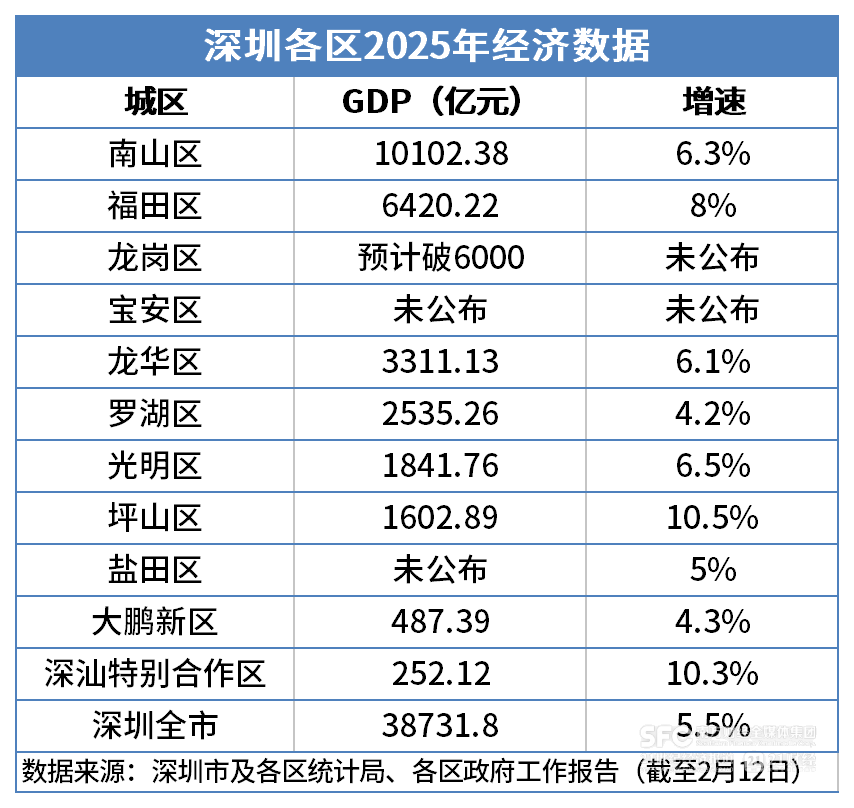
一区超万亿、两区超6千亿 这三区集中深圳近6成GDP
2 1 Shi Ji Jing Ji Bao Dao· 2026-02-13 09:33
Core Insights - The article highlights the economic growth of various cities in China, particularly focusing on Shenzhen, which has seen significant GDP increases and the emergence of new "trillion-yuan cities" [1][3]. Economic Growth and City Rankings - The number of cities with a GDP exceeding 1 trillion yuan is set to increase from 27 in 2024 to 29 in 2025, with Wenzhou and Dalian making the list [1]. - Beijing has joined the ranks of "5 trillion cities," while Shenzhen leads the four first-tier cities with a growth rate of 5.5%, aiming for a GDP exceeding 5 trillion yuan by 2025 [1]. District Performance in Shenzhen - Nanshan District has achieved a GDP of 10,102.38 billion yuan, becoming the first district in China to surpass the trillion-yuan mark [3][5]. - Futian and Longgang districts are also significant, with Futian's GDP reaching 6,420.22 billion yuan and Longgang expected to exceed 6,000 billion yuan [2][9]. - Nanshan contributes over 25% of Shenzhen's total economic output despite its small area of 185 square kilometers [3]. GDP Growth Rates - Among the districts, Pingshan (10.5%) and Shenshan (10.3%) have shown remarkable growth rates, focusing on high-value industries such as automotive and pharmaceuticals [10][11]. - The overall GDP of Shenzhen is projected to reach 38,731.8 billion yuan by 2025, with several districts outperforming the city average [2][10]. Sectoral Contributions - Nanshan is home to over 200 listed companies, contributing significantly to Shenzhen's economy, with a total market value expected to exceed 65 trillion yuan by 2025 [5][6]. - Futian's modern service sector is projected to grow, with a value of 4,754.98 billion yuan, accounting for 82.2% of its tertiary industry [6][7]. Industrial Focus and Innovation - Pingshan is concentrating on developing a "6+3" industrial cluster, focusing on smart connected vehicles, semiconductors, and biomedicine, with strategic emerging industries expected to account for 88% of its industrial output [11][12]. - The Shenshan Special Cooperation Zone is also leveraging the presence of BYD to enhance its automotive industry, with multiple projects set to launch by 2025 [12][13].
《明日方舟:终末地》5亿元登顶1月新游榜 《鹅鸭杀》第三
Nan Fang Du Shi Bao· 2026-02-13 09:30
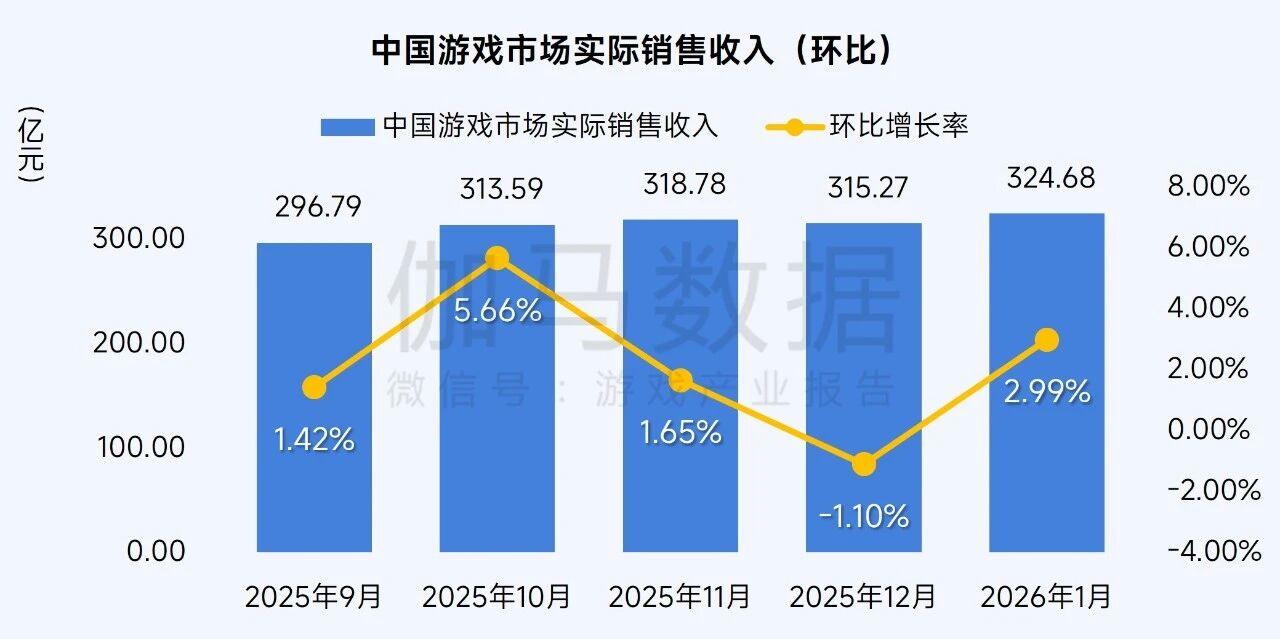
Core Insights - The Chinese gaming market showed a steady performance in January 2026, with actual sales revenue reaching 32.468 billion yuan, reflecting a month-on-month growth of 2.99% and a year-on-year growth of 4.47%, indicating a continuous positive growth trend [1] - The overseas sales revenue of domestically developed games in January was 2.077 billion USD, marking a significant year-on-year increase of 24.05% [1][12] Market Overview - The overall gaming market in China is stabilizing, supported by both established games and new releases, with a focus on policy adaptation, product iteration, and enhanced user operations [1] - The client game segment emerged as the largest growth highlight, with actual sales revenue of 8.236 billion yuan, showing a month-on-month increase of 7.77% and a year-on-year increase of 23.46% [5] Mobile Gaming Insights - The mobile gaming market experienced a "steady month-on-month increase but year-on-year pressure," with actual sales revenue of 22.621 billion yuan, reflecting a month-on-month growth of 1.8% but a slight year-on-year decline of 1.52% [7] - Major titles like "Honor of Kings" and "Peacekeeper Elite" contributed to revenue growth through content updates and new features, while competition and changing user demands led to declines in some older games [7][8] New Game Performance - New games performed well in January, with "Arknights: Endfield" leading the new game revenue chart with over 500 million yuan, leveraging its classic IP and innovative gameplay [10][12] - "Counter-Strike: Future" also performed strongly, benefiting from its established IP and cross-platform design, topping the iOS free chart on its launch day [12] International Market Dynamics - The overseas market for self-developed games remains a significant growth engine, with January's revenue at 2.077 billion USD, despite a slight month-on-month decline of 2.5% [12] - Successful titles like "Genshin Impact" and "Victory Peak" highlight the global competitiveness and innovation of Chinese games [12][14] Industry Trends - The gaming industry in China is characterized by "internal stability and external growth," with a resurgence in PC games and strong overseas performance injecting new momentum into the sector [16] - Product innovation, IP management, and refined user services are becoming core competitive elements across various segments [16]
港股收评:恒指下挫1.72%!黄金、保险股低迷,半导体逆势走强
Ge Long Hui· 2026-02-13 08:53
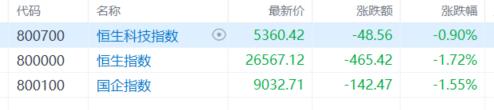
Market Overview - The Hong Kong stock market experienced a collective decline, with the Hang Seng Index falling by 1.72%, the Hang Seng Tech Index down by 0.9%, and the China Enterprises Index decreasing by 1.55% due to a significant drop in US stocks [1][2]. Sector Performance - Major technology stocks dragged the market lower, with Meituan and Baidu both dropping over 3%, Alibaba down over 2%, and other tech giants like JD.com, Kuaishou, NetEase, and Tencent also declining [2][5]. - Gold-related stocks saw a collective decline, with Zijin Mining falling over 7% [2][6]. - The financial sector weakened, with China Life Insurance dropping over 3% [2][10]. - Oil stocks also faced a downturn, with China Petroleum & Chemical Corporation down over 5% [2][9]. - Semiconductor stocks showed strength, with Aixin Yuan Zhi rising over 17% [2][12]. - The restaurant sector was active, with Jiu Mao Jiu increasing over 5% [2][13]. - Robotics stocks rose, with MicroPort Robotics gaining over 11% [2][15]. Notable Individual Stocks - Aixin Yuan Zhi surged by 17.16%, while other semiconductor stocks like Tian Shu Zhi Xin and Zhaoyi Innovation also saw significant gains [12]. - Jiu Mao Jiu in the restaurant sector rose by 5.09% [13]. - MicroPort Robotics in the robotics sector increased by 11.71% [15]. - Haizhi Technology Group debuted on the Hong Kong stock market with a remarkable increase of over 242% [17]. Capital Flows - Southbound funds recorded a net inflow of HKD 20.219 billion, with HK Stock Connect (Shanghai) net buying HKD 11.476 billion and HK Stock Connect (Shenzhen) net buying HKD 8.743 billion [19]. Future Outlook - Guolian Minsheng Securities suggests that historically, the Hong Kong market tends to show strong upward momentum during the Chinese New Year holiday, coupled with the current tech market catalyst and the inflow of funds due to the appreciation of the Renminbi [21].