格力电器

Search documents
财经早报:国办发文!扩范围、清障碍,促进民间投资13条来了,新能源赛道,利好来了!丨2025年11月11日
Xin Lang Zheng Quan· 2025-11-10 23:34
Group 1 - The U.S. has announced a suspension of the 301 investigation measures against China's shipbuilding industry, which includes halting port fees and tariffs on certain equipment, marking a step towards mutual cooperation between the U.S. and China [2] - The Chinese Ministry of Commerce responded positively to the U.S. announcement, indicating it as a significant move in implementing the consensus reached during the U.S.-China economic discussions [2] Group 2 - The Ministry of Industry and Information Technology plans to accelerate the cultivation of application scenarios in five key areas, including 5G and artificial intelligence, to enhance industrial capabilities [4][5] - The government has introduced 13 measures to promote private investment, focusing on expanding market access and ensuring fair competition, which aims to boost investment in emerging sectors [6] Group 3 - A strategic partnership has been established between CPE Yuanfeng and Burger King, with an initial investment of $350 million to support expansion and innovation in the Chinese market [11] - Gree Electric's CEO addressed concerns regarding the company's entry into the refrigerator market, emphasizing the commitment to quality and advanced manufacturing processes [12] Group 4 - The virtual power plant sector is set to benefit from favorable policies, indicating a shift towards large-scale development [13] - The demand for storage chips remains strong, with significant investments observed in several stocks since November [13]



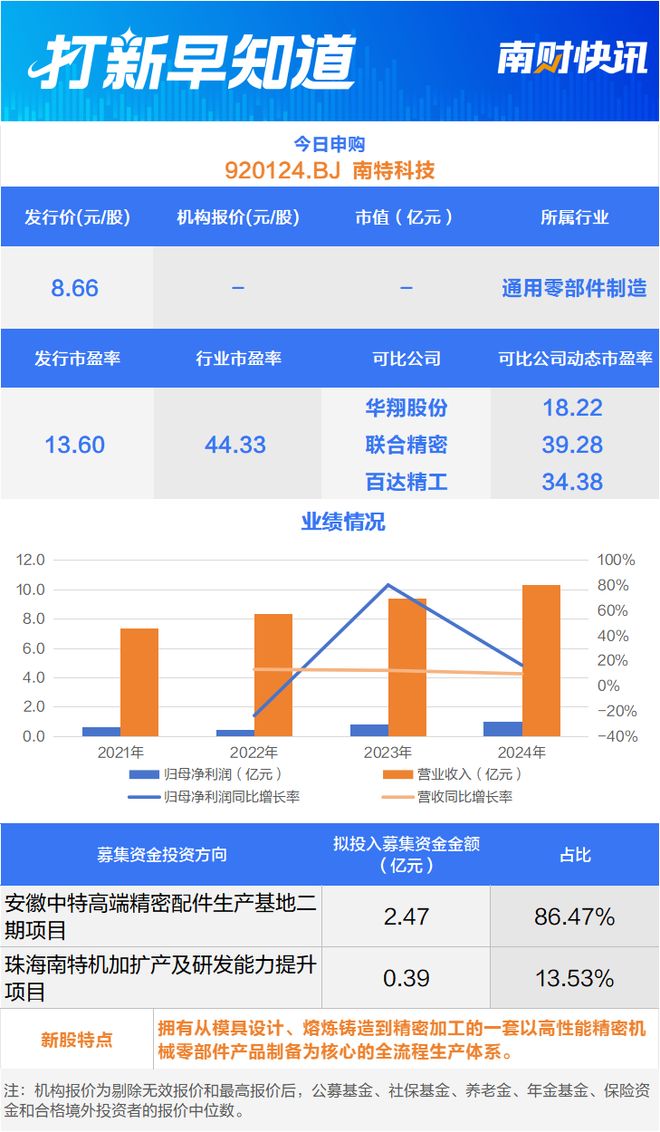
美的、格力撑起公司八成营收,精密机械领先企业今日申购丨打新早知道
2 1 Shi Ji Jing Ji Bao Dao· 2025-11-10 23:12
Core Viewpoint - Nantong Technology (920124.BJ) is set to be available for subscription on the Beijing Stock Exchange, focusing on the research, production, and sales of precision mechanical components, primarily for compressors and automotive parts [1] Group 1: Company Overview - Nantong Technology has received multiple honors, including being recognized as a specialized and innovative small and medium-sized enterprise in Guangdong Province and a national high-tech enterprise [1] - The company has established a comprehensive production system for high-performance precision mechanical components, capable of rapid production and delivery to meet diverse customer needs [4] Group 2: Financial Performance - From 2022 to 2024, Nantong Technology achieved revenues of 834 million yuan, 938 million yuan, and 1.031 billion yuan, with net profits of 47 million yuan, 84 million yuan, and 98 million yuan respectively [4] - In the first half of 2025, the company reported revenues of 573 million yuan and a net profit of 67 million yuan [4] Group 3: Market Position - Nantong Technology holds a 13.28% market share in the compressor component market, indicating a competitive advantage within the industry [4] - The company has established stable long-term partnerships with well-known enterprises such as Midea Group, Gree Electric, and Panasonic, receiving multiple supplier awards [4] Group 4: Investment Direction - The company plans to invest 2.47 billion yuan (86.47%) in the Anhui Zhongte high-end precision parts production base phase II project and 390 million yuan (13.53%) in the expansion and R&D capabilities of Zhuhai Nantong Machinery [3] Group 5: Risks - Nantong Technology faces risks related to a single product structure, as a significant portion of its revenue and profit is derived from sales to compressor manufacturers [5] - Although the company has the capability to produce for other downstream applications, these products have not yet gained substantial market share [5]
消费赛道复苏预期升温 多只消费股估值具备优势
Zheng Quan Shi Bao· 2025-11-10 23:10
Core Viewpoint - The consumer sector is experiencing a collective rebound, driven by government policies aimed at boosting consumption and supporting key industries [1][3]. Group 1: Market Performance - As of November 10, 2023, various consumer indices, including food and beverage, beauty care, and retail, have shown less than 10% growth year-to-date, underperforming the Shanghai Composite Index [2]. - The food and beverage sector has been the weakest performer, with its index in a downward trend for the year [2]. Group 2: Institutional Outlook - Institutions are becoming increasingly optimistic about the future performance of the consumer sector, with several brokerages identifying potential investment opportunities [3]. - Open Source Securities notes that the food and beverage sector is nearing a bottom, with recovery expectations rising as negative factors have largely been released and policy impacts are slowing [3]. - Huachuang Securities highlights that service consumption is in a transformative phase, with strong policy support expected to make it a key investment theme [3]. - Galaxy Securities emphasizes the importance of enhancing consumer power and expanding quality consumption supply during the 14th Five-Year Plan period, as new consumption trends emerge [3]. Group 3: Valuation and Stock Performance - Many consumer stocks are currently seen as undervalued, with 123 stocks having a rolling P/E ratio below 30 and underperforming the Shanghai Composite Index year-to-date [4]. - Notable large-cap stocks include Kweichow Moutai, Midea Group, and Wuliangye, among others [4]. - 23 stocks have seen a cumulative decline of over 10% this year, with Ganyuan Food experiencing the largest drop at 33.79% [4]. Group 4: Future Growth Potential - From an institutional perspective, 43 of the 123 identified consumer stocks have an upside potential exceeding 20% based on consensus target prices [5]. - Proya Cosmetics leads with a projected upside of 49.05%, supported by its international expansion plans [5]. - Xueda Education follows with an expected upside of 48.6%, driven by its clear business expansion strategy in personalized education [5][6].





美的、格力撑起公司八成营收 精密机械领先企业今日申购丨打新早知道
2 1 Shi Ji Jing Ji Bao Dao· 2025-11-10 23:06
Core Viewpoint - Nantong Technology (920124.BJ) is set to be available for subscription on the Beijing Stock Exchange, focusing on the research, production, and sales of precision mechanical components, particularly for compressors and automotive parts [1] Group 1: Company Overview - Nantong Technology has established a comprehensive production system centered on high-performance precision mechanical components, covering mold design, melting, casting, and precision processing [5] - The company has received multiple honors, including being recognized as a "National High-tech Enterprise" and a "Specialized and Innovative Small and Medium-sized Enterprise" in Guangdong Province [1] Group 2: Financial Performance - The company achieved revenues of 834 million yuan, 938 million yuan, and 1.031 billion yuan from 2022 to 2024, with net profits of 47 million yuan, 84 million yuan, and 98 million yuan respectively [5] - In the first half of 2025, Nantong Technology reported revenues of 573 million yuan and net profits of 67 million yuan [5] Group 3: Market Position - Nantong Technology holds a market share of 13.28% in the compressor component market, indicating a competitive advantage within the industry [5] - The company has established stable long-term partnerships with well-known enterprises such as Midea Group, Gree Electric, and Panasonic, contributing to over 80% of total revenue from sales to Midea and Gree in the first half of the year [5] Group 4: Risks - The company faces risks related to a single product structure, as its revenue and profits are primarily derived from sales to compressor manufacturers [6] - Although Nantong Technology has the capability to produce components for other downstream applications, these products have not yet gained significant market share [6]
A股申购 | 南特科技(920124.BJ)开启申购 深耕空调压缩机零部件领域
智通财经网· 2025-11-10 22:35
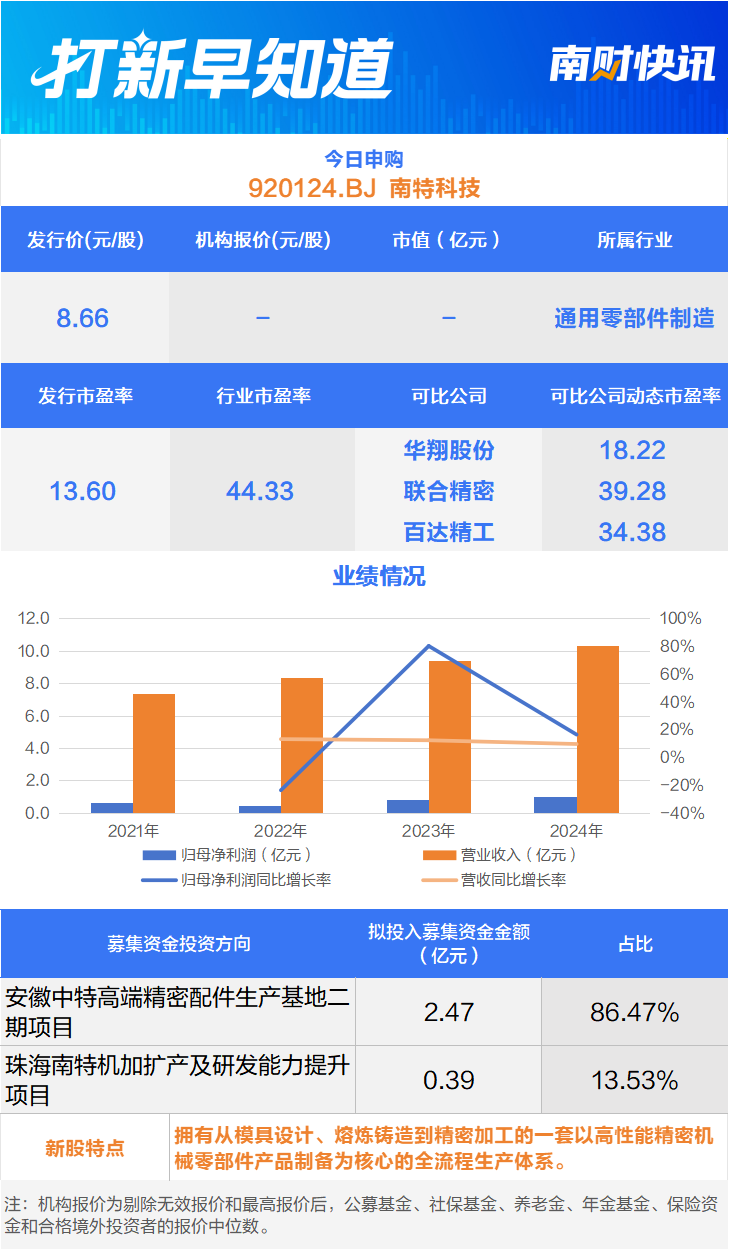
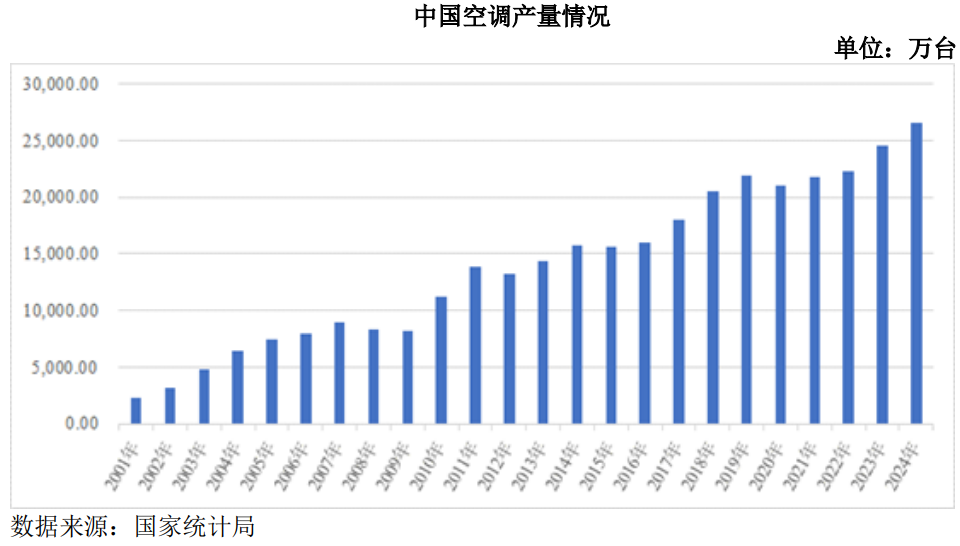
Company Overview - Nantong Technology (920124.BJ) has initiated its subscription on November 11, with an issue price of 8.66 CNY per share and a subscription limit of 1.6732 million shares, listed on the Beijing Stock Exchange with a price-to-earnings ratio of 13.60 times. Everbright Securities serves as its sponsor [1] - The company specializes in the research, development, production, and sales of precision mechanical components, focusing on air conditioning compressor parts, including cylinders, bearings, pistons, and crankshafts. It has established stable partnerships with four of the top five air conditioning compressor manufacturers, including Midea Group and Gree Electric [1] Industry Insights - According to the National Bureau of Statistics, China's total air conditioning production has grown from 23.13 million units in 2001 to 265.98 million units in 2024, with a compound annual growth rate of 11.20% from 2001 to 2024. The external sales of air conditioners have also shown significant growth, with household air conditioner exports reaching 69.586 million units in 2023, accounting for over 40% of total household air conditioner sales [2] Financial Performance - The company reported revenues of approximately 834 million CNY, 938 million CNY, and 1.031 billion CNY for the years 2022, 2023, and 2024, respectively. Net profits for the same years were approximately 46.64 million CNY, 84.19 million CNY, and 98.22 million CNY [4] - As of June 30, 2025, the total assets amounted to approximately 1.79 billion CNY, with total equity of about 737 million CNY. The company's asset-liability ratio stands at 36.32%, and the gross profit margin is 25.46% [5] - The company has maintained a high inventory turnover rate, with rates of 4.94 times, 5.41 times, and 5.86 times for the years 2022, 2023, and 2024, indicating low risk of inventory backlog [5][6] Competitive Position - Nantong Technology's inventory turnover speed is slightly higher than its industry peers, attributed to its production model based on sales orders, which minimizes excess inventory. The company benefits from a concentrated supply chain and customer base, leading to shorter procurement and sales cycles [6]
消费赛道复苏预期升温多只消费股估值具备优势
Zheng Quan Shi Bao· 2025-11-10 18:20
Core Viewpoint - The consumer sector is experiencing a collective rebound, driven by government policies aimed at boosting consumption and supporting key industries [1][3]. Group 1: Market Performance - As of November 10, 2023, various consumer indices, including food and beverage, beauty care, and retail, have shown less than 10% growth year-to-date, underperforming the Shanghai Composite Index [2]. - The food and beverage sector has been the weakest performer, with its index in a downward trend for the year [2]. Group 2: Institutional Optimism - Institutions are gradually becoming optimistic about the future performance of the consumer sector, with several brokerages identifying potential investment opportunities [3]. - Open Source Securities notes that the food and beverage sector is nearing a bottom, with recovery expectations rising as negative factors have largely been released and policy impacts are slowing [3]. - Huachuang Securities highlights that service consumption is in a transformative phase, supported by strong policy guidance, making it a promising investment focus [3]. - Galaxy Securities emphasizes the importance of enhancing consumer power and expanding quality supply during the 14th Five-Year Plan period, with new consumption trends emerging as key growth points [3]. Group 3: Valuation Advantages - Many consumer stocks currently exhibit valuation advantages, with 123 stocks having a rolling P/E ratio below 30 and underperforming the Shanghai Composite Index year-to-date [4]. - Notable large-cap stocks include Kweichow Moutai, Midea Group, and Wuliangye, among others [4]. - 23 stocks have seen a cumulative decline of over 10% this year, with Ganyuan Food experiencing the largest drop at 33.79% [4]. Group 4: Upside Potential - From an institutional perspective, several consumer stocks with low rolling P/E ratios have significant upside potential, with 43 stocks projected to rise over 20% [5]. - Proya Cosmetics leads with a projected upside of 49.05%, supported by its international expansion plans [5]. - Xueda Education follows with an expected increase of 48.6%, driven by its clear business expansion strategy in personalized education [5][6].
珠海国资出让*ST宝鹰控制权,罕见“反向”操作背后的地方国资新思路
Mei Ri Jing Ji Xin Wen· 2025-11-10 11:24
Core Viewpoint - The control transfer of *ST Baoying from state-owned enterprise to private enterprise is a strategic move reflecting the changing dynamics of local state-owned assets management and the need for operational revitalization in the construction decoration industry [1][9]. Group 1: Transaction Structure - The transaction involves a combination of share transfer, voting rights relinquishment, and a directed issuance of shares, ensuring a smooth transition of control [2][3]. - The controlling shareholder, Dahongqin Group, plans to transfer 75.96 million shares (5.01% of total shares) to the newly established company, Shitong Niu, at a minimum price of 4.67 yuan per share, totaling approximately 355 million yuan [2]. - Following the transaction, Shitong Niu will hold approximately 25.74% of *ST Baoying's shares, making it the new controlling shareholder [2]. Group 2: Strategic Implications - The transaction is designed to benefit multiple parties: Dahongqin Group can realize a premium on its investment while retaining a significant stake for future value enhancement; Shitong Niu gains control with a relatively low capital outlay, and *ST Baoying can raise about 800 million yuan through the directed issuance to improve liquidity and reduce debt [3][5]. - The introduction of private capital is expected to activate operational mechanisms within *ST Baoying, providing new management approaches and industry resources to revitalize the company [5][9]. Group 3: Risk Management - The transaction includes a conditional control transfer mechanism, ensuring that both parties maintain a close shareholding ratio, which allows for risk management and value enhancement [4]. - Shitong Niu commits to achieving a net profit of no less than 400 million yuan over three years, with penalties for non-compliance, ensuring alignment of interests between the new controlling shareholder and the company [4][6]. Group 4: Background and Context - The move by Zhuhai State-owned Assets Supervision and Administration Commission to divest from *ST Baoying aligns with broader trends in state-owned enterprise reform, focusing on optimizing asset quality and efficiency [7][8]. - The construction decoration industry, being a traditional sector, does not align with the strategic direction of Zhuhai's state-owned assets, prompting the decision to exit this non-core business [8][9].

年终重头戏,抢最后一轮“国补”
Feng Huang Wang· 2025-11-10 10:47
Core Insights - The national subsidy program has generated significant consumer interest, with discussions on social media highlighting both excitement and anxiety over obtaining subsidies [2][3] - The program has distributed a total of 300 billion yuan in subsidies for the year, with the final batch of 69 billion yuan announced on September 30, marking a temporary end to the consumption stimulus plan [2][3] - The effectiveness of the subsidy program is diminishing, as evidenced by a slowdown in retail sales growth since May, particularly in the automotive and home appliance sectors [3][20] Automotive Industry - The automotive sector has been the largest beneficiary of the subsidy program, with 4.12 million applications for vehicle trade-ins, accounting for 38%-51% of the total subsidy funds [16][17] - Sales of A00 and A0 class electric vehicles have surged by over 85% due to the subsidies, while traditional fuel vehicle sales have declined [6][16] - BYD has emerged as a leading player, reporting a 23.3% year-on-year revenue increase to 371.3 billion yuan in the first half of 2025, while other manufacturers face profit declines due to intense price competition [7][16] Home Appliance Industry - The home appliance sector has seen a significant recovery, with major companies like Midea, Haier, and Gree reporting profits exceeding 10 billion yuan in the first half of 2025 [17][18] - The subsidy program has led to a structural upgrade in the home appliance market, with smart and energy-efficient products experiencing substantial sales growth [18][20] - The overall retail sales growth in the home appliance sector is expected to slow down after the initial subsidy impact, as the market approaches saturation [20] 3C Products Industry - The introduction of subsidies for 3C products, including smartphones and tablets, has led to a shift in consumer preferences towards mid-to-high-end models priced between 3,000 and 6,000 yuan [8][18] - Xiaomi has capitalized on the subsidy program, achieving a 40% year-on-year increase in smartphone shipments in the first quarter of 2025, regaining the top market share position [8][9] - Apple has also benefited from the subsidy program, reporting a 4.4% year-on-year revenue increase in the Greater China region in the second quarter of 2025, despite overall market declines [9][20] E-commerce Platforms - E-commerce platforms have faced challenges in capitalizing on the subsidy program, with JD.com emerging as the most successful due to its direct engagement with local governments and efficient supply chain [10][11] - Pinduoduo has struggled to leverage the subsidies effectively, reporting a 47% decline in net profit, as its business model limits participation in the subsidy program [11][14] - The effectiveness of subsidy distribution varies significantly across regions, with economically developed areas benefiting more than less developed regions [21][22] Regional Disparities - The implementation of the subsidy program has highlighted regional disparities, with urban and higher-income consumers benefiting more than rural and low-income groups [21][22] - Different regions have adopted various strategies to enhance participation in the subsidy program, with some areas successfully increasing consumer engagement through targeted initiatives [21][26] - The distribution of subsidy funds is influenced by local economic conditions, with wealthier regions able to utilize funds more effectively than poorer areas [22][26]





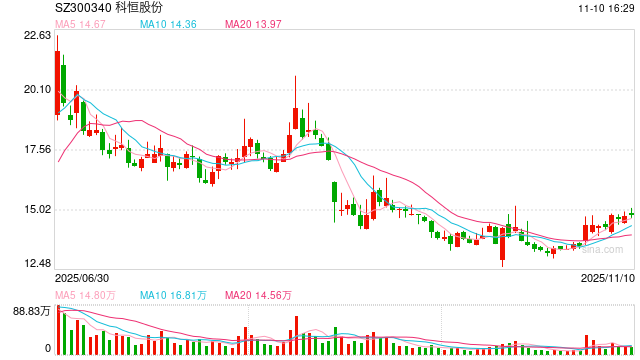
科恒股份大股东2亿债转股背后:负债率103%面临退市风险 “格力系”折戟新能源赛道
Xin Lang Zheng Quan· 2025-11-10 09:53
Core Viewpoint - The announcement from Keheng Co., Ltd. regarding the capital increase by its affiliate, Zhuhai Gree Supply Chain Management Co., Ltd., highlights the ongoing financial struggles of its subsidiary, Shenzhen Haoneng Technology Co., Ltd., which is heavily reliant on the troubled client, Zhuhai Yinlong New Energy Co., Ltd. [2][4][10] Group 1: Company Financials and Performance - Keheng Co., Ltd. has faced continuous losses since acquiring Haoneng Technology in 2016, with significant financial strain exacerbated by the downturn of its core client, Zhuhai Yinlong [6][7] - Haoneng Technology reported losses of 2.44 billion, 510 million, 1.33 billion, 2.50 billion, and 980 million from 2020 to 2024, with an additional loss of 810 million in the first half of this year [7] - Keheng Co., Ltd. is at risk of delisting due to negative net assets, with a debt ratio reaching 103% by the end of Q3 2025, indicating severe financial distress [12][15] Group 2: Strategic Moves and Investments - Gree Supply Chain plans to convert a 200 million debt into equity in Haoneng Technology, acquiring a 33.21% stake, as part of efforts to alleviate financial burdens on Keheng Co., Ltd. [2][4] - Gree Electric's acquisition of a stake in Zhuhai Yinlong for 1.828 billion in 2021 has not improved the financial situation of either company, with ongoing losses reported [10][11] - The Gree Group's strategy to inject capital into Keheng Co., Ltd. through various funding rounds has yet to yield positive operational results, raising questions about the effectiveness of these interventions [11][12]

董明珠回应格力跨界做冰箱遭质疑
Zheng Quan Shi Bao· 2025-11-10 09:48
Core Viewpoint - Gree's decision to enter the refrigerator market is driven by a commitment to quality and innovation, as emphasized by its CEO Dong Mingzhu, who highlights the company's investment in fully automated manufacturing processes [2] Group 1: Company Strategy - Gree aims to differentiate its refrigerator products by developing a fully automated factory, which is designed entirely in-house to ensure advanced quality control [2] - The company is willing to invest more in production costs to guarantee the quality of its products across various categories, including air conditioners, refrigerators, and washing machines [2] Group 2: Market Response - There is skepticism among consumers regarding Gree's move into the refrigerator market, which Dong Mingzhu addresses by stating that simply following market trends would not lead to the creation of high-quality products [2]