
谷歌

Search documents
中国市场归0,套现70亿,被做空,黄仁勋指望“炸鸡外交”
首席商业评论· 2025-11-05 05:08
Core Viewpoint - The article discusses the recent developments surrounding Nvidia, highlighting the significant cashing out by its founder Jensen Huang, the bearish stance taken by investor Michael Burry, and the implications of these actions on Nvidia's market position amidst a changing landscape in AI and chip supply chains [2][3][7]. Group 1: Jensen Huang's Cashing Out - Jensen Huang has sold over $1 billion worth of Nvidia shares since June, indicating a strategic plan to reduce his holdings, which aligns with SEC Rule 10b5-1 that allows executives to pre-arrange stock trades [4][9]. - Huang's total cashing out since 2001 exceeds $2.9 billion, and despite the recent sales, he still holds 3.5% of Nvidia's shares, which remain valuable [11]. - The broader executive team at Nvidia has also been selling shares, with insider sales exceeding $2 billion in 2024, significantly higher than the $462 million in 2023 [11]. Group 2: Nvidia's Financial Performance - Nvidia reported a second-quarter revenue of $46.743 billion, a 56% year-over-year increase, surpassing market expectations, although data center revenue was slightly below analyst predictions [12]. - The ongoing demand for AI technology is driving significant investments from major tech companies, with Microsoft, Google, and Meta planning to invest substantial amounts in AI infrastructure [12]. Group 3: Strategic Alliances and Market Position - Huang's recent diplomatic efforts in South Korea, including a meeting with Samsung and Hyundai, resulted in Nvidia securing a deal to supply over 260,000 Blackwell chips to South Korea, increasing their presence in the region [19][24]. - The collaboration with South Korean firms aims to solidify Nvidia's position as an indispensable supplier in the AI market, especially as competition from self-developed AI chips by cloud giants intensifies [22][24]. Group 4: Market Concerns and Future Outlook - Despite Nvidia's strong fundamentals, concerns about overvaluation are rising, with some analysts drawing parallels to the dot-com bubble, suggesting that the current market enthusiasm may not be sustainable [30][32]. - The loss of market share in China due to U.S. export restrictions has severely impacted Nvidia, with its share in the Chinese AI chip market plummeting from 95% to nearly zero, leading to significant revenue losses [26][28]. - Investor sentiment is shifting, as evidenced by Michael Burry's bearish position on Nvidia, indicating a growing caution among market participants regarding the sustainability of Nvidia's high valuation [4][32].


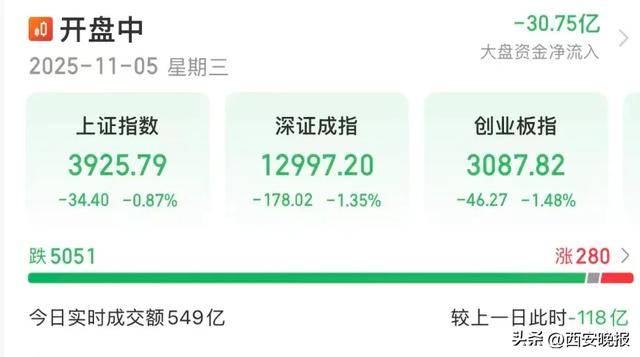
超5000只股票下跌
Sou Hu Cai Jing· 2025-11-05 03:49
Market Overview - On November 4, US stock indices fell across the board, with the Nasdaq dropping over 2% and the Dow Jones, Nasdaq, and S&P 500 indices closing down by 0.53%, 2.04%, and 1.17% respectively [6][7] - The total market capitalization of major US tech companies decreased by approximately 450 billion USD, equivalent to about 3.2 trillion RMB [7][6] Asian Market Reaction - Following the decline in US tech stocks, Japanese and South Korean markets opened significantly lower, with the Nikkei 225 index plummeting over 1200 points, a drop of 2.4% [6] - The South Korean Kospi 200 index futures fell more than 5%, triggering the "Sidecar" mechanism to pause programmatic trading for 5 minutes [3] Tech Sector Performance - Major tech stocks such as Tesla, Nvidia, Google, Amazon, META, and Microsoft all experienced declines, with Tesla down over 5% and Nvidia nearly 4% [7][5] - Concerns about overvaluation in US tech stocks, particularly in AI and semiconductor sectors, have led some investors to take profits [5] Investor Sentiment - Notable figures like hedge fund manager Michael Burry disclosed purchasing put options on Palantir and Nvidia, which heightened market anxiety [5] - Statements from CEOs of Goldman Sachs and Morgan Stanley indicated potential market corrections of 10% to 20% in the next 12 to 24 months, further dampening investor confidence [5] Federal Reserve Signals - Divergent signals from Federal Reserve officials regarding future interest rate cuts have negatively impacted market sentiment, with some officials expressing caution due to persistent inflation [5]
苹果放下身段?传明年推平价Mac,售价或低于1000美元
Jin Shi Shu Ju· 2025-11-05 03:25
Core Viewpoint - Apple is preparing to enter the low-cost laptop market with a budget version of the Mac aimed at consumers currently using Chromebooks and entry-level Windows laptops [1][2]. Group 1: Product Development - The new device, codenamed J700, is in active testing and has entered early production stages with overseas suppliers, aiming for a launch in the first half of next year [1]. - The laptop will be priced below $1,000 by using lower-cost components, featuring an iPhone processor and a smaller LCD screen than the MacBook Air [2]. - This will mark the first time Apple uses an iPhone processor in a Mac, although internal tests indicate that the performance of this smartphone chip surpasses that of the older M1 chip [2]. Group 2: Market Strategy - Apple's strategic shift comes in response to the rising threat from Chromebooks, which are gaining market share in North America [1]. - The new Mac's price point will be competitive with Apple's entry-level iPad, which is popular in the education sector, potentially attracting students and general consumers [3]. - Currently, Apple holds about 9% of the global PC market, ranking fourth behind Lenovo, HP, and Dell, all of which sell Windows or ChromeOS devices [3]. Group 3: Financial Performance - The Mac business has become Apple's fastest-growing hardware segment, with revenue growth of 13% reaching $8.73 billion last quarter [3]. - Future product plans include multiple new releases by 2026, such as the low-cost Mac, the M5 MacBook Air, and MacBook Pro models with M5 Pro and M5 Max chips [4].
“大空头”原型做空英伟达与Palantir,美股科技股集体收跌
Guan Cha Zhe Wang· 2025-11-05 03:24
当地时间周二,人工智能软件企业Palantir的首席执行官Alex Karp公开抨击卖空势力,并特别点出电影 《大空头》原型人物迈克尔·伯里(Michael Burry)的名字。 此前曝光的文件表明,伯里旗下基金已对Palantir与英伟达这两大AI行业龙头实施了做空布局。 上周五,伯里已在社交平台X上释放了明确信号,他分享了《大空头》中饰演自己的演员克里斯蒂安·贝 尔神情错愕注视电脑屏幕的剧照,并配文称:"有时,我们能察觉泡沫的存在。有时,我们能采取行动 应对。有时,唯一的获胜方式就是选择不参与。" 而本周一披露的信息则证实,他并非仅停留在口头警告层面,其管理的Scion资产管理公司正动用巨资 进行空头布局。 伯里还通过推文附带的图表进一步阐述其观点,他对比了Alphabet、亚马逊与微软在2018至2022年云业 务板块的增长态势与当前阶段的差异,暗指当前AI热潮的投资回报率远未达市场预期。这一论调与市 场上与日俱增的忧虑形成呼应:如同互联网泡沫初期对光纤领域的大规模过度投资,当前AI泡沫中的 头部企业未来或许可能遭遇崩盘危机。 具体来看,根据本周的一份证券公告,迈克尔·伯里已买入英伟达和Palantir ...

海内外云厂商发展与现状(二):AI投入、算力建设梳理与ROI测算-20251105
Guoxin Securities· 2025-11-05 02:59
Investment Rating - The report maintains an "Outperform" rating for the industry [1] Core Insights - The capital expenditure (Capex) of cloud service providers is expected to grow significantly, with overseas companies starting to increase investments from Q3 2023, while domestic companies are expected to follow a year later. Both markets are currently experiencing over 50% year-on-year growth in Capex [2][4][7] - Major cloud providers like Microsoft, Amazon, and Alibaba are investing heavily in AI infrastructure, with Capex amounts comparable to their annual cloud revenues. This indicates a shift towards a capital-intensive model to capture market share in AI [2][12] - The report highlights that cloud service providers contribute approximately 50% of Nvidia's data center revenue, with global data center investments projected to reach $600 billion by 2025 and potentially $3-4 trillion by 2030 [2][36] Summary by Sections 01 Capital Expenditure Review - Overseas cloud providers are accelerating Capex, with Microsoft leading the charge, followed by Google, Amazon, and Meta. Domestic providers are expected to see significant growth starting mid-2024 [6][9] - In 2025, major overseas players are projected to have Capex growth rates exceeding 50%, with Microsoft at approximately $116 billion, Amazon at $125 billion, and Google at $910-930 billion [9][10] 02 Cloud Providers' Computing Power and Construction Plans - Microsoft plans to increase its AI capacity by over 80% in the upcoming fiscal year, aiming to double its data center scale to about 10GW within two years [2][40] - Google is expected to invest over $170 billion from 2023 to 2025, focusing on both GPU and TPU chips [2] - Amazon's AWS aims to double its computing power by the end of 2027, with significant investments in self-developed AI chips [2] 03 Cloud Providers' Self-Developed Chip Layout and Progress - The report notes that ASIC products are expected to see a concentrated rollout in the coming years, with Nvidia currently holding over 80% of the market share in terms of actual computing power [2] 04 AI Cloud Revenue, ROI Measurement, and Valuation - The AI cloud business is projected to become cash flow positive by 2030, with a return on invested capital (ROIC) expected to exceed 10% [2] - The report recommends investing in AI cloud platform providers such as Microsoft, Google, Amazon, Alibaba, Tencent, and chip supplier Nvidia due to the rapid growth in AI-related demand [2]
英伟达市值一夜蒸发1.4万亿元,CEO黄仁勋此前刚完成10亿美元减持计划
Xin Lang Cai Jing· 2025-11-05 01:13
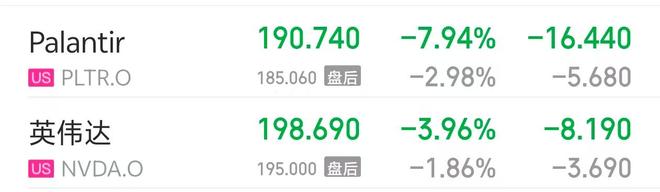
来源:智通财经 当地时间11月4日,美股三大指数集体回调,全线收跌。大型科技股普跌,其中,英伟达跌近4%,市值 一夜蒸发1990亿美元(约合人民币14188亿元),英特尔跌超过6%,特斯拉跌超5%,谷歌跌超2%,亚 马逊、Meta跌超1%。 自10月29日创下历史新高后,英伟达股价一路回落,这已是近期的第5连跌。截至11月5日收盘,英伟达 股价报收198.69美元/股,总市值约4.83万亿美元,跌破5万亿美元。 此时距离英伟达市值首次突破5万亿刚刚过去4天。 美东时间10月29日美股开盘,英伟达高开高走,涨幅扩大至5%,再创历史新高,最高摸到212.19美元/ 股,总市值达到5.156万亿美元,成为全球首家市值突破5万亿美元的公司,单日增加市值超2500亿美 元。 市场消息面上,AI热潮助推美股估值一路飞升,市场开始担忧高估值是否已经形成泡沫?高盛和大摩 CEO齐发预警,称美股估值太高了,可能出现至少10%回调。高盛董事长兼CEO苏德巍11月4日出席国 际金融领袖投资峰会时表示,目前科技股的估值已经"见顶",未来12到24个月内,股市很可能会出现 10%到20%的回撤。摩根士丹利首席执行官Ted Pick也称 ...

美政府“停摆”将破纪录!纳指跌近500点,英伟达市值一夜蒸发1.4万亿元,比特币跌破10万美元超40万人爆仓
Mei Ri Jing Ji Xin Wen· 2025-11-05 00:58
Group 1 - The U.S. Senate failed to pass a temporary funding bill, leading to a prolonged government shutdown that may break the previous record of 35 days set in late 2018 to early 2019 [1][4] - The main contention between the Democratic and Republican parties revolves around healthcare spending, particularly related to the Affordable Care Act, which has resulted in significant premium increases for insurance plans [3][4] - Approximately 1.3 million air traffic controllers and 50,000 airport security personnel are working without pay due to the shutdown, raising concerns about air safety and potential airspace closures [8] Group 2 - Major U.S. stock indices experienced declines, with the Nasdaq dropping 486.08 points (2.04%), reflecting investor concerns over high valuations in the tech sector [8][9] - Notable declines in large tech stocks included a more than 6% drop in Intel and over 5% in Tesla, which saw a market value loss of $80.2 billion (approximately 571.8 billion RMB) [9] - The Nasdaq China Golden Dragon Index fell by 2.05%, with significant drops in various Chinese concept stocks, indicating a broader market sell-off [12]
斥巨资买了一大堆芯片,AI会成功吗?
半导体行业观察· 2025-11-05 00:56
Core Insights - The article discusses the unprecedented AI boom, predicting that by the end of this decade, trillions of dollars will be invested in building and equipping thousands of new data centers to support the next generation of AI technologies [2] Investment Trends - HSBC estimates a planned investment of $2 trillion in AI data centers, while Citigroup projects this could reach $2.8 trillion by the end of 2029 [2] - ABI Research anticipates nearly 2,300 new data centers will be built globally by 2030, with JLL estimating $60 billion in data center construction spending in 2024, growing at an annual rate of 15% [2] New AI Data Centers - Samsung announced the construction of a new AI factory to house 50,000 NVIDIA chips, aimed at creating a real-time digital twin model for operational planning [4] - Digital Realty is collaborating with NVIDIA to build a 96 MW AI factory in Northern Virginia, expected to be operational by 2026 [4] - Oracle and OpenAI's Stargate Alliance is developing a $7 billion data center in suburban Detroit [4] - Google plans to invest $4 billion in a new data center in West Memphis, Arkansas [4] - Meta revealed plans to spend $27 billion on a 2 GW data center in Louisiana, significantly increasing its initial budget [5] - AWS launched a new $11 billion data center in Indiana for training AI models [5] Market Dynamics - NVIDIA has become the largest beneficiary of the AI boom, with a market capitalization exceeding $5 trillion, surpassing the GDP of all countries except the US and China [7] - Major tech companies are significant investors in AI, with NVIDIA, AMD, and Intel investing in firms like OpenAI and Anthropic [7] - The demand for blue-collar workers is increasing due to AI development, as stated by OpenAI, which predicts a need for more electricians, mechanics, and skilled tradespeople [8] Financial Performance - Alphabet is expected to invest $93 billion in capital expenditures primarily for AI this year, with a 16% stock price increase following its Q3 earnings report [9] - Meta plans to increase its capital expenditures to $97 billion but faced a 7% stock price drop after announcing its AI investments [9][10] Future Outlook - The sustainability of AI investments depends on whether companies can achieve good returns on their substantial investments [8] - If more companies can achieve measurable results like Google, investor confidence may grow, but a scattergun approach like Meta's could lead to skepticism and reduced spending [10]

美政府“停摆”将破纪录!纳指跌近500点,英伟达市值一夜蒸发1.4万亿元,比特币跌破10万美元,加密货币超40万人爆仓
Mei Ri Jing Ji Xin Wen· 2025-11-05 00:07
Group 1 - The U.S. Senate failed to pass a temporary funding bill, leading to an ongoing government shutdown that may become the longest in U.S. history, surpassing the previous record of 35 days from late 2018 to early 2019 [1][3] - The primary contention between the Democratic and Republican parties revolves around healthcare spending, particularly related to the Affordable Care Act, which has resulted in significant increases in insurance premiums [3][5] - Approximately 4 million Americans may lose their health insurance due to the inability of both parties to reach an agreement on government subsidies [3] Group 2 - The ongoing government shutdown has led to approximately 13,000 air traffic controllers and 50,000 airport security personnel working without pay, exacerbating staffing shortages and safety concerns in air travel [8] - The stock market reacted negatively to the shutdown, with major indices experiencing declines; the Nasdaq fell by 486.08 points (2.04%), and significant losses were observed in major tech stocks like Intel and Tesla [8][9] - The market sell-off was partly triggered by a sharp decline in AI-related stocks, raising concerns about overvaluation in the tech sector [10][11]
刚刚,全线崩跌!投资大佬“杀疯”,泡沫破了?
Zheng Quan Shi Bao· 2025-11-05 00:02
Core Viewpoint - Michael Burry, a well-known investor, is heavily shorting AI stocks like Nvidia and Palantir, raising concerns about potential market corrections and the sustainability of current valuations in the tech sector [1][2][6]. Group 1: Market Performance - The U.S. stock market experienced significant declines, with the Nasdaq dropping over 2%, the S&P 500 falling more than 1%, and the Dow Jones decreasing by 0.53% [1]. - Major tech stocks faced severe sell-offs, including Tesla down over 5%, Nvidia down nearly 4%, and Palantir down almost 8% [1]. Group 2: Burry's Short Position - Michael Burry's Scion Asset Management has a short position in Nvidia and Palantir, with a total nominal value of over $1 billion in put options, representing 80% of the firm's portfolio [2][3]. - The put options for Palantir are valued at approximately $912 million, while those for Nvidia are around $186 million [2]. Group 3: Stock Price Movements - Despite the recent downturn, both Palantir and Nvidia saw price increases after September 30, with Palantir rising 4.6% and Nvidia increasing 6.5% [3]. - Palantir reported a 63% year-over-year revenue growth in Q3, reaching $1.181 billion, and raised its revenue guidance for Q4 and 2025 [4]. Group 4: Company Background - Palantir specializes in big data analytics, primarily serving U.S. defense and financial sectors, and has launched an AI platform integrating large language models [4]. - The company's stock has surged over 152% year-to-date, with a market capitalization of approximately $452.5 billion [4]. Group 5: Market Sentiment and Warnings - Several Wall Street executives, including Goldman Sachs' CEO, have expressed concerns about high valuation levels in the U.S. stock market, predicting potential corrections of 10% to 20% in the next 12 to 24 months [2]. - Burry's warnings about market bubbles and the potential for significant losses highlight the risks associated with current market conditions [6][7].