
中国人民银行

Search documents
中国人民银行:将加大对要素市场化配置综合改革试点地区的金融支持力度
Zheng Quan Shi Bao Wang· 2025-09-11 08:28
责任编辑:曹睿潼 9月11日,国务院新闻办公室举行国务院政策例行吹风会,介绍全国部分地区实施要素市场化配置综合 改革试点有关情况。中国人民银行研究局局长王信表示,下一步,中国人民银行将围绕增加有效金融服 务供给,推动更高水平的金融开放合作,推动数智赋能金融发展等方面,加大对要素市场化配置综合改 革试点地区的金融支持力度,为建设全国统一大市场作出积极贡献。 ...
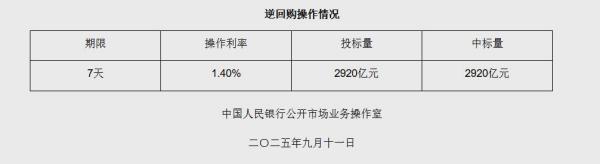
9月11日央行开展2920亿元7天期逆回购操作
Zhong Guo Xin Wen Wang· 2025-09-11 07:59
Group 1 - The People's Bank of China conducted a reverse repurchase operation amounting to 292 billion yuan on September 11, 2025, using a fixed rate and quantity tender method [1] - The operation aims to manage liquidity in the financial system [1] Group 2 - The specific details of the reverse repurchase operation were published on the central bank's official website [2]

央行开展买断式逆回购操作的三重意义
Zheng Quan Ri Bao· 2025-09-10 16:21
■苏向杲 央行买断式逆回购操作采用"利率招标、多重价位中标"的市场化方式,其操作利率通常低于同期限中期 借贷便利(MLF)利率。这有助于直接缓解商业银行在息差收窄背景下的负债成本压力。银行负债成本下 降为贷款端利率下行提供了空间,使货币政策利率能够更顺畅传导至实体经济,最终降低企业综合融资 成本。 近日,中国人民银行(以下简称"央行")开展10000亿元买断式逆回购操作,引发市场广泛关注。央行买 断式逆回购操作能够直接影响当下的流动性,进而影响金融市场走势以及实体经济融资成本。市场各方 也通过观察央行买断式逆回购操作的规模和频次,判断货币政策动向和流动性趋势。 此外,与央行传统的7天、14天质押式逆回购相比,买断式逆回购期限更长(3个月、6个月),填补了短 期工具与MLF之间的"期限空白"。这意味着商业银行可获得稳定、可预期的中期资金支持,便于其进行 中长期信贷规划,减少因短期资金波动导致的信贷投放谨慎情绪。 近期,我国股票市场持续回暖,债券市场波动加剧。与此同时,实体经济正加速转型。在这一背景下, 金融市场和实体经济均对资金流动性状况格外关注。央行也及时"回应"市场流动性需求,频频开展买断 式逆回购操作。据 ...
人民银行操作1915亿元逆回购!
Bei Jing Shang Bao· 2025-09-08 02:06
Group 1 - The People's Bank of China announced a reverse repurchase operation of 191.5 billion yuan for a 7-day term at a fixed rate of 1.40% on September 8 [1] - The total amount of bids was 191.5 billion yuan, with the same amount being awarded [1] - On the same day, 182.7 billion yuan of reverse repos matured, resulting in a net injection of 8.8 billion yuan [1]
央行发布通知,“数字人民币”或将全国普及?二维码以后会消失吗?
Sou Hu Cai Jing· 2025-09-07 13:15
Core Viewpoint - The rapid development and adoption of digital currency, specifically the digital renminbi (e-CNY), is transforming payment methods in China, with significant implications for traditional payment systems like QR code payments [1][4][10]. Group 1: Digital Renminbi Overview - Digital renminbi (e-CNY) is a legal digital currency issued by the People's Bank of China, with the same legal status and economic value as physical cash [1][3]. - As of June 2025, the digital renminbi pilot program has expanded to 28 provinces, with over 750 million personal wallets opened and transaction amounts exceeding 60 trillion yuan [1][4]. Group 2: Comparison with Third-Party Payment Tools - The digital renminbi differs from third-party payment tools like WeChat Pay and Alipay in several aspects, including issuance by the central bank, a dual-layer operational model, and support for offline payments [3][6]. - Digital renminbi emphasizes faster settlement and user privacy through a design principle of "small amount anonymity, large amount traceability" [3][6]. Group 3: Application Scenarios and Merchant Adoption - The application scenarios for digital renminbi are expanding from retail and dining to public services and cross-border trade, with over 21 million merchants supporting its use by mid-2025 [4][7]. - In some pilot cities, digital renminbi payments account for approximately 15% of local mobile payment volumes, positioning it as the third major payment method after WeChat Pay and Alipay [4][10]. Group 4: User Experience and Adoption Challenges - User habits pose a significant challenge for the adoption of digital renminbi, as established platforms like WeChat Pay and Alipay have high user loyalty [6][7]. - The People's Bank of China is implementing measures to enhance user experience, such as promotional activities and app optimizations, to encourage the use of digital renminbi [7][10]. Group 5: Security and Financial System Impact - Digital renminbi incorporates advanced security features, including dual authentication and real-time transaction monitoring to prevent fraud [8][9]. - The promotion of digital renminbi is expected to reduce cash circulation costs, enhance payment system efficiency, and provide innovative applications through programmable features [8][9]. Group 6: Future Outlook - By 2030, digital renminbi is projected to cover over 95% of administrative regions in China, with user numbers exceeding 1 billion and annual transaction volumes reaching 25% of total retail sales [11][12]. - Digital renminbi is not intended to replace existing payment methods but to coexist and complement them, contributing to a diverse and efficient payment ecosystem [11][12].


央行扩大黄金储备已连续出手10个月!
Zheng Quan Ri Bao Wang· 2025-09-07 09:26
| 2025.01 | | 2025.02 | | 2025.03 | | | | --- | --- | --- | --- | --- | --- | --- | | 亿美元 | ZSDR | 亿美元 | ZSDR | 亿美元 | ZSDR | 亿美元 | | 100million | 100million | 100million | 100million | 100million | 100million | 100milli | | USD | SDR | USD | SDR | USD | SDR | USD | | 32090.36 | 24612.47 | 32272.24 | 24654.06 | 32406.65 | 24389.83 | 32816 | | 100.48 | 77.07 | 100.87 | 77.06 | 101.12 | 76.10 | 111 | | 527.12 | 404.29 | 530.77 | 405.48 | 538.82 | 405.53 | 550 | | 2065.34 | 1584.06 | 2086.43 | 1593.91 | 2295.94 ...
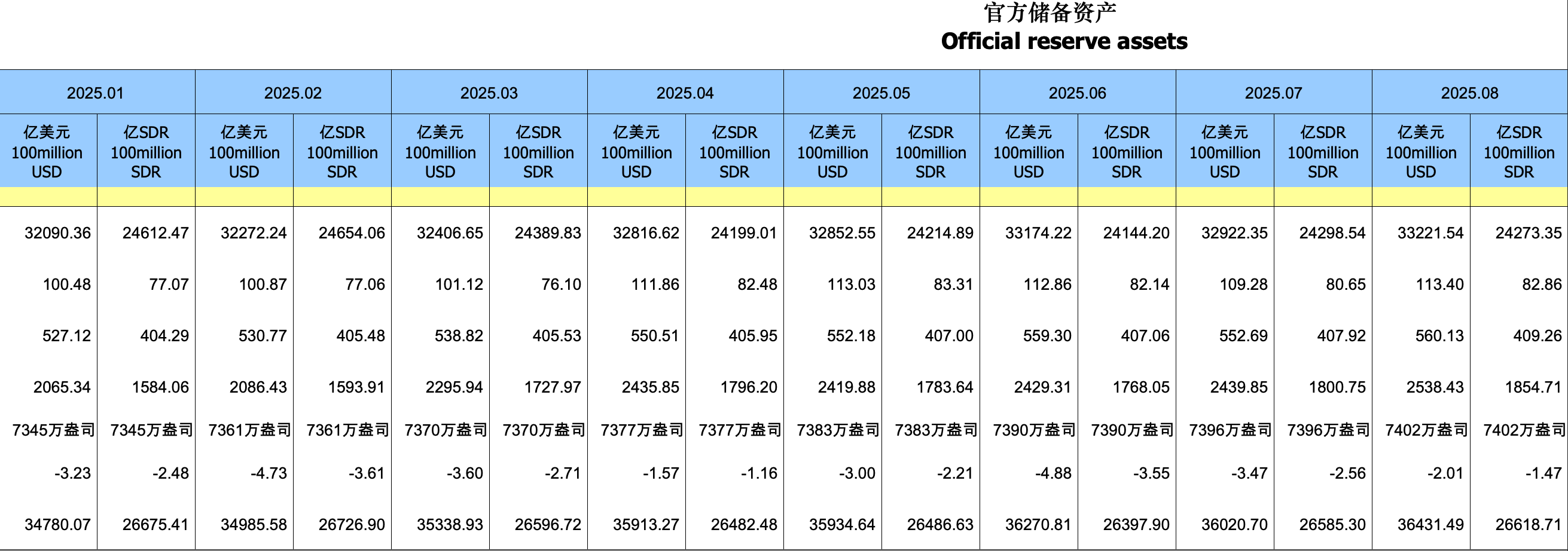
7402万盎司!央行连续第10个月增持黄金
Bei Jing Shang Bao· 2025-09-07 02:42
北京商报讯(记者 刘四红)9月7日,人民银行官网更新官方储备资产信息。数据显示,中国8月末黄金 储备报7402万盎司,7月末黄金储备报7396万盎司,为连续第10个月增持黄金。 ...
央行万亿买断式逆回购护航流动性 四季度降准预期升温
Zhong Guo Jing Ying Bao· 2025-09-05 20:42
Group 1 - The People's Bank of China (PBOC) conducted a 1 trillion yuan reverse repurchase operation to maintain liquidity in the banking system, with a term of 3 months (91 days) [1] - This operation serves as a continuation of a similar scale reverse repurchase that recently matured and aims to support liquidity needs during the peak of government bond issuance in September and the maturity of interbank certificates of deposit [1] - Analysts expect the PBOC to conduct a second 6-month reverse repurchase operation in mid-September and to utilize various monetary policy tools to enhance short- and medium-term liquidity [1] Group 2 - The financial institution analyst noted that fiscal spending at the end of August supports a seasonal easing of the funding environment, with a smaller scale of government bond payments expected this month [2] - Following a reserve requirement ratio cut in May, the average reserve requirement ratio for financial institutions in China stands at 6.2%, which is relatively high compared to major economies [2] - The PBOC's monetary policy report indicates a commitment to implementing a moderately accommodative monetary policy, with expectations for further reserve requirement ratio cuts and long-term liquidity injections in the fourth quarter [2]
钢材、铁矿石日报:反内卷再度发酵,钢矿震荡走高-20250905
Bao Cheng Qi Huo· 2025-09-05 09:44
Report Summary 1. Report Industry Investment Rating No relevant content provided. 2. Core Views of the Report - **Rebar**: The main contract price of rebar oscillated upwards with a daily increase of 1.06%, and both trading volume and open interest expanded. Currently, both supply and demand of rebar have weakened, the fundamentals have not improved, inventory has been increasing, and steel prices are under pressure. With the relatively favorable peak - season expectation and rising costs, steel prices will continue to oscillate to find the bottom, and attention should be paid to demand performance [4]. - **Hot - rolled coil**: The main contract price of hot - rolled coil oscillated higher with a daily increase of 1.03%, and trading volume and open interest expanded. At present, production has decreased due to production restrictions but can recover quickly. In contrast, demand resilience is weakening, the supply - demand imbalance in the hot - rolled coil industry continues to accumulate, inventory growth has widened, and steel prices continue to be under pressure. The relatively favorable factors are peak - season expectation and cost situation, and the short - term trend will continue to oscillate. Attention should be paid to demand performance [4]. - **Iron ore**: The main contract price of iron ore oscillated at a high level with a daily increase of 0.77%, and trading volume and open interest shrank. Currently, iron ore demand is declining while supply is rising, the fundamentals of iron ore are likely to weaken, and high - valued ore prices continue to be under pressure. The relatively favorable factors are peak - season expectation and the intervention of arbitrage funds. The short - term ore price will maintain a high - level oscillation, and beware of the intensification of industrial contradictions [4]. 3. Summary by Relevant Catalogs 3.1 Industry Dynamics - The central bank will conduct a 100 - billion - yuan outright reverse repurchase operation on September 5 with a term of 3 months to maintain sufficient liquidity in the banking system [6]. - The expected tariff increase in the US led to a significant expansion of the US trade deficit in July. The trade deficit in July expanded to $78.3 billion, significantly higher than that in June. The import in July was $358.8 billion, a month - on - month increase of 5.9%; the export was $280.5 billion, a month - on - month increase of 0.3%. The total trade deficit of goods and services increased by 32.5% month - on - month [7]. - In late August 2025, the average daily output of crude steel of key steel enterprises was 1.947 million tons, a decrease of 8.0% compared to the previous period; the average daily output of pig iron was 1.827 million tons, a decrease of 5.1%; the average daily output of steel products was 2.138 million tons, an increase of 4.4% [8]. 3.2 Spot Market - **Rebar**: The spot prices in Shanghai and Tianjin were 3,210 yuan, and the national average price was 3,283 yuan [9]. - **Hot - rolled coil**: The spot prices in Shanghai and Tianjin were 3,380 yuan and 3,320 yuan respectively, and the national average price was 3,431 yuan [9]. - **Iron ore**: The price of 61.5% PB powder at Shandong ports was 782 yuan, and the price of Tangshan iron concentrate was 792 yuan [9]. 3.3 Futures Market | Variety | Closing Price | Increase/Decrease (%) | Trading Volume | Open Interest | | ---- | ---- | ---- | ---- | ---- | | Rebar | 3,143 | 1.06 | 1,385,167 | 1,737,894 | | Hot - rolled coil | 3,340 | 1.03 | 534,944 | 1,300,035 | | Iron ore | 789.5 | 0.77 | 289,453 | 501,397 | [11] 3.4 Relevant Charts - **Steel inventory**: The report provides charts of weekly changes in rebar inventory, hot - rolled coil inventory, and total inventory (steel mill + social inventory) [14][16][22]. - **Iron ore inventory**: Charts of national 45 - port iron ore inventory, 247 - steel - mill iron ore inventory, and domestic mine iron concentrate inventory are included [20][24][30]. - **Steel mill production situation**: Charts of 247 - steel - mill blast furnace开工率 and capacity utilization rate, 87 - independent electric furnace开工率, and 75 - building - material independent electric - arc furnace steel mill profit and loss situation are provided [25][29][31]. 3.5 Market Outlook - **Rebar**: The supply - demand pattern has not changed much. Production of construction steel mills has weakened, and rebar weekly output decreased by 18,800 tons. Demand is weak, and both weekly apparent demand and high - frequency transactions are at low levels. Steel prices will continue to oscillate to find the bottom [32]. - **Hot - rolled coil**: Both supply and demand have weakened. During the parade, production was restricted, and weekly output decreased by 105,000 tons. Demand continues to be weak, and the demand resilience is weakening. Steel prices will continue to be under pressure and oscillate in the short term [33]. - **Iron ore**: The supply - demand pattern has changed. Due to production restrictions, terminal consumption of iron ore has decreased significantly, and supply has increased. Ore prices will maintain a high - level oscillation, and beware of the intensification of industrial contradictions [34].
煤焦日报:供应利好再现,煤焦强势反弹-20250905
Bao Cheng Qi Huo· 2025-09-05 09:38
Industry Investment Rating - No information provided in the report. Core Viewpoints - **Coke**: As of the week ending September 5, the combined daily coke output of independent coking plants and steel mill coking plants was 1.1223 million tons, a week-on-week increase of 16,200 tons per day. The latest ton - coke profit improved by 9 yuan/ton to 64 yuan/ton. The average daily pig iron output of 247 steel mills nationwide was 2.2884 million tons, a week-on-week decrease of 112,900 tons per day. The total coke inventory increased slightly to 8.9528 million tons, mainly accumulating in steel mills. The "anti - involution" policy's second fermentation drove market sentiment, and strong cost expectations supported the upward rebound of coke futures, but the sustainability of the upward trend depends on subsequent specific policies [3][32]. - **Coking Coal**: This week, the daily output of clean coal from 523 coking coal mines was 693,000 tons, a week-on-week decrease of 60,000 tons; coke daily output was 1.1223 million tons, a week-on-week decrease of 16,200 tons; pig iron daily output was 2.2884 million tons, a week-on-week decrease of 112,900 tons. The supply - demand data met the market's bearish expectations. However, the risk of the "anti - involution" policy's second fermentation was being released, and strong expectations pushed coking coal futures to strengthen again. The subsequent price trend of coking coal depends on whether the coal industry association and enterprises will introduce new policies or self - regulatory measures to support the "anti - involution" work [4][32]. Summary by Directory 1. Industry News - The central bank will conduct a 100 - billion - yuan repurchase operation on September 5 for a term of 3 months to maintain sufficient liquidity in the banking system [5]. - On September 5, Mongolia's ER company held an online auction for coking coal. The starting price of Meng 3 clean coal was 800 yuan/ton, and all 12,800 tons were sold at a price of 835 yuan/ton, 10 yuan/ton higher than the previous day. The supply location is the supervision area of Ganqimaodu Port in China, and the supply will be completed within 90 days after payment, with the final supply date being December 4, 2025 [6]. 2. Spot Market | Variety | Current Value | Weekly Change | Monthly Change | Annual Change | Year - on - Year Change | | --- | --- | --- | --- | --- | --- | | Coke (Rizhao Port quasi - first - grade flat - price) | 1,570 | 0.00% | 0.00% | - 7.10% | - 7.10% | | Coke (Qingdao Port quasi - first - grade ex - warehouse) | 1,420 | - 4.05% | - 4.05% | - 12.35% | - 12.35% | | Coking Coal (Ganqimaodu Port Mongolian coal) | 1,180 | 0.00% | 0.00% | 0.00% | - 16.01% | | Coking Coal (Jingtang Port Australian - produced) | 1,530 | - 3.16% | - 3.16% | 2.68% | - 9.47% | | Coking Coal (Jingtang Port Shanxi - produced) | 1,550 | - 4.91% | - 4.91% | 1.31% | - 10.40% | [7] 3. Futures Market | Futures | Active Contract | Closing Price | Change Rate | Highest Price | Lowest Price | Trading Volume | Volume Difference | Open Interest | Open Interest Difference | | --- | --- | --- | --- | --- | --- | --- | --- | --- | --- | | Coke | - | 1,646.5 | 4.71 | 1,662.5 | 1,574.5 | 34,829 | 11,280 | 47,026 | 199 | | Coking Coal | - | 1,158.5 | 6.33 | 1,172.0 | 1,090.5 | 1,732,556 | 547,153 | 721,541 | - 12,086 | [10] 4. Related Charts - **Coke Inventory**: Charts show the inventory trends of 230 independent coking plants, 247 steel mill coking plants, port coke, and total coke inventory from 2019 - 2025 [11][13][16]. - **Coking Coal Inventory**: Charts display the inventory trends of mine - mouth coking coal, port coking coal, 247 sample steel mills' coking coal, and all - sample independent coking plants' coking coal from 2019 - 2025 [19][20][23]. - **Other Charts**: Include domestic steel mill production (blast furnace start - up rate and steel mill profitability), Shanghai terminal wire rod and screw steel procurement volume, coal washery production (clean coal inventory and start - up rate), and coking plant start - up (ton - coke profit and coke oven capacity utilization rate) [25][27][31]. 5. Market Outlook - **Coke**: The fundamentals of coke have not improved significantly. The "anti - involution" policy's second fermentation drove market sentiment, and strong cost expectations supported the upward rebound of coke futures, but the sustainability of the upward trend depends on subsequent specific policies [32]. - **Coking Coal**: The supply - demand data met the market's bearish expectations, but the "anti - involution" policy's second fermentation risk was being released, and strong expectations pushed coking coal futures to strengthen again. The subsequent price trend of coking coal depends on new policies or self - regulatory measures [32].