微软

Search documents
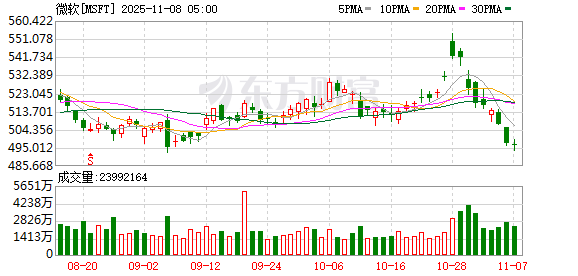
周末利空突袭!科技巨头被唱空:微软8连跌!下周科技股要凉了?
Sou Hu Cai Jing· 2025-11-08 17:24
Core Insights - Microsoft reported an 18% revenue growth and a 40% increase in cloud computing, yet its stock price fell for eight consecutive days, marking the longest decline since 2011, resulting in a market cap loss of over $300 billion. This decline reflects a shift in market sentiment regarding the sustainability of AI investments [1] - Other tech giants like Meta and Nvidia also faced significant stock price drops due to increased capital expenditures in AI, indicating a broader market concern about the balance between heavy investment and slow profit realization [3] Group 1: Market Reactions - The market's reaction to Microsoft's earnings report was negative, with an 8-day stock price decline despite strong financial results, highlighting investor skepticism about AI investments [1] - Meta's stock plummeted 11.33% in a single day after announcing increased AI spending, leading to a market cap loss of 1.52 trillion yuan [3] - The Philadelphia Semiconductor Index fell by 1.53% in one week, and both the Nasdaq 100 and indices tracking major tech companies dropped approximately 4%, marking the largest weekly decline since April [3] Group 2: AI Investment Dynamics - Major tech companies, including Microsoft, Google, Amazon, and Meta, collectively spent $77.1 billion on capital expenditures in the first quarter, a 64% year-over-year increase, primarily for data center construction and AI chip procurement [5] - Despite the surge in investment, Microsoft acknowledged a 98% utilization rate of AI infrastructure, indicating unmet customer demand and potential overcapacity concerns [5] - Conflicting signals emerged in the market, with OpenAI announcing a $450 billion data center project while Microsoft paused some data center projects due to excess capacity, raising questions about the sustainability of AI investments [5] Group 3: Institutional Perspectives - Analysts are increasingly concerned about the concentration of capital in a few tech stocks, with warnings from various executives about potential market corrections and the health of the tech sector [7] - Apple's conservative approach to AI investment contrasts with the aggressive strategies of Microsoft and Meta, as Apple reported better-than-expected revenue and profit, suggesting a reevaluation of investment strategies in the current environment [7] Group 4: Market Fundamentals - The disconnect between fundamentals and valuations is evident, as seen with Palantir Technologies, which has a rolling P/E ratio of 446 despite positive earnings reports, indicating a shift in market focus towards risk [9] - Tightening liquidity conditions, exacerbated by the U.S. government shutdown and increased short-term debt issuance, are adding pressure to the market [9] - Uncertainty regarding the Federal Reserve's interest rate path is diminishing the appeal of high-growth tech stocks, prompting caution among investors [10]


电子产品缺“骨架” 龙头厂商赚大钱!
Zhong Guo Jing Ying Bao· 2025-11-08 11:25
Core Insights - The PCB supply chain is facing significant shortages of upstream materials, particularly affecting high-end substrates like ABF and BT boards, with expectations that shortages will persist for another year [1] - The demand for PCBs is expected to remain strong over the next 2-3 years, with a peak in the fourth quarter of the current year, despite the ongoing material shortages [1][3] - The shortage is attributed to a surge in demand from the recovering global electronics industry and highlights the vulnerabilities in the supply chain [1][4] Material Shortages - Key materials such as T-Glass, quartz cloth, and low CTE fiberglass are in short supply, impacting the production of high-end PCBs [1] - The global demand for HVLP4-grade copper foil, essential for AI servers, is projected to exceed supply, with a current monthly production capacity of only 700 tons against a demand of 850 tons [3][4] - The supply of fiberglass materials is also constrained, with a projected demand of 18.5 million meters by 2026, while current capacity is only 10 million meters, resulting in a shortage of over 50% [3] Market Dynamics - The AI server market is driving a significant increase in PCB prices, with standard server PCBs priced between $3,000 and $15,000, while AI training server PCBs can exceed $200,000 [3] - Major cloud service providers are expected to increase their capital expenditures significantly, with a forecasted total exceeding $420 billion by 2025, marking a 61% increase from previous years [3] Financial Performance - Leading PCB manufacturers like Huadian and Weiergao reported substantial revenue growth in Q3 2025, with Huadian achieving a revenue of 5.019 billion yuan, up 39.92%, and a net profit increase of 46.25% [6] - The PCB industry is entering a new growth cycle, with a projected market value of $73.565 billion in 2024, reflecting a 5.8% year-on-year increase [7] Capacity Expansion - At least 11 PCB companies have announced expansion plans to increase high-end production capacity, with significant investments planned [7][8] - Companies like Jingwang Electronics and Shengyi Technology are investing heavily in new projects to meet the rising demand for high-end PCBs [8] Strategic Considerations - While leading companies are expanding capacity, there is a risk of overcapacity if AI demand slows down, particularly if growth rates drop below 15% post-2026 [9][10] - Smaller manufacturers are advised to focus on niche markets and technological differentiation to avoid direct competition with larger firms [9][10]

被产业链“寄予厚望”,AIPC现在如何了?
Jing Ji Guan Cha Wang· 2025-11-08 05:26
Core Insights - The article discusses the rise of AIPC (Artificial Intelligence Personal Computer) as a new category in the tech industry, highlighting Lenovo's launch of the "Lenovo Savior AI Edition" laptops equipped with AI capabilities through the integration of NPU (Neural Processing Unit) alongside traditional CPU and GPU [2][3] - The demand for AIPC has surged since the introduction of ChatGPT, prompting major tech companies to accelerate their AIPC strategies and product offerings [3][4] - Despite the growing market interest, challenges remain regarding the software ecosystem and practical applications of AIPC, with many users reporting underwhelming AI experiences [5][6] Industry Trends - AIPC sales have been increasing, with Lenovo's AIPC series seeing a production priority shift due to rising demand [3] - Intel reported a revenue increase of 2.8% in Q3 2025, attributed to AIPC, and anticipates supplying processors for over 100 million AIPC units by the end of 2025 [3][8] - Other companies, such as iFlytek, are also entering the AIPC market, aiming to create a comprehensive ecosystem with domestic CPUs and operating systems [4][10] Market Dynamics - The AIPC market is characterized by a fragmented software ecosystem and insufficient practical applications, leading to consumer dissatisfaction despite hardware advancements [5][6] - The hardware foundation of AIPC relies on a heterogeneous computing architecture (CPU+GPU+NPU), with various chip manufacturers, including Intel, AMD, and Qualcomm, competing in this space [6][8] - The operating system landscape is dominated by Microsoft, which has set standards for AIPC, while domestic players like iFlytek are adapting their systems to local needs [9][10] Supply Chain and Manufacturing - ODM manufacturers like Huaqin Technology are experiencing significant growth in AIPC-related revenues, with expectations of over 30% revenue growth in 2025 [11] - The demand for AIPC is driving up the prices of components, such as heat dissipation structures, which are expected to increase by around 30% due to higher cooling requirements [12] - The transition to AIPC is creating a complete supply chain that includes high-value products and improved profit margins for manufacturers [14] Consumer Experience and Challenges - Despite the hardware advancements, many consumers report that the AI functionalities of AIPC are not meeting expectations, often describing them as inadequate or frustrating [16][18] - The current AIPC offerings are seen as traditional computers with AI features rather than fully realized AI systems, indicating a gap between consumer expectations and actual performance [18][19] - Industry experts suggest that the true potential of AIPC will not be realized until the software ecosystem matures and AI applications become more robust and user-friendly [19]



外媒:微软成立新团队开发“只为服务人类”的人工智能
Huan Qiu Wang· 2025-11-08 05:05
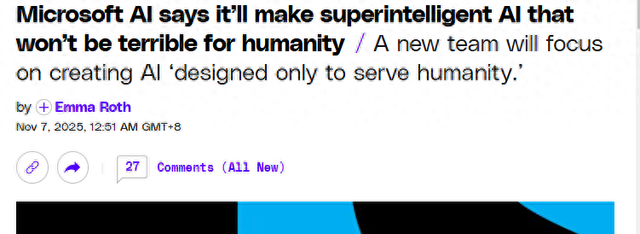
Core Insights - Microsoft has established a new team focused on developing artificial intelligence that is "only for the service of humanity" [1][3] - Mustafa Suleyman, head of Microsoft's AI division, emphasized that this "human-centered superintelligence" is not "unrestricted and highly autonomous," but rather "carefully calibrated, contextualized, and limited" [3] - Microsoft aims to avoid participating in the race for Artificial General Intelligence (AGI), while competition with OpenAI is expected to intensify [3] Applications of Human-Centered Superintelligence - The new AI will serve as a partner to help individuals "learn, act, enhance productivity, and receive support" [3] - It will provide assistance in the healthcare sector [3] - The AI aims to create "new scientific breakthroughs" in the clean energy field [3]
海内外云厂商发展与现状(二):AI投入、算力建设梳理与ROI测算
Sou Hu Cai Jing· 2025-11-08 03:37
Group 1: AI Investment and Capital Expenditure - Global cloud vendors are significantly increasing their investments in AI, with capital expenditures and computing power construction showing remarkable growth characteristics [1][2] - Overseas cloud vendors began accelerating investments from Q3 2023, while domestic vendors are expected to start growth around mid-2024, with both maintaining a year-on-year growth rate of over 50% in capital expenditures [1][12] - Leading cloud vendors are investing more than 100% of their net profits and over 60% of their operating cash flow into AI infrastructure, indicating a strong commitment to capital investment [1][22] Group 2: Computing Power Construction - The global data center investment scale is rapidly increasing, projected to reach $600 billion by 2025 and potentially $3-4 trillion by 2030 [2][39] - Major overseas vendors like Microsoft plan to double their data center capacity to 10GW in the next two years, while Google has invested over $170 billion in three years, with GPU and TPU computing power each accounting for half [2][39] - Domestic vendors, such as Alibaba, plan to invest 380 billion yuan in AI infrastructure over the next three years, with energy consumption expected to reach 15GW by 2032 [2][39] Group 3: Chip Development and Layout - ASIC products are expected to be launched intensively in the coming years, with NVIDIA currently holding over 80% market share in the computing power market, especially in training scenarios [2][39] - Cloud vendors are pursuing supply chain autonomy and cost reduction through self-developed or collaboratively developed ASIC chips, with domestic chip manufacturers continuously catching up in performance [2][39] Group 4: Commercialization and ROI - AI cloud services encompass GPU leasing, MaaS/API services, and PaaS/SaaS services, with overseas vendors like Microsoft and Google experiencing rapid revenue growth in AI-related services [3][39] - Domestic vendors primarily derive AI cloud revenue from GPU leasing, with significant growth in the MaaS layer [3][39] - By 2030, leading cloud vendors are expected to achieve positive cash flow contributions from their AI businesses, with a return on invested capital (ROIC) of over 10% and an investment recovery period of approximately six to ten years [3][39]

迪拜数字局携手微软推出AI工具
Shang Wu Bu Wang Zhan· 2025-11-08 03:15
Core Insights - Dubai Digital Authority collaborates with Microsoft to deploy Microsoft 365 Copilot for government employees, becoming one of the first government entities globally to adopt localized AI solutions on a large scale [1] - The initiative spans various departments, aiming to optimize workflows, enhance decision-making efficiency, and strengthen inter-departmental collaboration while ensuring data security and compliance [1] - This project further establishes Dubai as an innovative leader in government AI applications and digital sovereignty [1]
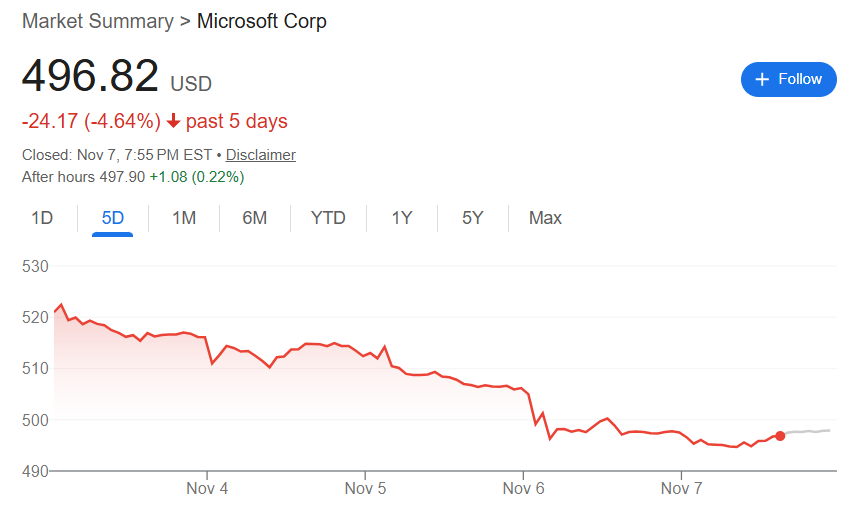
微软遭遇2011年来最长连跌,AI投资疑虑打压科技股
Hua Er Jie Jian Wen· 2025-11-08 01:02
Core Viewpoint - The cautious sentiment towards AI investments is putting pressure on large tech stocks, leading Microsoft to experience its longest losing streak in 14 years, with a significant market cap loss of over $300 billion [1][3]. Group 1: Microsoft Stock Performance - Microsoft's stock price fell by 0.06% on Friday, accumulating a decline of over 4% for the week, and more than 8% over the past eight days [1][2]. - The company's market capitalization has decreased by over $300 billion, marking its longest losing streak since November 2011 [1]. Group 2: Financial Performance and Market Sentiment - Since the quarterly earnings report at the end of October, Microsoft has not recorded a single positive trading day, despite a nearly 20% increase in revenue for the last quarter [3]. - Concerns are growing regarding Microsoft's significant capital expenditures, which reached $34.9 billion, and the expectation of further increases in spending for the current fiscal quarter [3]. Group 3: Broader Market Impact - The Nasdaq 100 index and the Tech Giants index both fell approximately 4% this week, marking the largest weekly percentage drop since April [4]. - In contrast, Apple has not adopted an aggressive strategy in AI, resulting in a slight increase in its stock price on Friday, although it ultimately followed the tech sector's downward trend [4].
英伟达V型反转!美股终结周线三连涨
Zhong Guo Zheng Quan Bao - Zhong Zheng Wang· 2025-11-08 00:55
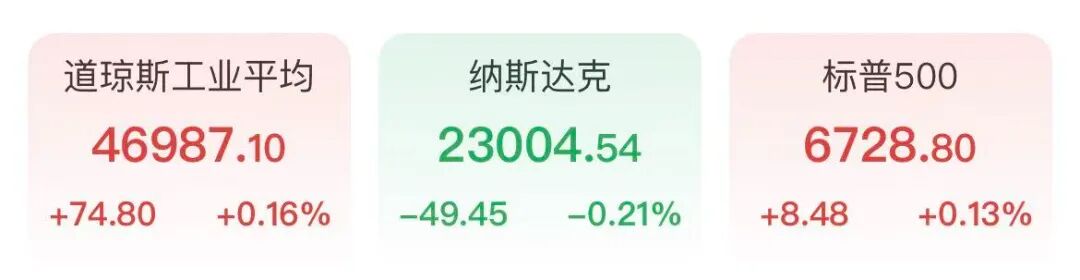
Market Performance - The U.S. stock market ended mixed on November 7, concluding a three-week streak of gains, with the Nasdaq down 0.21% and a weekly decline of 3.04%, marking the largest weekly drop since May [1][2] - The S&P 500 rose 0.13% but fell 1.63% for the week, while the Dow Jones increased by 0.16% with a weekly decline of 1.21% [1][2] Technology Sector - Major tech stocks showed mixed results, with the "Big Seven" tech index down 0.56%. Tesla fell 3.68%, and Microsoft dropped 0.06%, marking its longest losing streak since November 2011 [2][3] - Nvidia experienced a near 5% drop during the day but closed slightly higher, while storage stock SanDisk surged over 15%, reaching a historical high [1][6] Economic Indicators - The U.S. Labor Statistics Bureau failed to release the October non-farm payroll report for the second consecutive time due to the government shutdown, raising concerns about economic stability [4][8] - The preliminary consumer confidence index from the University of Michigan for November was reported at 50.3, the lowest since June 2022, against expectations of 53.2 [4] AI Sector Concerns - The decline in AI-related stocks, which previously led market gains, is attributed to concerns over high valuations and profitability, with Meta's announcement of significant capital expenditures for AI data centers leading to a stock price drop [5] - A report indicated that the number of corporate layoffs in October reached the highest level for that month in over two decades, adding to market pressures [5] Commodity Prices - International precious metals and oil prices saw an increase, with COMEX gold futures rising by 0.42% and NYMEX crude oil futures up by 0.69% [8][9]

深夜,美股大反转,英伟达V型反弹,中概股多数下挫!特斯拉市值一夜蒸发超3800亿元,加密币市场超25万人爆仓
Mei Ri Jing Ji Xin Wen· 2025-11-08 00:51
Core Viewpoint - The U.S. stock market experienced a "V-shaped reversal" as signs of a resolution to the government shutdown emerged, with the S&P 500 and Dow Jones Industrial Average turning positive towards the end of trading [1]. Market Performance - As of the market close, the Nasdaq Composite fell by 0.21%, with a weekly decline of 3.04%. The S&P 500 rose by 0.13%, with a weekly decline of 1.63%. The Dow Jones increased by 0.16%, with a weekly decline of 1.21% [2]. Individual Stock Movements - Nvidia, a leading AI trading stock, saw a nearly 5% drop during the day but managed to close slightly up. Microsoft missed the opportunity to turn positive, marking its longest losing streak since November 2011, with a total market value loss exceeding $330 billion [8]. - Tesla's stock dropped over 3%, resulting in a market value loss of $54.5 billion (approximately 388.2 billion RMB) [10]. - Major Chinese stocks listed in the U.S. mostly declined, with the Nasdaq Golden Dragon China Index falling by 0.95% and a weekly decline of 2.62%. Xpeng Motors dropped over 6%, while other companies like Tencent Music and NIO saw declines exceeding 4% [12]. Economic Indicators - The U.S. consumer confidence index fell to its lowest level since June 2022, dropping from 53.6 to 50.3, influenced by concerns over the government shutdown and high inflation [18]. - Concerns about rising unemployment have increased, with 71% of respondents expecting a rise in the unemployment rate over the next year, more than double the proportion from the previous year [19].
纳指创4月来最大单周跌幅 微软连跌8天 创14年来最长连跌纪录
2 1 Shi Ji Jing Ji Bao Dao· 2025-11-08 00:09
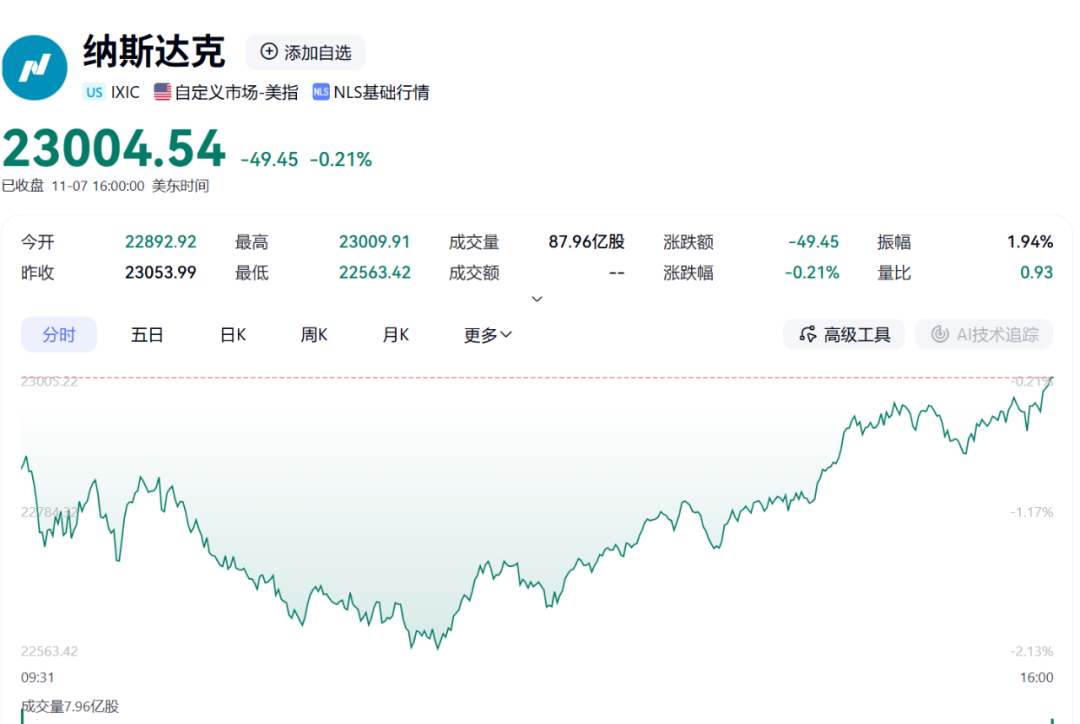
Market Performance - On November 7, the U.S. stock market experienced a "V-shaped reversal," with the Dow Jones Industrial Average rising by 0.16% and the S&P 500 increasing by 0.13%, while the Nasdaq fell by 0.21% [2] - For the week, the Dow dropped by 1.21%, the S&P 500 fell by 1.63%, and the Nasdaq saw a decline of 3.04%, marking the largest weekly drop for the Nasdaq since early April [4] Sector Performance - Large tech stocks showed mixed results, with the Wande American Technology Index down by 0.56%. Notable individual performances included Tesla down over 3%, Google down over 2%, and Amazon up by 0.56% [5] - Energy stocks collectively rose, with Exxon Mobil increasing by over 2% and Chevron by more than 1% [5] - Airline stocks mostly increased, with American Airlines up over 3% and Southwest Airlines up by 3% [6] - Semiconductor stocks generally declined, with the Philadelphia Semiconductor Index down by 1.01% [7] - Chinese concept stocks mostly fell, with the Nasdaq Golden Dragon China Index down by 0.95% [8] Commodity Performance - In precious metals, spot gold rose by 0.58% to $4000.29 per ounce, while COMEX gold futures increased by 0.42% to $4007.8 per ounce [8] Economic Context - There is a growing consensus in the U.S. capital markets regarding risks, particularly concerning the AI narrative, which is facing uncertainty due to the high costs and unclear pathways to achieving General Artificial Intelligence (AGI) [8] - The U.S. federal government has been in a "shutdown" for 37 days, causing significant disruptions, including the delay of the October non-farm payroll report [9]