
星展银行

Search documents
恐慌情绪驱动资金狂涌美债,策略师押注收益率跌至3.8%
Zhi Tong Cai Jing· 2025-11-05 08:11
周三,全球股市遭遇抛售潮,市场避险情绪升温,推动债券价格走高。美国国债全期限品种均上涨,推 动基准10年期美债收益率跌至一周低点。此前,科技股估值高企引发的担忧已冲击全球股指。澳大利亚 和新西兰同期国债收益率同样下跌,日本同期国债收益率也小幅走低。 随着科技股高估值引发的担忧冲击全球股指,被誉为全球最安全资产的美国国债前景已成为市场关注焦 点。摩根士丹利的泰德·皮克、高盛集团的戴维·所罗门等华尔街高管均警告股市可能进一步下跌,策略 师们正思考规模达73万亿美元的债券市场是否有进一步上涨的空间。 星展银行(DBS Bank)认为,若股市继续下跌,美国10年期国债收益率可能从当前的约4.07%降至3.8%;道 明证券(TD Securities)则预测,到2026年末,该基准收益率将跌至3.50%。 分析师马克·克兰菲尔德写道,"宏观交易员正趁还能兑现时了结获利头寸,以弥补人工智能相关股票主 题快速退潮带来的损失,且这种情况可能还会持续。" 道明证券高级利率策略师普拉尚特·纽纳哈表示:"企业高管对估值和资本支出的警告已引发关注。再加 上美国政府停摆、数据疲软以及流动性稀薄,这些因素共同构成了避险模式延续的条件—— ...
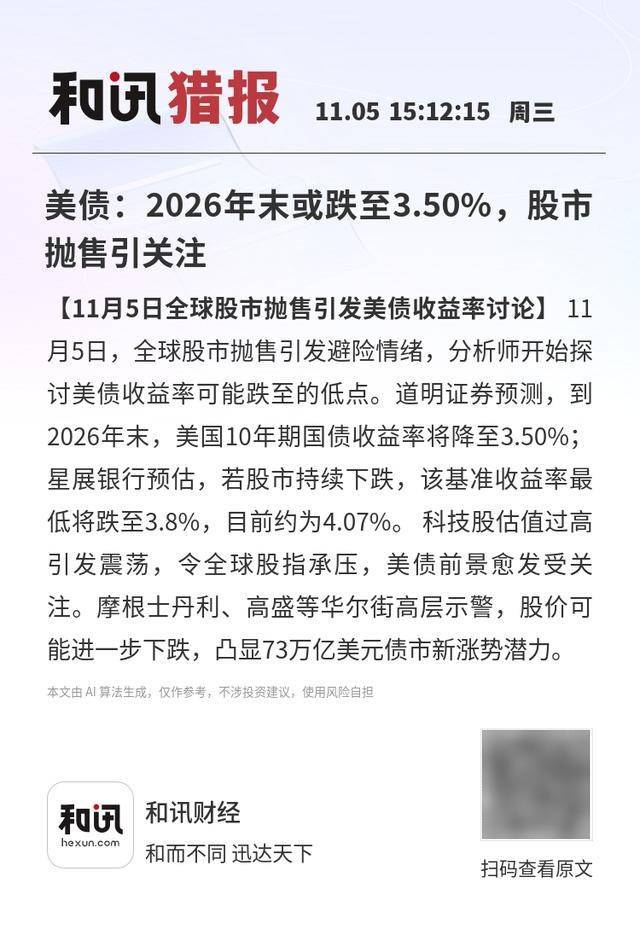
美债:2026年末或跌至3.50%,股市抛售引关注
Sou Hu Cai Jing· 2025-11-05 07:42
Group 1 - Global stock market sell-off on November 5 has triggered discussions about the potential low points for U.S. Treasury yields [1][2] - TD Securities predicts that the U.S. 10-year Treasury yield will drop to 3.50% by the end of 2026 [1][2] - DBS Bank estimates that if the stock market continues to decline, the benchmark yield could fall to a minimum of 3.8%, currently around 4.07% [1][2] Group 2 - High valuations in technology stocks have caused market volatility, putting pressure on global stock indices [1][2] - Wall Street executives from firms like Morgan Stanley and Goldman Sachs have warned that stock prices may continue to decline, highlighting the potential for a new upward trend in the $73 trillion bond market [1][2]

华尔街日报酸评:中国正用我们的武器打败我们,中国是最大赢家?
Sou Hu Cai Jing· 2025-11-04 17:03
Core Insights - The global financial focus is shifting from the US, which is burdened by $38 trillion in debt and has recently cut interest rates, to China, which has successfully issued $4 billion in sovereign bonds in Hong Kong, attracting $40 billion in global capital [1][3][4] Group 1: US Financial Situation - The Federal Reserve faces a dilemma: raising interest rates could worsen the debt crisis, while lowering them would signal failure, with the IMF predicting the US debt-to-GDP ratio will reach 133% by 2025, the highest since World War II [3][4] - The US struggles to maintain its national creditworthiness, even facing challenges in funding its nuclear arsenal [3][4] Group 2: China's Financial Strategy - China has maintained the world's largest foreign exchange reserves at over $3.2 trillion for 18 consecutive months, and its recent issuance of sovereign bonds in Hong Kong is part of a strategy to counter the US dollar [4][11] - The issuance of $20 billion in US bonds last year attracted $40 billion in subscriptions, demonstrating China's ability to leverage its financial instruments to challenge US dominance [6][11] Group 3: Global Financial Dynamics - Countries like Argentina and Turkey, suffering from dollar dependency, are looking to China for financial support, indicating a shift in global financial alliances [6][12] - China's approach contrasts with the US's coercive tactics, as it builds trust through cooperation rather than dominance [11][12] Group 4: Market Reactions and Future Implications - Major financial institutions like Goldman Sachs and Morgan Stanley are increasing their research efforts in China, focusing on sectors like consumption, renewable energy, and high-end manufacturing, indicating a strategic investment shift [15][16] - If China normalizes the issuance of dollar-denominated bonds, it could influence global capital flows by $1-1.5 trillion over the next five years, reducing the Federal Reserve's control over global interest rates [16][17] Group 5: Philosophical and Strategic Perspectives - The operation of dollar bonds is seen as a tactical maneuver, with capital flows representing the momentum, and the cooperative model embodying the overarching strategy [19]
《华尔街日报》酸评:中国正用我们的武器打败我们,中国是最大赢家?
Sou Hu Cai Jing· 2025-11-04 13:12
Core Insights - The Federal Reserve's decision to cut interest rates by 25 basis points amid a $38 trillion debt crisis indicates a significant shift in U.S. monetary policy, contrasting with China's successful issuance of $4 billion in sovereign bonds that attracted $40 billion in global capital [1][3][5] Group 1: U.S. Economic Challenges - The U.S. is facing a systemic crisis with a projected debt-to-GDP ratio of 133% by 2025, the highest since World War II, while the Federal Reserve struggles between raising and lowering interest rates [7][11] - The Fed's attempts to create dollar scarcity through quantitative tightening have backfired, as global liquidity remains stable due to China's actions [15][35] Group 2: China's Strategic Moves - China's issuance of sovereign bonds is not merely a financial maneuver but a strategic play to challenge U.S. dollar dominance, effectively positioning itself as a more reliable source of liquidity for countries in need [5][17][22] - The successful $4 billion bond issuance in Hong Kong reflects China's ability to attract international capital, showcasing its financial stability and credibility [20][46] Group 3: Global Capital Flows - There is a noticeable shift in global capital flows towards China, with significant foreign investment in Chinese assets, driven by favorable valuations and stable policies [28][30] - Countries like Argentina and Turkey are increasingly looking to China for financial support, indicating a growing reliance on Chinese financial mechanisms over traditional U.S. dollar-based systems [19][32] Group 4: Future Implications - If China continues to normalize the issuance of dollar-denominated sovereign bonds, it could reshape global dollar liquidity and reduce the Federal Reserve's control over global interest rates [35][42] - The evolving financial landscape suggests a transition towards a more multipolar and equitable global financial order, with China leading through cooperation rather than coercion [38][48]
【央行圆桌汇】美联储降息路径生变(2025年11月3日)
Xin Hua Cai Jing· 2025-11-03 03:28
Global Central Bank Dynamics - The People's Bank of China is advancing the internationalization of the Renminbi and researching foreign exchange futures, aiming to develop the Renminbi derivatives market and promote its trading with neighboring and Belt and Road countries [1] - The Federal Reserve has lowered the federal funds rate target range by 25 basis points to 3.75%-4.00%, marking the second consecutive rate cut following September's meeting [1] - The European Central Bank has maintained its benchmark interest rate at 2%, indicating no urgent need for policy adjustments as inflation has reached its target [2] - The Bank of Japan has kept its benchmark interest rate at 0.5%, with expectations of gradual inflation increases [2] - The Bank of Canada has also reduced its benchmark rate by 25 basis points to 2.25%, continuing its trend of rate cuts [2] Market Observations - Nomura Securities has canceled its expectations for another rate cut by the Federal Reserve in December, following the Fed's recent rate decision and Powell's press conference [4] - The market currently estimates a 72% probability of another rate cut by the end of the year, down from approximately 91% prior to the Fed's decision [5] - Analysts from Barclays and other institutions warn that traders may be underestimating the likelihood of a rate cut by the Bank of England [5] - The European Central Bank's President Lagarde has signaled that there will be no rate cuts in the coming months, reinforcing the rationale for maintaining current rates [6]
黄金交易税收政策调整,对金价有何影响?
Jin Rong Shi Bao· 2025-11-02 08:36
Core Viewpoint - The announcement by the Ministry of Finance and the State Taxation Administration clarifies tax policies related to gold trading, aiming to enhance the regulation of the precious metals market and encourage compliance among industry participants [1][2]. Tax Policy Summary - From now until December 31, 2027, transactions of standard gold through the Shanghai Gold Exchange and Shanghai Futures Exchange will be exempt from value-added tax (VAT) for sellers [1]. - For investment purposes, VAT will be refunded immediately upon purchase, while for non-investment purposes, VAT will be exempt [2]. - Non-exchange sales of standard gold will still be subject to the current VAT rate of 13% [2]. Impact on Market Participants - The new policy is expected to lower costs for institutions and the jewelry industry that engage in compliant trading through exchanges, promoting legitimate market activities [2]. - The regulation is likely to deter illegal trading and short-term speculative behaviors, potentially affecting gold prices in the short term but benefiting legitimate industrial and investment demand in the long run [2]. Effects on Retail Investors - Retail investors purchasing investment gold bars from stores will incur a VAT of 13%, which is included in the price, making exchange trading more attractive due to tax benefits [3]. - The appeal of physical gold investments outside of exchange channels may diminish due to the tax implications [3]. Influence on Jewelry Consumption - The tax burden for consumers purchasing gold jewelry remains unchanged, as the tax policies for non-exchange gold sales have not altered [4]. - However, fluctuations in gold prices may still impact retail prices of gold jewelry [4].
共赴深圳之约 共创美好明天——国际社会热切期待亚太经合组织“中国年”
Xin Hua She· 2025-11-01 15:02
Group 1 - The APEC meeting in Shenzhen is expected to enhance regional cooperation and development, with strong anticipation from various sectors in the Asia-Pacific region [1][2][3] - China's GDP in Shenzhen has grown significantly from 270 million RMB in 1980 to an estimated 3.68 trillion RMB in 2024, showcasing its transformation into a modern metropolis [2] - Trade between China and APEC members has surged from 127.7 billion USD in 1992 to 2.73 trillion USD in the first three quarters of this year [2] Group 2 - The upcoming APEC meeting is seen as a platform for promoting multilateralism and addressing global challenges, with expectations for China to lead discussions on regional development [7][8] - China's role as a host for APEC for the third time reflects its growing influence and commitment to regional economic integration [3][4] - The meeting is anticipated to generate new opportunities for collaboration in areas such as digital economy and artificial intelligence, aligning with China's strategic goals [6][8]
共赴深圳之约共创美好明天——国际社会热切期待亚太经合组织“中国年”
Bei Jing Ri Bao Ke Hu Duan· 2025-11-01 12:46
Core Points - The APEC (Asia-Pacific Economic Cooperation) informal leaders' meeting will be held in Shenzhen, China, in November 2026, as announced by Chinese President Xi Jinping [1][2] - The meeting is expected to enhance cooperation and development in the Asia-Pacific region, with various stakeholders expressing optimism about China's role in fostering regional growth [1][3] Group 1: Economic Growth and Cooperation - Shenzhen's GDP has grown from 270 million RMB in 1980 to an estimated 3.68 trillion RMB in 2024, showcasing its transformation into a modern international metropolis [2] - Since joining APEC in 1991, China's trade with APEC members has surged from 127.7 billion USD in 1992 to 2.73 trillion USD in the first three quarters of this year [2] - The APEC meeting in Shenzhen is anticipated to attract more business leaders from the region, highlighting China's commitment to open cooperation and mutual benefits [2][5] Group 2: Regional Leadership and Initiatives - China has transitioned from a participant to a leader in regional cooperation over the past 30 years, reflecting the recognition of its development model by APEC economies [3][6] - The upcoming APEC meeting is seen as an opportunity for China to propose new ideas for regional collaboration, particularly in areas like trade liberalization and digital economy [6][7] - The meeting is expected to address global challenges and enhance trust among APEC economies, reinforcing China's role in promoting multilateralism and regional stability [7][8] Group 3: Global Economic Context - The APEC region accounts for over 60% of the global economy and nearly half of global trade, making it a vital area for economic growth [6][8] - However, the region faces increasing uncertainties, with forecasts indicating a decline in average economic growth from 3.1% in 2025 to 2.9% in 2026 [6] - The meeting is positioned as a platform for discussing regional development strategies and responding to global economic challenges [7][8]
每日机构分析:10月31日
Xin Hua Cai Jing· 2025-10-31 14:26
Group 1: Central Bank Policies - Barclays suggests that traders are underestimating the likelihood of an unexpected interest rate cut by the Bank of England next week, predicting a 25 basis point cut to 3.75% [1] - According to Capital Economics, Eurozone inflation is expected to decline further in the coming months, potentially leading to another rate cut by the European Central Bank [2] - DBS Bank analysts indicate that the Bank of Japan may raise its policy rate by 25 basis points in December, depending on wage negotiations and the Federal Reserve's actions [3] - UOB economists believe that the Bank of Thailand may need to cut rates more than expected to combat deflation risks, with predictions of 25 basis point cuts in December and Q1 of next year [5] Group 2: Inflation and Economic Growth - Eurozone inflation decreased from 2.2% in September to 2.1% in October, attributed to falling energy and food prices, while core inflation remained at 2.4% [2] - The European Central Bank's survey indicates that inflation is expected to stabilize around the 2% target in the coming years, with economic growth projected to gradually recover [2] - Thailand's consumer prices have fallen for six consecutive months, raising concerns about deflation driven by weak bank credit and high private sector leverage [5] Group 3: Market Trends and Investment Sentiment - Hedge funds are betting that the Japanese yen will fall to 160 against the US dollar by year-end, driven by the divergence in monetary policy between the Fed and the Bank of Japan [4] - A report from Bank of America highlights a record outflow of $7.5 billion from gold funds in a single week, following a previous week of significant inflows [6]
DigiFT将启动大洋集团股份代币化——首个受新加坡监管的港股代币化项目
Zhi Tong Cai Jing· 2025-10-31 02:18
Core Insights - DigiFT, a regulated platform for tokenizing Real-World Assets (RWA) in Singapore, plans to tokenize shares of Ocean Group Holdings Limited, marking the first instance of tokenization of a Hong Kong-listed company through a regulated platform in Singapore [1][2] - This initiative highlights DigiFT's role in bridging traditional capital markets with regulated on-chain finance, facilitating institutional investors' compliant participation in tokenized asset investments [1] - Ocean Group's leadership supports this innovation, emphasizing the trend of integration between global capital markets and on-chain finance, which aligns with their commitment to transparency and shareholder value [1] Group 1 - DigiFT is one of the first on-chain exchanges licensed by the Monetary Authority of Singapore (MAS) and has also obtained licenses from the Hong Kong Securities and Futures Commission (SFC) [2] - The platform offers comprehensive digital asset services for RWA, including tokenization, issuance, distribution, trading, and instant liquidity allocation [2] - DigiFT has established partnerships with leading asset management firms such as Invesco, UBS Asset Management, DBS, CMB International, and Wellington Management [2] Group 2 - Ocean Group Holdings Limited, listed on the Hong Kong Stock Exchange since 2007, operates in various sectors including online marketing solutions, silicone rubber products, retail services, healthcare, and hospitality [2] - The company is actively transforming towards AI digital personas and RWA, exploring innovative measures to enhance competitiveness and shareholder value [2]