
重庆银行

Search documents
金融行业周报(2026、01、25):业绩比较基准新规正式落地,坚定保险中长期向好逻辑-20260125
Western Securities· 2026-01-25 10:30
Investment Rating - The report maintains a positive long-term outlook for the insurance sector, indicating a strong continuity in market performance despite recent fluctuations [2][12][16]. Core Insights - The financial sector experienced a mixed performance this week, with the non-bank financial index down by 1.45%, underperforming the CSI 300 index by 0.83 percentage points. The insurance sector saw a decline of 4.02%, while the brokerage sector decreased by 0.61% [1][10]. - The insurance sector's performance is driven by two main factors: policy support leading to economic recovery and liquidity easing combined with a strong stock market. The report suggests a shift from liquidity-driven growth to a focus on macro policy support and economic recovery expectations [2][13][16]. - The brokerage sector is expected to benefit from new regulations that enhance investment management quality, with a recommendation to focus on larger, undervalued firms and those involved in mergers and acquisitions [3][18]. - The banking sector is facing a slight decline, but there are signs of recovery in profitability for leading banks, with recommendations to focus on banks with high dividend yields and those expected to benefit from market conditions [19][21]. Summary by Sections Insurance Sector - The insurance sector's recent decline is attributed to short-term market sentiment and liquidity changes, but the long-term outlook remains positive due to strong support from both the liability and asset sides [2][12][16]. - Key recommendations include focusing on companies like China Pacific Insurance, China Ping An, China Life (H), and China Taiping, with a specific recommendation for New China Life [4][16]. Brokerage Sector - The brokerage sector's performance is slightly better than the overall market, with a focus on the new guidelines from the regulatory body that aim to improve fund management quality [3][17]. - Recommended firms include Guotai Junan, Huatai Securities, and others, particularly those with strong merger and acquisition prospects [4][18]. Banking Sector - The banking sector has shown a decline but is expected to stabilize, with recommendations to focus on banks with high earnings elasticity and strong dividend yields [19][21]. - Specific banks to watch include Hangzhou Bank, Ningbo Bank, and others, with a focus on those that have previously been undervalued [4][21].




银行周报(2026/1/19-2026/1/23):银行快报陆续披露,25A业绩稳健增长-20260125
GUOTAI HAITONG SECURITIES· 2026-01-25 07:47
Investment Rating - The report assigns an "Overweight" rating to the banking sector [4]. Core Insights - As of January 23, 2026, eight banks have reported stable growth in performance and maintained asset quality. The outlook for 2026 suggests continued improvement in bank performance, supported by narrowing interest margin declines and decreasing credit costs [2][4]. Summary by Sections 1. Performance Indicators - Eight banks reported their performance for 2025, showing stable growth and asset quality. The revenue growth rates for major banks were as follows: - Shanghai Pudong Development Bank: +1.9% - Industrial Bank: +0.2% - China Merchants Bank: +0.01% - CITIC Bank: -0.6% - Regional banks showed varied performance, with Nanjing Bank at +10.5%, Ningbo Bank at +8.0%, Hangzhou Bank at +1.1%, and Suzhou Rural Bank at +0.4% [4][6]. 2. Scale and Growth - Quality regional banks continued to experience strong credit growth. By the end of 2025, asset growth rates were: - Nanjing Bank: 16.6% - Ningbo Bank: 16.1% - Hangzhou Bank: 12.0% - Loan growth rates were: - Nanjing Bank: 13.4% - Ningbo Bank: 17.4% - Hangzhou Bank: 14.3% - Overall deposit growth remained stable, with city commercial banks maintaining a growth rate of over 10% and joint-stock banks at 7%-8% [4][6]. 3. Asset Quality - The non-performing loan (NPL) ratios showed a stable or declining trend across the eight banks, with Shanghai Pudong Development Bank at 1.26%, Suzhou Rural Bank at 0.88%, and CITIC Bank at 1.15%. The provision coverage ratios remained robust, with Hangzhou Bank and China Merchants Bank showing a decline of over 10 percentage points but still at high absolute levels [4][6]. 4. Outlook for 2026 - The report anticipates continued improvement in bank performance in 2026, driven by: - A narrowing decline in interest margins leading to improved net interest income growth. - Increased fee income from insurance and wealth management channels. - Continued resolution of risks in key corporate sectors and stabilization of retail risk exposure [4][6]. 5. Investment Recommendations - The report suggests focusing on three main investment lines for 2026: 1. Identifying banks with potential for performance growth, recommending Ningbo Bank, China Merchants Bank, and Nanjing Bank. 2. Considering banks with convertible bond expectations, recommending Chongqing Bank and Changshu Bank. 3. Continuing dividend strategies, recommending Bank of Communications, Jiangsu Bank, and Chongqing Rural Commercial Bank [4][6].






个人贷款不良率骤增 银行超低折竞抛
经济观察报· 2026-01-25 04:58
Core Viewpoint - The article discusses the increasing trend of personal non-performing loan (NPL) transfers in the banking sector, driven by regulatory changes and the rising pressure of bad debts on financial institutions [1][5]. Group 1: Market Dynamics - The personal NPL transfer market is experiencing a surge, with transaction volumes rising from 186.48 billion in 2021 to 965.30 billion in 2023, and projected to reach 1583.50 billion in 2024 [3][4]. - As of January 22, 2026, there were 20 new announcements for personal NPL transfers within the month, indicating heightened activity in the market [2][8]. - The average discount rate for personal NPL packages has significantly decreased, with rates dropping from 8%-10% before 2023 to around 5% in 2026 [10][11]. Group 2: Regulatory Impact - A regulatory notification extended the trial period for bulk transfers of personal NPLs until December 31, 2026, allowing a wider range of financial institutions to participate in the transfer process [2][4]. - The expansion of trial institutions to include city commercial banks and rural commercial banks has led to a notable increase in the volume of NPL transfers [5][17]. Group 3: Borrower Profile and Economic Context - The borrower demographic for personal NPLs includes failed entrepreneurs, unemployed individuals relying on credit cards for living expenses, and consumers with excessive debt [4][20]. - The economic backdrop, characterized by macroeconomic fluctuations and income instability, has exacerbated the bad debt situation, compelling banks to offload risk assets [5][20]. Group 4: Challenges in Asset Recovery - The recovery rates for NPLs have declined, with some packages facing average recovery rates below 6%, marking the lowest in five years [12][13]. - Financial institutions are facing challenges in asset valuation and recovery due to incomplete documentation and inefficient legal processes [26][28]. Group 5: Strategic Adjustments - Banks are adapting their strategies by improving the quality of NPL packages, such as reducing overdue times and increasing the concentration of borrowers in economically developed areas [24][25]. - There is a push for enhanced transparency and standardization in the NPL transfer process to improve market confidence and asset pricing [28].




个贷不良资产转让“狂奔”
Jing Ji Guan Cha Wang· 2026-01-25 03:17
Core Viewpoint - The personal non-performing loan (NPL) transfer market is experiencing a significant surge, driven by regulatory extensions and increasing demand for asset transfers among financial institutions [2][3][12]. Group 1: Market Dynamics - Jiangsu Guannan Rural Commercial Bank announced the re-listing of a personal NPL transfer project, with a total outstanding principal and interest amounting to 68.89 million yuan, involving 309 borrowers [2]. - The regulatory extension of the pilot program for transferring personal NPLs until December 31, 2026, has led to a notable increase in transfer announcements, with 20 new cases reported in January alone [2][3]. - The transaction volume of personal NPLs has shown substantial growth, from 18.65 billion yuan in 2021 to an estimated 200 billion yuan in 2025, indicating a robust market expansion [3]. Group 2: Borrower Profile - The typical borrowers in the personal NPL category include failed entrepreneurs, unemployed individuals relying on credit cards, and consumers with excessive debt [3][17]. - A case study of a failed entrepreneur highlights the challenges faced by individuals who have accumulated significant credit card debt, illustrating the broader issue of personal financial distress [18]. Group 3: Financial Institution Strategies - Financial institutions are increasingly motivated to offload NPLs due to rising default rates and declining recovery rates, prompting a shift in strategies to manage risk [4][5]. - The average discount rate for transferring personal NPLs has decreased significantly, from 8%-10% before 2023 to around 5% currently, reflecting the competitive nature of the market [6][11]. - Institutions are adapting their asset packages to improve recovery prospects, including reducing overdue durations and increasing the concentration of borrowers in economically developed regions [19][20]. Group 4: Regulatory Environment - The regulatory framework has expanded the scope of institutions eligible to participate in the NPL transfer market, which has contributed to increased activity and competition [12][13]. - Recent regulatory measures aim to enhance compliance and transparency in the NPL transfer process, with a focus on addressing potential violations and improving operational standards [21][22]. Group 5: Challenges and Future Outlook - The NPL transfer market faces ongoing challenges, including difficulties in asset valuation, legal proceedings, and operational inefficiencies, which hinder effective recovery efforts [20][22]. - The long-term resolution of personal NPL issues is contingent upon improving the financial health of borrowers and reducing the generation of new NPLs [22].

川渝首笔跨省域GEP质押贷款落地
Xin Lang Cai Jing· 2026-01-25 00:09
近日,重庆银行为位于川渝交界处的重庆市开州区大进镇、四川省宣汉县漆树土家族乡的两家经营主体 合计发放了120万元的GEP质押贷款,这是川渝地区首笔跨省域GEP质押贷款,迈出了从生态价值核算 到信用融资"两山"转化的关键一步。 大进镇和漆树土家族乡地处秦巴山区腹地,生态资源丰富。去年 底,开州区与宣汉县共建的川渝雪巴画廊绿色生态屏障统筹发展先行区获评"绿水青山就是金山银山"实 践创新基地,大进镇和漆树土家族乡则是该先行区的核心区域之一。 业内人士认为,GEP质押融资金 融创新,将生态效益转化为可度量、可质押的金融资产,为缺乏传统抵押物的绿色产业主体开辟了新的 融资渠道,将有效激励生态保护者,促进生态保护与经济发展良性互动。(四川日报) ...
“0”字头利率时代 分红型理财成稳健投资新宠
Zhong Guo Jing Ying Bao· 2026-01-24 13:01
与此同时,在理财公司产品货架或官微推广渠道上,也越来越多出现分红型理财的身影。招银理财官微 推出一款封闭式固定收益类的季度分红理财,产品期限36个月,业绩比较基准2.05%—2.65%。渝农商 理财也于近日上线多只固定收益类分红理财。 对于近期分红型理财产品的快速发展,普益标准研究员黄轼剡指出,其发行节奏明显提速,规模呈现持 续扩张趋势。"这主要是为了应对存款利率持续下行的环境,理财公司通过此类产品满足投资者对稳健 收益的需求。" 某理财公司业务人士表示,利率一降再降,最近不少银行的大额存单利率甚至已降至1%以下,进 入"0"字头区间,而且预期未来一段时间,银行定期存单的发行规模可能继续收缩,利率或将继续下 行。"在这种环境下,通过定期分红兼顾一定流动性的分红理财,尤其长期限分红理财,能更好地适配 稳健型风险偏好投资者的'长钱'资金的配置需求,因此越来越受投资者青睐。理财公司在产品供给上也 在相应跟进。" 从产品布局差异来看,黄轼剡指出,不同类型理财公司展现出鲜明的差异化特征。大型国有银行理财公 司,依托强大的客户基础,更倾向于发行封闭式分红产品或"按季"分红的产品,利用"固收+非标"的传 统优势,锁定优质资 ...
公募基金四季度转债持仓分析:回报率方差拉大,可转债基金领跑主动产品
Guoxin Securities· 2026-01-23 13:01
1. Report Industry Investment Rating No information provided in the content. 2. Core Viewpoints - The return variance of funds has widened, and convertible bond funds have outperformed active products. The scale of public funds' convertible bond holdings decreased by 2.6% to 30.83 billion yuan, less than the overall market scale decline of -7%. Most convertible bond funds achieved positive returns, and there was an obvious trend of funds flowing from passive to active products [1][13]. - In Q4 2025, funds mainly increased positions in bank, military, photovoltaic industry targets and semiconductor new - issue bonds, and reduced positions in battery convertible bonds. Convertible bond funds led active - type funds, and the performance variance of active equity - oriented funds was extremely large [2]. - Among the high - performing products, Fund A, which ranked first in returns, adopted a quantitative strategy with outstanding asset - switching ability. Fund B, which ranked second, had excellent bond - selection ability, heavily invested in securities and technology, and significantly outperformed the index during the rising stage [3]. 3. Summary According to the Directory 3.1 Fund Holding Convertible Bond Scale and Fund Type Distribution - The convertible bond holding scale of first - and second - tier bond funds and flexible allocation funds slightly increased, while that of partial - debt hybrid and convertible bond funds decreased. The total asset value of convertible bond funds decreased from 67.85 billion yuan at the end of Q3 to 65.459 billion yuan [12]. - In Q4 2025, affected by multiple factors, the market mostly oscillated until late December. The scale of the convertible bond market continued to shrink, and the supply - demand contradiction was prominent. The convertible bond holding scale of public funds decreased by 830 million yuan to 30.83 billion yuan, with a decline of 2.6%, less than the overall market scale decline [13]. - The number of funds with a decreased convertible bond position in Q4 2025 was more than those with an increased position, and the ratio of adding - position funds to reducing - position funds was 0.74. The number of funds with a convertible bond position of more than 5% decreased significantly compared with Q2 and Q3 2025 [15][17]. - By fund type, first - tier bond funds, second - tier bond funds, convertible bond funds, partial - debt hybrid funds, and flexible allocation funds were the main forces in convertible bond allocation. More first - tier bond funds began to allocate convertible bonds in Q4 2025, and the scale of second - tier bond funds expanded most significantly [20][25]. - In terms of the price of convertible bonds held by public funds in Q4 2025, the proportion of balanced convertible bonds slightly increased, the position of bank convertible bonds remained stable, and the proportion of high - priced convertible bonds slightly decreased [27]. 3.2 2025 Q4 All Types of Fund Return Statistics - In Q4 2025, convertible bond funds led active - type funds, and the performance variance of active equity - oriented funds was extremely large. The average quarterly returns of ordinary stock funds and partial - equity hybrid funds were - 1.59% and - 1.94% respectively, with performance variances of 6.72% and 7.5% respectively. The average quarterly return of convertible bond funds was 0.86% [2][43]. - Most convertible bond funds achieved positive returns, and the trend of funds flowing from passive to active products was obvious. The median return of 41 convertible bond funds (including convertible bond funds, Xingquan Convertible Bond, and two ETFs) in Q4 was + 1.09%, and the return of convertible bond ETFs was 1.45%. The median return of these 41 products in the past year was 1.21% [46]. - Among the high - performing products, Fund A, which ranked first in returns, adopted a quantitative strategy, with the proportion of convertible bonds in the fund's total assets increasing significantly in Q4. It had outstanding asset - switching ability. Fund B, which ranked second, had excellent bond - selection ability, heavily invested in securities and technology, and significantly outperformed the index during the rising stage [3][51][62].
25Q4基金对银行持仓点评:主动基金环比持平,被动基金增持
GUOTAI HAITONG SECURITIES· 2026-01-23 11:10
股票研究 /[Table_Date] 2026.01.23 票 研 究 主动基金环比持平,被动基金增持 [Table_Industry] 商业银行 | [姓名table_Authors] | 电话 | 邮箱 | 登记编号 | | --- | --- | --- | --- | | 马婷婷(分析师) | 021-23185608 | matingting@gtht.com | S0880525100001 | | 陈惠琴(分析师) | 021-38676666 | chenhuiqin@gtht.com | S0880525100003 | 本报告导读: 25Q4 主动基金对银行持仓比例环比持平于 1.9%,被动基金持仓比例环比+1.6pct 至 7.0%,其中宁波银行、兴业银行、中国银行、建设银行等获主动基金增配。 25Q4 基金对银行持仓点评 投资要点: [Table_Summary] 2025 年四季度基金重仓持股情况披露(主动基金包括普通股票型、 偏股混合型、灵活配置型,被动基金包括被动指数型、指数增强型): [Table_Report] 相关报告 商业银行《国有大行投放力度较大,不良压力或 企稳》20 ...


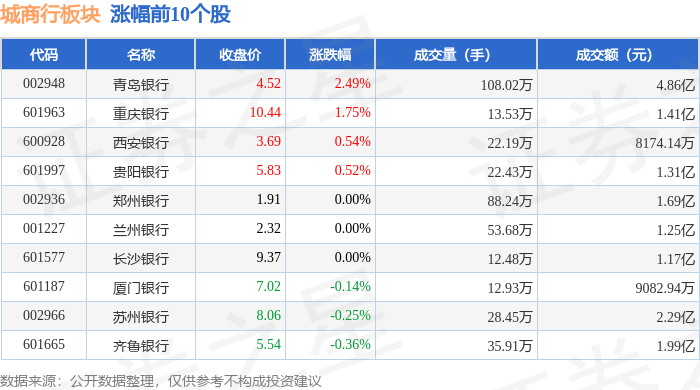
城商行板块1月23日跌1.01%,上海银行领跌,主力资金净流入1.48亿元
Zheng Xing Xing Ye Ri Bao· 2026-01-23 09:04
证券之星消息,1月23日城商行板块较上一交易日下跌1.01%,上海银行领跌。当日上证指数报收于 4136.16,上涨0.33%。深证成指报收于14439.66,上涨0.79%。城商行板块个股涨跌见下表: | 代码 | 名称 | 收盘价 | 涨跌幅 | 成交量(手) | 成交额(元) | | --- | --- | --- | --- | --- | --- | | 002948 | 青岛银行 | 4.52 | 2.49% | 108.02万 | 4.86亿 | | 601963 | 重庆银行 | 10.44 | 1.75% | 13.53万 | 1.41亿 | | 600928 | 西安银行 | 3.69 | 0.54% | 22.19万 | 8174.14万 | | 601997 | 豊阳银行 | 5.83 | 0.52% | 22.43万 | 1.31亿 | | 002936 | 郑州银行 | 1.91 | 0.00% | 88.24万 | 1.69亿 | | 001227 | 兰州银行 | 2.32 | 0.00% | 53.68万 | 1.25亿 | | 601577 | 长沙银行 | 9.37 | ...


25Q4公募基金转债持仓分析:固收加锐不可当,延续增长
GUOTAI HAITONG SECURITIES· 2026-01-23 08:47
固收加锐不可当,延续增长 [Table_Authors] 刘玉(分析师) 25Q4 公募基金转债持仓分析 本报告导读: Q4 固收+规模延续增长态势,震荡市下小幅增配权益、明显增持金融债,在提升权 益暴露的同时控制波动。 投资要点: 债券研究 /[Table_Date] 2026.01.23 | | 021-38038263 | | --- | --- | | | liuyu6@gtht.com | | 登记编号 | S0880523050002 | | | 孙飞帆(研究助理) | | | 021-23185647 | | | sunfeifan@gtht.com | | 登记编号 | S0880125042242 | [Table_Report] 相关报告 带"负久期"特征的基金产品平均超额收益再测 算 2026.01.19 考虑政府债久期拉长与存款置换:大行 EVE 指标 空间再测算的四个要点 2026.01.15 长债供给放量,需要担忧资金收敛吗 2026.01.13 债券 ETF 持续缩量 2026.01.12 "负久期"、信用套息和地方债套保 2026.01.10 证 券 研 究 报 告 研 究 [ ...