长江存储

Search documents
2026市场热点周报1月5日-1月11日
Sou Hu Cai Jing· 2026-01-12 14:10
Global Capital Markets - The global market is characterized by a simultaneous rise in risk appetite and demand for safe-haven assets, with A-shares experiencing a strong start to the year, as the Shanghai Composite Index returns to the 4000-point mark, driven by technology themes [2][3] - The US stock market sees the Dow Jones and S&P 500 indices reaching historical highs, supported by expectations of interest rate cuts and a rally in technology stocks [5][6] A-Share Market - The A-share market shows a strong performance with the ChiNext 50 Index surging nearly 10%, indicating a significant increase in risk appetite among investors [2][3] - The brain-computer interface concept emerges as a major highlight, with related stocks experiencing substantial gains, driven by technological breakthroughs and domestic industry acceleration [3][4] US Stock Market - The US stock market indices collectively rise, with the Dow Jones and S&P 500 achieving record closing highs, driven by expectations of a stable labor market and potential interest rate cuts [5][6] - Technology stocks, particularly semiconductor companies, are at the forefront of this rally, with significant gains observed in major players like Intel and Micron Technology [7] Commodity Markets - The international precious metals market sees significant price increases, with gold and silver prices rising sharply, driven by geopolitical tensions and expectations of liquidity easing [8][9] - Global official gold reserves surpass the value of overseas US Treasury bonds for the first time in 30 years, indicating a shift in the global reserve asset landscape [9][10] Semiconductor Industry - The semiconductor sector experiences a boom, particularly in storage chips, driven by surging demand from AI servers, with significant price increases reported [16][17] - Advanced process technology sees progress, with Qualcomm and Samsung discussing 2nm chip foundry cooperation, marking a new phase in the semiconductor industry's competitive landscape [18] AI Technology and Applications - The CES 2026 showcases significant advancements in AI technology, with major companies like NVIDIA and AMD unveiling new products that enhance AI capabilities [19][20] - Chinese manufacturers actively participate in the AI wearable sector, demonstrating technological strength and innovation, contributing to the global proliferation of AI devices [21][22] Commercial Space Industry - The commercial space sector witnesses intensified competition for frequency resources, with SpaceX receiving approval for additional Starlink satellites and China submitting large-scale satellite applications [23][24] - The rapid development of the space economy is anticipated, with projections indicating that the market could exceed $1 trillion in the coming years [25] Consumer Electronics - Rising storage chip prices are beginning to impact consumer electronics, leading to increased costs for smartphones, PCs, and electric vehicles, prompting companies to adjust their product strategies [26][27] - The smartphone market exhibits signs of "covert price increases," with manufacturers reducing configurations or shrinking discounts to offset rising costs [27][28] Global Market Interconnectivity - The global market shows enhanced interconnectivity, with the performance of the technology sector influencing asset allocation strategies across different markets [29] - The expectation of US Federal Reserve interest rate cuts is becoming a core variable in global asset pricing, affecting capital flows and investment strategies [29][30]


武汉光谷商学院即将揭牌
Xin Lang Cai Jing· 2026-01-12 06:46
来源:上海证券报·中国证券网 上证报中国证券网讯(记者 丁鹏)据中国光谷消息,光谷商学院将于1月13日在中国光谷科技会展中心 举行揭牌仪式。 据介绍,光谷商学院将培养具有全球格局的科技企业家,以赋能光谷企业突破成长边界,迈向世界级阵 营,实现"让科技人员懂产业,让创业者懂经营,让管理者懂创新",驱动武汉市东湖高新区科技创新优 势加速向产业规模优势转化。 上证报记者了解到,有多名上市公司高管和产业龙头企业负责人将成为光谷商学院顾问委员会成员。其 中包括长飞光纤总裁庄丹、精测电子董事长彭骞、帝尔激光董事长李志刚、蔚来董事长兼CEO李斌、阅 文集团CEO兼总裁侯晓楠、长江存储董事长陈南翔等。 上证报中国证券网讯(记者 丁鹏)据中国光谷消息,光谷商学院将于1月13日在中国光谷科技会展中心 举行揭牌仪式。 据介绍,光谷商学院将培养具有全球格局的科技企业家,以赋能光谷企业突破成长边界,迈向世界级阵 营,实现"让科技人员懂产业,让创业者懂经营,让管理者懂创新",驱动武汉市东湖高新区科技创新优 势加速向产业规模优势转化。 上证报记者了解到,有多名上市公司高管和产业龙头企业负责人将成为光谷商学院顾问委员会成员。其 中包括长飞光 ...
闪迪推全款预付锁单模式,这一存储产品价格环比或再涨100%
Xuan Gu Bao· 2026-01-11 23:28
Group 1 - SanDisk has proposed "100% cash prepayment" terms to some downstream customers to secure supply quotas for the next 1 to 3 years, a move described as "unprecedented" in the industry [1] - SanDisk plans to increase the prices of enterprise SSDs using high-capacity 3D NAND flash memory chips by over 100% month-on-month starting in March [1] - The surge in demand for AI servers and the shift in production capacity towards higher-margin HBM have led to extreme shortages in standard DDR4/DDR5 and NAND products, prompting major tech companies like Google and Meta to restructure their procurement teams [1] Group 2 - The global storage industry is entering a new upcycle driven by AI, with expectations for continued price increases through 2026, particularly in high-performance storage products like DDR5 and eSSD [1] - Domestic storage manufacturers in China have achieved technological breakthroughs, with Changxin Technology's DDR5 products reaching international standards and Yangtze Memory Technologies' Xtacking architecture advancing 3D NAND technology [2] - The demand for etching and thin-film deposition equipment is expected to rise as storage architectures shift towards 3D, with the serviceable market for 3D DRAM and NAND equipment increasing to 1.7 times and 1.8 times, respectively [2] Group 3 - Jingzhida is one of the few domestic companies that has achieved full coverage in semiconductor storage testing equipment, delivering high-speed FT testing machines to major clients [3] - Zhaoyi Innovation is recognized as a dual leader in domestic storage and MCU markets [4]
下周,半导体设备细分领域龙头来了
Shang Hai Zheng Quan Bao· 2026-01-11 14:24
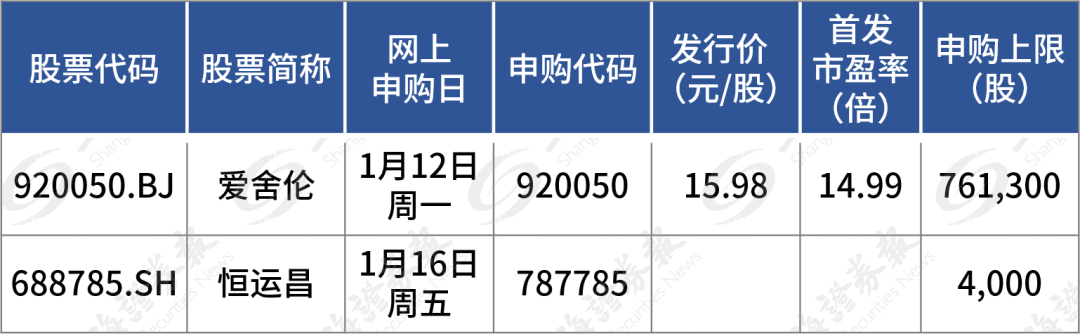
Group 1 - Shaanxi Tourism officially listed on the Shanghai Stock Exchange, marking the first IPO of 2026, with a first-day increase of 64.10% and a single ticket profit of approximately 26,000 yuan [1] - Next week, two new stocks will be available for subscription: Aisheren, a leading medical dressing company, and Hengyun Chang, a key supplier of semiconductor equipment core components [1][3] - Aisheren specializes in disposable medical consumables for rehabilitation and medical protection, with a strong competitive position in the medical care pad market and stable partnerships with international brands like Medline Group [5][1] Group 2 - Aisheren's forecast for 2025 indicates a net profit of 89.29 million to 98.48 million yuan, representing a year-on-year growth of 10.63% to 22.01% [5][6] - Projected revenue for Aisheren in 2025 is between 889.82 million and 939.87 million yuan, reflecting an increase of 28.65% to 35.89% compared to 2024 [6] - Hengyun Chang is a leading domestic supplier of semiconductor equipment core components, focusing on plasma RF power systems and has achieved mass delivery to major semiconductor equipment manufacturers [1][8] Group 3 - Hengyun Chang's forecast for 2025 shows a net profit of 102 million to 114 million yuan, with a year-on-year decline of 28.21% to 19.54% [8] - Projected revenue for Hengyun Chang in 2025 is estimated to be between 488.99 million and 515.43 million yuan, indicating a decrease of 9.58% to 4.69% compared to 2024 [8] - The company has developed second and third-generation products that support advanced process nodes of 28nm and 7-14nm, respectively, achieving international advanced levels [1]

扎推港股IPO,一场阳谋
Hu Xiu· 2026-01-11 09:06
Core Viewpoint - The surge of IPOs in the Hong Kong stock market at the beginning of 2026, particularly in sectors like AI and biotech, reflects a strategic move by companies to secure funding amid high cash burn rates and favorable listing conditions in Hong Kong [1][3][20]. Group 1: IPO Trends and Market Dynamics - The Hong Kong IPO market has seen significant activity with companies like Wallen Technology and others in the hard tech sector listing, indicating a strong interest in capital raising [1][2]. - The return of "thousand times subscription" phenomena with companies like Zhipu and MiniMax suggests a renewed investor enthusiasm for tech IPOs [2]. - The listing environment in Hong Kong is more favorable due to lower regulatory hurdles compared to other exchanges like the STAR Market and the Beijing Stock Exchange [7][8]. Group 2: Financial Pressures and R&D Costs - Many of the listed companies are facing substantial losses, with Wallen reporting a loss of 1.6 billion and Zhipu 2.36 billion in the first half of 2025, highlighting the financial pressures driving them to seek public funding [5][6]. - The high R&D expenditure rates, such as Zhipu's monthly spending of 266 million, indicate the intense cash requirements of AI companies [5][6]. Group 3: Strategic Considerations for Listing - Companies prefer Hong Kong for its international appeal and the ability to attract foreign investment, especially from USD funds, which are more familiar with the business development model prevalent in biotech [10][13]. - The presence of VIE structures and foreign investment considerations make Hong Kong a more attractive listing venue compared to A-shares, where regulatory processes can be cumbersome [10][11]. Group 4: Macro-Economic Implications - The influx of IPOs in Hong Kong is seen as a strategic maneuver in the broader context of Sino-US financial dynamics, with Hong Kong serving as a financial buffer against US dollar dominance [20][22]. - The shift of capital from US markets to Hong Kong reflects a changing landscape where international capital is increasingly looking to invest in Chinese assets through Hong Kong [22][23]. - The diversification of industries listed on the Hong Kong exchange, moving away from traditional sectors like finance and real estate, is expected to enhance its attractiveness to global investors [23].
暴涨!全线拉升!芯片传闻,突然刷屏
Xin Lang Cai Jing· 2026-01-11 06:59
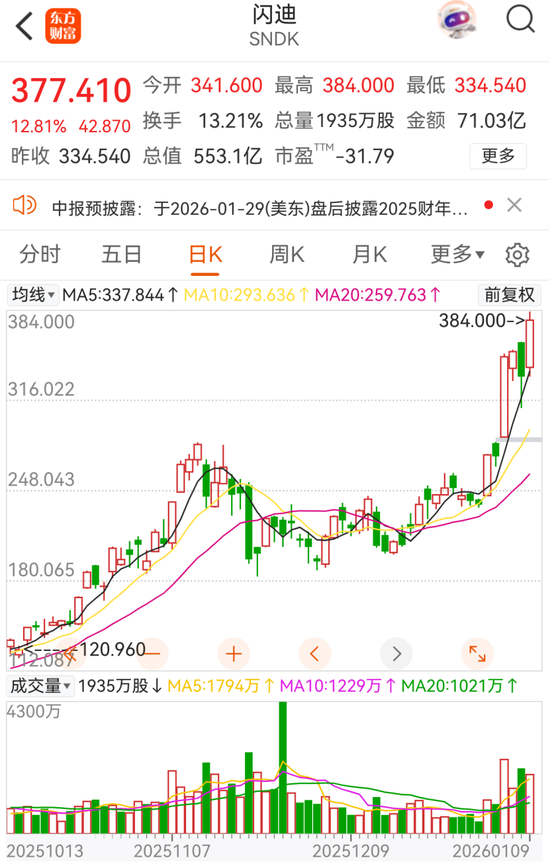
Core Viewpoint - The U.S. stock market saw a significant rise in semiconductor stocks, particularly in the storage chip sector, with SanDisk's stock reaching a new all-time high, driven by strong demand and price increases for enterprise-level NAND flash memory [1][8]. Group 1: Stock Performance - On January 9, SanDisk's stock surged by 12.81%, closing at $377.41 per share, with a total market capitalization exceeding $55 billion [10][12]. - Other semiconductor stocks also experienced gains, with Intel rising over 10%, Lam Research nearly 9%, and Micron Technology increasing by over 5% [1][9]. Group 2: Price Increases and Demand Drivers - Reports indicate that SanDisk may double the prices of its enterprise-level SSD NAND flash memory in response to strong demand for server-level storage [3][12]. - Nomura Securities noted that several storage suppliers are aggressively raising product prices, particularly for enterprise-grade NAND, with expected increases exceeding 100% quarter-over-quarter [4][13]. Group 3: AI Influence and Future Outlook - The demand for NAND flash memory is being significantly driven by advancements in AI, particularly through NVIDIA's inference context memory storage platform, which is expected to increase enterprise storage needs [4][15]. - Analysts predict that NAND and DRAM contract prices will rise by 33%-38% and 55%-60%, respectively, in the first quarter of 2026 due to the tight supply situation exacerbated by AI developments [15][16]. Group 4: Market Trends and Opportunities - The semiconductor industry is expected to see a strong growth trajectory, with global semiconductor sales projected to reach $72.7 billion in October 2025, marking a year-over-year growth rate of 27.2% [16]. - The current cycle is characterized by an "AI-driven" recovery, which is anticipated to lead to increased production and market share opportunities for domestic storage manufacturers [16].
暴涨!全线拉升!芯片传闻,突然刷屏
券商中国· 2026-01-11 06:56
Core Viewpoint - The article highlights a significant surge in U.S. semiconductor stocks, particularly in the storage chip sector, driven by strong demand and price increases for enterprise-level NAND flash memory [1][5]. Group 1: Stock Performance - On January 9, U.S. stock indices rose, with the S&P 500 reaching a new high. Notably, SanDisk's stock surged over 12%, marking a historical peak, with a cumulative increase of over 1100% since late April of the previous year [1][2]. - Other semiconductor stocks also experienced substantial gains, including Intel (up over 10%), Lam Research (up nearly 9%), and Micron Technology (up over 5%) [1][4]. Group 2: Price Increases and Demand Drivers - Reports indicate that SanDisk may double the prices of its enterprise-level SSD NAND flash memory to meet strong demand in upcoming quarters. Analysts from Nomura Securities noted that several storage suppliers are aggressively raising product prices, particularly for enterprise-grade NAND [5][6]. - The demand for NAND flash memory is being driven by NVIDIA's new storage platform, which is expected to significantly increase enterprise storage needs. This platform utilizes advanced data processing units (DPU) and is projected to require substantial amounts of 3D NAND [6]. Group 3: Market Dynamics and Future Outlook - A new contract model proposed by SanDisk requires full cash prepayment for a supply guarantee of 1 to 3 years, reflecting the tight supply situation exacerbated by rising AI demand [7]. - Analysts predict that the NAND and DRAM contract prices will see significant increases in early 2026, driven by the ongoing AI boom and supply constraints [8][9]. - The semiconductor industry is expected to experience a "super cycle," with domestic manufacturers poised to benefit from the current supply-demand imbalance and technological advancements [9].

三巨头收缩中国业务?3000亿空窗期来了,中国芯迎来泼天富贵
Sou Hu Cai Jing· 2026-01-10 20:13
Core Viewpoint - The global semiconductor market is approaching a trillion-dollar valuation, with WSTS estimating it at nearly $975 billion, but major companies like ASML, Micron, and Nvidia are retracting their operations in China, leaving a significant gap of nearly 300 billion yuan for domestic manufacturers to fill [1] Group 1: Market Dynamics - ASML, Micron, and Nvidia are key players in the semiconductor industry, with ASML being the sole supplier of lithography machines, Micron consistently ranking among the top three in memory, and Nvidia holding a 95% market share in AI chips in China [1] - The Dutch government plans to raise the export threshold for DUV lithography machines from 7nm to 14nm by October 2025, which is expected to impact ASML's sales and market expectations significantly [1] - ASML's stock dropped over 8% in a single day following the announcement, with market forecasts predicting a revenue decline of more than 10% in the coming year [1] Group 2: Domestic Manufacturers' Response - Domestic companies like Yangtze Memory Technologies (YMTC) and ChangXin Memory Technologies (CXMT) are ramping up production, with YMTC optimizing its Xtacking production line and achieving a 12% increase in speed and an 8% reduction in power consumption [3] - CXMT has increased its LPDDR5 memory speed to 6400MT/s, resulting in a 30% surge in industrial-grade orders, and has begun to receive significant orders from major players like Samsung [3] - Domestic manufacturers are also making strides in lithography and chemical materials, with Shanghai Micro Electronics achieving a 90% yield rate for its 28nm machines and increasing the domestic market share of lithography materials [1][3] Group 3: Challenges and Opportunities - The exit of major players from the Chinese market presents both challenges and opportunities for domestic firms, as they must stabilize yield rates, reduce costs, and build a complete ecosystem [6] - The Chinese semiconductor industry is under pressure to meet ambitious targets, such as the commercial launch of HBM3 by 2025, supported by significant funding from the national big fund [6] - The shift in market dynamics due to the withdrawal of ASML, Micron, and Nvidia is seen as a potential turning point for domestic manufacturers, who need to capitalize on this opportunity to fill the gaps left behind [6]


半导体材料:电子特气的国产替代(附77页PPT)
材料汇· 2026-01-10 15:49
Core Viewpoint - The article discusses the industrial gas sector, focusing on the classification, applications, and market dynamics of bulk gases and specialty gases, particularly in the semiconductor industry, highlighting the increasing demand for high-purity electronic gases and the challenges faced by domestic companies in achieving technological advancements and market competitiveness [7][10][39]. Group 1: Industrial Gas Classification - Industrial gases are categorized into bulk gases and specialty gases based on purity and usage. Bulk gases are used in large quantities with purity levels less than or equal to 99.99% (4N), while specialty gases are used in specific applications requiring higher purity [7][9]. - Bulk gases include air separation gases (oxygen, nitrogen, hydrogen) and synthetic gases (acetylene, carbon dioxide), which are essential in various industries such as metallurgy, chemical, and food processing [9][10]. Group 2: Applications of Specialty Gases - Specialty gases are critical in semiconductor manufacturing, particularly in processes like chemical vapor deposition (CVD), etching, and cleaning, where high purity and stability are paramount [12][16]. - The semiconductor industry accounts for 71% of the global demand for electronic specialty gases, with domestic demand in China at 42%, indicating a significant growth opportunity as the industry evolves [40][41]. Group 3: Market Dynamics and Challenges - The electronic specialty gas market is characterized by high entry barriers due to technological, certification, and qualification requirements, making it a capital-intensive and technically demanding industry [20][34]. - Domestic companies are actively pursuing research and development to achieve technological breakthroughs and reduce reliance on foreign suppliers, as many electronic specialty gases are still imported [23][39]. Group 4: Purity and Quality Requirements - The purity of specialty gases is a critical parameter, with requirements often reaching 5N to 6N (99.999% to 99.9999%), which significantly impacts the yield and performance of semiconductor products [25][32]. - The production process for high-purity gases involves complex techniques such as distillation and adsorption, which require advanced technology and expertise [27][29]. Group 5: Customer Relationships and Certification - The certification process for electronic specialty gases is lengthy, with strong customer loyalty due to the critical nature of these gases in production processes, leading to high switching costs for suppliers [30][33]. - Companies must navigate strict regulatory requirements and obtain various certifications to operate in the industrial gas sector, which adds to the complexity of market entry [35][36].
美国频繁失态的原因或许是:中国一脚踏入了舒适区,特朗普还没辙
Sou Hu Cai Jing· 2026-01-10 04:46
Group 1 - The U.S. is facing unprecedented challenges as China enters strategic areas previously dominated by the U.S. [1] - The U.S. announced its withdrawal from 66 international organizations, including 31 UN entities, highlighting its unilateralism [3] - U.S. tariffs on Chinese electric vehicles have backfired, with China's exports to the U.S. increasing to 9% and a trade surplus growing by 34.6% year-on-year [4] Group 2 - The U.S. has historically maintained a clear division in global supply chains, controlling high-end manufacturing and key technologies while allowing other countries to develop low-end manufacturing [8] - The balance of power has shifted as China's industrial and technological capabilities have risen, breaking the previous equilibrium [10] - China's "Made in China 2025" initiative has achieved 86% of its goals, directly competing with the U.S. in core industries, particularly in renewable energy [11] Group 3 - Chinese companies like CATL and BYD are leading in battery technology and electric vehicle sales, with China accounting for 68% of global new energy vehicle sales in 2025 [13][14] - China's self-sufficiency in semiconductors has increased from 14% in 2014 to 23% in 2023, with projections of reaching 27% by 2027 [16] - Despite U.S. export controls, major chip companies like Intel and NVIDIA are still reliant on the Chinese market for revenue [17] Group 4 - Germany's automotive industry is resisting U.S. sanctions against China, with BMW investing $15 billion to expand its operations in China [19] - The anticipated anti-China coalition led by the U.S. is faltering due to the economic interdependence of other countries with China [20] - The U.S. strategy of tariffs and sanctions has led to significant losses for American companies reliant on the Chinese market [20] Group 5 - The U.S. is experiencing a decline in global trust, with its reputation and governance indicators dropping in the Global Soft Power Index [24] - Public sentiment in countries like Germany, France, and Spain is increasingly supportive of countermeasures against U.S. imports [26] - The U.S. is caught in a cycle of sanctions and shortages, struggling to adapt to the new global industrial landscape shaped by China's advancements [28] Group 6 - The U.S. fears losing its exceptional status as a dominant global power, which would limit its ability to impose sanctions and manage risks [29] - Global investment trends show that 60% of sovereign funds are planning to increase investments in China, indicating a shift in capital flows [30] - The competition of the future will focus on who can provide more public goods for global development rather than monopolizing core technologies [31][32]