阿里健康

Search documents
阿里健康推出AI产品氢离子:定位医生版GPT;胡润发布中国人工智能50强,寒武纪以6300亿元价值居首丨AIGC日报
创业邦· 2026-01-20 00:10
Group 1 - MiniMax has established a technology company in Guangzhou with a registered capital of 70 million RMB, focusing on intelligent robotics and AI applications [2] - Alibaba Health has launched an AI product named "Hydrogen Ion," designed as a doctor-oriented version of GPT, emphasizing low hallucination rates and high evidence-based accuracy [2] - The Hurun Research Institute has released the "2025 Hurun China AI Enterprises Top 50," with AI chip company Cambricon valued at 630 billion RMB, marking a 165% increase from the previous year [2] - Xiaomi's health app has integrated with Ant Group's AI assistant "Ant Fu," providing preliminary health suggestions based on user data, with 30 million monthly active users [2]



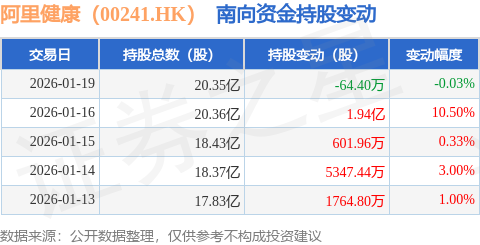
阿里健康(00241.HK):1月19日南向资金减持64.4万股
Sou Hu Cai Jing· 2026-01-19 20:21
Group 1 - The core point of the article highlights the recent trading activity of Southbound funds in Alibaba Health, indicating a slight reduction in holdings on January 19, with a total of 64,400 shares sold, while overall, there has been a net increase of 270 million shares over the past five trading days [1] - Over the last 20 trading days, Southbound funds have increased their holdings in Alibaba Health for 14 days, resulting in a total net increase of 214 million shares [1] - As of now, Southbound funds hold 2.035 billion shares of Alibaba Health, which represents 12.57% of the company's total issued ordinary shares [1] Group 2 - On January 19, the total number of shares held by Southbound funds was 2.035 billion, reflecting a decrease of 64,400 shares, which is a change of -0.03% [2] - On January 16, there was a significant increase of 194 million shares, marking a 10.50% change [2] - The company, Alibaba Health Information Technology Co., Ltd., focuses on providing industrial internet solutions for the healthcare and pharmaceutical industry, operating e-commerce platforms and consumer medical service platforms [2]
巨头竞逐医疗AI,如何重塑行业发展逻辑?
2 1 Shi Ji Jing Ji Bao Dao· 2026-01-19 12:25
Core Insights - Artificial Intelligence (AI) is becoming a core force driving a new wave of technological revolution and industrial transformation in the healthcare sector, injecting strong momentum for high-quality development [1][2] - The medical AI sector is a competitive battleground for internet healthcare companies and tech firms, with significant advancements and product launches from major players like JD Health and Alibaba Health [1][4][5] Company Developments - JD Health launched the "Zhi Yi" evidence-based medicine AI tool for doctors and the 2.0 version of "JD Zhuo Yi," aiming to transform patient service processes and become a new growth engine for hospitals [1][4] - JD Zhuo Yi 2.0 integrates JD Health's "AI + supply chain" capabilities, providing a comprehensive management solution covering clinical nutrition, outpatient medication, and weight metabolism [4] - Alibaba Health introduced its first self-developed medical large model "Hydrogen Ion," focusing on low hallucination rates and high evidence-based capabilities, now in practical application for clinical and research doctors [5][6] Market Trends - The AI healthcare market in China reached 97.3 billion yuan in 2023 and is expected to grow to 159.8 billion yuan by 2028, indicating a shift from conceptual hype to value realization [11] - The integration of AI in healthcare is expected to significantly change the behavior patterns of hospitals, clinicians, and patients, moving towards long-term health management rather than one-time treatments [7][8] Challenges and Considerations - The successful implementation of AI in healthcare faces challenges such as data quality issues, data silos, and the need for improved regulatory frameworks [9][10] - The quality of AI medical products is heavily dependent on the quality and accuracy of training data, necessitating a robust data governance mechanism [9] - Balancing technological functionality with humanistic care is crucial, as AI should enhance the patient experience while ensuring efficient clinical decision-making [10]

巨头竞逐医疗AI 如何重塑行业发展逻辑?
2 1 Shi Ji Jing Ji Bao Dao· 2026-01-19 12:21
Core Insights - Artificial Intelligence (AI) is becoming a core force driving a new round of technological revolution and industrial transformation in the healthcare sector, injecting strong momentum for high-quality development [1] - The medical AI sector is a competitive battleground for internet healthcare companies and technology firms, with significant advancements and product launches occurring [1][2] Company Developments - JD Health launched the "Zhuoyi" 2.0 version, aiming to become a new growth engine for hospitals, having already served over 5 million patients [2][3] - Alibaba Health introduced its first self-developed medical model "Hydrogen Ion," focusing on low hallucination rates and high evidence-based capabilities, now in practical application [3][4] - OpenAI has launched a healthcare version of ChatGPT, which is being deployed in various institutions to enhance patient care [5][4] Industry Trends - The healthcare industry is entering a new phase that demands high quality, efficiency, and sustainability, with AI technology providing new possibilities [2] - The integration of AI in healthcare is shifting patient behavior from single-instance treatment to long-term health management, indicating a transition to continuous healthcare [7][10] - The AI healthcare market in China reached 97.3 billion yuan in 2023 and is projected to grow to 159.8 billion yuan by 2028, marking a shift from conceptual hype to value realization [10] Challenges and Considerations - The successful implementation of AI in healthcare requires addressing data quality issues, regulatory frameworks, and ensuring a balance between technological functionality and humanistic care [8][9] - Companies must collaborate deeply with healthcare institutions to optimize AI models and workflows, creating a mutually beneficial relationship [8][10]
氪星晚报 |飞书史上第一次硬件合作,和安克创新做了一款“AI录音豆”;良品铺子2025年预计净亏损1.2亿至1.6亿元;马斯克称AI5将是一款“性能非常...
3 6 Ke· 2026-01-19 11:33
Group 1 - Li Auto's subsidiary Jiangsu Li Auto Drive Technology Co., Ltd. increased its registered capital from 180 million RMB to 300 million RMB, a growth of approximately 67% [1] - Good Products expects a net loss of 120 million to 160 million RMB for the year 2025, with a decrease in sales revenue due to store structure optimization and product price adjustments [2] - CATL's subsidiary, Runan New Energy Co., Ltd., was established with a registered capital of 4.55 million RMB, focusing on emerging energy technology research and solar power services [3] Group 2 - Jiangzhong Pharmaceutical announced a name change to China Resources Jiangzhong Pharmaceutical Co., Ltd. and will change its stock abbreviation to China Resources Jiangzhong while keeping the stock code unchanged [4] - Furi Electronics expects a net loss of approximately 50 million RMB for the year 2025 [5] - Cainiao's global overseas warehouse order volume is projected to grow by 32% year-on-year in 2025, with plans for expansion in key markets [6] Group 3 - Tencent and Taobao have invested in Zhijia Power Technology Co., Ltd., increasing its registered capital to 1.5191 million RMB [7] - Noumena recently secured tens of millions of RMB in Pre-A round financing from investors including Lion City Capital and Baidu [8] - Alibaba Health's AI product "Hydrogen Ion" has completed internal testing and is now available for download, targeting clinical and research fields [9] Group 4 - Feishu is collaborating with Anker Innovation to launch a smart recording device named "AI Recording Bean," marking its first hardware product since its establishment [10] - Porsche's sales in China decreased by 26.28% in 2025, with the company acknowledging the challenges in the luxury car market [10] - Elon Musk stated that the AI5 chip will be a "very powerful" chip, with development progressing smoothly [11]

氪星晚报 |飞书史上第一次硬件合作,和安克创新做了一款“AI录音豆”;良品铺子2025年预计净亏损1.2亿至1.6亿元;马斯克称AI5将是一款“性能非常强大”的芯片
3 6 Ke· 2026-01-19 11:31
Group 1: Company Developments - Li Auto's subsidiary Jiangsu Li Auto Drive Technology Co., Ltd. increased its registered capital from 180 million RMB to 300 million RMB, a growth of approximately 67% [1] - Ningde Times established a new company, Ma'anshan Run'an New Energy Co., Ltd., with a registered capital of 4.55 million RMB, focusing on emerging energy technology [3] - Jiangzhong Pharmaceutical changed its name to China Resources Jiangzhong Pharmaceutical Co., Ltd. and plans to change its stock abbreviation to "China Resources Jiangzhong" while keeping the stock code unchanged [4] - Hangzhou Zhijian Power Technology Co., Ltd. saw new shareholders including Tencent and Taobao, with its registered capital increased to 1.5191 million RMB [7] Group 2: Financial Forecasts - Liangpinpuzi expects a net loss of 120 million to 160 million RMB for the year 2025, with a decrease in sales revenue and gross margin due to store restructuring and product price adjustments [2] - Furi Electronics anticipates a net loss of approximately 50 million RMB for 2025, with a projected net loss of about 73 million RMB after excluding non-recurring gains and losses [5] Group 3: Industry Trends - Cainiao's global overseas warehouse order volume is expected to grow by 32% year-on-year in 2025, with plans to expand coverage and automation in key markets [6] - Alibaba Health's AI product "Hydrogen Ion" has completed internal testing and is now available for download, targeting clinical and research fields [10] - Feishu is collaborating with Anker Innovation to launch a smart recording device named "AI Recording Bean," marking its first hardware product since its establishment [11]



中泰国际每日晨讯-20260119
ZHONGTAI INTERNATIONAL SECURITIES· 2026-01-19 09:51
Market Overview - The Hang Seng Index closed at 26,845 points, down 0.3%, while the Hang Seng China Enterprises Index fell 0.5% to 9,221 points[1] - Total turnover in the Hong Kong market was HKD 255.1 billion, a decrease of 12.2% from HKD 290.5 billion the previous Thursday[1] - Blue-chip stocks like Techtronic Industries (669 HK) and Li Ning (2331 HK) rose by 4.9% and 4.3%, respectively, while Pop Mart (9992 HK) and Alibaba Health (241 HK) fell by 5.6% and 5.2%[1] Economic Indicators - The U.S. NAHB housing market index for January was reported at 37, below last week's 39 and market expectations of 40[3] Sector Performance - In the automotive sector, AI-related stocks surged, with Cao Cao Chuxing (2643 HK) and Hesai (2525 HK) rising by 10.9% and 5.6% respectively[4] - The heavy truck sector benefited from a subsidy policy, with China National Heavy Duty Truck Group (3808 HK) and Weichai Power (2338 HK) increasing by 3%-4%[4] - Pop Mart faced allegations of labor exploitation, leading to a 5.6% drop in its stock price, marking a cumulative decline of 48% from its peak[4] Energy Sector Developments - The electricity equipment sector showed strong performance, with stocks like Dongfang Electric (1072 HK) and Harbin Electric (1133 HK) rising by 4.9% and 5.8% respectively[5] - The State Grid announced an expected fixed asset investment of RMB 4 trillion during the 14th Five-Year Plan, a 40% increase from the previous plan[5]
京东若爆雷,或将成为历史上最大的雷,其规模甚至可能超过恒大
商业洞察· 2026-01-19 09:46
Core Viewpoint - JD.com has achieved a record revenue of 1.15 trillion yuan, surpassing Alibaba by nearly 180 billion yuan and Huawei by approximately 300 billion yuan, establishing itself as China's largest private enterprise and the only private company with over a trillion yuan in revenue [1][3][5]. Group 1: Revenue and Workforce - JD.com reported a total revenue of 1.1588 trillion yuan, significantly exceeding Alibaba's 984.7 billion yuan and Huawei's 860 billion yuan, marking it as the largest private enterprise in China [3][5]. - The company employs 670,000 staff members, contributing to its substantial revenue generation [1]. Group 2: Employee Welfare and Business Strategy - JD.com has invested heavily in employee welfare, with over 116.1 billion yuan spent on labor costs last year, and offers a housing loan program for employees, providing up to 1 million yuan [1][9]. - The company has implemented a strategy of full social insurance coverage for all delivery personnel, enhancing employee satisfaction and loyalty [7][9]. Group 3: JD Health and Growth Potential - JD Health has shown remarkable growth, with total revenue projected to increase by 8.6% to 58.2 billion yuan in 2024, becoming a significant profit driver for the group [10]. - The introduction of innovative health products, such as "Xiaoniu Acid," has led to substantial revenue growth, with JD Health's net profit reaching 2.44 billion yuan, accounting for nearly a quarter of the group's total profit [17]. Group 4: Market Position and Competitive Advantage - JD.com has established a robust logistics network with 3,600 smart warehouses and a storage area equivalent to 4,500 football fields, enabling rapid order fulfillment [7]. - The company has successfully penetrated the high-net-worth consumer market, with 77% of households earning over 500,000 yuan annually making purchases on JD.com [12]. Group 5: Contribution to National Economy - Private enterprises in China, including JD.com, have collectively generated 41 trillion yuan in revenue, significantly contributing to the national economy and employment [21]. - The government is supporting private enterprises through tax reductions and encouraging technological advancements, allowing companies like JD.com to thrive [23].


港股科网股,集体下跌
第一财经· 2026-01-19 08:40
1月19日,香港恒生指数收跌1.05%,恒生科技指数跌1.24%。 | 科网股普跌,哔哩哔哩大跌近7%,华虹半导体、阿里健康、阿里巴巴均跌超3%,中芯国际、商汤、快手均下跌。 | | --- | | 德琪医药-B | 3.800 | -6.40% | | --- | --- | --- | | 6996.HK | | | | 华花生物-B | 10.940 | -6.34% | | 2396.HK | | | | 思路迪医药股份 | 5.510 | -6.29% | | 1244.HK | | | | 中国生物制药 | 6.520 | -6.19% | | 1177.HK | | | | 加科思-B | 6.940 | -6.09% | | 1167.HK | | | | 维亚生物 | 1.940 | -5.83% | | 1873.HK | | | | 轩竹生物-B | 66.600 | -5.73% | | 2575.HK | | | | 英矽智能 | 52.050 | -5.71% | | 2406 HK | | | 多只AI应用概念股大跌,MINIMAX跌超13%,智谱跌超10%,美图公司跌超7%。 ...

A股超100股涨停,中航系集体飘红,黄金逼近4700美元,白银年内涨超30%
21世纪经济报道· 2026-01-19 07:49
Market Overview - Major stock indices in the Asia-Pacific region showed mixed results, with the Shanghai Composite Index surpassing 4100 points, while Hong Kong's main indices were in the red [1] - The South Korean Composite Index broke through 4900 points for the first time, with Hyundai and Kia Motors both rising over 12% [1] - A-shares experienced a contraction in trading volume, with the Shanghai Composite Index up 0.29% and the Shenzhen Component Index up 0.09%, while the ChiNext Index fell by 0.7% [1][2] Trading Volume and Stock Performance - The total trading volume in the Shanghai and Shenzhen markets was 2.73 trillion yuan, a decrease of 324.3 billion yuan from the previous trading day [1] - Over 3500 stocks in the market rose, with 103 stocks hitting the daily limit [1] Sector Performance - The electric grid equipment sector showed strong performance throughout the day, with stocks like China West Electric, Dalian Electric Porcelain, and Guangdian Electric all hitting the daily limit [3] - The AVIC index opened high and saw all constituent stocks in the green, with AVIC Aircraft, AVIC Power, AVIC Control, and AVIC Technology all hitting the daily limit, while Hongdu Aviation rose nearly 9% [4][5] Hong Kong Market - The three major indices in Hong Kong collectively declined, with the Hang Seng Index and Hang Seng Technology Index both dropping over 1%, and the Hang Seng China Enterprises Index down over 0.8% [6] - Most tech stocks in Hong Kong fell, with Bilibili down over 7%, Alibaba and Alibaba Health down over 3%, and other companies like Kuaishou and JD Health down over 2% [6] Commodity Performance - Gold and silver prices reached new highs, with spot gold nearing $4700 and silver up over 3.6%, marking a year-to-date increase of over 30% [7] - The cryptocurrency market continued to decline, with Bitcoin dropping nearly 3% and over 250,000 individuals facing liquidation, totaling approximately $871 million [7]