
浦发银行

Search documents
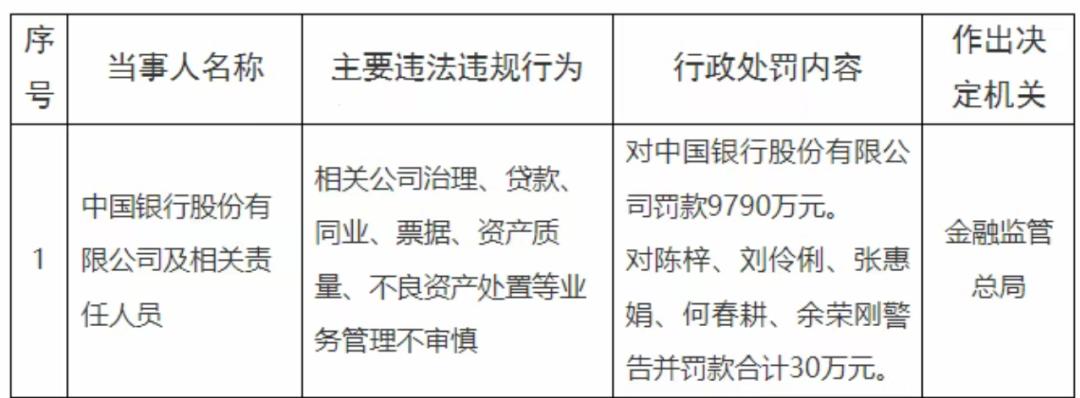
中国银行收到成立来最大罚单
3 6 Ke· 2025-11-04 00:57
Core Viewpoint - The banking industry is undergoing a stringent regulatory cycle, highlighted by significant fines imposed on major banks for compliance failures and internal control shortcomings [2][12][16]. Summary by Sections Regulatory Environment - The regulatory landscape is tightening, with increasing demands for compliance in the banking sector, as evidenced by the record fines issued this year [2][12]. - The total number of fines and the amount imposed on banks have significantly increased, indicating a shift towards stricter enforcement of compliance standards [15]. Major Fines - China Bank received a fine of 97.9 million yuan, marking the largest fine in its history, due to issues related to loan management, asset quality, and internal controls [3][4]. - Other banks, including Agricultural Bank and Minsheng Bank, also faced substantial fines for various compliance failures, with amounts of 27.2 million yuan and 58.65 million yuan respectively [8][9]. Internal Control Issues - The fines reveal critical weaknesses in internal controls and compliance culture within major financial institutions, suggesting that compliance is not merely an option but a necessity for survival [13][16]. - China Bank's response to the fine indicates a commitment to rectify identified issues and enhance risk management and internal control systems [4][10]. Industry Implications - The trend of hefty fines serves as a warning to the entire banking sector, emphasizing the importance of robust internal controls and adherence to regulatory requirements [12][16]. - The regulatory focus on compliance is expected to evolve, with an emphasis on digitalization and intelligent compliance systems to meet the growing complexity of regulatory demands [19][20].


中泰证券:继续看好银行股稳健性和持续性 关注两条投资主线
智通财经网· 2025-11-03 23:45
被动基金:持仓银行股市值规模及其占银行板块流通市值的比例虽环比下滑,但仍处于相对高位。1) ETF基金的规模和银行股占比:三季度末被动基金持有银行股总市值为1953.53亿元,整体规模虽较二 季度末下降14.47%,但仍位于2020年以来第二高位。持有银行股总市值占上市银行自由流通市值的 6.73%,较2Q25末下降0.37个百分点。2)被动基金对银行股的增减持规模:3Q25大部分银行处于资金 流出状态,银行板块合计净流出规模为330.3亿元,仅农业银行、南京银行、齐鲁银行获得资金流入, 分别为10.69、4.09、1.17亿元。 北向资金:整体减持银行板块。1)3Q25末北向资金持有银行股总市值1736.87亿元,环比2Q25末下降 31.66%,持有银行股总市值占上市银行自由流通市值比例为5.98%,较上季度末下降1.92个百分点。2) 从北向资金对银行股的增减持情况来看,三季度整体对银行板块净流出,减持规模为599.6亿元;从个 股来看,3Q25净流入银行有宁波、民生、成都和江阴银行,分别流入8.94、2.04、1.82和0.77亿元。 国有资金(汇金、证金、社保等机构资金):持仓市值小幅下滑,但仍位于 ...

深圳中电港技术股份有限公司 关于超短期融资券和中期票据获准注册的公告
Zhong Guo Zheng Quan Bao - Zhong Zheng Wang· 2025-11-03 23:29
Core Viewpoint - Shenzhen Zhongdian Port Technology Co., Ltd. has received approval from the National Association of Financial Market Institutional Investors to issue short-term financing bonds and medium-term notes totaling up to RMB 40 billion, with each category capped at RMB 20 billion [1][2]. Group 1: Short-term Financing Bonds - The company has been granted registration for short-term financing bonds amounting to RMB 20 billion, valid for two years from the date of the acceptance notice [2]. - The underwriting for the short-term financing bonds will be conducted by a consortium of banks including China Merchants Bank, Industrial Bank, Shanghai Pudong Development Bank, Bank of Communications, and Bank of China [1][2]. Group 2: Medium-term Notes - The company has also received approval for medium-term notes, with a registration amount of RMB 20 billion, similarly valid for two years from the acceptance notice [2]. - The same consortium of banks will underwrite the medium-term notes as well [2]. Group 3: Issuance Strategy - The company plans to issue the short-term financing bonds and medium-term notes in phases based on funding needs and market conditions, ensuring compliance with relevant laws and regulations for timely information disclosure [2].
浙江五洲新春集团股份有限公司关于公司控股股东之一致行动人部分股票解除质押的公告
Shang Hai Zheng Quan Bao· 2025-11-03 20:07
Core Viewpoint - The announcement details the partial release of stock pledges by a significant shareholder of Zhejiang Wuzhou Xinchun Group Co., Ltd., indicating a stable financial situation and no immediate risks to the company's operations or governance [1][4]. Summary by Sections Stock Pledge Release - Zhejiang Wuzhou Holdings Group Co., Ltd. released a total of 3,150,000 shares from pledge on October 31, 2025, which were previously pledged to Shanghai Pudong Development Bank [3]. Shareholding and Pledge Status - As of the announcement date, Zhejiang Wuzhou Holdings Group holds 23,360,187 shares, representing 6.38% of the total share capital, with 19,090,000 shares pledged, accounting for 81.72% of their holdings and 5.21% of the total share capital [2]. - The total shares held by the controlling shareholder and its concerted parties amount to 138,451,165 shares, or 37.81% of the total share capital, with a cumulative pledge of 24,580,000 shares, which is 17.75% of their holdings and 6.71% of the total share capital [2][3]. Financial Health and Risk Management - The controlling shareholder and its concerted parties are reported to have a good credit status and repayment capability, primarily relying on stock dividends and investment income, indicating no risk of forced liquidation of pledged shares [3]. - The partial release of stock pledges is not expected to materially affect the company's operations or governance, nor will it lead to changes in actual control [4].

机遇“金闪闪” 银行贵金属业务规模大增
Shang Hai Zheng Quan Bao· 2025-11-03 18:11
Core Viewpoint - The strong international gold prices and rising global risk aversion are driving the growth of banks' precious metals businesses, with significant year-on-year increases reported in the third-quarter financial results of listed banks. However, the recent fluctuations in gold prices present new challenges for these banking operations [1]. Group 1: Growth in Precious Metals Business - The precious metals business of banks has rapidly expanded due to the sustained rise in gold prices, with smaller banks showing particularly impressive growth. As of the end of September, Nanjing Bank's precious metals business reached 7.201 billion yuan, a staggering increase of 11,914.36% compared to the end of 2024. Hangzhou Bank's precious metals business grew to 1.217 billion yuan, up 1,523.57% from the end of 2024 [2]. - Joint-stock banks also experienced significant growth in their precious metals business. By the end of September, compared to the end of 2024, the precious metals business of Shanghai Pudong Development Bank increased by over 350%, while China CITIC Bank saw an increase of over 200%. Other banks like Zhejiang Commercial Bank, Industrial Bank, China Merchants Bank, and Minsheng Bank all reported growth exceeding 100% [2]. - Major banks maintained steady growth from a high base, with the precious metals business of Bank of China, China Construction Bank, and Agricultural Bank of China all increasing by over 10% compared to the end of 2024 [2]. Group 2: Strategic Focus on Precious Metals - The precious metals business combines wealth management and increased intermediary income, potentially becoming a significant factor in banks' intermediary income. Precious metals, especially gold, are seen as irreplaceable in banks' wealth management offerings and are crucial for customer asset allocation [3]. - Analysts note that the demand for gold as a hedge and a store of value is rising among residents. Banks, as key channels for gold bar sales and coin distribution, are well-positioned to meet this demand through the continued popularity of online investment products like account gold and gold accumulation [3]. - The decline in gold jewelry consumption may lead banks to reduce reliance on traditional jewelry sales and instead focus on innovation and promotion of their precious metals business [3]. Group 3: Risk Management Amid Price Volatility - Despite the growth, the high volatility of precious metals, particularly gold and silver, poses challenges for banks. Since October, these metals have entered a period of high volatility, prompting banks to enhance their risk management strategies [4]. - In response to market fluctuations, banks have adjusted trading rules and increased the minimum purchase thresholds for gold accumulation products to a range of 950 to 1,200 yuan, compared to around 500 yuan last year. Additionally, some banks have modified their precious metals wallet services to align with real-time gold price fluctuations [4]. - Looking ahead, institutions expect gold to retain its upward potential, maintaining its importance in asset allocation. The profitability of banks' precious metals business will increasingly depend on their internal capabilities, including the establishment of robust risk management systems to mitigate price volatility risks and the optimization of asset allocation for stable returns [4].






比亚迪等百家上市公司发布ESG委员会细则 | ESG热搜榜
2 1 Shi Ji Jing Ji Bao Dao· 2025-11-03 14:00
Group 1 - Li Auto announced a recall of 11,411 units of the MEGA 2024 model due to insufficient corrosion resistance of the coolant, which could lead to safety hazards such as battery thermal runaway [1] - The recall affects vehicles produced between February 18, 2024, and December 27, 2024, and will begin on November 7, 2025 [1] - Li Auto's chairman emphasized the proactive nature of the recall, stating that the company cannot wait for the investigation results given the potential risks [1] Group 2 - A total of 99 A-share listed companies, including BYD and Yili, have released ESG committee work guidelines from October 24 to 31 [2] - Some companies have rebranded their strategic committees to ESG committees, integrating ESG considerations into core decision-making processes [2] - Companies like Jinling Mining have revised their guidelines to clarify the responsibilities of the chairman in convening ESG committee meetings [2] Group 3 - Five banks, including China Bank and Agricultural Bank of China, received fines for various management failures, totaling millions in penalties [3] - The fines were primarily due to imprudent management in areas such as corporate governance, loan management, and asset quality [3] Group 4 - China's Ministry of Ecology and Environment called for a financing roadmap of $1.3 trillion ahead of COP30, highlighting dissatisfaction with the current funding targets set for developed countries [5] - The report emphasizes the need for substantial progress on financing commitments to support global adaptation goals [5] Group 5 - Zhejiang Securities reported a significant divergence in ESG investment trends between the US and Europe, with large-scale withdrawals from passive ESG funds in Europe [6] - BlackRock has transformed approximately $48 billion of institutional client index products into "ESG dedicated accounts" to meet specific ESG requirements [6] Group 6 - An interview with Zhong Hongwu highlighted that China's ESG evaluation system is transitioning from a follower to a leader, focusing on value creation rather than just risk avoidance [7] - The emphasis is on aligning ESG efforts with national strategic goals, providing a new inclusive development option for global ESG governance [7] Group 7 - Roland Berger's senior partner emphasized the need for businesses to integrate ESG and green transformation into product development systems [7] - The current phase of green low-carbon transformation requires overcoming challenges in standards and collaboration, with CCUS technology being crucial for achieving net-zero goals [7]

浦发银行三季报出炉:经营业绩持续向好 集团协同效应卓见成效
Jing Ji Guan Cha Bao· 2025-11-03 13:51
Core Viewpoint - Shanghai Pudong Development Bank (SPDB) demonstrated strong operational growth and improved asset quality in the first three quarters of 2025, driven by its "digital intelligence" strategy and a focus on enhancing financial support for the real economy [1][2]. Financial Performance - For the first three quarters, SPDB achieved operating income of 132.28 billion yuan, a year-on-year increase of 1.88% - The net profit attributable to shareholders reached 38.82 billion yuan, reflecting a year-on-year growth of 10.21% [1]. - As of the end of September, total assets amounted to 9,892.21 billion yuan, up 4.55% from the end of the previous year [2]. Asset Quality and Risk Management - SPDB's non-performing loan (NPL) balance and NPL ratio both decreased, with the NPL ratio at 1.29%, down 0.07 percentage points from the end of the previous year - The provision coverage ratio improved to 198.04%, an increase of 11.08 percentage points, enhancing the bank's risk mitigation capabilities [2]. Strategic Initiatives - The bank focused on key sectors and regions, enhancing its digital and scenario-based development capabilities, and deepening the integration of technology with financial services [3]. - In the technology finance sector, SPDB established a comprehensive "Group Innovation" ecosystem, serving over 250,000 technology enterprises with a loan balance exceeding 1 trillion yuan [3]. Supply Chain and Inclusive Finance - SPDB served 32,708 supply chain clients, a growth of 72.91% year-on-year, with online supply chain business volume reaching 574.86 billion yuan, up 267.65% [4]. - The "Puhui Loan" product system was developed to meet the diverse financing needs of small and micro enterprises, with a balance of 127.8 billion yuan, growing over 130% from the end of the previous year [4]. Cross-Border and Wealth Management - Cross-border transaction settlement volume increased by 47%, with cross-border loans growing by 23% [5]. - Personal financial assets under management reached 4.62 trillion yuan, a year-on-year increase of 19.07%, indicating strong growth in wealth management services [5]. Future Outlook - SPDB plans to continue aligning with national strategic deployments, enhancing financial service quality, and supporting high-quality development through digital transformation and risk management [6].
定存普增、活期分化,多家上市银行前三季度存款现“温差”
Bei Jing Shang Bao· 2025-11-03 13:33
Core Insights - The banking deposit business is experiencing a "temperature difference" phenomenon, with personal fixed deposits showing significant growth while demand for current deposits is uneven across banks [1][3][10] Group 1: Personal Fixed Deposits - Personal fixed deposit balances across nine listed banks showed positive year-on-year growth in the first three quarters of 2025, with notable increases from Hangzhou Bank (29.12%), Chengdu Bank, and Nanjing Bank (both over 24%) [3][4] - City commercial banks are performing well due to their deep ties with regional economies and flexible product innovation strategies [3][4] - The growth in personal fixed deposits reflects a shift in residents' asset allocation preferences, driven by lower risk tolerance amid market volatility [5][10] Group 2: Current Deposits - Current deposit growth is characterized by significant disparities, with some banks experiencing strong growth while others face declines [6][7] - Shanghai Pudong Development Bank reported a current deposit balance of 4,617.38 billion yuan, growing by 11.80% year-on-year, attributed to effective deposit management strategies [6][7] - Some regional banks, like Ruifeng Rural Commercial Bank, reported a decline in current deposits, indicating challenges in maintaining customer loyalty and competitive positioning [8][9] Group 3: Industry Trends and Strategies - The overall increase in household deposits and the rise of net worth management products indicate a shift in the banking industry's competitive landscape, moving from scale competition to a focus on comprehensive financial service capabilities [10][12] - Banks are adopting differentiated strategies to attract long-term funds and enhance service offerings, with a focus on optimizing deposit structures and managing costs effectively [11][12] - The trend of fixed deposits is expected to continue as interest rates decline, prompting banks to adapt their strategies to align with changing resident asset allocation needs [12]

商务部:鼓励金融机构基于产品碳足迹创新绿金产品丨绿色金融周报
2 1 Shi Ji Jing Ji Bao Dao· 2025-11-03 13:15
Group 1 - The rapid development of the green finance market has led to an increase in relevant information and data, with a focus on the latest trends and practices in green finance [1] - The Ministry of Commerce has issued guidelines to encourage financial institutions to innovate green finance products based on product carbon footprints, aiming to support foreign trade enterprises in their green development [2] - The China Green Bond Index showed a slight increase of 0.12% in Q3, indicating enhanced resilience against interest rate fluctuations, with a sample bond market value growth of 6.10% quarter-on-quarter [3] Group 2 - The national carbon market saw a highest price of 55.14 yuan/ton last week, with a total trading volume of 20,905,400 tons and a total transaction value of approximately 991.83 million yuan [4][5] - Guangdong has launched its first green foreign debt pilot program, allowing banks to facilitate foreign debt registration for green projects, thereby easing financing bottlenecks [6][7] - The Shanghai Pudong Development Bank has implemented a "data interconnection" climate financing project, providing nearly 35 million yuan in loans to small and medium-sized enterprises, significantly streamlining the financing process [8] Group 3 - Everbright Group released a Green Finance White Paper, outlining its innovative model of integrating comprehensive finance with environmental protection, and plans to introduce various green financial products [9] - Guangdong Nanyue Bank issued the province's first ESG-linked circular finance loan of 50 million yuan, promoting sustainable finance through performance-linked interest rates [10]
浦银安盛总助、首席权益投资官蒋佳良拟离职
Sou Hu Cai Jing· 2025-11-03 12:52
Core Viewpoint - The announcement of a managerial change at浦银安盛基金管理有限公司 highlights the ongoing talent movement within the fund industry, driven by competitive pressures and regulatory reforms [1][6]. Group 1: Managerial Changes - 蒋佳良 has left his position as the fund manager of浦银安盛价值成长混合基金 due to internal adjustments, with 高翔 appointed as the new fund manager [1]. - 蒋佳良 has held various roles within the company since joining in June 2018, including positions as the assistant director of the equity investment department and the chief equity investment officer [3]. - 江峰, a former fund manager at中信保诚基金, is set to join浦银安盛基金, indicating the company's strategy to attract experienced investment talent [5]. Group 2: Company Background - 浦银安盛基金 was established in August 2007 as a Sino-French joint venture, with Shanghai Pudong Development Bank holding 51% of the shares and AXA Investment Managers holding 39% [5]. - The company has been expanding its business scale, focusing on fixed income products while also developing its equity strategies under the leadership of the new general manager, 张弛 [5]. Group 3: Strategic Focus - The company is implementing three main business strategies: "Global Tech Innovator," "Index Specialist," and "Fixed Income Expert," aiming to enhance its product offerings and market positioning [6]. - The "Index Specialist" strategy includes the launch of index-enhanced funds and products related to "hard technology," creating a comprehensive index matrix [6]. - The "Global Tech Innovator" brand focuses on cutting-edge technology and Hong Kong stock technology sectors, while the "Fixed Income Expert" strategy aims to diversify credit strategies and "fixed income+" products [6]. Group 4: Industry Trends - The movement of senior talent within the fund industry has become a common phenomenon, influenced by intensified competition and deepening regulatory reforms [6]. - New regulations linking executive compensation to performance benchmarks are pushing fund companies to adjust their talent to meet high-quality development requirements [6]. - The rapid market style shifts and demand for product innovation are driving institutions to actively recruit management talent with new strategies [6].
