宁波银行

Search documents
散户要注意了!节后A股三大动力已经到位,这3类股将引发行情
Sou Hu Cai Jing· 2025-10-09 02:35
Group 1 - Nikkei 225 index surged 4.75% to reach a historical high, while Hang Seng Index rose 9.3% during the holiday, indicating strong performance in overseas markets [1] - A-share market has a historical trend of over 70% probability of rising in the first week after National Day, with three main drivers identified for a potential rebound [3] - The probability of a Federal Reserve rate cut in November has risen to 94%, leading to a shift of global funds from high-yield assets to emerging markets, with Chinese assets becoming a focal point [3] Group 2 - Domestic policies and liquidity are crucial for stabilizing the A-share market, with the central bank injecting 300 billion yuan in liquidity through reverse repos [5] - Various policy measures have been implemented, including tax refunds for semiconductor equipment purchases and consumer subsidies, creating a supportive environment for market recovery [5] - Industrial profits showed a significant turnaround, with a 20.4% year-on-year increase in August, ending three months of negative growth [5] Group 3 - The AI sector is experiencing growth, with AMD and OpenAI entering a multi-billion dollar partnership, driving global demand for computing power [7] - The penetration rate of domestic AI chips is expected to rise from 12% in 2024 to 28% in 2025, with private equity firms showing strong confidence in the technology sector [7] - Historical data indicates a 60% probability of the Shanghai Composite Index rising in the first five trading days after National Day, with an average increase of 1.41% [7] Group 4 - Analysts suggest the market has entered a "fundamentally driven bull market phase," with technology leading the way, while consumer and financial sectors are expected to catch up [9] - Semiconductor equipment companies are likely to benefit from policy subsidies, with firms like North Huachuang and Changchuan Technology showing strong profit growth [9] - The valuation of technology stocks remains low, with the computer industry PE at 38 times, below the 50th percentile since 2015 [9] Group 5 - Consumer sectors such as liquor and new energy are expected to benefit from seasonal demand and foreign capital inflow, supported by fiscal subsidies [11] - Financial sectors, including brokerage firms and banks, are positioned to gain from improved market sentiment and increased trading volumes [11] - Concerns exist regarding whether high valuations in technology stocks have already priced in future growth, especially if foreign capital takes profits [11]






资讯早班车-2025-10-09-20251009
Bao Cheng Qi Huo· 2025-10-09 02:13
1. Report Industry Investment Rating No relevant content provided. 2. Core Viewpoints of the Report - A - shares are expected to maintain an upward - trending oscillation in the context of stable economic fundamentals, continuous inflow of incremental funds, global liquidity easing, and improved Sino - US relations [28][29]. - During the "Double Festival" in China, the international gold futures price reached a new historical high. Although there is a callback risk in the short term, gold will still perform well in the long - term due to the expected decline in the credibility and purchasing power of the US dollar [21][22]. - To achieve the goal of doubling the economic aggregate or per capita income compared to 2020 by 2035, China's economy needs to maintain a moderate average annual growth rate of about 4% - 4.5% during the "14th Five - Year Plan" period. Policies in various fields will focus on technological innovation and industrial upgrading [29]. 3. Summary by Directory 3.1 Macro Data Overview - In Q2 2025, GDP at constant prices grew by 5.2% year - on - year, slightly lower than the previous quarter's 5.4% but higher than the same period last year (4.7%) [1]. - In September 2025, the manufacturing PMI was 49.8%, up 0.4 percentage points from the previous month; the non - manufacturing business activity index was 50.0%, down 0.3 percentage points [1][16]. - In August 2025, social financing increment was 2566.8 billion yuan, M0 increased by 11.7% year - on - year, M1 by 6.0%, and M2 by 8.8% [1]. 3.2 Commodity Investment Reference 3.2.1 Comprehensive - Mexico launched 4 anti - dumping investigations on Chinese products such as float glass and PVC coated fabrics, and China initiated a trade and investment barrier investigation [2]. - On October 9, the A - share market started the fourth - quarter trading. Overseas stock markets generally strengthened during the holiday, and the international gold price exceeded $4000 per ounce, while domestic consumption during the Golden Week showed resilience, which may support the A - share market [2]. - The Fed showed a willingness to cut interest rates further in 2025, but many officials were cautious due to inflation concerns. The WTO raised the 2025 global goods trade growth forecast to 2.4% and lowered the 2026 forecast to 0.5% [3]. 3.2.2 Metals - During the "National Day" holiday, the global commodity market was dominated by the metal sector. The international gold price exceeded $4000 per ounce, and domestic gold jewelry prices reached new highs. The price of copper may rise due to supply shortages [5]. - The central bank's gold reserve increased for 11 consecutive months. The LME inventory of some metals changed, and the copper market is expected to shift from a surplus in 2025 to a shortage in 2026 [6][7]. 3.2.3 Coal, Coke, Steel, and Minerals - The State Council's Work Safety Committee deployed the investigation, sealing, and rectification of abandoned mines and the crackdown on illegal mining [8]. - The Xinjiang Jinghe County coal reserve project was completed and put into use, with a total construction area of 131,647.92 square meters and a new 250,000 - ton coal storage bunker [8]. - Brazil and China plan to jointly establish a $1 - billion investment fund focusing on energy transition, infrastructure, and other fields [8][9]. 3.2.4 Energy and Chemicals - On October 8, the US crude oil futures rose due to a decline in US refined oil inventories and a rise in the stock market. Azerbaijan's BTC crude oil exports in November are expected to decrease [10]. - Russia is committed to fulfilling the OPEC+ agreement, gradually increasing oil production, and its refineries have increased fuel production [10]. 3.2.5 Agricultural Products - Brazil is expected to export 1.92 million tons of soybean meal and 7.12 million tons of soybeans in October 2025 [12]. - China proposed to strengthen regional agricultural cooperation at the ASEAN - China - Japan - South Korea Agriculture and Forestry Ministers' Meeting [13]. - Ukraine approved a tax - free export mechanism for rapeseed and soybeans [13]. 3.3 Financial News Compilation 3.3.1 Open Market - On October 9, the central bank conducted 1.1 trillion yuan of 3 - month (91 - day) outright reverse repurchase operations, with an incremental roll - over of 300 billion yuan [14]. - On September 30, the central bank conducted 242.2 billion yuan of 7 - day reverse repurchase operations, with a net withdrawal of 33.9 billion yuan [14]. - This week, 2.6633 trillion yuan of reverse repurchases will mature, with 2.0633 trillion yuan maturing on October 9 [14]. 3.3.2 Important News and Information - China and the US should expand cooperation and resolve issues through equal negotiation [15]. - As of the end of June 2025, China's total external debt was 1.74437 trillion yuan, and the debt risk was generally controllable [15][16]. - In September 2025, China's manufacturing PMI was 49.8%, and the non - manufacturing business activity index was 50.0% [16]. 3.3.3 Bond Market Summary - On September 30, the bond market and futures market recovered, with yields of major interest - rate bonds in the inter - bank market generally declining [23]. - On October 8, European and US bond yields generally fell [25][26]. 3.3.4 Foreign Exchange Market Express - On September 30, the on - shore RMB against the US dollar closed at 7.1186, up 18 points from the previous trading day [27]. - On October 8, the US dollar index rose 0.27%, and most non - US currencies fell [27]. 3.3.5 Research Report Highlights - CITIC Construction Investment believes that precious metals and copper prices have risen, and A - shares are expected to rise in the future [28][29]. - Yangtze River Fixed Income analyzed the situation of the money market last week [29]. - CITIC Securities estimated China's economic growth rate during the "14th Five - Year Plan" period [29]. 3.4 Stock Market Important News - On Wednesday, the Hang Seng Index fell 0.48%, and the Hang Seng Technology Index fell 0.55%. Gold and nuclear power stocks rose, while AI and consumer stocks were weak [32]. - During the "Double Festival", overseas stock markets and Chinese concept stocks performed well, and foreign capital flowed into the Chinese stock market in September [32]. - On October 9, 23 funds were launched, and about 70 new funds are scheduled to be issued in October, mainly including active equity funds, index funds, and convertible bond funds [33].
银行股,回调到位了吗?
Ge Long Hui A P P· 2025-10-05 10:02
Core Viewpoint - The A-share market has shown a slow upward trend since 2025, with significant gains in the third quarter, while the banking sector has experienced a contrasting decline, raising questions about whether the downturn has reached its bottom [2][3]. Market Performance - The Shanghai Composite Index and Shenzhen Component Index rose by 12.76% and 29.25% respectively in Q3, while the ChiNext Index surged by 50.4%, marking a rare quarterly increase [2]. - In contrast, 38 listed banks have collectively declined for three consecutive months since July, with several banks, including Minsheng Bank and Huaxia Bank, experiencing over 20% cumulative pullbacks [2][3]. Fund Flow Dynamics - The decline in bank stocks is attributed to a shift in capital towards high-growth sectors like AI and biotechnology, which have attracted significant new investments, leading to a "siphoning effect" away from the banking sector [2][3]. - Despite the downturn, state-owned banks have not reduced their holdings, indicating that the primary reason for the adjustment may be the temporary halt in buying by state-backed funds [5]. Historical Context - The average maximum drawdown for the China Securities Banking Index over the past decade is 19.34%, with the current drawdown of 14.78% nearing historical maximum levels during structural bull markets [6][7]. Industry Fundamentals - The banking sector has shown robust performance in H1 2025, with over 60% of listed banks reporting growth in both revenue and net profit, reflecting a 5 percentage point increase from the previous year [8]. - Key risk control indicators remain stable, with a non-performing loan ratio of 1.23% and a provision coverage ratio of 238.6%, indicating strong risk management capabilities [8][9]. Investment Appeal - The banking sector continues to offer attractive dividend yields, with many banks providing yields above 4%, making them appealing in a low-interest-rate environment [14][12]. - Long-term institutional investments in banking stocks have increased, with social security funds raising their holdings to 51.71% and insurance funds actively acquiring bank shares [14][15]. Future Outlook - Historical data suggests that bank stocks tend to perform well after the National Day holiday, with a 79% probability of rising in the week following the holiday [18]. - The fourth quarter is expected to see improved performance for bank stocks, with anticipated returns of 10%-15% due to policy support and increased institutional buying [18].


天雷滚滚!假期20家公司发布减持公告,3家退市风险,8家异常波动
Sou Hu Cai Jing· 2025-10-05 02:51
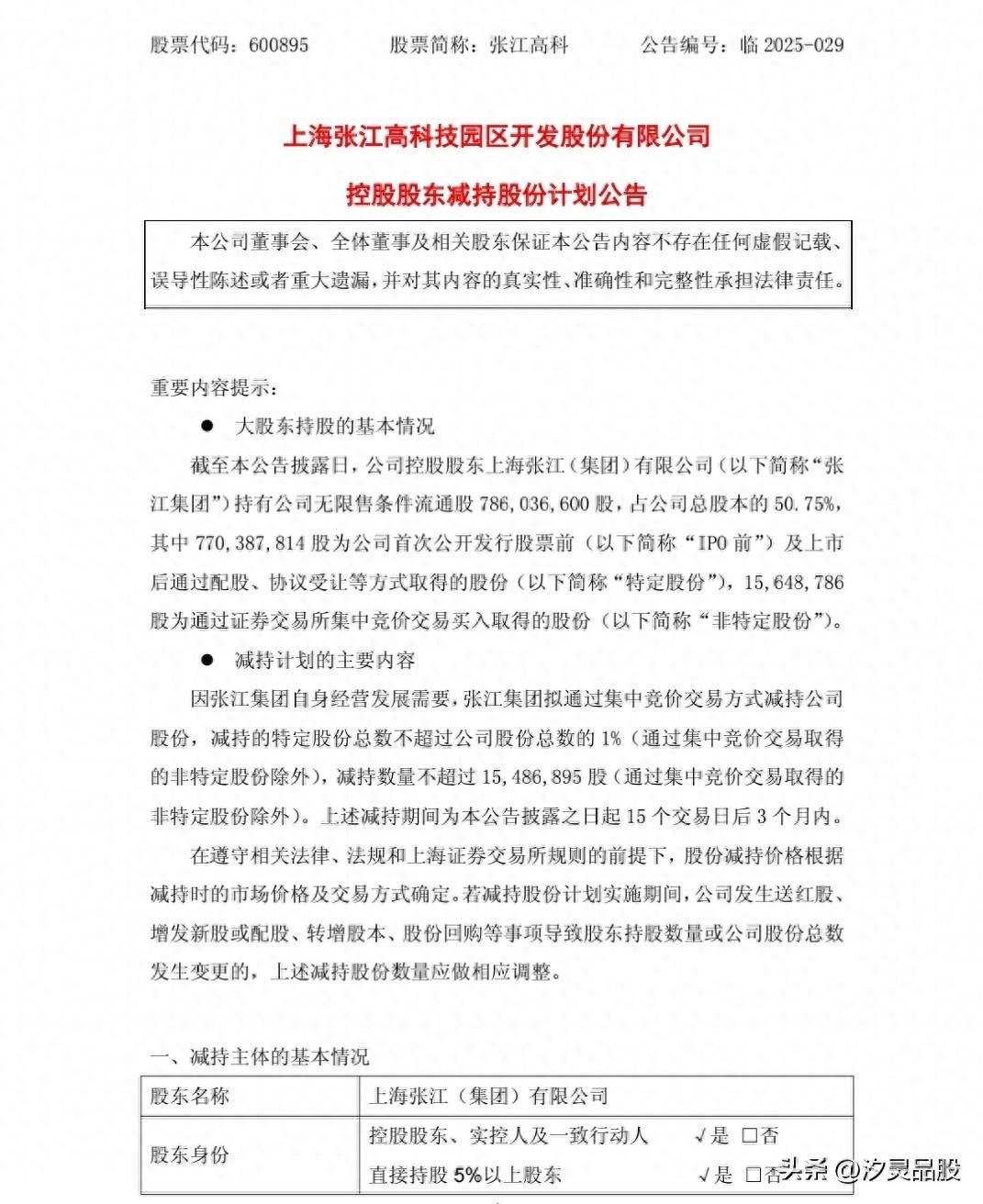
Group 1 - The Hong Kong stock market has shown positive performance with notable gains in technology-related companies such as Alibaba, Kuaishou, and SMIC, leading to increased expectations for the A-share market post-holiday [1] - 20 companies have announced share reduction plans, with 9 of them being new reduction plans, including Zhangjiang Hi-Tech, Zhejiang Wenlian, RunDa Medical, and Suotong Development [2] - Zhangjiang Hi-Tech plans to reduce its shares by up to 15,486,895 shares, not exceeding 1% of the total shares, within three months after the announcement [2] Group 2 - Lin'an Xinjing intends to reduce up to 23,746,800 shares, which is 1.60% of the total share capital, with specific limits for different trading methods [4] - RunDa Medical's shareholders, Zhu Wenyi and Liu Hui, plan to reduce their holdings by up to 10,540,000 shares and 7,460,000 shares respectively, representing 1.75% and 1.24% of the total shares [10] - Three companies have issued delisting risk warnings, including ST Dongshi, ST Suwu, and ST Zhengping, indicating potential risks of stock delisting due to low share prices [12] Group 3 - Eight companies have reported abnormal stock trading fluctuations, including Shida Shenghua, Pinming Technology, and Fengshan Group, which have issued announcements regarding these trading anomalies [12]




美元存款利率集体下调,高收益时代渐行渐远
Sou Hu Cai Jing· 2025-09-30 17:57
Core Viewpoint - The high-yield allure of USD deposits is fading as the Federal Reserve initiates a rate-cutting cycle, leading to a downward adjustment in deposit rates across banks [1][6]. Group 1: Rate Adjustments by Banks - Foreign banks, particularly HSBC, were the first to lower USD deposit rates following the Fed's announcement, with HSBC reducing its one-year rate to 3% and six-month rate to 3.5% [2]. - Chinese banks, including Huashang Bank and Nanjing Bank, have also begun to adjust their USD deposit rates, with rates for one-month, three-month, and six-month deposits set at 3.75%, 3.85%, and 3.90% respectively [2]. - There are notable differences in USD deposit rate structures among banks, reflecting their expectations of future Fed rate changes, with some banks offering higher rates for shorter terms and others for longer terms [2]. Group 2: Expert Insights on Rate Cuts - Experts indicate that foreign banks typically respond more swiftly to Fed policy changes, while some Chinese banks may lag due to high demand for USD funds and internal pricing mechanisms [3]. - Market expectations suggest that the Fed's rate-cutting cycle is not yet complete, with predictions of two additional 25 basis point cuts by the end of the year and another in early next year [3]. - The median forecast from the Fed's dot plot indicates a potential cumulative rate cut of 50 basis points in the remaining meetings of the year [3]. Group 3: Investor Considerations - Investors are advised to be cautious of the risks associated with USD deposits, including exchange rate fluctuations and opportunity costs compared to higher-yielding assets [4][5]. - With the trend of declining deposit rates, investors should consider diversifying their asset allocation to include higher-yielding and lower-risk options such as bonds and funds [5]. - Current USD investment products, such as those offered by Ningbo Bank, still present attractive yields compared to traditional deposits, suggesting a shift in investment strategy may be beneficial [5]. Group 4: Future Outlook - The downward trend in USD deposit rates is expected to continue, with projections indicating a cumulative reduction of 50 basis points by the end of 2025 [6]. - The average annualized yield for USD investment products has decreased from 4.52% in January to 3.79% recently, signaling a shift away from the "high-yield era" for USD deposits [6].
大A的荣耀不再属于“性价比”投资者
Hu Xiu· 2025-09-30 10:32
Core Insights - Deep value fund managers, who performed well during the bear market, are underperforming in the current bull market, primarily due to the significant rise in technology stocks and growth-oriented funds [1][2][10] - The average annual return of deep value fund managers is below the industry average, with many products yielding less than 20% year-to-date, while the CSI Active Equity Fund Index has achieved a return of 34.11% [3][9] - The investment philosophy of deep value managers focuses on long-term intrinsic value, safety margins, and stable business models, which contrasts sharply with the growth-oriented approach that prioritizes high growth potential and current market trends [10][11][12] Performance Comparison - As of September 24, 2023, prominent deep value fund managers like Xu Yan and Jiang Cheng have seen their flagship products yield less than 20%, with only a few exceeding 30% [3][9] - The performance of deep value funds is generally in line with the CSI 300 Index, which has a year-to-date return of 15.63% [10] - In contrast, growth-oriented funds have seen returns exceeding 200% in some cases, highlighting the stark difference in performance between the two styles [5][10] Market Trends - The current market environment favors growth-oriented strategies, particularly in sectors like technology and innovation, while deep value strategies are struggling due to their focus on low-valuation sectors such as finance and real estate [10][12][26] - The number of deep value fund managers is relatively small compared to growth-oriented managers, and many notable deep value figures have left the industry, further limiting the available options for investors [25][29] Investment Strategy - Deep value funds are recommended for conservative investors as a core holding, while growth funds may be allocated for those seeking higher returns [16][17] - A balanced approach that includes both deep value and growth strategies may provide better risk management and potential returns [18][19] - Investors should be cautious of deep value funds that show unusually high performance in a bull market, as this may indicate a shift in investment style [16]
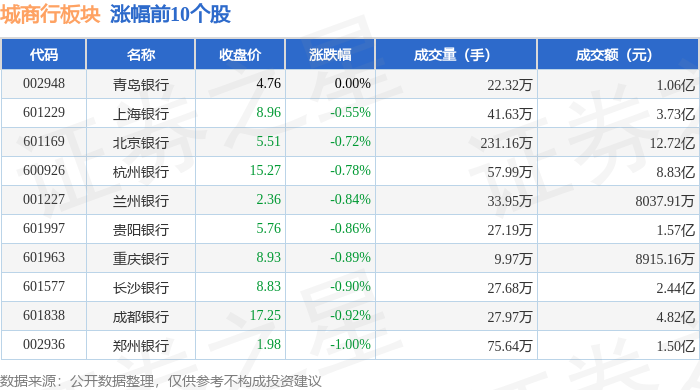
城商行板块9月30日跌1%,苏州银行领跌,主力资金净流出4.62亿元
Zheng Xing Xing Ye Ri Bao· 2025-09-30 08:51
Core Insights - The city commercial bank sector experienced a decline of 1.0% on September 30, with Suzhou Bank leading the drop [1] - The Shanghai Composite Index closed at 3882.78, up 0.52%, while the Shenzhen Component Index closed at 13526.51, up 0.35% [1] Stock Performance Summary - Qingdao Bank: Closed at 4.76, unchanged; trading volume of 223,200 shares, turnover of 106 million [1] - Shanghai Bank: Closed at 8.96, down 0.55%; trading volume of 416,300 shares, turnover of 373 million [1] - Beijing Bank: Closed at 5.51, down 0.72%; trading volume of 2,311,600 shares, turnover of 1.272 billion [1] - Hangzhou Bank: Closed at 15.27, down 0.78%; trading volume of 157,990 shares, turnover of 883 million [1] - Lanzhou Bank: Closed at 2.36, down 0.84%; trading volume of 339,500 shares, turnover of 80.379 million [1] - Guiyang Bank: Closed at 5.76, down 0.86%; trading volume of 271,900 shares, turnover of 157 million [1] - Chongqing Bank: Closed at 8.93, down 0.89%; trading volume of 99,700 shares, turnover of 89.151 million [1] - Changsha Bank: Closed at 8.83, down 0.90%; trading volume of 276,800 shares, turnover of 244 million [1] - Chengdu Bank: Closed at 17.25, down 0.92%; trading volume of 279,700 shares, turnover of 482 million [1] - Zhengzhou Bank: Closed at 1.98, down 1.00%; trading volume of 756,400 shares, turnover of 150 million [1] Capital Flow Analysis - The city commercial bank sector saw a net outflow of 462 million from main funds, while speculative funds had a net inflow of 331 million, and retail investors had a net inflow of 131 million [2] - Suzhou Bank: Main fund net inflow of 55.9396 million, speculative fund net outflow of 11.5337 million, retail net outflow of 44.4059 million [3] - Changsha Bank: Main fund net inflow of 33.8793 million, speculative fund net outflow of 13.6525 million, retail net outflow of 20.2268 million [3] - Qilu Bank: Main fund net inflow of 8.6825 million, speculative fund net outflow of 2.7980 million, retail net outflow of 5.8846 million [3] - Hangzhou Bank: Main fund net inflow of 7.6881 million, speculative fund net inflow of 44.2474 million, retail net outflow of 51.9354 million [3] - Guiyang Bank: Main fund net inflow of 4.8665 million, speculative fund net outflow of 1.6412 million, retail net outflow of 3.2254 million [3]

永赢基金选择彭博AIM优化QDII投资流程
彭博Bloomberg· 2025-09-30 02:07
Core Viewpoint - Bloomberg has announced that Yongying Fund Management Co., Ltd. has adopted its leading order and investment management technology solution, AIM, to optimize the entire process of overseas investments, enhance operational efficiency, strengthen compliance management, and deepen insights into investment portfolios [1] Group 1: Yongying Fund Management Co., Ltd. - Yongying Fund is a leading asset management company in China, supported by strong shareholders such as Ningbo Bank and Oversea-Chinese Banking Corporation Limited, which provide robust capital, technology, and brand support for diversified business development [3] - As of the end of Q2 2025, Yongying Fund's non-monetary asset management scale reached 358.6 billion yuan, ranking 18th among 162 fund companies according to data from Galaxy Securities [4] Group 2: Bloomberg's AIM Solution - Bloomberg's AIM solution covers the entire investment lifecycle and possesses multi-asset management capabilities, including research management, order and execution management, portfolio and risk analysis, trading compliance, and operational support [2] - The AIM solution is used by over 900 institutional clients and nearly 15,000 professionals globally, managing a total of over 22 trillion dollars in assets [1]

机构密集“踩点”银行股 息差与资产质量等成焦点
Zhong Guo Zheng Quan Bao· 2025-09-29 22:14
Core Insights - The focus of institutional research has shifted towards regional banks in economically developed areas, particularly in the Yangtze River Delta, due to their strong performance and resilience [1][2][5] Group 1: Institutional Research Activity - As of September 29, A-share listed banks have been researched 326 times this year, with over 2000 institutions participating [2] - Regional city commercial banks and rural commercial banks in the Yangtze River Delta, such as Changshu Bank and Ningbo Bank, have been the most frequently researched [2][3] - Changshu Bank reported a revenue of 6.062 billion yuan, a 10.10% year-on-year increase, and a net profit of 1.969 billion yuan, up 13.51% year-on-year [2] Group 2: Key Concerns of Institutions - Institutions are primarily concerned with the stability of net interest margins, potential risks to asset quality, and future credit allocation strategies [3][4] - Shanghai Bank aims to enhance its credit allocation to key sectors and regions, focusing on technology, green finance, and inclusive finance [4] Group 3: Investment Value of Bank Stocks - The investment logic for bank stocks is evolving from valuation recovery to deep value discovery in high-quality banks amid industry differentiation [5][6] - The banking sector is expected to benefit from increased inflows of incremental capital, particularly from insurance funds, due to its high dividend returns and stable earnings [6]

机构密集“踩点”银行股息差与资产质量等成焦点
Zhong Guo Zheng Quan Bao· 2025-09-29 20:45
Core Viewpoint - The article highlights the increasing interest of institutional investors in regional banks, particularly in the Yangtze River Delta, due to their strong performance and resilience in a developed economic region [1][2]. Group 1: Institutional Research Focus - As of September 29, 2023, A-share listed banks have been surveyed over 300 times by more than 2000 institutions, with regional banks in the Yangtze River Delta receiving significant attention [1]. - Institutions are particularly focused on net interest margin stability, potential asset quality risks, and future credit allocation strategies during their research [2][3]. Group 2: Financial Performance of Regional Banks - Changshu Bank reported a revenue of 6.062 billion yuan, a year-on-year increase of 10.10%, and a net profit of 1.969 billion yuan, up 13.51% [2]. - The bank also declared its first interim cash dividend since its listing, distributing 0.15 yuan per share, totaling 499 million yuan [2]. Group 3: Investment Trends in Banking Sector - The investment logic for bank stocks is shifting from valuation recovery to deep value discovery of high-quality banks amid industry differentiation [3]. - As of September 29, 2023, the Shenwan Primary Bank Index closed at 4000.30 points, with a year-to-date increase of 2.33%, while individual stocks like Agricultural Bank, Qingdao Bank, and Pudong Development Bank rose over 20% [4]. - Institutional investments in bank stocks have increased, with insurance funds actively purchasing shares in various banks, indicating a preference for high dividend returns and stable earnings [4].