吉利汽车

Search documents
多家车企公布2026销量目标
智通财经网· 2026-01-07 22:35
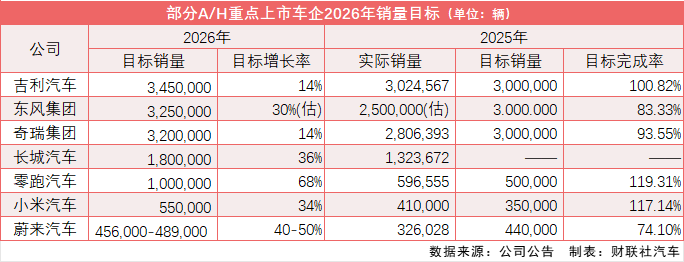
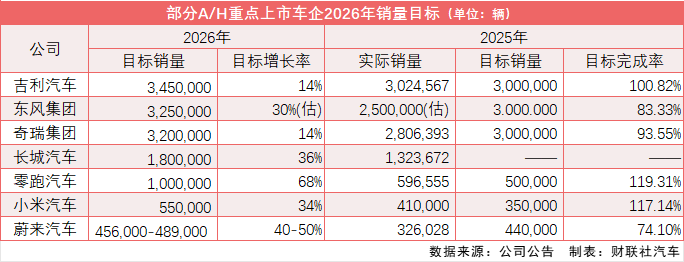
已连续多年未达成年度目标的长城汽车,下调了2026年员工持股计划业绩考核目标,将原计划中2026年 的汽车销量考核目标从不低于249万辆下调至不低于180万辆,较去年实际销量增长36%;净利润考核目 标(不低于100亿元)保持不变。 新能源汽车购置税减半政策的实施及"两新"补贴政策的调整延续,为2026年国内汽车市场带来了新的变 量。 在此背景下,多家车企相继披露的2026年销量目标呈现出截然相反的走势——尚处于全面智电转型、且 背负较大燃油车时代存量资产、销量基数较大的传统车企普遍给出了较为审慎的增长目标,而新造车企 业对市场估计则更为乐观。其中,在2025年均超额完成KPI的零跑、小米汽车今年销量目标的增幅分别 达到68%和34%;意欲在2026年实现全年盈利的蔚来汽车,年度目标增幅同样高达40-50%。 | | | 部分A/H重点上市车企2026年销量目标(单位:辆) | | | | | --- | --- | --- | --- | --- | --- | | 公司 | 2026年 | | 2025年 | | | | | 目标销量 | 目标增长率 | 实际销量 | 目标销量 | 目标完成率 | | 吉 ...




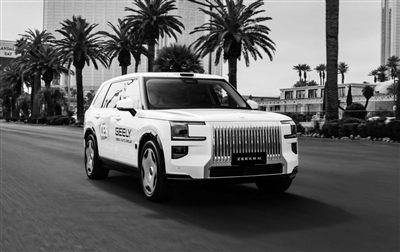
吉利千里浩瀚英文命名:G-ASD 今年将推送高速L3和低速L4功能
Mei Ri Shang Bao· 2026-01-07 22:31
Core Insights - Geely Auto Group announced the evolution of its AI technology system to version 2.0, integrating AI across various domains of vehicle functionality, marking a significant advancement in automotive intelligence [2][3] - The introduction of the Eva super-human emotional intelligence agent aims to enhance user experience by providing a highly intelligent and user-friendly vehicle intelligence hub [2][4] - Geely's new G-ASD (Geely Afari Smart Driving) system represents a cutting-edge intelligent driving solution developed in collaboration with Qianli Zhijia, focusing on delivering superior user experiences [2][5][6] Group 1: AI Technology Evolution - The full-domain AI 2.0 system is built on the World Action Model (WAM), enabling cross-domain integration among driving, cabin, chassis, and assistance systems [3] - Key breakthroughs in AI 2.0 include "agentification" and "engineification," leading to a more standardized and coordinated technical architecture [3] - The unified "worldview" and "knowledge base" provided by the WAM model enhance the vehicle's understanding of distance, speed, object behavior, and social norms [3] Group 2: Eva Super-Human Agent - Eva's upgraded capabilities include advanced conversational skills and emotional intelligence, transitioning from "general AI" to "personal AI" [4] - The agent can autonomously understand and execute complex travel needs, completing the entire process from planning to execution [4] - Eva aims to achieve deep integration of cabin and driving functions, enhancing the overall travel experience for users [4] Group 3: G-ASD Intelligent Driving System - The G-ASD system is characterized by high modularity, extensive data sets, and a robust hardware platform, establishing a technological moat in the industry [5][6] - It incorporates the WAM model and is one of the most advanced intelligent driving systems globally [6] - The G-ASD system will support L2, L3, and L4 autonomous driving capabilities, with plans to launch Robotaxi operations under regulatory conditions [6] Group 4: Sales and Future Goals - Geely's sales reached 3.02 million units in 2025, with nearly 1.69 million units being new energy vehicles, marking a 90% year-on-year increase [6] - The company aims to launch approximately 10 new models in 2026, targeting an annual sales goal of 3.45 million units [6] - Geely is committed to integrating its innovative electric vehicle technologies with the global supply chain, striving to become a leader in the global smart automotive sector [6]
利用率提升11.3个百分点,“沉睡产能”醒过来
Si Chuan Ri Bao· 2026-01-07 20:54
Core Insights - The article highlights the significant improvement in industrial capacity utilization in Nanchong, with a rise from 53.4% in 2024 to 64.7% in 2025, marking an increase of 11.3 percentage points [1][2] - The Nanchong government has implemented various measures to enhance industrial efficiency and reduce costs, including the introduction of bundled electricity purchasing, which has saved companies over 40 million yuan in electricity costs [3][4] Group 1: Industrial Performance - Nanchong's industrial capacity utilization rate improved to 64.7% in 2025, up from 53.4% in 2024, indicating better use of production capabilities [1][2] - The city aims to address the long-standing issue of "sleeping capacity," which has hindered economic growth and led to high operational costs for businesses [2] Group 2: Cost Reduction Initiatives - The implementation of bundled electricity purchasing has allowed 434 companies to save over 40 million yuan in electricity costs, with an average reduction of 0.0375 yuan per kilowatt-hour [3][4] - The average industrial electricity price in Nanchong decreased by 8.8% from the end of 2024 to 2025, contributing to lower operational costs for businesses [5] Group 3: Economic Impact - The automotive and parts industry in Nanchong saw a 5.9% increase in output value from January to November 2025, with 219 enterprises classified as above-scale [4] - Industrial tax revenue has become the largest source of tax income in Nanchong, indicating a growing contribution of the industrial sector to the local economy [5]
车企组团出逃俄罗斯!304亿直接打水漂?
电动车公社· 2026-01-07 16:40
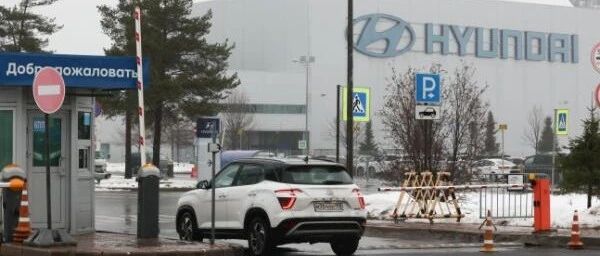
Core Viewpoint - International car companies that voluntarily exited the Russian market two years ago may now find it difficult to return due to ongoing geopolitical instability and financial implications of their decisions [1]. Group 1: International Car Companies' Dilemma - Hyundai sold its St. Petersburg factory for 7,000 rubles (approximately 550 RMB) with a two-year buyback option, but now faces the dilemma of either investing heavily to restore the factory or losing a significant investment of 540 billion KRW (approximately 2.6 billion RMB) [4][5][10]. - Other international car manufacturers, such as Toyota and Volkswagen, chose to exit without retaining buyback rights, while companies like Mazda and Renault are now grappling with the implications of their buyback options [12][19]. - Mazda sold its 50% stake in a Russian joint venture for 1 euro and opted not to exercise its buyback option after three years, indicating the varying levels of commitment among companies [16][24]. Group 2: The Rise of Chinese Car Manufacturers - The exit of major international car companies led to a 60% drop in car production and sales in Russia, creating an opportunity for Chinese car manufacturers to capture market share [35][36]. - Chinese brands increased their market share in Russia from 9% in 2022 to 49% in 2023, with projections to reach 62% in 2024, demonstrating a significant shift in the automotive landscape [44]. - The volume of Chinese car exports to Russia is projected to rise from 163,000 units in 2022 to 1.28 million units in 2024, making Russia the largest export market for Chinese cars [45][48]. Group 3: Challenges Ahead for Chinese Car Manufacturers - Despite the initial success, Chinese car manufacturers face challenges starting in 2024, including increased taxes on imported vehicles and negative media coverage regarding vehicle reliability [53][61]. - The Russian government has implemented significant tax increases on imported vehicles, which could impact the profitability of Chinese car manufacturers operating in the market [57][60]. - The need for Chinese manufacturers to adapt their products to meet local consumer demands and improve quality is critical, but establishing local production facilities involves substantial investment risks [69][70].



今日新闻丨新款小米SU7开启预售,涨价增配,4月上市!吉利银河V900开启预售,预售价31.98-38.98万元!
电动车公社· 2026-01-07 16:40
Group 1 - The new Xiaomi SU7 has started pre-sales on January 7, with a price range of 229,900 to 309,900 yuan, and the Pro and Max versions have seen price increases of 14,000 and 10,000 yuan respectively [1][10] - The new model retains the design of the current Xiaomi SU7, featuring full laser radar, new color options, and enhanced body strength [4] - Interior upgrades include a new steering wheel design, removal of physical buttons in the center console, and improved seating design, with all models equipped with advanced braking systems and high-performance chips [6] Group 2 - The new Xiaomi SU7's powertrain has been upgraded, with the standard and Pro versions using a 752V silicon carbide high-voltage platform with a maximum power of 235 kW, while the Max version continues with an 897V platform providing 508 kW, and the CLTC electric range is 720/902/835 km respectively [8] - The new model addresses many pain points of the current version and is expected to see high demand after its launch [10] - The Geely Galaxy V900 has also started pre-sales on January 7, with a price range of 319,800 to 389,800 yuan [2][12] Group 3 - The Geely Galaxy V900 features a distinctive design with a large chrome grille and integrated lighting, and it is positioned as a mid-to-large MPV with dimensions of 5360/1998/1920 mm and a wheelbase of 3200 mm [12] - The interior offers flexible seating arrangements (6/7/8 seats), advanced entertainment systems, and a high-tech dashboard design [14] - The powertrain includes a 120 kW 1.5T engine paired with electric motors, providing a range of 220 to 260 km and a 0-100 km/h acceleration time of 6.5 seconds [15][17]


吉利醇氢,成了破解高寒新能源难题的“关键答案”
Bei Jing Qing Nian Bao· 2026-01-07 16:27
Core Viewpoint - The Harbin International Ice and Snow Economic Expo showcases Geely Holding Group's advancements in methanol-hydrogen electric technology, emphasizing its role in supporting the green future of the ice and snow economy in extreme cold environments [1][5]. Group 1: Technological Advancements - Geely is recognized as a global leader in methanol ecology and carbon neutrality, with methanol-hydrogen technology expanding from road transport to marine, mining, and construction machinery, providing reliable green power solutions for low-temperature economies [3][5]. - The methanol-hydrogen electric buses and snow removal vehicles presented can operate reliably at temperatures as low as -40°C, addressing the industry pain point of traditional electric vehicles struggling in winter conditions [5][7]. Group 2: Economic Impact - The long-range methanol-hydrogen electric buses are already in large-scale operation in northern cities, achieving a range of over 600 kilometers in low temperatures, with operational costs approximately 0.2 yuan lower per kilometer compared to pure electric vehicles, leading to savings of about 180,000 yuan over the vehicle's lifecycle [5][7]. - In the municipal sector, Geely's methanol-hydrogen electric snow removal vehicles reduce energy consumption costs by over 30% compared to traditional fuel vehicles and decrease emissions by 90% [7]. Group 3: Ecosystem Development - Geely is building a closed-loop methanol ecosystem through a "methanol-transport-station-vehicle" model, promoting the collaborative development of green methanol production, refueling infrastructure, and methanol electric vehicles [9]. - The company has established over 900 methanol refueling stations nationwide, with plans to increase this number to 4,000 by the end of 2027, making methanol refueling as convenient as traditional refueling [9].
多家车企公布2026销量目标
财联社· 2026-01-07 16:07
Core Viewpoint - The implementation of the half-price purchase tax policy for new energy vehicles and the continuation of the "two new" subsidy policy have introduced new variables for the domestic automotive market in 2026, leading to divergent sales targets among traditional and new car manufacturers [2]. Group 1: Traditional Automakers - Geely has set the highest sales target for 2026 at 3.45 million units, with a growth rate of 14%, including 2.75 million units for the Geely brand, 300,000 for Zeekr, and 400,000 for Lynk & Co [4]. - Dongfeng Group aims for a total sales target of 3.25 million units in 2026, with an estimated growth rate of over 30%, including 1.7 million units for new energy vehicles, representing a 63% increase [5]. - Chery Group has set a target of 3.2 million units for 2026, reflecting a 14% growth compared to 2025, with a total of 2.806 million units sold in 2025 [5]. - Great Wall Motors has lowered its 2026 sales target from at least 2.49 million to at least 1.8 million units, indicating a 36% increase from last year's actual sales [5][6]. Group 2: New Car Manufacturers - Leap Motor has set an aggressive target of 1 million units for 2026, following a record sales performance in 2025 [7]. - Xiaomi aims for a sales target of 550,000 units in 2026, a 34% increase from the previous year, with new models expected to launch [7]. - NIO has set a target of 456,000 to 489,000 units for 2026, with a growth rate of 40-50%, supported by the introduction of several new models [8]. Group 3: Market Outlook - The automotive market is expected to experience a "front low and back high" trend in 2026, with overall growth driven by favorable national policies [9]. - The continuation of the vehicle replacement subsidy policy is anticipated to mitigate the impact of the half-price purchase tax policy, providing a stabilizing effect on market growth [8][9].

AI“统治”CES 2026:车企加码全域智能
Mei Ri Jing Ji Xin Wen· 2026-01-07 13:16
Core Insights - The 2026 Consumer Electronics Show (CES) highlights the automotive electronics sector, showcasing advancements in AI applications across various automotive domains, including smart driving assistance and intelligent cockpit experiences [1][2] - AI remains a central theme at CES 2026, driving breakthroughs in autonomous driving and industrial automation, reshaping lifestyles and work environments [1] Automotive Technology Showcase - Automakers focus on demonstrating technological roadmaps and electronic architectures rather than just vehicle models at CES [2] - Geely introduced its AI 2.0 technology system, which integrates various domains such as intelligent driving and cockpit systems, enhancing collaboration among different AI agents [3] - BMW showcased its AI-driven personal assistant integrated with Amazon's "Alexa+", allowing intuitive interaction between passengers and vehicles [3] Advanced Driver Assistance Systems (ADAS) - The popularity of advanced driver assistance systems remains strong, with many exhibitors presenting the latest developments in this field [7] - Nvidia's CEO unveiled the Alpamayo series of open-source AI models, which include advanced reasoning and simulation capabilities [7] - Geely and Qianli Technology launched the G-ASD brand, a high-capacity driving assistance solution covering levels from L2 to L4 [8] Robotics Integration - Human-like robots are transitioning from novelty to practical applications, with companies like Hyundai showcasing production versions of robots capable of performing real tasks [10][11] - Hyundai plans to integrate its Atlas robot into its global production network, starting with simple tasks and expanding to more complex operations by 2030 [11] - Companies are increasingly investing in robotics, with a focus on enhancing capabilities in various sectors, including automotive and smart devices [10][11]
2026年,这些“创二代”,谁能突围,谁是扶不起的阿斗?
3 6 Ke· 2026-01-07 13:07
Core Insights - The new energy vehicle (NEV) industry in 2025 has seen a clear division between leading brands and those lagging behind, with companies like Leap Motor, Hongmeng Zhixing, and Xiaopeng firmly establishing themselves in the top tier, while traditional automaker-backed brands struggle to gain traction [1][6][11] Group 1: Market Performance - In 2025, the top three new car brands were Leap Motor (596,555 units, +103%), Hongmeng Zhixing (589,107 units, +32%), and Xiaopeng (429,445 units, +126%) [6][7] - The second tier includes Xiaomi Auto (over 411,625 units), Li Auto (406,343 units), and Deep Blue (333,117 units), while brands like Lantu, Avita, and Zhiji lagged with sales of 150,169, 128,772, and 81,017 units respectively [6][7][8] - The overall NEV market is expected to enter a phase of slower growth and intensified competition in 2026, with significant price cuts from major players like BMW and Tesla reigniting a price war [2][5] Group 2: Brand Dynamics - The "second-generation" brands, despite their backing from established automakers, have not been able to match the performance of pure new car brands, with significant sales gaps [6][11] - However, brands like Deep Blue and Lantu have shown impressive growth rates, with Lantu achieving a 87% increase in sales [8][21] - Traditional automakers are heavily investing in these "second-generation" brands, providing them with essential resources and support to compete in the high-end NEV market [11][13][15] Group 3: Future Outlook - Predictions for 2026 indicate a potential market growth of only about 2%, significantly lower than the previous year's growth [16] - Lantu is expected to expand its product lineup significantly and is on track for an IPO, which could enhance its market position [21][23] - Deep Blue is also positioned for growth, having achieved a high completion rate of its annual sales target [21][23] - Brands like Avita and Zeekr may stabilize but face challenges in maintaining competitive pricing and market share [26][29]



多家车企公布2026销量目标:传统车企审慎、新势力乐观
Feng Huang Wang· 2026-01-07 12:58
Core Viewpoint - The implementation of the half-price purchase tax policy for new energy vehicles and adjustments to the "two new" subsidy policies have introduced new variables for the domestic automotive market in 2026, leading to divergent sales targets among traditional and new car manufacturers [1] Traditional Automakers - Geely has set the highest sales target for 2026 at 3.45 million units, with a growth rate of 14%, including 2.75 million for the Geely brand, 300,000 for Zeekr, and 400,000 for Lynk & Co [3] - Dongfeng Group aims for a total sales target of 3.25 million units in 2026, with an estimated growth rate of 30%, and plans to sell 1.7 million new energy vehicles, reflecting a 63% increase [4] - Chery Group has set a target of 3.2 million units for 2026, a 14% increase from 2025, with its five brands aiming for a combined sales target of 3 million units [4] - Great Wall Motors has lowered its 2026 sales target from 2.49 million to 1.8 million units, reflecting a 36% increase from the previous year, while maintaining its net profit target [4] New Automakers - Leap Motor has set an aggressive target of 1 million units for 2026, representing a 68% increase from the previous year, following a record sales performance in 2025 [5][6] - Xiaomi aims for a sales target of 550,000 units in 2026, a 34% increase from 2025, with plans to launch new models including the SU7 [6] - NIO has set a target of 456,000 to 489,000 units for 2026, with a growth rate of 40-50%, and plans to introduce several new models [6] Market Outlook - The automotive market is expected to experience a "front low and back high" trend in 2026, with overall growth driven by supportive national policies, including the continuation of the vehicle replacement subsidy policy [7] - Industry experts predict that the overall growth rate of the automotive market in 2026 will exceed zero growth, with January expected to show strong sales performance [7]