中国生物制药

Search documents
JPMMNC肿瘤进展梳理:IO和ADC为焦点,联用将迎突破-20260128
Orient Securities· 2026-01-28 05:14
Investment Rating - The report maintains a "Positive" outlook for the pharmaceutical and biotechnology industry in China [6] Core Insights - The focus remains on the combination of IO (Immuno-Oncology) and ADC (Antibody-Drug Conjugates), with significant advancements expected in their joint applications [10][11] - The year 2026 is identified as a critical year for the confirmation of IO combined with ADC, with expectations for increased demand for ADCs, particularly in the context of various cancer treatments [11][41] Summary by Sections Section 1: Focus on Second-Generation IO and ADC - Merck's sac-TMT is a strategic focus, with 16 ongoing Phase III clinical trials, particularly in gynecological tumors [14][15] - AstraZeneca has 8 ADCs in clinical stages, with significant data readouts expected in 2026 [19][20] - Pfizer is advancing 4 Phase III trials for its PD-1/VEGF dual antibody SSGJ-707, highlighting its strategic importance in oncology [26][27] - Johnson & Johnson aims to become the leading oncology company by 2030, focusing on multiple myeloma and other cancers [30] - Bristol-Myers Squibb (BMS) is advancing its PD-L1/VEGF dual antibody with multiple ongoing trials [32] Section 2: Confirming the Year of "IO+ADC" Combination - The combination of IO and ADC is seen as a key development direction, with various clinical trials underway [41] - The first-generation IO combined with ADC is competitive, with sac-TMT emerging as a significant player [42] - The second-generation IO combined with chemotherapy is led by AK112, with multiple milestones expected in the coming years [47] - The second-generation IO combined with ADC is still in early exploration, with AstraZeneca leading the way [49] Section 3: Investment Recommendations and Targets - The report identifies several investment targets, including Kangfang Biotech, 3SBio, and others, emphasizing their potential in the oncology sector [11][56]


生物医药ETF(512290)近20日资金净流入超3.6亿元,近期医药生物制品行业整合与合作活跃
Sou Hu Cai Jing· 2026-01-28 03:41
Group 1 - The pharmaceutical and biotechnology industry is experiencing active consolidation and collaboration, with significant acquisitions and partnerships announced recently [1] - China National Pharmaceutical Group announced a full acquisition of Hejiya Biotech for 1.2 billion RMB, gaining access to its leading technology platform and diverse product pipeline [1] - Rongchang Biotech entered an exclusive licensing agreement with AbbVie for the bispecific antibody RC148, receiving an upfront payment of 650 million USD and potential milestone payments [1] Group 2 - WuXi AppTec announced plans to acquire all issued shares of Dongyao Pharmaceutical for approximately 2.79 billion HKD [1] - The Ministry of Commerce and nine other departments released guidelines to promote high-quality development in the pharmaceutical retail industry, focusing on transformation, payment, supply, and integration [1] - The policy encourages mergers and acquisitions, aiming to shift the industry from a "single drug sales" model to a "health service" model, which is expected to accelerate the clearing of individual pharmacies and increase industry concentration [1]


永安期货股指期货周报-20260128
Xin Yong An Guo Ji Zheng Quan· 2026-01-28 03:11
Market Performance - A-shares showed a slight increase with the Shanghai Composite Index up 0.18% to 4139.9 points, and the Shenzhen Component Index up 0.09%[1] - The Hang Seng Index rebounded, rising 1.35% to 27126.95 points, with the Hang Seng Technology Index up 0.5% and the Hang Seng China Enterprises Index up 1.07%[1] - The total market turnover in Hong Kong was 2543.726 billion HKD[1] Currency and Federal Reserve Insights - Trump downplayed concerns over the dollar's depreciation, leading to a significant drop in the dollar index, with the euro rising above 1.20 against the dollar[1][12] - The Federal Reserve is expected to pause its interest rate cuts, indicating a potential consensus on policy direction[1][12] Economic Sentiment - A survey by the People's Bank of China revealed that more households are looking to increase savings and reduce spending compared to before the latest round of the US-China trade war, reflecting a more pessimistic outlook on income[8][12] - The market is closely monitoring the Federal Reserve's interest rate decision, with expectations of no changes this week[12]


新修订《药品管理法实施条例》发布,港股通创新药ETF(520880)放量反弹,亿元级资金提前进场
Xin Lang Cai Jing· 2026-01-28 02:54
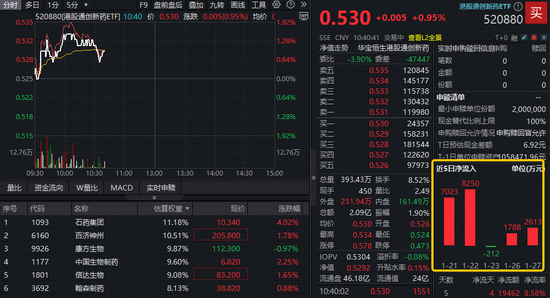
1月28日,港股通创新药板块回暖,龙头股石药集团涨超3%,百济神州、中国生物制药、信达生物集体 上涨。 100%创新药研发标的——港股通创新药ETF(520880)一度涨逾1.5%,成交快速突破2亿元。近期资 金面持续升温,截至昨日,520880近5日吸金1.9亿元,份额升至46.18亿份,再创历史新高。 | 分时 多日 1分 5分 * | | | | F9 盘前盘后 霞加 九转 画线 工具 (2 >> | | | | | 港股票创新的ETF (1) | | | --- | --- | --- | --- | --- | --- | --- | --- | --- | --- | --- | | 0.539 | | | 520880[層胶通创新药ETF] 10:40 价 0.530 温跃 0.005(0.95%) 均价 | | ದ್ರಿ 1.92% | | 0.530 +0.005 +0.95% | | | 520880 | | 0.532 | | TUM | | | 1.28% | | SSE CNY 10:40:41 交易中 查看L2全国 | | | T+0 酸 / 原 用 | | | | | | | | ...

中国生物制药(01177):TQA3605“核心蛋白变构调节剂”慢性乙型肝炎二期取得积极进展
Zhi Tong Cai Jing· 2026-01-27 08:42
Core Insights - China Biopharmaceutical (01177) announced that its self-developed national class 1 innovative drug TQA3605, a core protein allosteric modulator (CpAM), has recently completed a phase II clinical trial for patients with chronic hepatitis B virus (HBV) infection, achieving its primary endpoint [1] Group 1: Clinical Trial Results - The study was a randomized, double-blind, placebo-controlled, multi-center phase II trial (NCT06644417) aimed at evaluating the efficacy and safety of TQA3605 in combination with nucleos(t)ide analogs (NAs) in treated patients with low viral load [1] - A total of 122 subjects were enrolled, divided into a placebo control group and multiple different dosage groups of TQA3605, administered orally once daily [1] - Results showed that among adult HBV-infected patients who had received NAs treatment for at least 12 months, TQA3605 combined with NAs for 24 weeks significantly increased the proportion of subjects with HBV DNA below the lower limit of quantification (<20 IU/mL), with nearly 90% in all dosage groups, significantly better than the NAs monotherapy control group (p < 0.0001) [1] - In terms of safety, TQA3605 demonstrated overall good safety, with the incidence of adverse reactions comparable to the control group, and most treatment-emergent adverse events (TEAEs) were of grade 1-2, with no new safety signals observed [1] Group 2: Drug Profile and Market Potential - TQA3605 is a core protein modulator developed by the company that can effectively inhibit multiple genotypes of HBV and has no cross-resistance with NAs [2] - Currently, there are no approved core protein modulators for HBV globally, and compared to other similar investigational drugs, TQA3605 shows superior safety and a more convenient once-daily oral administration, potentially providing a new treatment option for chronic HBV-infected patients [2]
中国生物制药:TQA3605“核心蛋白变构调节剂”慢性乙型肝炎二期取得积极进展
Zhi Tong Cai Jing· 2026-01-27 08:37
Core Insights - China Biopharmaceutical (01177) announced that its self-developed national class 1 innovative drug TQA3605, a core protein allosteric modulator (CpAM), has recently completed a phase II clinical trial for patients with chronic hepatitis B virus (HBV) infection, achieving its primary endpoint [1] Group 1: Clinical Trial Results - The study was a randomized, double-blind, placebo-controlled, multi-center phase II trial (NCT06644417) aimed at evaluating the efficacy and safety of TQA3605 in combination with nucleos(t)ide analogs (NAs) in chronic HBV-infected subjects with low viral load [1] - A total of 122 subjects were enrolled, divided into a placebo control group and multiple different dosage groups of TQA3605, administered orally once daily [1] - Results showed that among adult HBV-infected patients who had received NAs treatment for at least 12 months, TQA3605 combined with NAs for 24 weeks significantly increased the proportion of subjects with HBV DNA below the lower limit of quantification (<20 IU/mL) to nearly 90% across all dosage groups, significantly outperforming the NAs monotherapy control group (p<0.0001) [1] - In terms of safety, TQA3605 demonstrated overall good safety, with the incidence of adverse reactions comparable to the control group, and most treatment-emergent adverse events (TEAEs) were of grade 1-2, with no new safety signals observed [1] Group 2: Drug Profile and Market Potential - TQA3605 is a core protein modulator developed by the company that effectively inhibits multiple genotypes of HBV and has no cross-resistance with NAs [2] - Currently, there are no approved core protein modulators for HBV globally, and compared to similar investigational drugs, TQA3605 shows superior safety and a more convenient once-daily oral administration, potentially providing a new treatment option for chronic HBV-infected patients [2]
中国生物制药(01177.HK):TQA3605“核心蛋白变构调节剂”慢性乙型肝炎二期取得积极进展
Ge Long Hui· 2026-01-27 08:37
Core Insights - China Biologic Products (01177.HK) announced the completion of Phase II clinical trials for its self-developed innovative drug TQA3605, a core protein allosteric modulator (CpAM), targeting chronic hepatitis B virus (HBV) infection patients, achieving its primary endpoint [1] Group 1: Clinical Trial Details - The study was a randomized, double-blind, placebo-controlled, multi-center Phase II trial (NCT06644417) aimed at evaluating the efficacy and safety of TQA3605 in combination with nucleos(t)ide analogs (NAs) in chronic HBV patients with low viral load [1] - A total of 122 subjects were enrolled, divided into a placebo group and multiple dosage groups of TQA3605, administered orally once daily [1] Group 2: Efficacy Results - Results indicated that among adult HBV patients who had received NAs treatment for at least 12 months, the combination therapy of TQA3605 and NAs for 24 weeks significantly increased the proportion of subjects with HBV DNA below the lower limit of quantification (<20 IU/mL), with nearly 90% in all dosage groups, significantly outperforming the NAs monotherapy control group (p < 0.0001) [1] Group 3: Safety Profile - The overall safety profile of TQA3605 was found to be good, with the incidence of adverse reactions comparable to the control group, and most treatment-emergent adverse events (TEAEs) were of grade 1-2, with no new safety signals observed [1] - Detailed study results are expected to be presented at upcoming international academic conferences [1]
中国生物制药(01177) - 自愿公告 - TQA3605「核心蛋白变构调节剂」慢性乙型肝炎二期取...
2026-01-27 08:30
香港交易及結算所有限公司及香港聯合交易所有限公司對本公告的內容概不負責,對其準確性或完 整性亦不發表任何聲明,並明確表示,概不對因本公告全部或任何部份內容而產生或因倚賴該等內 容而引致的任何損失承擔任何責任。 (於開曼群島註冊成立之有限公司) 網站:www.sinobiopharm.com (股份編號:1177) 自願公告 TQA3605「核心蛋白變構調節劑」慢性乙型肝炎二期取得積極進展 該研究是一項隨機、雙盲、安慰劑對照、多中心二期研究(NCT06644417),旨在評價TQA3605聯合 核甘(酸)類藥物(NAs)在經治的低病毒血症的慢性HBV感染受試者中的有效性和安全性。該研究共入 組122例受試者,分為安慰劑對照組及多個不同劑量TQA3605試驗組,給藥方式為每日一次口服。 中國生物製藥有限公司(「本公司」,連同其附屬公司統稱「本集團」)董事會(「董事會」)宣佈,本集團自 主研發的國家1類創新藥TQA3605片「核心蛋白變構調節劑(CpAM)」已於近日完成針對慢性乙型肝炎 病毒(HBV)感染患者的二期臨床試驗,並達到主要終點。 中國生物製藥有限公司 中國現有約8600萬HBV攜帶者,其中慢性HBV感染 ...
华福证券:医药生物业新技术全面突破 战略看多中国创新出海
智通财经网· 2026-01-27 03:02
Core Viewpoint - By 2025, China's innovative pharmaceuticals are expected to demonstrate significant global competitiveness, with record overseas transactions and many companies turning profitable [1][2]. Domestic Review - The global competitiveness of Chinese innovative drugs is highlighted, with a record-breaking overseas transaction total exceeding $135 billion in 2025, and upfront payments reaching $7 billion. The average deal size has increased from $600 million to $900 million [2]. - A comprehensive support system from policy, including review and approval processes to medical insurance payments, is being established, leading to a rapid increase in market share for innovative drugs, particularly in oncology and immunology, which now exceeds 32% [2]. - Companies like BeiGene and Innovent Biologics have already turned profitable, with others like CanSino Biologics and Zai Lab expected to follow suit in the next three years, indicating a positive cycle of capital influx, R&D iteration, and value realization [2]. Overseas Review - The S&P Biotechnology Index has risen over 50% from its bottom in the second half of 2025, driven by interest rate cuts that have shifted funds from tech stocks to biotech [3]. - Major pharmaceutical companies (MNCs) are actively pursuing mergers and acquisitions to supplement their pipelines, particularly in oncology and immunology, as they face a "patent cliff" with key drugs like Keytruda and Opdivo losing patent protection by 2027-2028 [3]. Assessment - Chinese companies are becoming significant partners for the top 20 MNCs, with Chinese transaction amounts accounting for 40% of the global innovative drug market. China is transitioning from a "fast-follower" to a "smart-innovator" in fields like PD-1 bispecific antibodies, ADCs, and small nucleic acids, leading in pipeline numbers and clinical progress [4]. - The speed and cost advantages of Chinese innovative drug companies are notable, with patient recruitment occurring at 2-5 times the speed of international counterparts and costs being half that of Western companies [4]. Key Tracks and Investment Opportunities - Bispecific antibodies are expected to surpass $120 billion in global sales, with Chinese companies leading the development of second-generation IO products [5]. - ADCs are seeing significant contributions from China, with over half of the global pipeline, and are expected to achieve proof of concept (POC) validation by 2026 [5]. - Combination therapies in oncology are showing synergistic effects, with key clinical data expected in 2026 [5]. - The market for iRAS inhibitors is projected to exceed $8 billion in the U.S., with critical breakthroughs anticipated in 2026 [5]. - Small nucleic acids are expanding into broader applications, with key products expected to commercialize and deliver critical data in 2026 [5]. - Protein degradation technologies are advancing rapidly, with numerous autoimmune disease targets expected to yield data in 2026 [5]. - The metabolic and cardiovascular fields are also poised for breakthroughs, with new targets addressing issues like muscle loss associated with GLP-1 therapies [5]. Main Lines and Recommended Focus - Recommended companies in the bispecific antibody space include CanSino Biologics, Innovent Biologics, and others [7]. - ADC-focused companies include I-Mab, Kelun-Biotech, and others [7]. - Small nucleic acid companies to watch include Ribobio, BIBO, and others [7]. - Strategic combinations to consider include CanSino Biologics, BeiGene, and others [8]. - Flexible combinations include BIBO, Eifang Biologics, and others [8]. - Stable combinations include Hengrui Medicine, China National Pharmaceutical Group, and others [8].



小核酸赛道,挤满了下一代大药
Ge Long Hui· 2026-01-26 21:06
Core Insights - The small nucleic acid drug sector is experiencing a significant surge, marking the beginning of a golden era driven by technological breakthroughs and capital enthusiasm [2][11][22] Industry Developments - On January 5, 2026, Sanofi's APOC3 siRNA drug Plozasiran was approved for domestic market use to treat hyperlipidemia [1] - On January 9, 2026, Rebio Biotech, known as "China's first small nucleic acid stock," successfully listed on the Hong Kong Stock Exchange, with its stock price soaring by 40% on the first day, leading to a market capitalization exceeding 13 billion HKD [1] - China National Pharmaceutical Group announced a 1.2 billion CNY acquisition of Hegia Biotech, securing the world's first clinically validated liver-targeted delivery platform capable of annual dosing [1] Market Trends - The global small nucleic acid drug market has seen nearly 100 business development (BD) collaborations in the past three years, with transaction numbers and amounts increasing annually, reaching over 30 BD deals in 2025 totaling nearly 30 billion USD [4][9] - Notable transactions in 2025 included Novartis acquiring Avidity Biosciences for 12 billion USD and multiple other significant deals involving RNA therapies [7][9] Clinical Advancements - Ionis's APOC3 ASO drug Olezarsen showed promising results in reducing triglyceride levels by up to 72% in patients with severe hypertriglyceridemia, leading to an increase in peak annual sales forecast from 1.5 billion USD to 2.5 billion USD [12] - GSK's ASO therapy Bepirovirsen is expected to be the first drug to achieve functional cure for chronic hepatitis B, with a peak annual sales potential of 2 billion USD [12] Emerging Opportunities - The small nucleic acid drugs are expanding into various therapeutic areas, including obesity and kidney diseases, with promising results from clinical trials demonstrating significant weight loss and metabolic health improvements [13][15] - The number of small nucleic acid drugs in development globally has surpassed 1,200, with siRNA and ASO therapies being the most prominent [17] Strategic Collaborations - Domestic companies are increasingly recognized for their innovative value in small nucleic acid drugs, with active BD transactions, including significant collaborations by Rebio Biotech and other firms [18][21] - Companies like Saintin Biotech are forming strategic partnerships with major pharmaceutical firms to advance their small nucleic acid drug pipelines [19] Conclusion - The convergence of technological advancements, capital influx, and successful clinical outcomes is propelling small nucleic acid drugs into a pivotal position within the pharmaceutical industry, with China poised to become a global innovation hub [22]