
电投能源

Search documents
煤炭开采板块1月9日涨1.23%,江钨装备领涨,主力资金净流出3.24亿元
Zheng Xing Xing Ye Ri Bao· 2026-01-09 09:01
Group 1 - The coal mining sector increased by 1.23% on January 9, with Jiangte Equipment leading the gains [1] - The Shanghai Composite Index closed at 4120.43, up 0.92%, while the Shenzhen Component Index closed at 14120.15, up 1.15% [1] - Jiangte Equipment's stock price rose by 9.95% to 9.06, with a trading volume of 448,900 shares and a transaction value of 397 million yuan [1] Group 2 - Major coal companies such as China Shenhua and Xinda Zhou A also saw increases, with China Shenhua up 2.41% to 42.45 and a transaction value of 1.551 billion yuan [1] - Conversely, some companies like Dayou Energy and Shanxi Coking Coal experienced declines, with Dayou Energy down 3.23% to 8.10 and a transaction value of 859 million yuan [2] - The coal mining sector experienced a net outflow of 324 million yuan from major funds, while retail investors saw a net inflow of 397 million yuan [2][3] Group 3 - Jiangte Equipment had a net inflow of 109 million yuan from major funds, while retail investors had a net outflow of 46 million yuan [3] - China Shenhua also saw a net inflow of 34.67 million yuan from major funds, with retail investors experiencing a slight outflow [3] - The overall trend indicates a mixed sentiment in the coal mining sector, with significant retail interest despite the net outflow from major funds [2][3]




决胜“十四五” 擘画“十五五”·地方资本市场高质量发展之内蒙古篇: 夯实资本市场“天骏方阵” 护航北疆战略产业安全
Zheng Quan Shi Bao· 2026-01-08 22:17
Group 1 - The core viewpoint of the article highlights the significant progress made in the Inner Mongolia capital market during the "14th Five-Year Plan" period, with a focus on enhancing the service efficiency of the capital market and supporting the transformation of the regional economy [1][9] - Inner Mongolia added 12 new listed companies during the "14th Five-Year Plan," with the total market capitalization of A-share listed companies exceeding 1 trillion yuan, marking a 68% increase since the end of 2020 [2][3] - The region has established a multi-tiered enterprise listing cultivation system, with 112 companies in the listing reserve pool and 9 companies signing cultivation agreements, focusing on specialized and innovative enterprises [2][3] Group 2 - The quality and market value of listed companies in Inner Mongolia have improved, with significant developments in industrial clusters and resource optimization through mergers and acquisitions [3][4] - Inner Mongolia's listed companies distributed approximately 930.26 billion yuan in cash dividends, doubling the amount from the previous five-year period, indicating enhanced investor returns [4] - The region's capital market has developed a multi-faceted financial system that integrates stocks, bonds, funds, and futures, supporting the new ecological model of industry-finance integration [6][9] Group 3 - The Inner Mongolia Securities Regulatory Bureau has implemented strict regulatory measures to ensure market stability, including the smooth delisting of underperforming companies and increased scrutiny of financial misconduct [8] - The region has successfully launched various financial instruments, including the first public REITs in the northwest, which provide a market-based model for energy companies to optimize their assets [6][7] - Looking ahead to the "15th Five-Year Plan," the focus will be on cultivating new productive forces and enhancing the collaborative efficiency of the capital market to support key industries such as new energy and rare earth materials [9]




决胜“十四五” 擘画“十五五”·地方资本市场高质量发展之内蒙古篇:夯实资本市场“天骏方阵” 护航北疆战略产业安全
Zheng Quan Shi Bao· 2026-01-08 18:13
Group 1 - The core viewpoint of the article highlights the significant progress made in the Inner Mongolia capital market during the "14th Five-Year Plan" period, focusing on the development of a multi-level enterprise listing cultivation system and supporting regional economic transformation [1][2] - Inner Mongolia added 12 new listed companies during the "14th Five-Year Plan," with the total market capitalization of A-share listed companies exceeding 1 trillion yuan, marking a 68% increase since the end of 2020 [2][3] - The region's capital market has seen the emergence of industry clusters in rare earths, energy, and dairy, with direct financing steadily expanding and the clean energy REITs breaking new ground in the northwest [1][3] Group 2 - The "Tianjun Plan" was implemented to cultivate enterprises for listing, resulting in 12 companies successfully entering the domestic and international capital markets, with 7 listed on the Shanghai and Shenzhen stock exchanges [2] - The Inner Mongolia equity trading center was approved as the first pilot for regional equity market innovation, transitioning to a listing "nursery" and "preparatory class" [2] - The region has established a complete and controllable rare earth listing company chain, supporting the construction of a national strategic resource base [3][4] Group 3 - Inner Mongolia's listed companies have undergone significant asset restructuring, raising approximately 23.77 billion yuan through refinancing, with notable acquisitions aimed at green transformation [4] - Cash dividends from 28 listed companies reached 93.026 billion yuan, doubling the amount from the previous five-year period, indicating enhanced investor returns [4] - The region's capital market has developed a multi-faceted financial system integrating stocks, bonds, funds, and futures, supporting the new ecological integration of production and finance [6] Group 4 - The region's private equity fund management scale has surpassed 35 billion yuan, focusing on long-term capital support for sectors like new energy and rare earth materials [6] - The "insurance + futures" pilot projects have been implemented to safeguard farmers' income, with over 20 projects launched [7] - The Inner Mongolia Securities Regulatory Bureau has strengthened regulatory measures to ensure market stability and investor protection, including the establishment of a comprehensive investor education mechanism [8] Group 5 - Looking ahead to the "15th Five-Year Plan," the Inner Mongolia Securities Regulatory Bureau aims to align with national strategies, focusing on cultivating new productive forces and enhancing the collaborative efficiency of the multi-level capital market [9] - The goal is to create a safe, transparent, and vibrant capital market that supports innovation and green development while solidifying the region's economic foundation [9]
当前时点如何看煤炭板块
2026-01-08 02:07
Summary of Coal Industry Conference Call Industry Overview - The coal sector is currently under scrutiny due to rumors regarding tightened coal production capacity replacement policies, which could impact coal supply if strictly enforced in 2026 [1] - There are mixed reports about production cuts in Inner Mongolia's Ordos region, with some truth to the rumors stemming from governance policies from 2020 to 2025, but specific data remains uncertain [1][2] - The recent rise in coking coal futures prices is primarily driven by market sentiment, with low inventory levels and replenishment demand providing short-term support, although the profitability of downstream steel mills may limit price increases [1][3] Key Points and Arguments - The profitability of rebar steel is nearing breakeven, and high coking coal prices could suppress steel mill profits, indirectly capping coking coal prices [1][3][4] - A reduction in photovoltaic installations is expected to improve fuel demand, with limited supply increases and stable imports, indicating a high certainty of supply-demand improvement and potential price stabilization [1][5] - In a less optimistic demand scenario, coal prices are expected to have a ceiling and a floor, recommending companies with growth potential and price elasticity, such as Yanzhou Coal Mining Company, Rio Tinto, and A-share Electric Power Investment Energy [1][6] Investment Opportunities - The coal sector is viewed as having significant investment opportunities in 2026, driven by expected improvements in supply-demand dynamics and stable pricing [1][5] - Recommended stocks include those with robust dividends and growth potential, such as China Coal Energy Company and companies with strong market positions like Liu'an Huanneng and Shanxi Coking Coal [6][7] - The policy shift from quantity assurance to price stability since October 2021 indicates a changing landscape, with potential for improved demand in 2026 [8][9] Additional Insights - Recent price increases in coal futures and stocks are attributed to unverified rumors, and if production cuts are confirmed, coal prices may continue to rise [8] - The overall market sentiment remains cautious, as unverified rumors could lead to pressure if they do not materialize [8] - The policy changes reflect a broader trend towards stabilizing prices rather than merely ensuring supply, which will continue to influence the coal market in the coming years [9]
伦铜期货历史首次触及13000美元,有色ETF基金(159880)涨超1.6%
Sou Hu Cai Jing· 2026-01-06 02:13
Group 1 - The core viewpoint of the news highlights a strong performance in the non-ferrous metals sector, with the industry index rising by 1.94% and individual stocks like Huayou Cobalt and Zhongkuang Resources showing significant gains [1] - Huayou Cobalt is expected to achieve a net profit of 5.85 billion to 6.45 billion yuan for the fiscal year 2025, representing a year-on-year growth of 40.8% to 55.24% [1] - The overall upward trend in non-ferrous metals is attributed to rising geopolitical tensions and loose liquidity, with copper futures reaching a historic high of $13,000 per ton and aluminum prices surpassing $3,000 per ton for the first time in over three years [1] Group 2 - According to Fangzheng Securities, the short-term global copper inventory is expected to continue adjusting, with supply shortages in copper mines reinforcing the upward price trend [2] - The aluminum sector is anticipated to benefit from low alumina prices, leading to an expansion in profit margins, while the Federal Reserve's interest rate cuts may further support aluminum prices [2] - The report emphasizes the importance of supply-driven factors in cobalt pricing, particularly in relation to the Democratic Republic of Congo's efforts to secure pricing power [2] Group 3 - As of December 31, 2025, the top ten weighted stocks in the non-ferrous metals industry index account for 51.65% of the index, with major companies including Zijin Mining, Luoyang Molybdenum, and Huayou Cobalt [3]





伦铜再创历史新高,有色ETF基金(159880)涨2.45%,“铜含量”占比超3成
2 1 Shi Ji Jing Ji Bao Dao· 2026-01-06 02:08
Core Viewpoint - The copper market is experiencing a significant price increase, with futures reaching $13,000 per ton for the first time, driven by supply constraints and heightened market enthusiasm at the start of the year [1] Group 1: Market Performance - On January 6, the three major indices collectively rose, with the National Index for Nonferrous Metals (399395.SZ) increasing by 2.53% [1] - Notable performers among the index constituents included Huayou Cobalt, which rose nearly 6%, and Dongyangguang, which increased by nearly 5% [1] - The Nonferrous ETF (159880) also saw a rise of 2.45%, with a trading volume of 12.97 million yuan [1] Group 2: Supply Dynamics - The recent surge in copper prices is attributed to ongoing labor disputes at the Mantoverde copper-gold mine in northern Chile, a major copper-producing country, with expected production between 29,000 to 32,000 tons in 2025 [1] - Overall, geopolitical tensions are expected to enhance the premium on strategic resources, with copper anticipated to perform strongly [1] Group 3: Investment Trends - The Nonferrous ETF experienced a net inflow of 57.64 million yuan on January 5, with a cumulative net inflow of 108 million yuan over the past five trading days [1] - The ETF has a total circulation of 483 million shares, with a market size of 964 million yuan [1] Group 4: ETF Composition - The Nonferrous ETF closely tracks the National Index for Nonferrous Metals, which includes 50 securities from the nonferrous metals sector, reflecting the overall performance of listed companies in this industry [2] - Copper constitutes over 30% of the index's composition, indicating its significant role in the sector [2]

久违的煤价反弹力度如何
2026-01-05 15:42
Summary of Conference Call Records Industry Overview: Coal Market Key Points on Coal Price Dynamics - By the end of 2025, the average daily production of thermal coal in national sample coal mines decreased by over 4% month-on-month, leading to a contraction in domestic supply which is expected to support a rebound in port coal prices [1][2] - The cold wave has stimulated coal demand, and policies from the Central Economic Work Conference and safety production discussions have enhanced market expectations for price support at the bottom [1][2] - Despite high inventory levels, the resumption of coal mines, and cautious terminal procurement, the downside risk for coal prices is limited, with a notable trend of insurance capital increasing allocations to the coal sector at year-end [1][2] Short-term Influencing Factors on Thermal Coal Prices - Key factors affecting thermal coal prices in the short term include the resumption of coal mines after New Year, high terminal inventory, and seasonal demand for replenishment before the Spring Festival [4] - The lowest price point at Qinhuangdao port in 2025 is projected at 609 RMB/ton, close to the 90th percentile of the industry cost curve, indicating a potential uplift in the 2026 low point due to supply regulation policies [4] Long-term Outlook for 2026 Thermal Coal Market - The thermal coal market in 2026 is expected to show a stable upward trend in average prices throughout the year, supported by significant inflows of insurance capital and favorable cost and policy factors [5] - The recommendation is to continue focusing on opportunities for industry dividend allocation [5] Recommended Stocks in the Coal Sector - Three main lines of recommended stocks: 1. **Balanced Growth Stocks**: Yanzhou Coal Mining Company and China Power Investment Corporation [6] 2. **Stable Dividend Stocks**: China Coal Energy, Shaanxi Coal and Chemical Industry, and China Shenhua Energy [6] 3. **Aggressive Growth Stocks**: Huayang Co., Jinkong Coal Industry, Lu'an Environmental Energy, and Pingshan International [6][7] - Shanxi International is highlighted for its stable fourth-quarter performance, with an expected annual dividend yield of 4.5-6% and a price-to-book (PB) ratio at a historical low, indicating a good safety margin [7] Focus on Coking Coal Market - The price of coking coal at Jintang Port fell from 1,740 RMB to over 1,600 RMB, contrasting with the rebound in thermal coal prices [8] - The coking coal market is currently weak due to the traditional off-season for steel mills, high raw material inventories, and low enthusiasm for winter stockpiling [8] - The expectation is for coking coal prices to remain weak in the short term, with a focus on the winter stockpiling pace of steel mills and changes in supply from production areas leading up to the Spring Festival [8]
煤炭开采板块1月5日涨0.3%,电投能源领涨,主力资金净流入9870.76万元
Zheng Xing Xing Ye Ri Bao· 2026-01-05 09:09
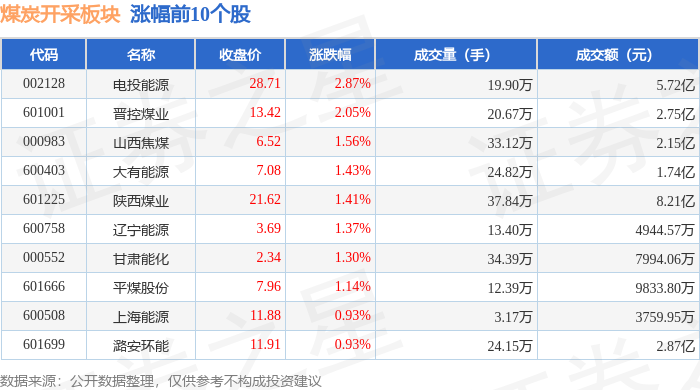
从资金流向上来看,当日煤炭开采板块主力资金净流入9870.76万元,游资资金净流出1.79亿元,散户资 金净流入8017.72万元。煤炭开采板块个股资金流向见下表: | 代码 | 名称 | 收盘价 | 涨跌幅 | 成交量(手) | | 成交额(元) | | --- | --- | --- | --- | --- | --- | --- | | 002128 | 电投能源 | 28.71 | 2.87% | | 19.90万 | 5.72亿 | | 601001 | 晋控煤业 | 13.42 | 2.05% | | 20.67万 | 2.75亿 | | 000983 | 山西焦煤 | 6.52 | 1.56% | | 33.12万 | 2.15亿 | | 600403 | 大有能源 | 7.08 | 1.43% | | 24.82万 | 1.74亿 | | 601225 | 陕西煤业 | 21.62 | 1.41% | | 37.84万 | 8.21亿 | | 600758 | 辽宁能源 | 3.69 | 1.37% | | 13.40万 | 4944.57万 | | 000552 | 日肃能化 | 2.34 ...


需求预期或上调,铝价强势突破创新高
Zhong Guo Neng Yuan Wang· 2026-01-05 01:24
Group 1: Aluminum - The price of alumina remains stable at 2685 yuan/ton, with metallurgical-grade alumina production capacity reaching 88.689 million tons/year and a weekly operating rate increase of 0.55 percentage points to 80.39% [1][3] - The short-term supply-demand fundamentals for alumina continue to show an oversupply, with inventories accumulating and spot prices remaining weak [1][3] - Domestic electrolytic aluminum prices increased by 1.59% to 22,700 yuan/ton, while London aluminum prices rose by 1.79% to 3,010 USD/ton, with electrolytic aluminum margins increasing by 7.18% to 6,862 yuan/ton [3] Group 2: Copper - Copper prices experienced fluctuations after reaching historical highs, with weekly changes in London copper, Shanghai copper, and US copper prices being +2.39%, -0.49%, and -2.62% respectively [2] - Domestic copper inventories saw a significant accumulation, with social inventories of electrolytic copper at 238,900 tons, a 23.40% increase [2] - The supply-demand balance for copper may shift from tight equilibrium to shortage due to insufficient capital expenditure in copper mines and frequent supply disruptions [2] Group 3: Lithium - Lithium carbonate prices increased by 5.90% to 118,500 yuan/ton, while lithium spodumene prices rose by 3.89% to 1,548 USD/ton, indicating a positive trend in lithium prices [4] - The supply of lithium carbonate increased by 1.2% to 22,400 tons, with SMM weekly inventory decreasing by 0.2% to 109,600 tons, marking 20 consecutive weeks of inventory reduction [4] - The demand for lithium batteries remains strong, with expectations for continued growth in lithium demand despite seasonal trends [4] Group 4: Cobalt - Cobalt prices are expected to continue rising, with MB cobalt increasing by 1.53% to 24.88 USD/pound and domestic cobalt prices rising by 10.11% to 490,000 yuan/ton [5] - The Democratic Republic of Congo has lifted its cobalt export ban, implementing a quota system instead, which may affect the supply chain in the near future [5] - The structural tightness in cobalt raw materials remains unchanged, supporting the outlook for rising cobalt prices [5]
煤炭与消费用燃料行业周报:久违的煤价反弹力度如何?-20260105
Changjiang Securities· 2026-01-04 23:30
Investment Rating - The industry investment rating is "Positive" and maintained [10] Core Viewpoints - The recent rebound in coal prices is driven by a combination of supply contraction at year-end and marginal demand improvement, alongside strengthened policy support expectations. Despite high inventory levels and cautious purchasing attitudes from end-users, the price decline has a bottom, and there are opportunities for investment in the coal sector as insurance capital is expected to increase allocation to this sector at year-end [2][7] Summary by Relevant Sections Market Performance - The coal index (Yangtze) fell by 0.67%, underperforming the CSI 300 index by 0.09 percentage points, ranking 19th out of 32 industries. The price of thermal coal as of December 31 was 678 RMB/ton, up by 6 RMB/ton week-on-week [6][16] Supply and Demand Analysis - As of December 30, the daily coal consumption in 25 provinces was 6.116 million tons, a week-on-week increase of 0.2% but a year-on-year decrease of 3.9%. The inventory at power plants was 135 million tons, down 0.3% week-on-week, with a usable days count of 22.0 days, a decrease of 0.1 days [17][35] Price Trends - The price of 5500 kcal thermal coal at Qinhuangdao port was 678 RMB/ton as of December 31, reflecting a week-on-week increase of 6 RMB/ton. The price of coking coal at Jingtang port remained stable at 1740 RMB/ton, while the price of first-grade metallurgical coke at Rizhao port was 1530 RMB/ton, also stable week-on-week [6][42] Investment Recommendations - The report suggests embracing the coal sector's bottom reversal trend, with stock selection strategies focusing on balanced approaches, leading companies, and those with elastic growth potential. Specific recommendations include Yanzhou Coal Mining Company (H+A), China Shenhua Energy (H+A), and Huayang Co., among others [8][28]