福田汽车

Search documents
L3量产“破冰”!行业激辩商业化前景
Mei Ri Jing Ji Xin Wen· 2026-02-04 12:26
Core Insights - The core focus of the articles revolves around the commercialization and strategic implications of L3 and L4 autonomous driving technologies in the automotive industry, highlighting the ongoing debate about the necessity and feasibility of L3 as a transitional phase towards full autonomy [1][2][3]. Group 1: Industry Trends and Developments - The penetration rate of L2 level assisted driving in China reached 64% with a year-on-year sales growth of 21.2% for new passenger cars equipped with such features in the first three quarters of 2025 [2]. - The Ministry of Industry and Information Technology (MIIT) of China issued the first batch of L3 conditional autonomous driving vehicle licenses in December 2025, sparking intense discussions about the commercial prospects of L3 technology [1][2]. - Companies like Xiaomi, XPeng, and GAC are actively pursuing L3 testing licenses, indicating a competitive race among automakers to establish their presence in the L3 segment [2]. Group 2: Strategic Perspectives - XPeng's CEO expressed that L3 is merely a transitional phase, suggesting that the industry may leap directly from L2 to L4, bypassing L3 altogether [3]. - The distinction between L3 and L4 is primarily based on the responsibility of the driver versus the vehicle, with L3 requiring the driver to take control under certain conditions, while L4 allows for full autonomy [3][5]. - The current regulatory standards for L3 certification are perceived as exceeding traditional definitions, necessitating that companies achieve near-L4 capabilities to obtain L3 licenses [5]. Group 3: Commercialization Challenges - The initial commercial value of L3 is challenged by restrictive operational scenarios, such as the limited use of the BAIC Arcfox Alpha S (L3 version) to specific road types and a maximum speed of 80 km/h, which may not attract average consumers [6]. - The integration of L2++ capabilities is seen as a prerequisite for achieving L4, indicating that the path to full autonomy may involve a gradual accumulation of data and experience in various driving scenarios [7]. - The automotive industry is experiencing rapid growth, with significant sales of vehicles equipped with advanced driving assistance features, which is fueling competition and innovation in the autonomous driving space [8].
15家A股上市车企2025年业绩预告出炉:乘用车企仅上汽、长城盈利,这家商用车企预计净利增长15倍
Mei Ri Jing Ji Xin Wen· 2026-02-04 11:39
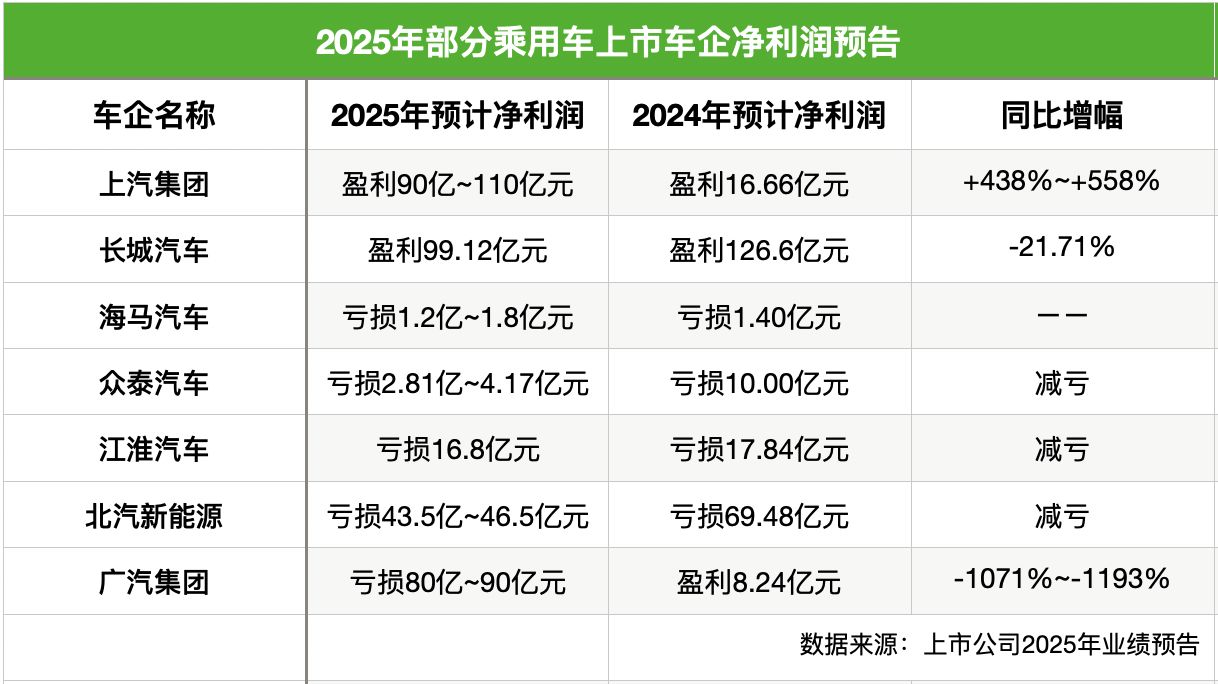
Core Viewpoint - The automotive industry is facing significant profitability challenges, with many companies reporting losses for 2025, particularly in the passenger vehicle sector, while some commercial vehicle manufacturers show improved profitability [1][10]. Passenger Vehicle Companies - Among the seven passenger vehicle companies, only SAIC Motor and Great Wall Motors are expected to be profitable in 2025, with SAIC Motor projecting a net profit of approximately 9 billion to 11 billion yuan, a substantial increase of 438% to 558% compared to 2024 [3][4]. - Great Wall Motors anticipates a net profit of about 9.912 billion yuan for 2025, representing a decline of 21.71% from 2024 [4]. - Other companies like Haima, Zotye, and GAC Group are expected to incur losses, with GAC Group projecting a net loss of 8 billion to 9 billion yuan, a drastic drop of 1071% to 1193% compared to the previous year [5][6]. Commercial Vehicle Companies - The commercial vehicle sector shows a more favorable outlook, with five out of eight companies expected to be profitable in 2025 [1][7]. - Beiqi Foton is projected to achieve a net profit of approximately 1.33 billion yuan, a significant increase of 1551% compared to 2024 [8][9]. - Other companies like Xiamen Jinlong and Zhongtong Bus also expect profit growth, driven by increased sales in overseas markets [9]. Industry Trends and Challenges - The overall automotive industry is experiencing pressure on profitability, with a sales profit margin of only 4.1%, significantly lower than the average of 5.9% for downstream industrial enterprises [12]. - The industry is facing rising costs, particularly in raw materials, which are squeezing profit margins [12]. - A shift towards a "value war" rather than a price war is emerging, as companies seek to maintain brand value and reasonable profits [13]. - The automotive service market is expected to become a crucial profit pool, potentially matching the manufacturing sector by 2030, highlighting the need for companies to diversify their revenue streams [13][14].





稳增长 提信心 地方两会:撬动汽车经济新动能
Zhong Guo Qi Che Bao Wang· 2026-02-04 09:40
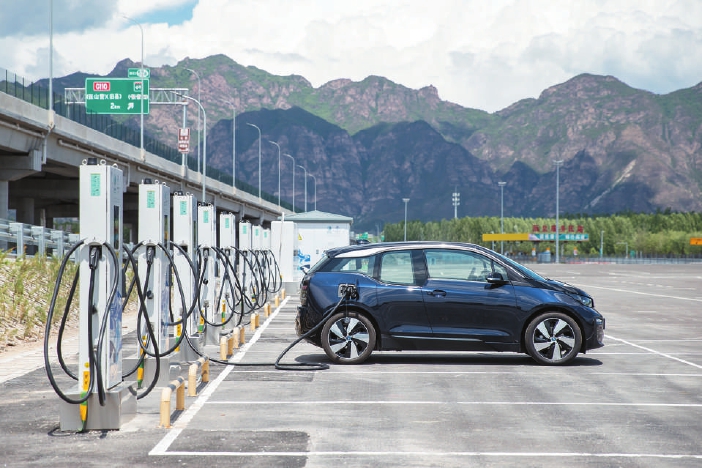
Core Insights - The automotive industry is highlighted as a pillar industry in various local government work reports, emphasizing its role in driving high-quality development during the "14th Five-Year Plan" period [2][4]. Economic Growth - In 2025, 18 provinces reported GDP growth rates exceeding the national average, with Guangdong leading at 14.58 trillion yuan, growing by 3.9%, and Jiangsu at 14.23 trillion yuan, growing by 5.3% [3]. - Industrial growth remains crucial, with the automotive sector acting as a stabilizing force for economic growth, particularly in provinces like Anhui, which produced 368.65 million vehicles in 2025, including 179.41 million new energy vehicles [4]. Innovation and Technology - Local governments are focusing on technological innovation to support emerging industries, with a particular emphasis on new energy smart connected vehicles [5][6]. - Various provinces are promoting the development of intelligent driving and new-generation smart wearable devices, with expected revenue growth in the AI core industry exceeding 20% [6]. Consumer Activation - The automotive sector is identified as a key driver for consumer spending, with initiatives to boost automobile consumption through policies like trade-in programs [7][9]. - Local governments are implementing measures to enhance the automotive consumption environment, including increasing parking spaces and charging stations [9]. Investment Environment - Creating a favorable business environment is a priority, with measures to combat unfair competition and improve market order in the automotive industry [10][11]. - Provinces like Zhejiang and Guangdong are committed to establishing a market-oriented, law-based, and international business environment to support the automotive sector [10][12]. International Expansion - Local governments are focusing on international market expansion, with initiatives to enhance logistics services and promote high-quality automotive exports [13][14]. - In 2025, China's automotive exports surpassed 7 million units, with plans for further international cooperation and infrastructure development to support exports [14][15].



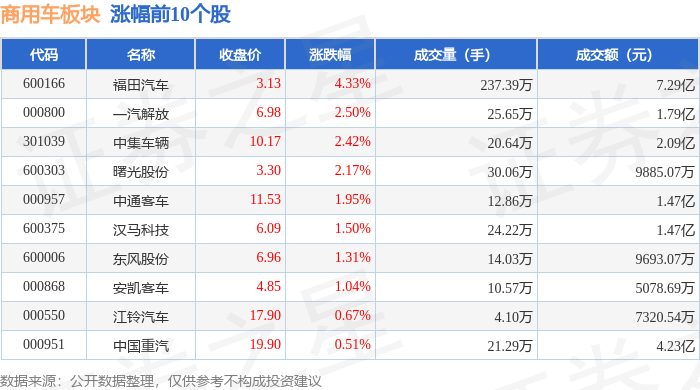
商用车板块2月4日涨0.55%,福田汽车领涨,主力资金净流出3561.66万元
Zheng Xing Xing Ye Ri Bao· 2026-02-04 08:56
证券之星消息,2月4日商用车板块较上一交易日上涨0.55%,福田汽车领涨。当日上证指数报收于4102.2,上涨0.85%。深证成指报收于 14156.27,上涨0.21%。商用车板块个股涨跌见下表: | 代码 | 名称 | 收盘价 | 涨跌幅 | 成交量(手) | 成交额(元) | | | --- | --- | --- | --- | --- | --- | --- | | 600166 | 福昌汽车 | 3.13 | 4.33% | 237.39万 | | 7.29亿 | | 000800 | 一汽解放 | 6.98 | 2.50% | 25.65万 | | - 1.79亿 | | 301039 | 中隼车辆 | 10.17 | 2.42% | 20.64万 | | 2.09亿 | | 600303 | 曙光股份 | 3.30 | 2.17% | 30.06万 | | 9885.07万 | | 000957 | 中通客车 | 11.53 | 1.95% | 12.86万 | | 1.47亿 | | 600375 | 汉马科技 | 6.09 | 1.50% | 24.22万 | | 1.47亿 | | 60 ...
2026中国车企欧洲本土化动真格
Zhong Guo Qi Che Bao Wang· 2026-02-04 08:04
Group 1 - The EU is considering extending anti-subsidy tariffs on Chinese electric vehicles to include hybrid vehicles due to the rapid increase in sales of Chinese plug-in hybrids in Europe [3][4] - In October 2023, the EU initiated an anti-subsidy investigation into Chinese electric vehicles, claiming they distort the European market due to unreasonable subsidies [3][4] - The EU's investigation could lead to additional tariffs on Chinese electric vehicles, with rates potentially reaching up to 35.3% for certain manufacturers [3][4] Group 2 - Chinese car manufacturers are accelerating local production in Europe, with companies like Chery, Xpeng, and GAC already establishing assembly operations [2][6] - BYD plans to start trial production at its Hungarian passenger car factory in Q1 2026, with full production expected in Q2 2026 [2][8] - The overall sales of Chinese plug-in hybrids in Europe are projected to grow significantly, with a 645% increase expected in 2025, capturing a market share of 14% [4][5] Group 3 - The local production strategy of Chinese car manufacturers is characterized by a comprehensive approach, including supply chain, R&D, and service localization [6][9] - Xpeng is establishing a localized supply chain team in Europe and has opened a R&D center in Munich to better align with local market demands [9][10] - BYD has set up its European headquarters in Budapest, focusing on sales, after-sales, and local vehicle design, indicating a commitment to the European market [9][10] Group 4 - GAC aims to achieve an overseas sales target of 250,000 units by 2026, with Europe being a key market for its expansion [10][11] - NIO is establishing user experience centers in Norway and Germany to enhance brand perception and service offerings in Europe [11] - Xpeng leads the European market in customer satisfaction with an 81% rating, surpassing Tesla, while NIO ranks seventh among traditional luxury brands [11]

重汽/解放超2.3万争冠,东风/徐工/福田大涨!1月重卡销量超10万辆 | 光耀评车
第一商用车网· 2026-02-04 07:06
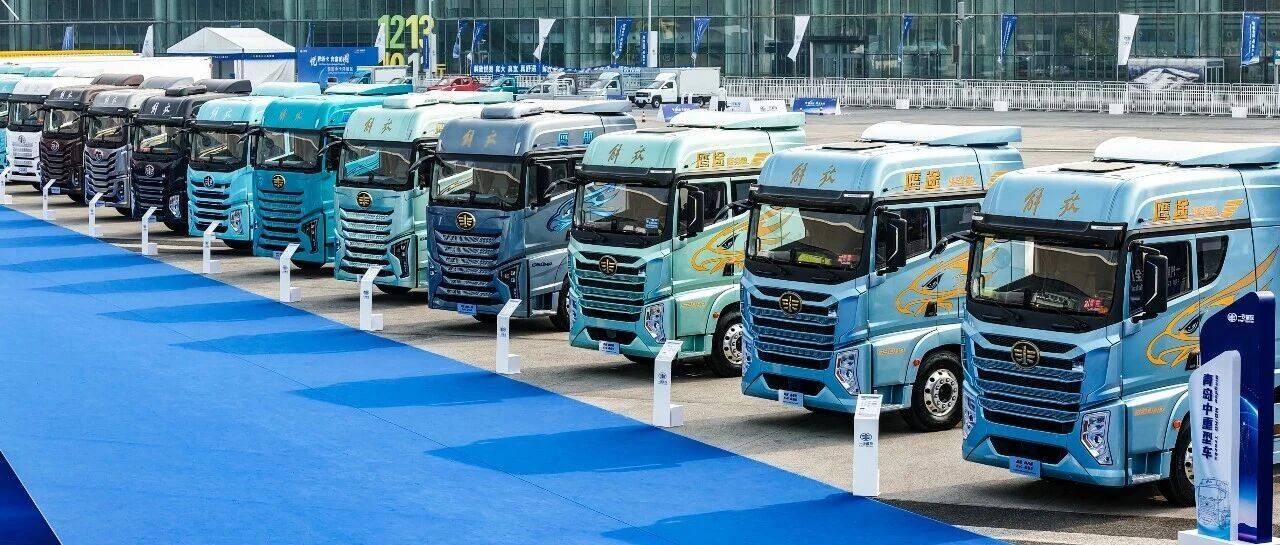
Core Viewpoint - The heavy truck market in China experienced a strong wholesale performance but weak retail sales in January 2026, with wholesale sales rising by approximately 40% year-on-year to about 101,000 units, while retail sales are expected to decline by 5-10% year-on-year [1][4][17]. Group 1: Market Performance - In January 2026, the heavy truck market sold approximately 101,000 units, marking a 40% increase from 72,200 units in January 2025 [1]. - The wholesale sales growth is attributed to manufacturers' strategies to ensure a strong start to the year, despite a weak terminal sales performance [4][6]. - The export of heavy trucks continued to grow steadily, with a year-on-year increase of over 20% in January 2026 [6]. Group 2: Manufacturer Performance - China National Heavy Duty Truck Group (CNHTC) sold about 24,000 heavy trucks in January 2026, achieving a year-on-year growth of approximately 13% and holding a market share of about 23.8% [8]. - FAW Jiefang sold around 23,000 heavy trucks, with a significant year-on-year increase of about 48%, resulting in a market share of approximately 22.8% [8]. - Dongfeng Motor Corporation sold about 16,000 heavy trucks, marking a year-on-year growth of approximately 92% and a market share of about 15.8% [10]. - Shaanxi Automobile Group sold around 15,000 heavy trucks, achieving a year-on-year growth of about 20% and a market share of approximately 14.9% [12]. - Beiqi Foton sold about 13,000 heavy trucks, with a year-on-year increase of approximately 66%, resulting in a market share of about 12.9% [14]. - XCMG, focusing on new energy heavy trucks, sold about 4,000 units, achieving a year-on-year growth of approximately 95% [16]. Group 3: Future Outlook - The heavy truck industry is expected to maintain rapid wholesale growth in the first quarter of 2026, but retail sales may decline by 10-15% year-on-year [17]. - The traditional peak sales season for heavy trucks is delayed due to the late Lunar New Year holiday, which may impact sales timing [17]. - New policies regarding the replacement of old National III and IV trucks are anticipated to be implemented in the latter part of the first quarter, which could provide substantial benefits and stimulate sales in the second quarter [17].


产业政策加速中国未来企业培育,500质量成长ETF(560500)整固蓄势,中小科技企业迎来制度与资本双稳期
Xin Lang Cai Jing· 2026-02-04 05:39
风险提示:"中证500质量成长指数(930939)由中证指数有限公司("中证")编制和计算,其所有权归属 中证或其指定的第三方。中证对于标的指数的实时性、准确性、完整性和特殊目的的适用性不作任何明 示或暗示的担保,不因标的指数的任何延迟、缺失或错误对任何人承担责任(无论是否存在过失)。中 证对于跟踪标的指数的产品不作任何担保、背书、销售或推广,中证不承担与此相关的任何责任。"本 基金为被动投资的交易型开放式指数基金,主要采用完全复制策略,跟踪标的指数市场表现,具有与标 的指数所表征的市场相似的风险收益特征。投资者投资于本基金面临标的指数回报与相应市场平均回报 偏离、标的指数波动、跟踪误差控制未达约定目标、标的指数变更、指数编制机构停止服务、成份股停 牌或退市等潜在风险。本产品由鹏扬基金管理有限公司发行与管理,销售机构不承担产品的投资、兑付 责任。基金管理人承诺以诚实信用、勤勉尽责的原则管理和运用基金资产,但不保证基金一定盈利,也 不保证最低收益。基金的过往业绩并不预示其未来表现,本公司管理的其他基金的业绩并不构成对本基 金业绩表现的预示和保证。投资者在投资基金前应认真阅读基金合同、招募说明书和基金产品资料概要 ...
归母净利润激增1551%,北汽福田战略转型进入收获期
Huan Qiu Wang· 2026-02-04 02:17
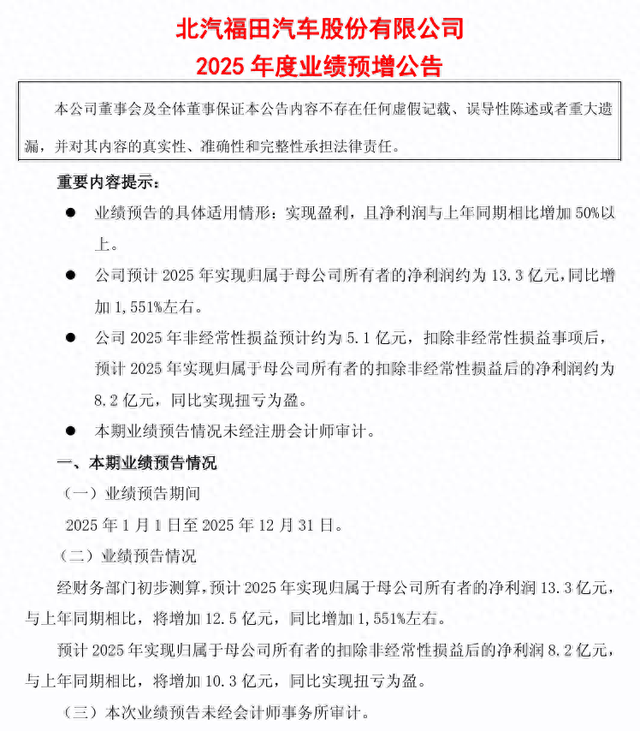
Core Viewpoint - Beiqi Foton Motor Co., Ltd. is expected to achieve a net profit of approximately 1.33 billion yuan in 2025, representing a staggering increase of 1551% year-on-year, driven by its strategies of comprehensive internationalization, electrification, and intelligence [1][4][11] Financial Performance - The company anticipates a non-recurring profit of about 510 million yuan, accounting for approximately 38.3% of the net profit, indicating a strong contribution from core business operations [4] - Total sales for 2025 are projected to reach 650,000 units, a year-on-year increase of 5.85%, surpassing the industry average growth of about 4% [6] - Heavy-duty truck sales are expected to double to 142,000 units, while new energy vehicle sales are projected to reach 101,200 units, reflecting an 87.21% increase, significantly above the industry average of 66.5% [6] Strategic Initiatives - The company's performance surge is attributed to the successful implementation of its three strategic pillars: comprehensive internationalization, electrification, and intelligence [8] - In the new energy sector, Beiqi Foton aims for over 50% of its sales to come from new energy vehicles by 2030, with significant advancements in battery technology and commercial operations [8][9] - The internationalization strategy has evolved from product exports to localized production, with 32 smart manufacturing bases established overseas, leading to a 25% share of overseas sales [9] Operational Efficiency - The company has adopted a matrix management structure to enhance operational efficiency, resulting in over 100 million yuan in cost savings through smart manufacturing and strategic partnerships [11] - Marketing innovations have led to a customer base of 2.03 million, with a lead conversion rate of 18%, significantly higher than the industry average [11] Industry Positioning - Beiqi Foton's new energy vehicle sales account for nearly 16%, positioning the company favorably in the market as most competitors rely heavily on traditional fuel vehicles [12] - The company is set to achieve its "GREEN3030 strategy" goals, targeting 300,000 units in overseas sales and 30% in new energy by 2030 [13] - The performance of Beiqi Foton signifies a pivotal shift in the Chinese commercial vehicle industry from scale competition to quality competition, providing a model for other domestic companies [13]
多行业联合人工智能2月报:公募增配光通信、半导体设备、封测,减配芯片设计、游戏、广告-20260204
Huachuang Securities· 2026-02-04 02:06
策略研究 证 券 研 究 报 告 【华创证券人工智能研究中心】 公募增配光通信、半导体设备、封测,减配芯片设 计、游戏、广告——多行业联合人工智能 2 月报 策略月报 2026 年 02 月 04 日 华创证券研究所 证券分析师:姚佩 邮箱:yaopei@hcyjs.com 执业编号:S0360522120004 证券分析师:耿琛 邮箱:gengchen@hcyjs.com 执业编号:S0360517100004 证券分析师:岳阳 电话:021-20572543 邮箱:zhangchenghang@hcyjs.com 执业编号:S0360519070003 邮箱:yueyang@hcyjs.com 执业编号:S0360521120002 证券分析师:吴鸣远 邮箱:wumingyuan@hcyjs.com 执业编号:S0360523040001 证券分析师:张程航 2026-01-26 《【华创策略】再通胀主线:五朵金花——策略周 聚焦》 2026-01-25 证监会审核华创证券投资咨询业务资格批文号:证监许可(2009)1210 号 证券分析师:范益民 电话:021-20572562 邮箱:fanyimin@ ...
凯龙高科拟控股金旺达 推动技术与市场多维协同
Zhong Guo Zheng Quan Bao· 2026-02-04 00:56
2月3日晚间,凯龙高科(300912.SZ)公告称,上市公司拟通过发行股份及支付现金的方式向许照旺、 安义拓荒者购买金旺达70%股权,并向公司实际控制人臧志成发行股份募集配套资金。本次交易完成 后,金旺达将成为上市公司的控股子公司。公司将于2026年2月4日开市起复牌。 标的公司金旺达主营滚珠直线导轨副、滚珠丝杠副、直线模组、直线电机等精密传动功能部件的研发、 生产与销售,产品已广泛应用于3C电子、新能源锂电、半导体设备、医疗设备、机器人、汽车制造装 备等领域的工业自动化场景,长期为比亚迪、宁德时代、华为、富士康、歌尔股份、立讯精密、京东方 等国内知名智能制造企业的设备供应商提供批量配套产品,其产品还成功应用于苹果、特斯拉等国际高 端制造商的产线。凯龙高科表示,标的公司主业契合上市公司产业升级战略方向,可加速上市公司战略 布局落地,培育新质生产力,进一步提高上市公司持续盈利能力。 公告显示,上市公司与标的公司将在技术、市场、产能及管理等方面实现多维协同。技术层面,双方将 整合研发资源、共享关键环节经验,凯龙高科作为国家企业技术中心和国家博士后科研工作站,具备较 强的研发团队和技术积累,可为金旺达提供研发支持, ...