OPPO

Search documents
非洲手机之王传音即将退位?利润腰斩 50元手机扛不住存储涨价
Xin Lang Ke Ji· 2026-02-05 08:53
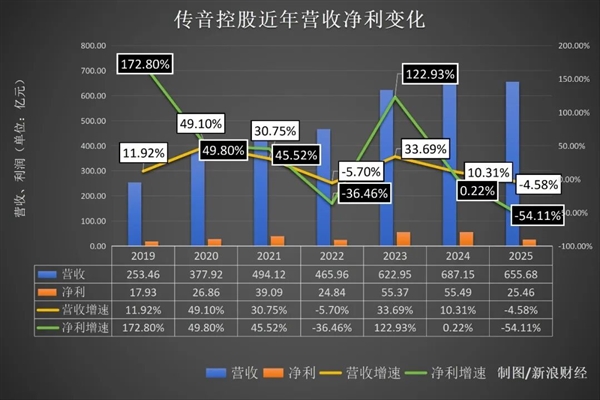
Core Viewpoint - Transsion Holdings is expected to experience a decline in both revenue and net profit in 2025, with net profit projected to be halved, marking the worst performance since its IPO in 2019 [1][5][6]. Financial Performance - The company forecasts a revenue of approximately 65.568 billion yuan for 2025, a decrease of about 31.47 billion yuan or 4.58% year-on-year [2]. - The expected net profit for 2025 is around 2.546 billion yuan, down by approximately 30.03 billion yuan or 54.11% compared to the previous year [2][5]. Market Competition - Transsion remains the market leader in Africa, but faces increasing competition from Xiaomi and Honor, which have shown growth rates of 34% and 158% respectively in the third quarter of 2025 [1][8]. - The overall smartphone market is experiencing sluggish growth, particularly in emerging markets, with a projected global smartphone shipment growth of only 2% in 2025 [7][8]. Cost Pressures - The company attributes its poor performance to rising storage prices, which have increased by over 40% due to demand from AI data centers, impacting product costs and gross margins [7][8]. - Transsion's average smartphone price in 2025 is reported to be 332.1 yuan, with feature phones averaging only 50.1 yuan, indicating a focus on the low-end market [9][10]. Diversification Efforts - To mitigate risks, Transsion is exploring new business areas such as mobility and energy storage, although these segments currently contribute only 8.8% to total revenue [12][14]. - The company has established a mobility division and is expanding into electric two-wheelers and energy storage products, but these initiatives are still in early stages and have not yet significantly impacted overall revenue [11][12].


高价值专利助力培育新质生产力(人民日报)
Ren Min Ri Bao· 2026-02-05 08:22
Group 1 - The integration of technology innovation and industrial innovation is deepening, with a focus on high-value patents driving this process [2][4][6] - The smartphone market in China is expected to exceed 1 trillion yuan by 2025, with foldable smartphones showing a shipment growth of 9.2% year-on-year, reaching over 10 million units [2] - OPPO has invested over 8 years in R&D for foldable smartphones, holding more than 3,500 related patents, and aims to have over 118,000 global patent applications by the end of 2025 [2] Group 2 - The agricultural machinery industry faces challenges such as crop loss during harvesting due to complex conditions, prompting innovation in real-time monitoring and automatic adjustment technologies [3] - A new patent for an adaptive cleaning control device in harvesters has been developed, significantly improving harvesting efficiency and reducing reliance on subjective experience [3] - Collaborative efforts between academia and industry have led to the development of prototypes that have generated over 1 billion yuan in revenue for companies [3] Group 3 - Over 280,000 companies in China hold 1.764 million high-value invention patents, accounting for more than three-quarters of the total, indicating a strong focus on patent commercialization [4] - The industrialization rate of invention patents has increased from 44.9% to 54% since the start of the 14th Five-Year Plan, reflecting a growing emphasis on integrating research and development with market needs [4] - Innovations in brain-machine interface technology have shown promising results in rehabilitation, utilizing a non-invasive interface combined with AI algorithms [4][5] Group 4 - The accumulation of high-value patents is crucial for China's goal of achieving high-level technological self-reliance, with nearly 800,000 patents maintained for over 10 years generating significant economic and social value [6] - Original and leading innovations are emerging in key sectors such as artificial intelligence, advanced manufacturing, biomedicine, and new energy, supported by a robust patent framework [6]
中国软件技术发展洞察和趋势预测研究报告2026
极客邦科技· 2026-02-05 07:26
Investment Rating - The report does not explicitly state an investment rating for the industry Core Insights - The artificial intelligence (AI) sector continues to dominate investment, accounting for 88.1% of total financing in the technology field in 2025, an increase of 5.3 percentage points from 2024 [21] - The humanoid robot sector has emerged as a significant area of investment, capturing 16.8% of the total technology financing [28] - The report highlights the rapid evolution of AI technologies, particularly in reasoning models and multimodal models, which are reshaping the landscape of AI applications [36][38] Summary by Sections 2025 Technology Market Review - In 2025, the technology sector saw a total financing of 738.4 billion yuan across 644 events, with AI leading the way [21] - Key developments included the rise of humanoid robots and advancements in AI models, such as the release of various reasoning models by major companies [19][36] 2026 Technology Trend Outlook - The report anticipates continued growth in AI and humanoid robotics, with significant investments expected in these areas [28] - The integration of AI into various applications is expected to accelerate, driven by advancements in multimodal models and reasoning capabilities [36][38] Financing Events and Trends - The AI sector experienced 212 financing events exceeding 100 million yuan, representing 88.7% of all such events in the technology field [29] - The report notes a shift towards more substantial financing rounds, with seed and A rounds making up 67.7% of total financing events [31] Key Companies and Innovations - Notable companies in the AI sector include Zhiyuan AI, Minimax, and Yuzhi Technology, which have raised significant funds in recent rounds [32] - The report highlights the emergence of new technologies and models, such as DeepSeek and various multimodal models, which are expected to drive future growth [36][38]
全球手机季度收入创历史新高!均价首破400美元!
Sou Hu Cai Jing· 2026-02-05 06:32
【CNMO科技消息】2月5日,据Counterpoint Research发布的《Market Monitor Service》报告,2025年第 四季度,全球智能手机市场收入同比增长13%,达到1430亿美元(约合人民币9930亿元),创单季度历 史新高。同时,手机平均售价(ASP)同比增长8%,首次在单季度内突破400美元(约合人民币2777 元)。 据CNMO了解,2025年第四季度,苹果出货量和收入均创历史新高,分别同比增长14%和23%。三星则 以11%的市场份额继续保持全球第二大收入贡献者地位,2025年第四季度收入同比增长12%;同期,其 出货量同比增长17%,为前五大品牌中最高。 Counterpoint Research指出,苹果的增长主要由iPhone 17系列驱动,受益于换机超级周期。同时,各区 域ASP的整体提升也带来了更强劲的收入增长,Pro版机型的占比提升尤为明显。苹果在美国、中国等 多个地区的收入均创下新纪录。 2025年第四季度,小米收入同比下降9%,出货量同比下降11%,主要受到供应受限以及元器件成本上 升对其入门级和中端产品组合的冲击;OPPO的收入和ASP分别同比增长23 ...

全球智能手机单季度平均售价首次突破400美元关口
Feng Huang Wang· 2026-02-05 06:22
同时,在高端化趋势持续推进以及物料清单(BOM)成本上升的双重推动下,智能手机平均售价 (ASP)同比增长8%,首次在单季度内突破400美元。出货量同比增长5%,表明随着越来越多消费者选 择更高价位的设备,市场增长继续以"价值扩张"而非"规模扩张"为主。 vivo在该季度的收入亦同比增长6%,主要由其在中国和印度市场的强劲表现所支撑。 报告显示,在2025年第四季度,苹果以23%的同比增速成为前五大品牌中收入增长最快的厂商,主要得 益于iPhone 17系列的表现。苹果在该季度的收入市场份额达到59%。 三星以17%的同比增速成为前五大品牌中出货量增长最快的厂商,主要受Galaxy A系列在各区域的强劲 表现推动。同期,三星收入同比增长12%。 小米收入同比下降9%,出货量同比下降11%,主要受到供应受限以及元器件成本上升对其入门级和中 端产品组合的冲击。 凤凰网科技讯 2月5日,市场研究机构Counterpoint报告显示,2025年第四季度,全球智能手机市场收入 同比增长13%,达到1,430亿美元,创单季度历史新高。 OPPO在2025年第四季度的收入和ASP同比分别增长23%和6%,为前五大品牌中第二 ...

雷军放出新SU7关键信息,OPPO大片上架、荣耀新机入网
Sou Hu Cai Jing· 2026-02-05 06:14
Group 1 - Lei Jun continues to provide updates on the new generation Xiaomi SU7, emphasizing its enhanced driving experience and significant upgrades in the chassis and intelligent control systems, tested under extreme conditions like -39 degrees Celsius [3] - The new Xiaomi SU7 underwent rigorous testing in five harsh scenarios, including icy roads and emergency braking at 75 mph, to ensure reliability in extreme environments [3] Group 2 - OPPO's 2026 Spring Festival blockbuster titled "Stealing Time" has been released, focusing on the emotional struggles of young people and showcasing the capabilities of the Find X9 Pro smartphone, which supports 4K 120fps Dolby Vision recording [5] - The film was created in collaboration with notable directors and screenwriters, highlighting OPPO's commitment to high-quality content production [5] Group 3 - Vivo announced its 2025 Innovation Awards, recognizing projects such as the 200MP Zeiss APO telephoto lens and various imaging innovations, emphasizing that innovation goes beyond specifications to enhance user experience [7] - Vivo expressed gratitude to its team for their continuous efforts in innovation, indicating a strong focus on user-oriented technology [7] Group 4 - Honor's latest foldable phone, the Magic V6, has officially entered the network and is expected to be released at MWC 2026, featuring a Snapdragon 8 Elite Gen5 processor and a 7000mAh battery, while being lighter and thinner than its predecessor [8] - The first sales data for the REDMI Turbo 5 series has been released, although specific sales figures are not yet available [8]

OPPO新春影片《偷时间的人》上映:神仙主创打造 全片由OPPO Find X9 Pro拍摄
Xin Lang Cai Jing· 2026-02-05 03:11
Core Viewpoint - OPPO's new Spring film "The Time Thief" focuses on the emotional struggles of young people, using the metaphor of "stealing time" to explore themes of self-awareness and returning to the present moment [1][1]. Group 1 - The film is directed by Yang Lina, known for "Little Me," and co-written by Qiu Yujie, the screenwriter of "The Beginning" [1]. - "The Time Thief" depicts a chaotic event in a small town that leads to personal awakening and reflection among its characters [1].
前华为、OPPO、腾讯的技术骨干,给外国孩子做了款会讲故事的AI“小房子”|36氪专访
3 6 Ke· 2026-02-05 02:18
Core Insights - The article discusses the innovative AI toy Talenpal, designed to stimulate children's imagination without screens, targeting the growing AI toy market, which is projected to exceed $11 billion in 2024 and reach $58 billion by 2030, with an annual growth rate of over 20% [2]. Company Overview - Talenpal was founded by Ma Xiucheng and Pan Xuan, both experienced professionals from the mobile industry, who transitioned to create a product that meets the needs of parents for screen-free, imaginative play for children [1][5]. - The core team includes members with backgrounds from major tech companies like Huawei, Apple, Tencent, and Amazon, providing a diverse skill set in consumer electronics, content creation, and international market expansion [5]. Product Features - Talenpal is a unique AI toy resembling a small house, equipped with a micro-display for simple visual prompts, and comes with various character dolls, each preloaded with specific stories and activities [1][3]. - The product aims to enhance children's imagination by providing auditory storytelling and interactive AI conversations, avoiding the pitfalls of screen dependency [6][14]. Market Positioning - Talenpal primarily targets the U.S. market, emphasizing compliance with local regulations and data security, which presents a high barrier to entry for competitors [3]. - The company leverages exclusive IP assets derived from overseas picture book copyrights, combined with local content production, to create a unique storytelling experience [3][12]. User Engagement - Initial user feedback indicates a high "screen replacement rate," with children showing increased focus and engagement compared to traditional screen-based toys [17]. - The product serves as a helpful tool for parents, reducing the burden of childcare while providing frequent companionship for children [17]. Content Strategy - Talenpal's content is designed to be systematic and educational, addressing emotional recognition and social skills through character-driven narratives [13][12]. - The company emphasizes the importance of high-quality content, asserting that AI toys without substantial content are merely empty shells [19]. Business Model - Talenpal operates on a "razor-and-blades" business model, where the main device serves as a platform for ongoing content and character doll sales, encouraging repeat purchases as children grow [25]. - The pricing strategy reflects the value of the content and IP behind each character, with dolls priced between $10 and $15 [20]. Future Outlook - The company is exploring potential investments but prioritizes gathering user feedback to validate the product's market fit and effectiveness [26]. - Talenpal's adaptability to different cultural contexts and local preferences positions it well for international expansion, with plans to customize content for various markets [18].
钉钉大楼换LOGO硬刚飞书,网友:商战总是朴实无华;马斯克团队摸底中国光伏产业链,A股巨头回应;断友商后路?元宝回应被微信「封了」
雷峰网· 2026-02-05 01:08
Group 1 - Tesla's team is exploring the Chinese photovoltaic industry chain and has signed orders with a leading heterojunction equipment manufacturer [4][5] - JinkoSolar confirmed contact with Tesla's team regarding their technology and production capabilities, leading to a surge in stock prices [5] - The photovoltaic sector saw a collective rise in stock prices following the news of Tesla's interest [5] Group 2 - DingTalk changed its logo in a competitive move against Feishu, reflecting a playful approach to brand rivalry [7][8] - The logo change was inspired by a perceived height advantage of Feishu's logo, leading to humorous online reactions [8] Group 3 - The CEO of RT-Mart's parent company, Gao Xin Retail, has been unreachable after only two months in the position, raising concerns about his status [10][11] - The company reported a significant decline in revenue and profit prior to the CEO's disappearance, indicating potential operational challenges [11] Group 4 - WeChat blocked the sharing links for the Yuanbao app, leading to a rapid adjustment in its sharing mechanism to maintain user experience [12][13] - The incident highlights the competitive tensions within Tencent's ecosystem, as other apps also faced similar restrictions [12][13] Group 5 - Vivo has confirmed the development of a Vlog camera aimed at competing with DJI's Pocket series, with a planned release in 2026 [15][16] - The new product is part of Vivo's strategy to expand its offerings in the camera technology sector [16] Group 6 - Xiaohongshu's valuation has reportedly increased to 350 billion RMB after a recent sale of shares, reflecting strong investor interest [23][24] - The platform experienced a surge in monthly active users, surpassing 350 million, contributing to its rising valuation [24] Group 7 - Panasonic announced plans to expand its layoffs to 12,000 employees due to challenges in its AI business and a decline in sales [45] - The company is facing significant operational restructuring costs as it attempts to navigate these challenges [45] Group 8 - Realme has begun layoffs in India as it transitions back under OPPO's management, indicating a shift in its operational strategy [46][47] - The brand's return to OPPO aims to enhance product innovation and service delivery [46][47] Group 9 - Samsung Electronics' market value surpassed 1,000 trillion KRW, driven by a surge in demand for storage chips amid the AI boom [49][50] - The company's stock has seen significant growth, with expectations for continued strong performance in the semiconductor market [49][50] Group 10 - AMD's CEO revealed that the next generation Xbox is on track for a 2027 release, with custom SoCs already in development [52] - This collaboration continues AMD's long-standing partnership with Microsoft in the gaming console market [52]




从“猎奇”到“信赖”:折叠屏手机用户发展洞察报告
艾瑞咨询· 2026-02-05 00:00
Core Insights - The global foldable smartphone market is experiencing continuous growth, particularly in China, driven by technological advancements and an improved supply chain, leading to product diversification [1] - China has emerged as the main growth engine for the global foldable smartphone market, with Huawei maintaining a significant market share [1][18] - User willingness to purchase foldable smartphones is increasing, with higher expectations for product functionality and experience [1] Market Overview - The global smartphone market has transitioned into a saturated phase since 2017, with annual shipment volumes declining by approximately 2.52%, projected to reach 1.22 billion units by 2024 [2] - The foldable smartphone segment is seen as a strategic direction to overcome market growth bottlenecks, with expected high growth in shipments from 2022 to 2024 [5] Competitive Landscape - The foldable smartphone industry chain includes upstream raw material supply, midstream design and manufacturing, and downstream sales [7] - Chinese manufacturers, led by Huawei and Samsung, are driving the industry forward through strong technological capabilities and market influence [7][8] User Behavior and Preferences - The user demographic for foldable smartphones shows a preference among high-education individuals, with over 75% of users holding a bachelor's degree or higher [20] - The majority of users spend between 5,000 to 9,000 yuan on foldable smartphones, with Huawei being the most popular brand, accounting for 62.3% of usage [22] - Key reasons for purchasing foldable smartphones include a stronger sense of technology and innovation, with 44.7% of users citing this as a primary factor [24] Brand Recognition and Perception - Huawei leads in brand recognition across various metrics, significantly ahead of competitors like Samsung, Xiaomi, and OPPO [26] - In terms of brand image, Huawei excels in high-end perception, business appeal, and innovation, reinforcing its leadership in the foldable smartphone sector [28] User Satisfaction and Future Intentions - User satisfaction is highest for Huawei, indicating strong brand loyalty, followed by Xiaomi and Samsung [30] - Over 90% of consumers are considering purchasing a foldable smartphone for their next device, with a focus on reliability and battery life [41] Market Transition - The foldable smartphone market is transitioning from a niche segment to mainstream practicality, driven by hardware maturity and software ecosystem improvements [43] - The hardware is evolving from merely functional to providing a comprehensive user experience, with innovations in hinge and screen technology [45] - Consumers are shifting from "novelty" to "regular use," with 95.5% expressing willingness to switch to foldable smartphones in the future [47]