极氪

Search documents
炸裂!比亚迪发布
Zheng Quan Shi Bao· 2025-04-01 12:33
Group 1 - BYD's electric vehicle sales exceeded 1 million units in the first three months of the year, with March sales reaching 377,400 units, a year-on-year increase of 24.8% [1] - The overall sales of BYD's electric vehicles for the first quarter reached 1,000,800 units, representing a year-on-year growth of 59.81% [1] - New energy vehicle startups like Li Auto and NIO also reported significant sales increases, with XPeng's March sales surging nearly 270% year-on-year [1][5] Group 2 - BYD is experiencing a "two-headed" growth trend, capturing the 100,000 to 200,000 yuan market with its Dynasty and Ocean series while solidifying its presence in the luxury market above 400,000 yuan [2] - The launch of the Super e-platform, featuring advanced technologies such as a 10C charging rate and a 1000V high-voltage architecture, is expected to drive product upgrades and sales growth [2][3] - BYD has implemented limited-time pricing strategies for certain models, with price reductions of up to 16,000 yuan for non-intelligent driving versions [2] Group 3 - BYD is actively expanding into the high-end market, with the launch of the Yangwang U7, priced from 628,000 yuan, featuring innovative capabilities and fully electric suspension systems [3] - The company aims to achieve a sales target of 5.5 million units by 2025, with expectations of over 90% growth in overseas markets [4] Group 4 - Other new energy vehicle manufacturers also reported strong sales, with Xiaomi delivering over 29,000 vehicles in March and aiming for an annual target of 350,000 units [7] - Li Auto and NIO reported year-on-year increases in deliveries of 26.5% and 26.7% respectively for March, while Leap Motor and Zeekr also showed significant growth [5][7] Group 5 - The China Electric Vehicle Hundred People Association predicts that new energy vehicle sales will exceed 16 million units by 2025, entering a stable growth phase thereafter [8]


炸裂!比亚迪发布!
证券时报· 2025-04-01 12:15
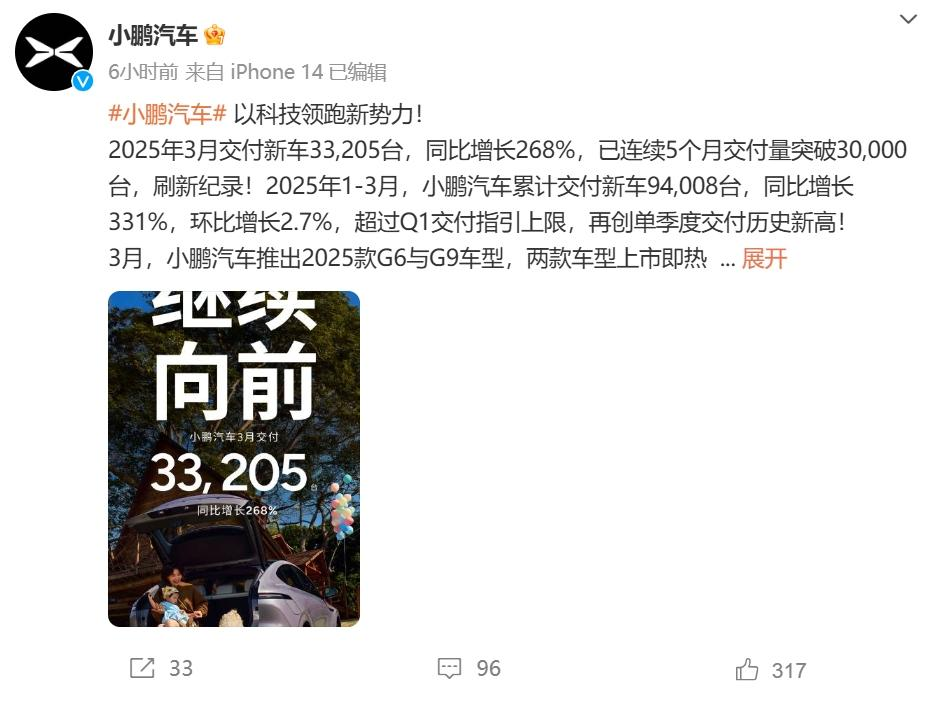
Core Viewpoint - BYD's electric vehicle sales have surpassed one million units in the first three months of the year, indicating strong growth in the market for new energy vehicles [1][2]. Group 1: BYD's Sales Performance - In March, BYD's new energy vehicle sales reached 377,400 units, a year-on-year increase of 24.8%, with passenger car sales at 371,400 units, up 23.1% [1]. - For the first three months of the year, BYD's new energy vehicle sales totaled 1,000,800 units, reflecting a year-on-year growth of 59.81% [1]. - BYD is experiencing a "two-headed" growth trend, capturing both the 100,000 to 200,000 yuan market with its Dynasty and Ocean series, and the luxury market above 400,000 yuan with brands like Tengshi and Fangchengbao [3]. Group 2: Product and Technology Innovations - BYD launched the groundbreaking Super e-platform, featuring a 1000V high-voltage architecture and the world's first mass-produced 10C charging rate electric platform [3]. - The company has introduced limited-time pricing policies for certain models, with the Qin LDM-i starting at 89,800 yuan and the Song LDM-i at 119,800 yuan [3]. - The launch of the Yangwang U7, a flagship electric sedan, marks a significant advancement in electric vehicle technology, featuring a fully electric suspension system [4]. Group 3: Market Expansion and Future Goals - BYD aims to achieve a sales target of 5.5 million units by 2025, with expectations of over 90% growth in overseas markets [5]. - The company is also set to mass-produce its self-developed "end-to-end urban intelligent driving" technology within the year [5]. Group 4: Performance of New Car Manufacturers - Other new energy vehicle manufacturers have also reported significant sales growth, with XPeng Motors delivering 33,200 vehicles in March, a year-on-year increase of 268% [7]. - Xiaomi Motors delivered over 29,000 vehicles in March, with a target of 350,000 units for the year [9]. - Li Auto and NIO reported year-on-year increases of 26.5% and 26.7% in March deliveries, respectively, with NIO's total deliveries for the first quarter reaching 42,100 units, up 40.1% [9].

左手托举昊铂,右手牵上华为:广汽如何在高端化赛道上突围
2 1 Shi Ji Jing Ji Bao Dao· 2025-03-31 09:57
"不设上限支持昊铂品牌",是广汽集团(601238)高层寄予大众的承诺。 "华望汽车主要面向30万元级高端客户。"是广汽集团董事长冯兴亚明确对广汽和华为合作品牌给出的定 位。 短短两周时间内,广汽集团的高端化布局接连迎来新进展,冲刺豪华车市场的步伐愈发清晰。 前者是被注入了诸多资源的昊铂品牌,作为集团高端豪华电动车品牌,取名"Hyper""超越"之意,在广 汽埃安自主品牌固化的"网约车"标签之外,承载着广汽冲向中高端市场的使命;后者是广汽华为GH项 目下,集团自主板块的"新鲜血液",一个全新的高端智能新能源汽车品牌酝酿当中。 提振销量、加码自主、稳固合资,"番禺行动"元年启动,广汽渴望在2025年突围高端市场,寻找新的增 长机会。 "无上限"支持昊铂冲刺豪华头部 品牌焕新后的首款产品昊铂HL于日前正式开启预售,定位"家庭智能新豪华SUV",推出纯电和增程两 种动力形式,共6个版本,预售价格27.98万~32.98万元。 冯兴亚在接受21世纪经济报道记者采访时表示,由于新技术和新产业(300832)的出现,科技创新和产 业革命给消费者带来了多元化的需求,也给中国品牌提供了打造豪华品牌的机会。"如果没有智能网联 ...

特斯拉的麻烦不只是马斯克
36氪· 2025-03-31 09:24
Core Viewpoint - Tesla's brand value is rapidly declining, with significant stock price drops and negative sales trends, particularly in the European and Chinese markets [3][4][30]. Group 1: Sales Performance - Tesla's stock has dropped over 30% this year, making it the worst performer among the "Big Seven" tech companies in the U.S. [4] - In Europe, Tesla sold only 25,852 electric vehicles in the first two months of the year, a significant decline of 45% year-over-year [6]. - In the U.S., Tesla's new car sales decreased by 5% year-over-year in February, marking the fourth consecutive month of decline [7]. - Tesla's total vehicle deliveries for 2024 are projected to be approximately 1.79 million, a slight decrease of 1% compared to the previous year, marking the first year-over-year decline since 2015 [9]. Group 2: Market Share and Competition - In China, Tesla's market share dropped from 8.3% in 2023 to 6.1% in 2024, while BYD's market share increased from 11.5% to 15.4% [10]. - The overall sales growth in the Chinese new energy vehicle market is significantly outpacing Tesla, with a 35.5% increase in total sales compared to Tesla's 8.8% growth [10]. - Tesla's Model 3 and Model Y, which account for 90% of its sales, are facing increasing competition from local brands like BYD and new entrants like Xiaomi [14][17]. Group 3: Profitability and Financial Health - Tesla's gross margin has been declining for three consecutive years, dropping from 29.3% in 2021 to 18.4% in 2024 [11]. - In contrast, BYD's automotive revenue for 2024 is projected to be 617.38 billion yuan, with a year-over-year growth of 27.7% and a gross margin above 20% [11]. Group 4: Product Strategy and Innovation - Tesla's lack of new product excitement is a key reason for its sales stagnation, with its current models being on the market for several years without significant updates [14][16]. - To regain market share, Tesla plans to produce a low-cost version of the Model Y, expected to be priced around 200,000 yuan, which is a 20% reduction in production costs [19][20]. - The introduction of the Full Self-Driving (FSD) feature has not significantly boosted sales, with FSD revenue remaining at 0.8% of total vehicle sales despite price adjustments [24][29]. Group 5: Market Challenges - Tesla faces increasing competition not only from local Chinese manufacturers but also from traditional automakers in the U.S. and Europe, with its market share in the U.S. projected to drop from 55% in 2023 to about 49% in 2024 [29]. - In Europe, Tesla's sales have decreased by 45%, while competitors like Volkswagen have seen a 182% increase in electric vehicle sales [29].

宝马牵手阿里巴巴!
券商中国· 2025-03-26 04:26
Core Viewpoint - BMW Group announced a deepened strategic cooperation with Alibaba Group to jointly develop an AI engine based on Alibaba's Tongyi AI model, aimed at the Chinese market for BMW's new generation series vehicles, expected to be delivered in 2026 [1][2]. Group 1: Strategic Cooperation - The collaboration focuses on cutting-edge technologies such as AI models and intelligent voice interaction, with the new BMW Intelligent Personal Assistant integrating the jointly developed AI engine [2]. - The AI engine will support smart cockpit and smart travel interaction scenarios, which will debut at the Shanghai Auto Show in April [3]. Group 2: Industry Trends - The automotive industry is rapidly embracing AI, with BMW emphasizing the importance of understanding local consumer needs in China through its Skylab human-computer interaction research center [4]. - BMW's CEO in Greater China highlighted the partnership with Alibaba as a testament to the benefits of collaboration in creating prosperity and growth, aiming to enter a new era of cooperation in the fields of intelligence and electrification [4]. Group 3: AI Investment and Growth - Alibaba has been a pioneer in AI technology research and application in China, with other automotive companies like Xpeng and Zeekr also integrating the Tongyi series models [5]. - As demand for AI technology grows across various industries, Alibaba Cloud's revenue is experiencing accelerated growth, with a significant recruitment drive for AI talent from top global universities [6]. - Alibaba's financial performance shows a return to double-digit growth in external commercial revenue from Alibaba Cloud, with AI-related product revenue achieving triple-digit year-on-year growth for six consecutive months [6].


二手卖价16万,换电池却要22万?电动汽车换电何解
Qi Lu Wan Bao Wang· 2025-03-25 11:48
Core Insights - The high cost of battery replacement for electric vehicles (EVs) is causing significant concern among owners, with replacement costs often exceeding the vehicle's resale value [1][2][3] - The trend of increasing EV scrappage is evident, with projections indicating a substantial rise in the number of retired EVs in the coming years [3][4] - Consumers are increasingly considering the total cost of ownership, including battery replacement and vehicle depreciation, when purchasing EVs [4][8] Group 1: Battery Replacement Costs - The cost of replacing batteries for older EV models, such as the Tesla Model S, can reach up to 22,000 USD (approximately 160,000 RMB), which is higher than the vehicle's current market value [1][2] - In China, the battery replacement costs for various EV models are similarly high, with prices ranging from 19,900 RMB to over 220,000 RMB, while the resale value of these vehicles is significantly lower [2][4] Group 2: Market Trends and Consumer Behavior - The number of scrapped EVs is on the rise, with projections of 12,000 units in 2023 and 26,000 units in 2024, indicating a growing trend in the retirement of older EVs [3] - The penetration rate of EVs in the Chinese market is expected to reach 40.3% by the end of 2024, with an anticipated increase to 57.8% by 2025 [3] Group 3: Consumer Considerations - Consumers are increasingly weighing the cost of battery replacement and vehicle depreciation when deciding whether to purchase an EV or a traditional fuel vehicle [8][9] - The resale value of EVs is a significant concern, with experts suggesting that consumers should aim to keep the purchase price of EVs between 200,000 to 300,000 RMB to mitigate depreciation risks [8][9] Group 4: Warranty and Technology Developments - Many manufacturers are introducing comprehensive warranty policies to alleviate consumer concerns regarding high battery replacement costs, with companies like BYD offering lifetime warranties on battery systems for the first owner [6][7] - Technological advancements in fast-charging capabilities are being developed by various brands, enhancing the user experience and addressing concerns about charging times [7]
乘用车、智能化3月报:2月产批零符合预期,奇瑞广汽接力智驾平权-2025-03-25
Soochow Securities· 2025-03-25 11:04
Investment Rating - The industry investment rating is "Overweight," indicating an expected outperformance of the industry index relative to the benchmark by more than 5% in the next six months [107]. Core Insights - The automotive industry is expected to replicate the 2020 market conditions, driven by the dual trends of electrification and automation, with a significant focus on smart driving technologies [3][101]. - The penetration rate of L3 autonomous driving in new energy vehicles is projected to increase significantly, with expectations of a twofold growth in 2025 compared to the previous year [3][102]. - The report emphasizes the importance of smart driving as the core theme for the automotive sector in 2025, with a strong recommendation for investment in both vehicle manufacturers and component suppliers [3][101]. Summary by Sections Industry Sentiment Tracking - February production and sales figures met expectations, with a production volume of 1.736 million units, reflecting a year-on-year increase of 40.6% and a month-on-month decrease of 17.6% [11][14]. - The wholesale sales volume reached 1.767 million units, showing a year-on-year increase of 36.4% and a month-on-month decrease of 15.9% [11][14]. - The retail sales volume under compulsory insurance was 1.280 million units, with a year-on-year increase of 19.2% but a month-on-month decrease of 28.0% [14]. New Energy Tracking - The penetration rate of new energy vehicles in wholesale sales reached 46.3%, with a month-on-month increase of 4.04 percentage points [21][23]. - Retail penetration for new energy vehicles was 51.3%, reflecting a month-on-month increase of 11.70 percentage points [20][23]. Autonomous Driving Tracking - The penetration rate of L3 autonomous driving in new energy vehicles was 16.6%, with a month-on-month increase of 1.6 percentage points [45]. - Key players like Wanjie and Xiaopeng showed significant penetration rates, with Wanjie's autonomous driving penetration reaching 74.7% [49]. Component Market Tracking - The report highlights a trend of increasing penetration of high-end intelligent components, with DLP and ADB headlight penetration rates at 0.77% and 11.13%, respectively [81]. - The penetration rate for air suspension was 13.28%, while the HUD penetration rate was 17.42% [86][90]. Investment Recommendations - The report suggests a comprehensive bullish outlook on the vehicle sector, emphasizing smart driving as the core theme, with specific recommendations for companies like Xiaopeng, Li Auto, and BYD [3][101]. - For component suppliers, the focus is on AI chips and domain controllers, with companies like Horizon Robotics and Desay SV expected to benefit [3][101].
智驾价格“打下去”:车企密集“亮剑”,下探到6万元车型
Bei Ke Cai Jing· 2025-03-25 09:31
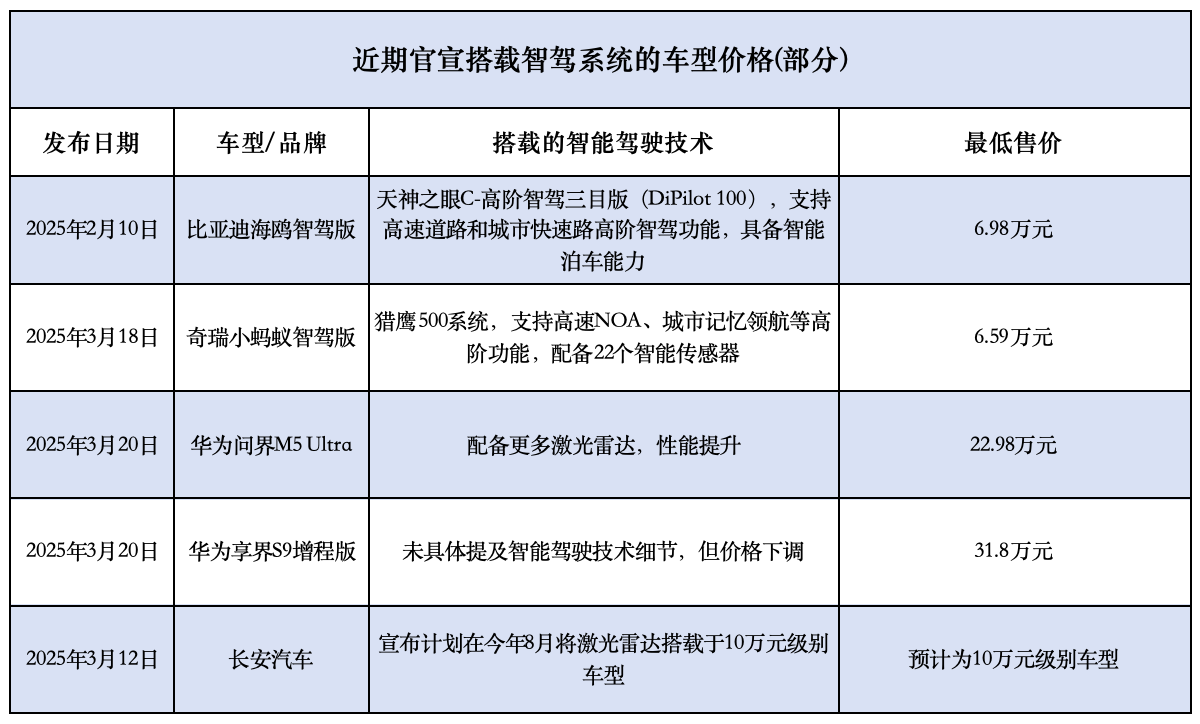
Core Viewpoint - The automotive industry is experiencing a fierce competition in the smart driving sector, with companies like BYD and Chery introducing advanced driving technologies at increasingly lower price points, marking a significant shift in market dynamics [1][4][6]. Group 1: Price and Technology Competition - BYD has introduced its high-end smart driving system in models priced at 69,800 yuan, while Chery has followed suit by offering smart driving features in models starting at 65,900 yuan [3][4]. - Multiple companies, including Huawei, Chery, and GAC, have recently held smart driving technology launch events, emphasizing a strategy of "no lowest, only lower" pricing [2][6]. - The introduction of smart driving technology in lower-priced models is seen as a "dimensionality reduction strike," significantly lowering the entry barrier for consumers [6]. Group 2: Features and Specifications - Chery's new model, the small ant smart version, is equipped with 22 intelligent sensors and supports 23 smart driving functions, including automatic parking and high-speed navigation [5][6]. - The BYD Seagull model features the "Tian Shen Eye" high-end smart driving system, which is the first of its kind in a vehicle priced under 70,000 yuan [7]. Group 3: Market Trends and Predictions - The competition is expected to intensify as more automakers, like Changan, plan to introduce smart driving features in models priced at 100,000 yuan and below [8]. - Analysts suggest that the increasing maturity of sensor technologies, such as millimeter-wave and ultrasonic radars, is driving down the costs of smart driving systems, making them more accessible [9][10]. - The penetration rate of L2 and above smart driving new cars is projected to exceed 60% by 2025, with L3 level vehicles accounting for 8.5% of the market [22].
【财闻联播】买房能7天无理由退订?湖南住建局回应!汽车摇号,有新变化!
券商中国· 2025-03-22 11:19
Macro Dynamics - The Ministry of Commerce launched the 2025 National Home Appliance Consumption Season, emphasizing the importance of old-for-new appliance exchanges to stimulate growth and transformation while benefiting people's livelihoods and the industry [1] - Beijing initiated a "Guarding Consumption" campaign to address consumer issues such as "ghost" takeout and e-commerce "bully clauses," focusing on nine key areas to protect consumer rights [3] - In Changsha County, a new policy allows homebuyers a "7-day no-reason cancellation" option, which has reportedly increased foot traffic to real estate developers [4] - The recent "Consumption Promotion Action Plan" aims to shift car consumption management from purchase to usage, benefiting carless families by issuing additional new energy vehicle quotas [8][9][10] Company Dynamics - Eli Lilly launched its diabetes and weight loss drug Mounjaro in India, surpassing competitor Novo Nordisk, as India faces rising obesity and diabetes rates [13] - The Twitter blue bird logo, removed during Elon Musk's rebranding of the platform to X, is being auctioned for approximately $35,000 [15]

极氪:纯电黑马 “萎靡”,何时重振旗鼓?
海豚投研· 2025-03-21 12:38
4)但汽车毛利率继续环比上行,表现还不错: 汽车业务四季度毛利率 17.3%,继续环比上行 1.5 个百分点,主要仍在于规模效应的释放带来的单车摊折成本的下 滑。 5)研发费用高增,带动经营利润和经调整后净利润不及预期: 研发费用本季度环比的大幅上升(环比上行 12 亿), 虽然毛利率超出市场预期,但最后经营利润和 经调整后净利仍双双 miss 预期。 海豚君认为主要极氪仍在加速补足智驾短板,以及为 2025 年推出的 5 款新车型发布做准备,所以相对可以理解,但仍然需要让市场看到以换取销量的增长作为前 提。 | | | | | | 极搞财报數据概览 | | | | | | | | | | | --- | --- | --- | --- | --- | --- | --- | --- | --- | --- | --- | --- | --- | --- | --- | | 单位:亿元 | 1072 | 2072 | 3022 | 40 22 | 1025 | 2023 | 3 023 | 4023 | 1024 | 2024 | 3024 | 40724 | 4Q24E 4Q24 Gap | | | SIR ...