腾讯

Search documents
2025人形机器人报告:国产人形机器人多维共振应用场景落地加速
Sou Hu Cai Jing· 2025-10-12 12:13
Core Insights - The report highlights that the domestic humanoid robot industry is set to enter a critical turning point in 2025, driven by policy support, technological breakthroughs, and capital investment, leading to the commercial application of humanoid robots across various sectors such as industrial manufacturing, medical rehabilitation, and home services [1][13][16]. Policy Support - A multi-layered promotion system has been established in China, combining central coordination, local collaboration, and alliance interaction, with the central government issuing the "Guiding Opinions on the Innovative Development of Humanoid Robots" in 2023, outlining a three-step goal for the industry [2][21]. - Local governments are leveraging regional advantages for differentiated layouts, with cities like Beijing, Shanghai, and Shenzhen focusing on high-end research and scene opening, while mid-western cities like Chongqing and Chengdu emphasize local supply chain development [2][26]. Capital Investment - The investment enthusiasm in the humanoid robot sector has surged, with 108 financing events and over 15.35 billion yuan invested in the first seven months of 2025, primarily in early-stage projects [3][32]. - Major tech companies and local governments are significant investors, with strategic investments aimed at enhancing technology capabilities and supporting early-stage startups [3][33]. Supply Side Dynamics - The industry is characterized by a diverse competitive landscape involving automotive companies, tech firms, and startups, each leveraging their strengths to drive technological advancements [4][5]. - Automotive companies are utilizing their expertise in autonomous driving and supply chain collaboration to facilitate the large-scale deployment of humanoid robots, while tech companies focus on enhancing the "brain" capabilities of robots through large models [4][15]. Application Expansion - The expansion of application scenarios is opening vast market opportunities for humanoid robots, with significant advancements in industrial, medical, and commercial service sectors [6][16]. - The report emphasizes that as technology continues to evolve and costs decrease, domestic humanoid robots are transitioning from being merely functional to being user-friendly, with a projected market worth in the trillions [6][16].



全球Agent产业化竞速
CAITONG SECURITIES· 2025-10-12 06:42
Investment Rating - The report maintains a "Positive" investment rating for the industry [2] Core Insights - The global large model Agent capability is accelerating its industrialization, shifting from a focus on parameter scale competition to embedding Agent capabilities into systems and core entry points [7][10] - The transformation of large models is evolving from "single language interaction" to "multi-modal perception," enabling them to "see and do" while being controllable and manageable throughout the entire process [10] - Domestic companies are collaborating around a "model-entry-computing power" framework, establishing a triangular industrial structure that is gradually closing the loop from "model → platform → entry/scenario → supply side" [7][10] Summary by Sections Global Large Model Agent Capability Industrialization - Since September 2025, the focus has shifted from "parameter scale competition" to "Agent capability embedding," with significant advancements in commercial viability from companies like OpenAI, Anthropic, and Google [10] - OpenAI's Sora 2 model and app have entered a commercial operational phase, integrating video generation technology with compliance management [12] - Anthropic's Claude Sonnet 4.5 model enhances engineering capabilities for long-term tasks and tool operations, focusing on production environment usability [13] - Google has integrated Gemini into Chrome, enabling high-frequency scenarios and expanding capabilities from answering to executing tasks [18] Content, Agent, and Entry Advancement: Paths of Overseas Leading Companies - Overseas companies are using product forms and system interfaces to support Agents, transitioning from "can speak and answer" to "can see and do" [22] - The focus is on thickening entry points (browsers/home) and toolchains (SDK/testing/security) to facilitate the transition from technical demonstrations to industrialization [22] Model-Entry-Computing Power Convergence: The Chinese Path - Alibaba's Qwen3-Max flagship model leads the "model-platform-entry" upgrade, establishing a comprehensive path from foundational models to enterprise tools and creative entry points [23] - Tencent's Agent Development Platform 3.0 and mixed models have shown significant advancements, with a focus on efficiency and global expansion [28] - Baidu's Wenxin model X1.1 has improved performance metrics significantly, enhancing its capabilities in complex writing and long-term tasks [30] Domestic and International AI Upgrade Resonance - The AI industry is entering a critical phase of large-scale implementation, with future competition focusing on the construction of an "engineering triangle" system [47] - The core differences between domestic and international developments lie in the pace and financial structure, with international firms accelerating exploration but facing higher risks [56]



AI周报:Sora下载量突破100万次;AMD与OpenAI达成巨额算力供应协议
Di Yi Cai Jing· 2025-10-12 04:49
Group 1 - OpenAI's Sora app achieved over 1 million downloads within 5 days, surpassing the download speed of ChatGPT, despite being limited to iOS and requiring an invitation code for access [1] - Sora currently ranks first in the Apple App Store downloads, indicating strong market interest, but it faces backlash regarding potential copyright infringement [1] - OpenAI's CEO has stated that the company will soon provide more detailed control over character generation for copyright holders [1] Group 2 - AMD announced a strategic partnership with OpenAI, issuing warrants for OpenAI to purchase up to 160 million shares at $0.01 each, while deploying 6 gigawatts of AMD GPU capacity [2] - OpenAI is securing its computing power through multiple partnerships, including a significant investment plan from NVIDIA, which could reach up to $100 billion [2] - The success of these partnerships hinges on OpenAI's ability to deploy the chips and systems from AMD and NVIDIA in large-scale data centers [2] Group 3 - Hon Hai Precision Industry (Foxconn) reported a revenue of 837.068 billion New Taiwan dollars for the year ending September 2025, with a 38.01% quarter-over-quarter growth and a 14.19% year-over-year growth [3] - The company anticipates a continued increase in AI server shipments in the fourth quarter, driven by the ongoing demand for AI infrastructure [3] - Recent collaborations, such as AMD's deal with OpenAI and NVIDIA's support for AI data centers, are contributing to the growth of AI server manufacturers like Hon Hai [3] Group 4 - NVIDIA's CEO confirmed the company's investment in Elon Musk's xAI, expressing excitement about the financing opportunities and highlighting Musk's entrepreneurial success [4] - xAI has reportedly raised $20 billion in its latest funding round, with NVIDIA contributing $2 billion [4] - NVIDIA's recent investments in the AI sector have approached $110 billion, focusing on accelerating AI application development [4] Group 5 - OpenAI announced at its DevDay 2025 that ChatGPT will evolve into a "super app," allowing users to access third-party applications directly within conversations [5][6] - The introduction of the AgentKit toolkit aims to lower the barriers for developers to create AI applications, while the Codex programming tool will be fully opened with new features [6] - The release has sparked mixed reactions, with some praising OpenAI's vision for an AI-centric software ecosystem, while others criticize the pace of commercialization [6] Group 6 - ABB has signed an agreement to sell its robotics business unit to SoftBank for $5.375 billion, abandoning plans for an independent IPO of the robotics unit [7] - The transaction is subject to regulatory approval and is expected to be completed by mid-2026 [7] - SoftBank aims to deepen its AI strategy by integrating ABB's robotics capabilities, aligning with its vision for physical AI [7] Group 7 - Elon Musk announced the establishment of an xAI game studio, planning to release an AI-generated game by the end of 2026, which has faced criticism from industry professionals [8] - Critics argue that the gaming industry needs more emotionally resonant experiences rather than AI-generated content, emphasizing the importance of creativity in game development [8] - The debate highlights concerns over the potential for AI to replace human creativity in game design [8] Group 8 - Tencent's Hunyuan-Vision-1.5-Thinking model ranked third globally and first domestically in the latest visual model rankings by LMArena [9] - The Hunyuan image model has demonstrated strong multi-language and multi-modal understanding capabilities [9] - Other domestic open-source models are also gaining recognition, with Alibaba's Tongyi models making it to the top ten in global rankings [9] Group 9 - Yao Shunyu, a notable physicist from Tsinghua University, transitioned from Anthropic to Google DeepMind, citing a desire for more opportunities in AI [10][11] - During his time at Anthropic, he contributed to significant advancements in AI models, but felt it was time to move on [11] - His shift reflects the rapid pace of AI development compared to traditional fields like physics [11]


AI周报|Sora下载量突破100万次;AMD与OpenAI达成巨额算力供应协议
Di Yi Cai Jing Zi Xun· 2025-10-12 03:25
Group 1: OpenAI Developments - OpenAI's video AI application Sora achieved over 1 million downloads within 5 days of launch, surpassing the download speed of ChatGPT [1] - Sora is currently limited to iOS devices and operates on an invitation-only basis, which contrasts with ChatGPT's initial public release [1] - OpenAI is enhancing ChatGPT into a "super app" that allows users to directly access third-party applications within conversations [6] Group 2: Strategic Partnerships and Investments - AMD has issued a warrant to OpenAI allowing the purchase of up to 160 million shares at $0.01 each, as part of a strategic partnership to deploy 6 gigawatts of AMD GPU capacity [2] - NVIDIA is also collaborating with OpenAI, with plans to invest up to $100 billion, contingent on the construction of data centers [2] - NVIDIA confirmed its investment in Elon Musk's xAI, contributing $2 billion in a recent funding round, as part of its broader strategy to support AI applications [4] Group 3: Industry Trends and Performance - Hon Hai Precision Industry (Foxconn) reported a 38.01% quarter-over-quarter revenue increase, driven by a surge in AI server shipments [3] - SoftBank is acquiring ABB's robotics unit for $5.375 billion, indicating a strategic shift towards physical AI and automation technologies [7] - Tencent's Hunyuan-Vision-1.5-Thinking model ranked third globally in the latest visual model rankings, highlighting the competitive landscape in AI model development [9] Group 4: Talent Movement in AI Sector - Yao Shunyu, a notable physicist, transitioned from Anthropic to Google DeepMind, citing a desire for more opportunities in the rapidly evolving AI field [10][11]

宗泽后推出“娃小智”品牌,称水军害了宗馥莉;娃哈哈任命新总经理;比亚迪回应宋PLUS即将停产;美团外卖骑手能屏蔽顾客了丨邦早报
创业邦· 2025-10-12 01:08
Group 1 - The core viewpoint of the article revolves around the competitive dynamics within the Zong family, particularly between Zong Qinghou's niece, Zong Fuli, and her uncle, Zong Zehou, as they launch competing beverage brands, "Wawa Xiaozong" and "Wawa Xiaozhi" respectively [2][3][14] - Zong Zehou's brand "Wawa Xiaozhi" has signed contracts with 153 distributors, primarily in Zhejiang, and offers a diverse product line including AD calcium milk and coconut water, with pricing lower than that of Wahaha [2] - Following Zong Fuli's resignation from her positions at Wahaha, there are reports that Wahaha distributors have been instructed not to represent "Wawa Xiaozong," indicating a potential internal conflict within the company [3][10] Group 2 - Zong Fuli has recently dissolved over ten companies under her name, including Zhejiang Wahaha Health Management Co., indicating a strategic shift in her business focus [14] - Wahaha has undergone multiple name changes for its subsidiaries, rebranding them under the name "Hongsheng," suggesting a broader restructuring within the company [15] - The article highlights the competitive landscape in the beverage industry, particularly the implications of Zong Fuli's departure and the emergence of Zong Zehou's brand, which could reshape market dynamics [2][3][14]


股价暴跌,贸易战火重燃,黄仁勋却在担心另一件事
3 6 Ke· 2025-10-11 09:06
Core Viewpoint - The recent plunge in the US stock market, particularly the Nasdaq index, is attributed to renewed tensions in US-China trade relations, exacerbated by Trump's announcement of additional tariffs on China, which has caused significant concern among tech entrepreneurs [2][4]. Group 1: Market Impact - The Nasdaq Composite Index fell by 3.56%, marking the largest drop in six months, with Nvidia experiencing a decline of 4.89% [1]. - The market downturn is linked to the political friction between the US and China, particularly regarding new Chinese rare earth export controls and Trump's unilateral decision to cancel high-level meetings [2]. Group 2: AI Industry Developments - Nvidia announced a $100 billion investment in OpenAI to develop a large-scale AI data center, which will consume more electricity than France's total annual usage [4]. - OpenAI has also partnered with Oracle to purchase $300 billion worth of computing power over five years, indicating a strong collaborative effort among major tech companies [4]. - Nvidia's investments extend to Intel and Elon Musk's xAI, with Musk's company now valued at over $20 billion, showcasing Nvidia's strategy to build alliances in the AI sector [6]. Group 3: Competitive Landscape - The AI industry in the US is entering a phase of collaboration among major players, referred to as the "alliance era," as companies seek to leverage each other's strengths [6][12]. - The traditional "Silicon Valley + Wall Street" model of innovation is under scrutiny due to the risks of creating market bubbles and disconnects from real market demands [7][8]. Group 4: Chinese AI Opportunities - Despite the significant capital investments by US tech giants, Chinese AI companies are focusing on the speed of application and commercialization rather than just capital [10][12]. - Chinese entrepreneurs emphasize the importance of finding real-world applications for AI technology, as highlighted by Alibaba's and Tencent's leadership perspectives [10][12]. - The competitive advantage for Chinese AI firms lies in their ability to understand and meet local market needs, as demonstrated by successful innovations in the past [12][13].

2025海外上市架构揭秘,不同行业企业差异化选择
Sou Hu Cai Jing· 2025-10-11 07:13
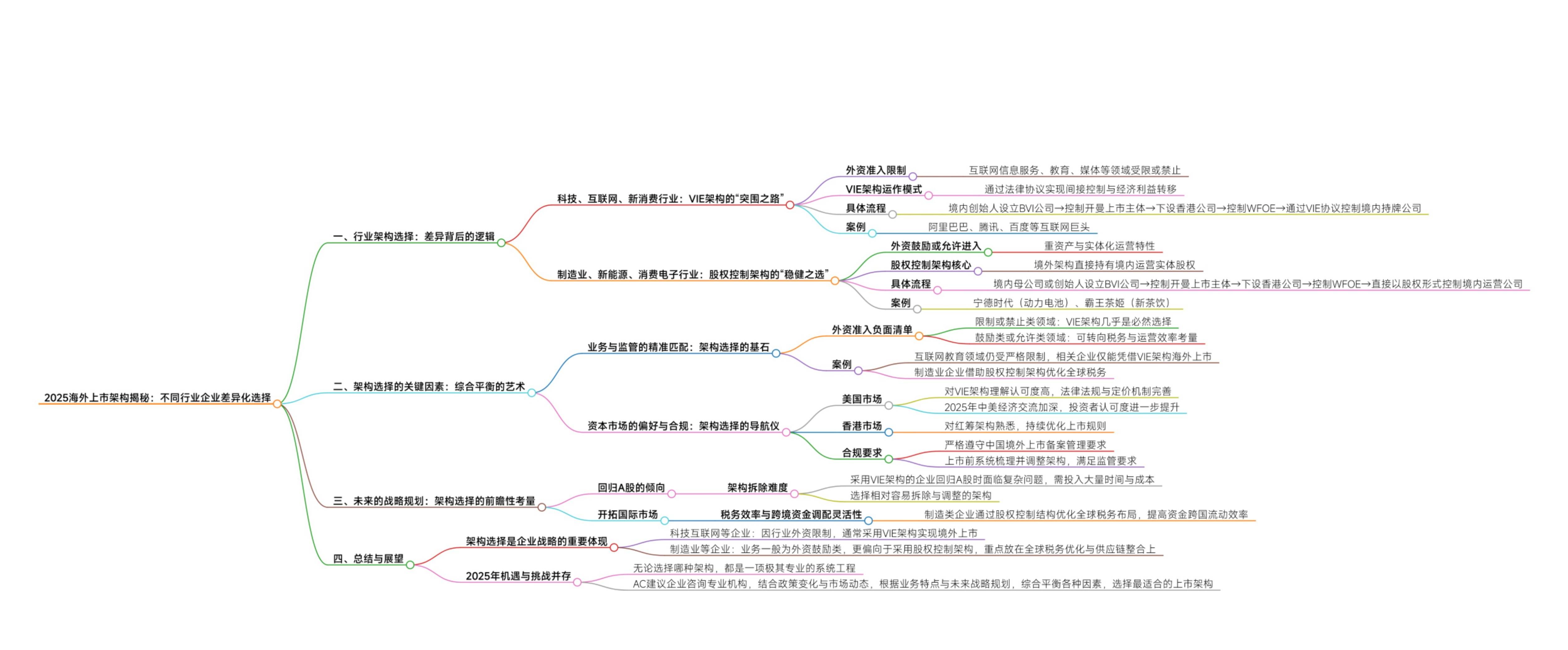
Core Insights - The enthusiasm of domestic companies for overseas listings continues to rise in 2025, with different industries showing distinct preferences for listing structures based on their business characteristics, regulatory environments, and capital needs [1] Group 1: Technology, Internet, and New Consumption Industries - Companies in the technology, internet, and new consumption sectors often face restrictions on foreign investment access, leading them to adopt the Variable Interest Entity (VIE) structure to attract international capital and achieve rapid listings [4][7] - The VIE structure operates through a series of legal agreements that allow indirect control and economic benefit transfer between domestic operating entities and overseas listed entities, exemplified by companies like Alibaba, Tencent, and Baidu [4][8] - The success of these internet giants using the VIE structure has provided valuable lessons for subsequent technology and internet companies, promoting widespread adoption of this model in the sector [4][11] Group 2: Manufacturing, New Energy, and Consumer Electronics Industries - In contrast, companies in manufacturing, new energy, and consumer electronics typically prefer equity control structures, such as the Red Chip structure, as they are generally encouraged or permitted for foreign investment [3][4] - The equity control structure allows direct ownership of domestic operating entities through offshore entities, facilitating legal and financial consolidation, as seen with companies like CATL and Bawang Chaji [4][11] - These companies focus on optimizing global tax structures and enhancing operational efficiency through their chosen listing frameworks, which is crucial for maintaining competitiveness in the global market [4][11] Group 3: Regulatory and Market Considerations - The alignment of business operations with regulatory requirements is a critical factor in choosing a listing structure, with companies needing to monitor changes in foreign investment policies closely [7][9] - Different capital markets exhibit varying levels of acceptance for listing structures, with the U.S. market showing a high understanding of the VIE structure, while Hong Kong is familiar with the Red Chip structure, both providing conducive environments for respective companies [8][9] - Companies must ensure compliance with regulations governing overseas listings to avoid delays in the listing process, emphasizing the importance of a well-structured approach to meet regulatory demands [9][10] Group 4: Future Strategic Planning - Companies should consider their future strategic plans, including the potential for returning to A-shares, when selecting a listing structure, as the complexity of dismantling certain structures can pose challenges [10][11] - The choice of listing structure reflects a company's strategic direction and intent, with technology and internet firms typically resorting to VIE structures due to foreign investment restrictions, while manufacturing firms focus on equity control structures for tax optimization and supply chain integration [11]
大湾区世界级城市群框架成型
Shen Zhen Shang Bao· 2025-10-11 06:17
Core Insights - The Guangdong-Hong Kong-Macao Greater Bay Area (GBA) is experiencing significant economic growth, with a projected GDP of approximately $1.89 trillion in 2023, making it the second-largest bay area globally, just behind the Tokyo Bay Area [2] - The GBA's nine inland cities are expected to see their economic output rise from 8.04 trillion yuan in 2018 to 11.5 trillion yuan by 2024, representing a substantial increase in economic activity [2] - The GBA is home to over 71,000 high-tech enterprises, indicating a strong focus on innovation and technology development [3] Economic Performance - The GBA accounts for 5.6% of the national population while generating 8.6% of China's total economic output, showcasing its economic significance [2] - The combined GDP of Guangzhou and Shenzhen is expected to maintain a share of over 5% of the national GDP in recent years, with Shenzhen and Guangzhou ranking 3rd and 5th among Chinese cities by GDP in 2024 [2] Innovation and Technology - The "Shenzhen-Hong Kong-Guangzhou" innovation cluster has surpassed the "Tokyo-Yokohama" cluster, becoming the world's leading innovation hub [3] - R&D expenditure in Guangdong has exceeded 510 billion yuan, with an R&D intensity of 3.6%, indicating a strong commitment to research and development [3] Industrial Development - Guangdong produces one out of every three industrial robots globally, highlighting its manufacturing prowess [4] - The GBA has established nine trillion-yuan industrial clusters, including electronics, green petrochemicals, and new energy, positioning itself as a leader in several emerging industries [4] Infrastructure and Connectivity - The GBA has developed extensive transportation infrastructure, including 7 cross-river and cross-sea passages, with a total highway length of approximately 5,459 kilometers [4] - Major cities within the GBA have achieved basic one-hour connectivity, enhancing regional integration and accessibility [4]
当AI开始分发流量|AI产品榜·网站榜2025年9月榜
36氪· 2025-10-10 13:34
Core Insights - The article discusses the latest AI product rankings, highlighting the dominance of ChatGPT in web traffic and active users among AI applications, with ChatGPT accounting for 46% of the top 100 web traffic and 30% of active users in the app category [10][11][13]. Group 1: AI Product Rankings - The AI Product Rankings for September 2025 include various categories such as global rankings, domestic rankings, and growth/decline rankings, featuring a total of 19 AI product lists [4][5]. - The top five products in the global ranking are ChatGPT, New Bing, Gemini, DeepSeek, and Nano AI Search, with ChatGPT leading significantly [20]. Group 2: ChatGPT's Market Position - ChatGPT's web traffic is reported at 6.1 billion monthly visits, representing a 0.98% increase, while its app active users are significantly higher compared to Google, with ChatGPT at 25% of Google's active users [10][13]. - The article emphasizes that ChatGPT is becoming a traffic distributor for powerful internet applications, integrating tools like Canva directly within its platform to enhance user experience [8][9]. Group 3: Performance of Other AI Products - Sora, a video generation product, experienced a significant drop in traffic, falling by 44.15% to 35.37 million visits, indicating volatility in user retention within the video generation sector [15]. - In contrast, Mercor, an AI job search tool, saw a remarkable growth of 89.3%, reaching 5.58 million visits, ranking fourth in global growth [17]. - The domestic growth leaderboard is topped by TianGong AI from Kunlun Wanwei, which grew by 35.47% to 4.21 million visits, followed by Jiemeng AI with a 27.25% increase [18][36]. Group 4: Trends in AI Applications - The article notes that video generation products tend to experience spikes in traffic with new features but often struggle with user retention, a trend more pronounced than in chatbot applications [15]. - The growth of AI tools for education and productivity is highlighted, with several products like Q-Chat and Google AI Studio showing significant increases in user engagement [34][36]. Group 5: Declining Products - Several AI products are experiencing declines, with Joi and Transkriptor seeing drops of 37.04% and 34.07% in web traffic, respectively [38]. - Sora, another video generation tool, also faced a decline of 24.19%, indicating challenges in maintaining user interest [40].

豆包突然要做输入法,能在红海突出重围吗
3 6 Ke· 2025-10-10 12:07
Core Insights - The article discusses the emergence of Doubao Input Method by ByteDance, which aims to capitalize on the controversy surrounding Sogou Input Method and focuses on voice input technology [1][5][11] - The integration of AI with input methods has been a trend among major Chinese internet companies, with various upgrades and features introduced to enhance user experience [3][5] - The primary challenge for AI input methods lies in their interaction logic, which often limits the amount of information presented, making it less effective compared to AI assistants [5][9] Industry Trends - Major companies like Baidu and Tencent have previously launched AI-enhanced input methods, transforming them into AI creative tools and adding features like AI Q&A [3][5] - The focus on input methods is partly due to their ability to bridge text and image generation capabilities, facilitating user adaptation to AI-generated content [3][5] Target Market - Doubao Input Method specifically targets the elderly demographic, who often struggle with digital technology, thus addressing the digital divide [5][8][11] - The article highlights the need for user-friendly features, such as larger fonts and simplified interfaces, to cater to older users [8] Competitive Advantage - Doubao's voice recognition model, Seed-ASR, boasts a significant reduction in error rates compared to competitors, enhancing its appeal to the elderly [9][11] - The ability to accurately interpret user intent, even with recognition errors, positions Doubao Input Method as a strong contender in the market [11]