
陕西煤业

Search documents
0602脱水研报
2025-06-04 01:50
Summary of Conference Call Records Industry and Company Involvement 1. **Magnetic Sensors**: The report highlights the magnetic sensor industry, emphasizing its role as a core component in intelligent perception layers, benefiting from the growth in robotics and automotive electronics markets [1][3][5]. 2. **Pharmaceuticals**: The report discusses the pharmaceutical industry, particularly focusing on the impact of centralized procurement policies on generic drugs and the potential for performance recovery in the formulation sector [15][32]. 3. **Coal Industry**: The coal sector is analyzed, with insights into port inventory dynamics and the expected rebound in coal prices due to seasonal demand [28][29]. 4. **Gaming Industry**: The gaming industry is covered, noting the successful launch of new games and their impact on company growth [30][31]. Core Insights and Arguments Magnetic Sensors 1. **Market Growth**: The magnetic sensor market is expected to grow due to increased demand from robotics, automotive electronics, and other sectors like renewable energy and consumer electronics, with a projected market size increase from $2.9 billion in 2023 to $3.7 billion by 2029, reflecting a CAGR of 4% [6][11]. 2. **Technological Advancements**: The report details the technological evolution of magnetic sensors, with Hall effect sensors holding a 64% market share in 2024, and the rise of AMR/GMR/TMR sensors in high-end applications [4][11]. 3. **Domestic Market Potential**: There is significant room for domestic manufacturers to replace international leaders, as the current localization rate for magnetic sensor chips in China is only 25% [11][13]. Pharmaceuticals 1. **Centralized Procurement Impact**: The pharmaceutical sector has faced challenges due to centralized procurement policies, which have been in place for eight years, affecting the performance of certain companies [15][16]. 2. **Optimizing Procurement Policies**: Recent trends indicate a shift towards optimizing procurement policies, which may lead to performance recovery opportunities for companies in the formulation sector [15][20]. 3. **Long-term Cash Flow Transition**: The report suggests that the generic drug business is transitioning to a cash flow model, with a focus on stabilizing prices post-competition [25][27]. Coal Industry 1. **Inventory Dynamics**: Port inventories are decreasing due to improved demand from thermal power plants, which is expected to lead to a rebound in coal prices as seasonal demand peaks [28][29]. 2. **Investment Opportunities**: The report identifies stable dividend-paying coal companies as potential investment opportunities, particularly those with robust cash flow and growth prospects [29]. Gaming Industry 1. **Market Growth**: The gaming market in China saw a total sales scale of 27.35 billion yuan in April 2025, marking a year-on-year growth of 21.93% [30]. 2. **Successful Game Launches**: Several gaming companies have successfully launched new products, which are expected to drive further growth [30][31]. 3. **Product Pipeline**: Companies are well-positioned with a rich pipeline of upcoming games, indicating strong future growth potential [31]. Other Important Insights 1. **Market Sentiment**: The overall market sentiment is improving, particularly in the pharmaceutical sector, as companies adapt to new procurement policies [20][23]. 2. **Sector-Specific Risks**: The report highlights the risks associated with centralized procurement for generic drugs, including potential price declines and market volatility [16][18]. 3. **Technological Innovations**: The advancements in magnetic sensor technology are crucial for applications in various sectors, including industrial automation and consumer electronics [4][7]. This summary encapsulates the key points from the conference call records, providing a comprehensive overview of the discussed industries and their respective dynamics.
红利基金悄悄多赚5%的秘密
Sou Hu Cai Jing· 2025-06-03 16:31
Core Insights - The article emphasizes the advantages of semi-annual rebalancing of dividend funds, which can lead to an additional 5% return compared to annual rebalancing [1] Group 1: Timing and Performance - Semi-annual rebalancing offers a significant timing advantage, allowing funds to capture dividends from newly announced high-dividend stocks earlier than annual rebalancing funds [2] - For instance, in May 2024, the index included Shaanxi Coal, which had a proposed dividend yield of 9.2%, allowing investors to benefit from a complete dividend payout before the stock price increased by 15% [2] Group 2: Risk Management - The semi-annual rebalancing strategy helps avoid "dividend traps" often set by cyclical stocks, which may announce high dividends but later report poor performance [3] - In December 2023, the CSI 800 Dividend Low Volatility Index removed a coal stock that saw its dividend yield plummet from 12% to 3%, thus avoiding a subsequent 40% drop in stock price [3] Group 3: Cost Efficiency - Funds with semi-annual rebalancing maintain a lower turnover rate of 20%-30%, which reduces transaction costs compared to high-frequency rebalancing funds that exceed 50% turnover [4] - For example, a 10,000 yuan investment could yield an additional 4,000 yuan over five years due to lower trading fees associated with semi-annual rebalancing [4] Group 4: Recommended Dividend Indices - The CSI 800 Dividend Low Volatility Index includes 100 stocks with a diversified industry weight, effectively mitigating risks from any single sector [5] - The CSI Dividend Quality Index focuses on 50 stocks with stable earnings, ensuring that only companies with a return on equity (ROE) greater than 15% are included [6] - The Hang Seng High Dividend Low Volatility Index has a safety check for stocks with yields over 7%, successfully avoiding a stock that later fell by 60% [7] - The S&P A-Share Large Cap Dividend Low Volatility Index has shown strong defensive performance, with a maximum drawdown of 11.3%, significantly lower than the 22.7% drawdown of the CSI 300 [8] Group 5: Tax Efficiency - Semi-annual rebalancing strategies can minimize tax liabilities by allowing investors to hold stocks longer, thus reducing the tax burden associated with short-term holdings [12] - The CSI 300 Dividend Low Volatility Index has a tax cost of only 0.2%, compared to 0.6% for quarterly rebalancing funds [12] Group 6: Portfolio Strategy - Combining different types of dividend funds can enhance overall returns while providing risk diversification [15] - The West China State-Owned Enterprise Dividend Index has outperformed its benchmark by 22 percentage points over five years, focusing on stocks with high dividend yields and state-owned enterprise reforms [15]
险资私募基金扩容!千亿级“长钱”锚定高股息+硬科技赛道
Nan Fang Du Shi Bao· 2025-06-03 10:01
Core Viewpoint - The acceleration of insurance capital entering the market is highlighted by the establishment of new private equity funds, indicating a significant shift towards long-term equity investments by insurance companies in response to regulatory encouragement [2][3][6]. Group 1: Insurance Capital Market Entry - Ping An Asset Management has received approval to establish Hengyi Chiying (Shenzhen) Private Fund Management Co., marking the third insurance private equity manager licensed in China [2][3]. - The total scale of the insurance capital long-term investment reform pilot will increase to 222 billion yuan, with 50 billion yuan already invested and an additional 172 billion yuan in preparation for market entry [3][4]. - The new "National Ten Articles" policy released in September 2024 aims to expand the pilot program, allowing more insurance institutions to establish private equity funds [3][4]. Group 2: Investment Strategies and Focus - Hengyi Chiying will focus on long-term and value investments, targeting high-quality listed companies that align with policy directions and insurance capital needs [3][6]. - Insurance companies are increasingly favoring large-cap, liquid stocks with stable dividends, as seen in the investment strategies of various funds like Honghu Fund [9][10]. - The investment landscape includes a diverse range of sectors, with significant holdings in electronics, pharmaceuticals, machinery, and power equipment, among others [8][10]. Group 3: Regulatory Support and Market Dynamics - Regulatory measures have been implemented to encourage long-term investments, including raising the upper limit for equity asset allocation and adjusting risk factors for stock investments [6][11]. - The establishment of new private equity funds has surged, with several insurance companies launching their funds in May 2025, indicating a robust response to regulatory incentives [6][7]. - The shift towards equity investments is seen as a strategic move for insurance companies to optimize asset allocation, reduce risks, and enhance long-term returns [11][12].





尿素2025年6月报:回归供需季节性-20250603
Chang Jiang Qi Huo· 2025-06-03 09:29
尿素2025年6月报: 回归供需季节性 长江期货股份有限公司交易咨询业务资格:鄂证监期货字【2014】1号 产业服务总部 | 能化产业服务中心 张英 执业编号:F03105021 投资咨询号:Z0021335 2025-06-03 目 录 01 尿素行情回顾 05 复合肥及工业需求分析 02 尿素产能产量分析 06 尿素及肥料出口分析 03 尿素成本利润分析 07 尿素库存水平分析 04 尿素农业需求分析 08 尿素后市展望 01 尿素5月行情回顾 受出口信息持续影响,5月上旬尿素价格高位震荡,下旬回归实际供需矛盾,尿素产销转弱,价格高位回落,接近出口 调整前运行区间。5月30日尿素09合约收盘于1773元/吨,较上月底下调84元/吨,尿素河南市场价格1880元/吨,较 上月底下调26元/吨。 尿素09合约期货价格(元/吨) 1050 1550 2050 2550 3050 3550 中国尿素(小颗粒)日度均价(元/吨) 2021 2022 2023 2024 2025 资料来源:同花顺,长江期货能化产业服务中心 02 尿素基差与价差 价差:5月尿素9-1价格整体呈现走弱趋势,5月30日9-1价差70元/吨, ...
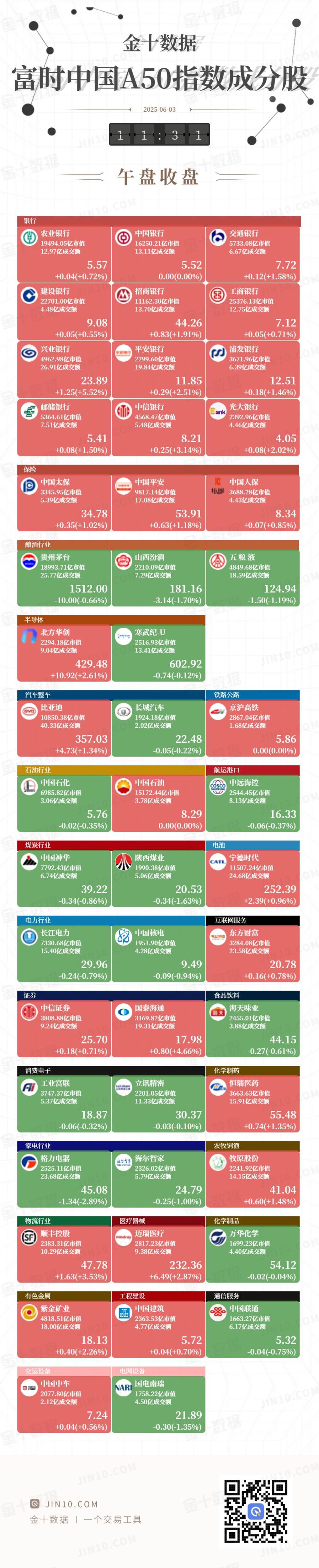
金十图示:2025年06月03日(周二)富时中国A50指数成分股午盘收盘行情一览:银行股全面走高,煤炭、电力股飘绿
news flash· 2025-06-03 03:36
长江电力 东方财富 02)中国核电 1951.90亿市值 7330.68亿市值 3284.08亿市值 15.40亿成交额 4.28亿成交额 23.58亿成交额 20.78 29.96 9.49 -0.24(-0.79%) -0.09(-0.94%) +0.16(+0.78%) 食品饮料 证券 中信证券 国泰海通 海天味业 ■双 3808.88亿市值 3169.82亿市值 2455.01亿市值 9.24亿成交额 19.31亿成交额 3.88亿成交额 25.70 17.98 44.15 +0.18(+0.71%) +0.80(+4.66%) -0.27(-0.61%) 消费电子 化学制药 恒瑞医药 立讯精密 工业富联 3747.37亿市值 2201.05亿市值 3663.63亿市值 5.37亿成交额 11.33亿成交额 15.91亿成交额 55.48 30.37 18.87 -0.06(-0.32%) -0.03(-0.10%) +0.74(+1.35%) 家电行业 农牧饲渔 牧原股份 格力电器 海尔智家 油气长官 2525.11亿市值 2326.02亿市值 2241.92亿市值 23.68亿成交额 5.79亿成 ...





A股煤炭开采加工板块持续走弱,中煤能源跌超3%,安源煤业、电投能源、陕西煤业、冀中能源跟跌。
news flash· 2025-06-03 01:55
A股煤炭开采加工板块持续走弱,中煤能源跌超3%,安源煤业、电投能源、陕西煤业、冀中能源跟 跌。 ...

未知机构:脱水研报丨它是智能感知层核心器件,机器人、汽车电子等下游需求翻倍增长;集采优化政策不断出台,部分公司或出现明显的业绩预期修复—2025602-20250603
未知机构· 2025-06-03 01:55
Summary of Conference Call Records Industry or Company Involved 1. **Magnetic Sensors**: Core component in intelligent perception layer, benefiting from growth in robotics and automotive electronics [3][5][11] 2. **Pharmaceuticals**: Focus on drug formulation and the impact of centralized procurement [15][32] 3. **Coal Industry**: Insights on coal price rebound and inventory dynamics [28][29] 4. **Gaming Industry**: Performance of newly launched games and market growth [30][31] Core Points and Arguments Magnetic Sensors 1. **Market Growth**: The magnetic sensor market is expected to grow due to increased demand from robotics, automotive electronics, and other sectors like renewable energy and consumer electronics. The global market size is projected to increase from $2.9 billion in 2023 to $3.7 billion by 2029, with a CAGR of 4% [6][11]. 2. **Domestic Manufacturers**: There is significant room for domestic manufacturers to replace international leaders, as the current domestic market share is only 25% [11][13]. 3. **Technological Advancements**: The market is driven by technological evolution and diverse applications, with Hall effect sensors dominating the market with a 64% share in 2024 [4][11]. Pharmaceuticals 1. **Centralized Procurement Impact**: The pharmaceutical industry has faced challenges due to centralized procurement, which has been in place for eight years. However, recent optimization policies may lead to performance recovery for some companies [15][20]. 2. **Performance Recovery**: Companies like Huadong Medicine may see a reduction in procurement risks for several products in 2024, potentially stabilizing their sales [23][25]. 3. **Long-term Outlook**: The pharmaceutical sector is transitioning towards cash flow generation as competition increases and prices stabilize post-procurement [27]. Coal Industry 1. **Inventory Dynamics**: Recent improvements in coal inventory levels are expected to lead to a price rebound as demand increases during peak seasons [28][29]. 2. **Market Sentiment**: The coal sector is anticipated to experience valuation increases as stable high dividends become more attractive [29]. 3. **Demand Recovery**: The demand for thermal power generation is expected to turn positive, supporting coal price recovery [28]. Gaming Industry 1. **Market Growth**: The gaming market in China saw a total sales scale of 27.35 billion yuan in April 2025, a year-on-year increase of 21.93% [30]. 2. **Successful New Releases**: Several gaming companies have launched successful new products, contributing to their growth and market presence [30][31]. 3. **Future Potential**: Companies with strong product pipelines and successful launches are expected to continue growing, with notable titles set to release soon [31]. Other Important but Possibly Overlooked Content 1. **Magnetic Sensor Applications**: The sensors are crucial in various applications, including industrial automation, automotive systems, and consumer electronics, indicating a broad market potential [7][9]. 2. **Pharmaceutical Pricing Dynamics**: The long-tail effects of centralized procurement pricing governance may continue to impact the market, necessitating ongoing adjustments [18][19]. 3. **Coal Supply Constraints**: The reduction in coal production due to low prices and high-cost mines may support price stability in the coal market [28]. This summary encapsulates the key insights from the conference call records, highlighting the growth potential and challenges across multiple industries.
朝闻国盛:市场下行空间有限
GOLDEN SUN SECURITIES· 2025-06-03 01:30
Group 1: Macro Insights - The manufacturing PMI in May showed a seasonal rebound but remains in the contraction zone, while the non-manufacturing PMI slightly decreased [4] - Key signals include a rebound in supply and demand, an increase in import and export orders, and a slight decline in price indices, indicating ongoing pressure on prices [4] - The overall economic outlook suggests that internal demand issues remain prominent, with a need for policy intervention to support growth [4] Group 2: Market Analysis - The market is currently experiencing limited downside potential, with the probability of returning to previous lows being negligible [5] - A mid-term bullish trend is confirmed across multiple indices, indicating the beginning of a new bull market phase [6] - Investors are encouraged to position themselves strategically during this market adjustment phase, as opportunities are expected to arise [6] Group 3: Fixed Income Insights - In the first quarter of 2025, Jiangsu showed strong economic growth with a focus on debt reduction, while Guangdong faced economic adjustments due to global trade uncertainties [9][10] - The overall market environment is expected to improve post mid-June, with potential for interest rates to decline further, creating more opportunities in the bond market [11] - The central bank's actions are aimed at maintaining liquidity, with a stable performance in certificates of deposit [12] Group 4: Industry-Specific Developments - The automotive sector is witnessing significant advancements, with the launch of the Huawei and JAC Motors' ZunJie S800, which has already seen strong pre-orders [19][20] - The smart driving industry is expected to enter a golden growth period, with increasing penetration of advanced driver-assistance systems (ADAS) in new vehicles [21] - The stablecoin regulatory framework in Hong Kong marks a significant step in financial innovation, benefiting various segments of the digital asset ecosystem [24] Group 5: Company Performance - Ideal Auto's Q1 2025 gross margin exceeded expectations, with projected sales and revenue growth for the next three years [31] - Xiaomi Group is expected to maintain strong revenue growth driven by core technology advancements, with significant contributions from its automotive segment [32] - Honglu Steel Structure is positioned for recovery with a notable increase in orders and production, benefiting from demand restoration and operational efficiencies [34]
煤炭开采行业周报:港口库存回落,动力煤价格止跌
EBSCN· 2025-06-03 00:30
Investment Rating - The report maintains an "Accumulate" rating for the coal mining industry [6]. Core Viewpoints - Port coal inventories are declining, and thermal coal prices have stopped falling. As of May 30, the coal inventory at ports in the Bohai Rim was 30.572 million tons, down 4.78% week-on-week but up 18.83% year-on-year. The average closing price for thermal coal at Qinhuangdao port was 611 CNY/ton, remaining stable week-on-week. The approaching summer peak electricity demand is expected to support a rebound in coal prices [1][4]. Summary by Sections Price Trends - The average closing price for thermal coal at Qinhuangdao port was 611 CNY/ton, with a slight decrease of 0.03% week-on-week. The average price for mixed thermal coal at Yulin was 475 CNY/ton, unchanged week-on-week. The FOB price for thermal coal at Newcastle, Australia, was 67 USD/ton, down 2.14% [2]. Production and Utilization - The operating rate of 110 sample coal washing plants was 61.6%, down 0.8 percentage points week-on-week and down 7.3 percentage points year-on-year. The capacity utilization rate of 247 blast furnaces was 90.69%, down 0.63 percentage points week-on-week but up 2.52 percentage points year-on-year. The average daily pig iron output was 2.4185 million tons, down 0.7% week-on-week but up 2.6% year-on-year [3]. Inventory Tracking - As of May 30, the coal inventory at Qinhuangdao port was 6.75 million tons, down 7.53% week-on-week and up 42.41% year-on-year. The Bohai Rim port coal inventory was 30.572 million tons, down 4.78% week-on-week and up 18.83% year-on-year. The inventory levels at independent coking plants and sample steel mills are currently at low levels [4][53]. Investment Recommendations - The report suggests that the seasonal increase in electricity demand during the summer is likely to support a rebound in coal prices. It recommends companies with a high proportion of long-term contracts and stable profitability, specifically China Shenhua and China Coal Energy [4]. Key Company Earnings Forecasts - The report includes earnings per share (EPS) and price-to-earnings (PE) ratios for key companies, with China Shenhua's EPS forecast for 2025 at 2.5 CNY and a PE ratio of 16. The investment rating for China Shenhua is "Accumulate" [5].


煤炭 价格寻底,布局右侧
2025-06-02 15:44
Summary of Coal Industry Conference Call Industry Overview - The coal industry is currently experiencing a price bottoming phase, with a focus on positioning for future recovery [1] - The average production cost of thermal coal is projected to be 370 RMB/ton in 2024, which, while higher than historical lows, still has room for reduction [1][3] - Coking coal costs are expected to average 551 RMB/ton in 2024, also indicating potential for cost reduction [1][3] Key Insights and Arguments - Historical data shows that the average production cost of thermal coal has increased from 208 RMB/ton in 2016 to 370 RMB/ton in 2024, while coking coal costs rose from 300 RMB/ton to 551 RMB/ton during the same period [1][5] - The increase in costs is attributed to policy changes and rising expense standards, but there remains significant potential for cost control in the future [1][6] - Current port coal prices are at 611 RMB/ton, providing a profit margin of 91 RMB/ton when considering a production cost of 370 RMB/ton, and nearly 500 RMB/ton at a cost of 550 RMB/ton [1][9] - Recent increases in pithead coal prices in regions like Datong, Yulin, and Inner Mongolia indicate a gradual recovery in demand [1][10] Market Dynamics - The port coal price has remained stable at 611 RMB/ton for 11 consecutive days, while domestic coal prices have reached 1,270 RMB/ton [2] - The cost support logic is challenged by the presence of variable costs, suggesting that price support levels may trend downward in a weak demand environment [3][9] - The coal sector's stock prices have benefited from sector rotation, public fund allocations, and expectations of coal price rebounds [3][13] Future Outlook - The coal price rebound is anticipated, with potential price levels expected between 650 and 700 RMB/ton, influenced by weather conditions and hydropower output [12] - The current low inventory levels in downstream power plants are expected to drive increased replenishment efforts, supported by policy guidance [11][15] - The coal sector is projected to have significant upside potential, particularly for growth-oriented stocks that have not yet seen substantial price increases [14][15] Additional Considerations - The reliability of production cost data is emphasized, with audited financial reports from listed companies being more trustworthy than market rumors regarding cost percentiles [7][8] - The overall market sentiment is bolstered by the expectation of a demand recovery and the strategic positioning of major coal companies [16]