
蔚来

Search documents
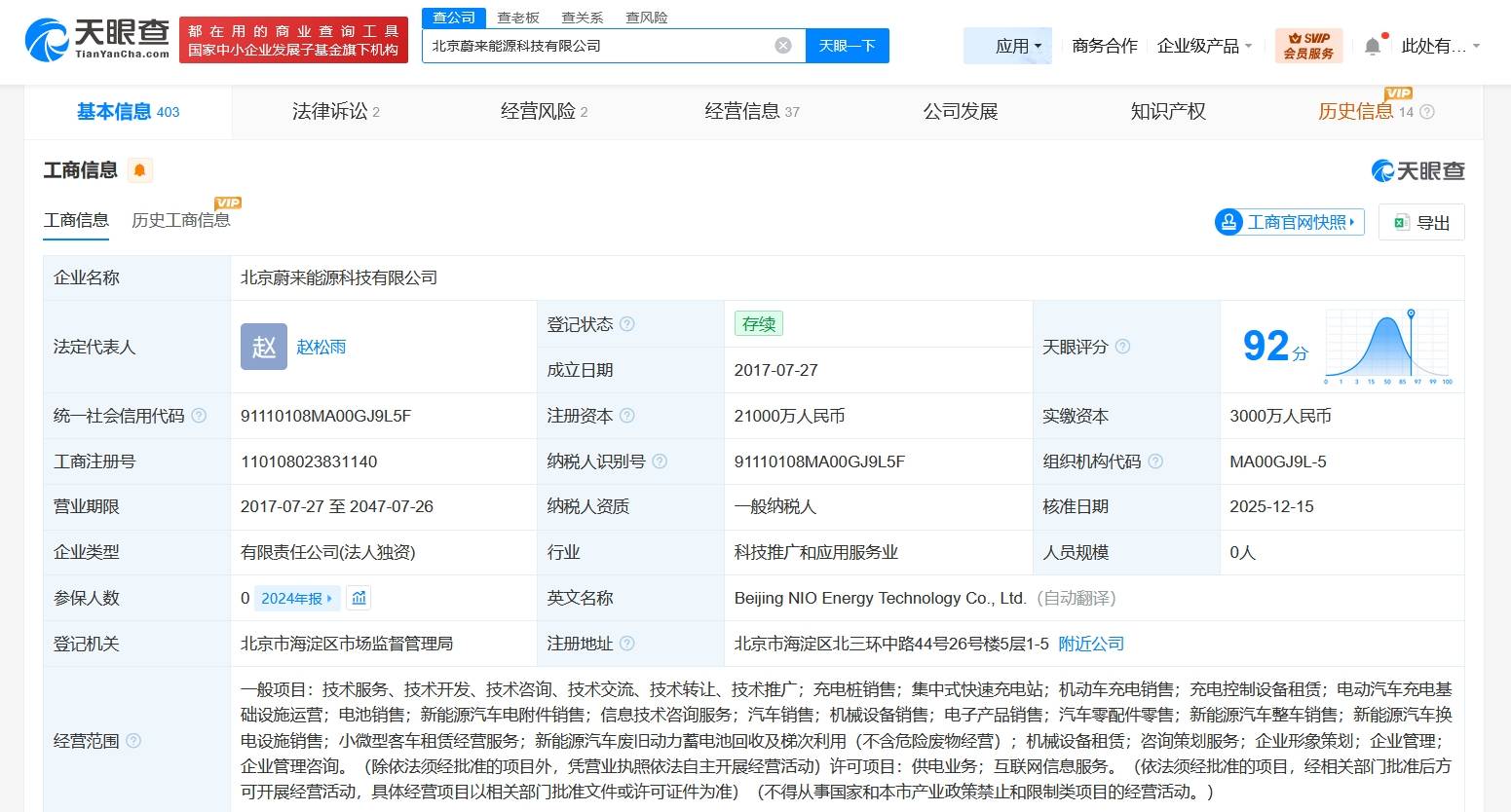
蔚来旗下北京能源科技公司增资至2.1亿元
Sou Hu Cai Jing· 2025-12-18 04:49
Core Viewpoint - Beijing NIO Energy Technology Co., Ltd. has increased its registered capital from 30 million RMB to 210 million RMB, representing a 600% increase, indicating significant growth and potential expansion in the electric vehicle infrastructure sector [1]. Company Information - The company was established in July 2017 and is wholly owned by Wuhan NIO Energy Co., Ltd. [1][2]. - The legal representative of the company is Zhao Songyu [1]. - The company operates in various sectors including the sale of charging piles, operation of electric vehicle charging infrastructure, battery sales, and recycling of used power batteries [1][2]. Business Scope - The business scope includes sales of charging piles, centralized fast charging stations, electric vehicle charging sales, leasing of charging control equipment, and sales of electric vehicle accessories [1][2]. - The company is also involved in the recycling and secondary utilization of used power batteries from electric vehicles [1][2].


蔚来能源与中安能源首批合作共建的50座充换电站在安徽省内投入运营
Mei Ri Jing Ji Xin Wen· 2025-12-18 04:48
Core Viewpoint - NIO Energy and Zhong'an Energy announced the operation of the first batch of 50 charging and battery swap stations in Anhui Province, marking a significant advancement in their strategic cooperation and an important milestone in NIO Energy's ecosystem openness and collaborative construction [1] Group 1 - The collaboration between NIO Energy and Zhong'an Energy represents a deepening of their strategic partnership [1] - The launch of the "Charging Partner" program in August 2024 has led to the establishment of nearly 200 charging and battery swap stations in collaboration with 35 partners across 25 provinces and regions [1] - The industry collaboration has entered a new phase of large-scale implementation [1]
蔚来能源与中安能源首批共建50座充换电站投入运营
Zheng Quan Shi Bao Wang· 2025-12-18 04:43
Core Viewpoint - NIO Energy and Zhong'an Energy have launched the first batch of 50 charging and battery swap stations in Anhui Province, marking a significant step in their collaboration [1] Group 1: Company Developments - NIO Energy has introduced the "Charging Partner" program in August 2024, collaborating with 35 partners across 25 provinces and regions to build nearly 200 charging and battery swap stations [1] - The company has invested approximately 18 billion yuan in charging and battery swap technology and infrastructure [1] Group 2: Industry Position - NIO has established a nationwide network of 8,466 charging and battery swap stations, leading the industry in the number of stations built [1]
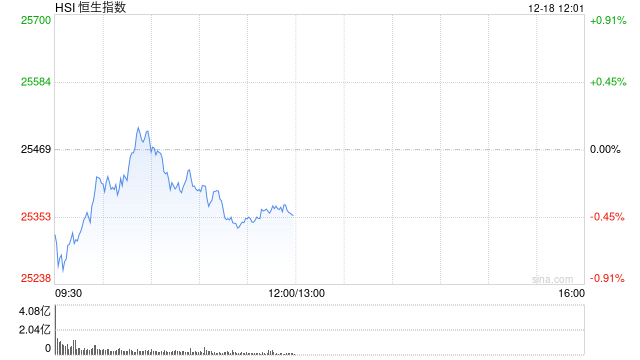
午评:港股恒指跌0.44% 科指跌1.26% 科网股普跌 锂电池板块走弱 航空股逆势走强
Xin Lang Cai Jing· 2025-12-18 04:01
Market Overview - The Hong Kong stock market indices experienced a collective decline, with the Hang Seng Index falling by 0.44% to 25,357.69 points, the Hang Seng Tech Index dropping by 1.26%, and the State-Owned Enterprises Index decreasing by 0.6% [1][8]. Sector Performance Technology Sector - Technology stocks saw widespread declines, with Xiaomi dropping over 3%, Lenovo down more than 2%, and both Baidu and Alibaba falling over 1% [1][9]. Aviation Sector - Aviation stocks continued their upward trend, highlighted by Beijing Capital International Airport's shares rising over 7%. The new round of duty-free tenders at major airports, including Shanghai Pudong and Hongqiao, as well as Beijing Capital, will introduce foreign participants [2][11]. Lithium Battery Sector - Lithium battery stocks faced significant declines, with CATL (Contemporary Amperex Technology Co., Limited) falling over 3%. Morgan Stanley has raised its global lithium demand forecast for 2030 to 3.5 million tons, indicating a potential supply-demand gap of 4-7% in the medium term, which could push lithium carbonate prices to $18,000 by the end of next year, a 33% increase from current spot prices [3][12]. New Consumption Sector - New consumption concept stocks weakened, with Pop Mart dropping over 2%. The Ministry of Commerce and other departments issued a notice to strengthen the collaboration between commerce and finance to boost consumption, emphasizing the cultivation of new consumption models [5][13].



蔚来旗下北京能源科技公司增资至2.1亿
Sou Hu Cai Jing· 2025-12-18 03:52
Core Viewpoint - Beijing NIO Energy Technology Co., Ltd. has increased its registered capital from 30 million RMB to 210 million RMB, marking a 600% increase [1] Company Overview - The company was established in July 2017 and is legally represented by Zhao Songyu [1] - Its business scope includes sales of charging piles, centralized fast charging stations, motor vehicle charging sales, leasing of charging control equipment, operation of electric vehicle charging infrastructure, battery sales, sales of electric vehicle accessories, sales of complete electric vehicles, and recycling and repurposing of used power batteries [1] - The company is wholly owned by Wuhan NIO Energy Co., Ltd. [1]
「二次创业」大戏拉开帷幕
3 6 Ke· 2025-12-18 03:31
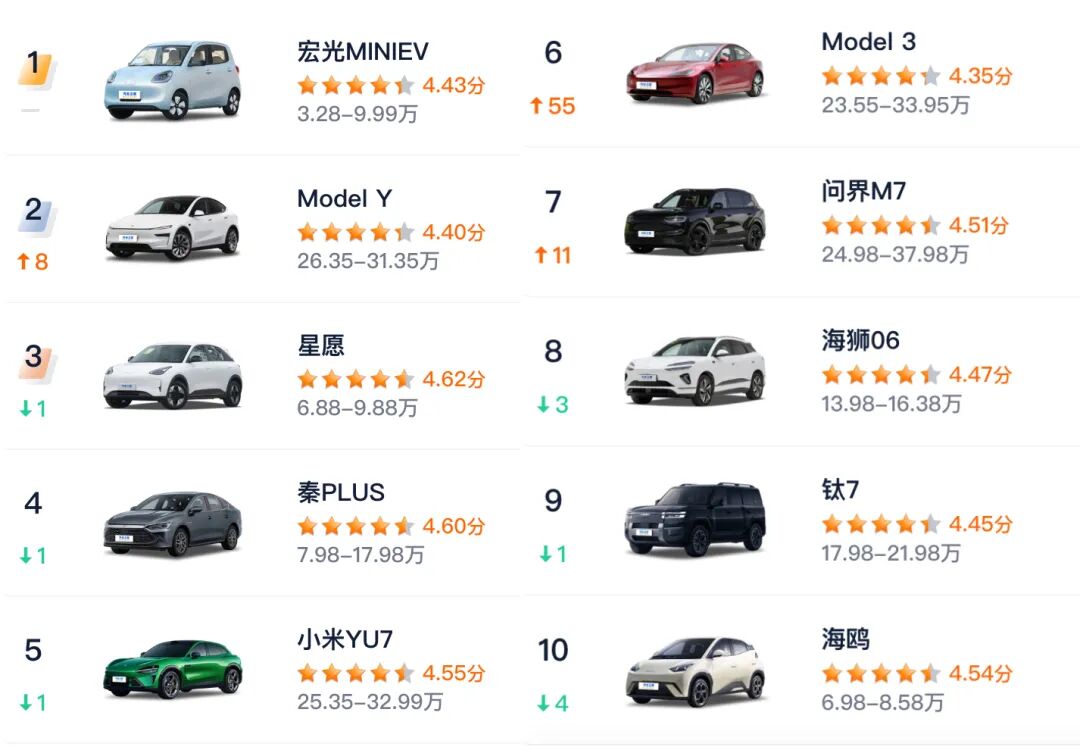
Core Insights - The rapid growth of the new energy vehicle market in China has led to a significant division in the automotive market, with distinct trends emerging in the price segments below and above 200,000 yuan [1][2][5] Market Trends - In November, vehicles priced above 200,000 yuan occupied four spots in the sales rankings, with the Model Y selling over 47,000 units and the AITO M7 selling over 25,000 units [1] - Conversely, vehicles priced below 100,000 yuan also claimed four spots, with the Hongguang MINIEV selling over 56,000 units and the BYD Seagull selling over 21,000 units [2] - The market has bifurcated into segments below 100,000 yuan and above 200,000 yuan, leaving the 100,000-200,000 yuan segment relatively quiet [2][5] Sales Performance - The top-selling models in the overall automotive market for November included the Hongguang MINIEV, Model Y, and others, with significant sales figures indicating a preference for lower-priced vehicles [4] - The sales figures for electric vehicles showed a notable increase, with pure electric vehicles selling 7,155 units and plug-in hybrids 28,213 units [4] Consumer Behavior - The shift in consumer behavior reflects a change from purchasing vehicles out of necessity to buying based on emotional appeal, particularly in the above 200,000 yuan market [7] - The lower-priced market is seeing a mix of consumption downgrade and upgrade, with traditional brands like Geely and BYD dominating this segment, while new entrants struggle to penetrate [7][8] Competitive Landscape - New energy vehicle brands such as Xiaomi and Hongmeng Zhixing are gaining traction, with Xiaomi achieving over 40,000 units sold in November, marking its entry into the top three for the first time [9][10] - Traditional automakers are facing challenges in the above 200,000 yuan market, where they need to enhance their overall offerings to regain competitive advantage [19][20] Industry Evolution - The automotive industry is undergoing a "second entrepreneurship," with traditional manufacturers transitioning from fuel vehicles to smart new energy vehicles, while new entrants are establishing themselves in the market [20]


金元证券每日晨报-20251218
Jinyuan Securities· 2025-12-18 02:59
Market Overview - The US stock market experienced a decline, with the Dow Jones falling by 0.47% to 47,885.97 points, the S&P 500 down by 1.16% to 6,721.43 points, and the Nasdaq decreasing by 1.81% to 22,693.32 points. Caterpillar and Nvidia led the decline, both dropping over 4% [5][11] - In the European market, the major indices showed mixed results, with the DAX down by 0.02% to 24,072.25 points, CAC40 down by 0.25% to 8,086.05 points, and the FTSE 100 up by 0.92% to 9,774.32 points [11] - The Asia-Pacific market saw the Hang Seng Index rise by 0.92% to 25,468.78 points, while the Nikkei 225 increased by 0.26% to 49,512.28 points [11] Economic Indicators - The UK’s November CPI growth rate slowed to 3.2%, the lowest since March, with a month-on-month decrease of 0.2% [11] - Japan's November exports to the US increased by 8.8%, marking the first rise in eight months, while exports to China fell by 2.4% [10][11] - China's fiscal revenue for the first 11 months reached 20.05 trillion yuan, a year-on-year increase of 0.8%, with tax revenue growing by 1.8% [12] Company Developments - BYD has initiated comprehensive testing for L3 level autonomous driving in Shenzhen, completing over 150,000 kilometers of real-world verification [17] - Xiaomi held its 2025 ecosystem partner conference, showcasing advancements in its open-source model, MiMo-V2-Flash, which ranks among the top in global open-source models [17] - CATL launched the world's first mass production line for humanoid intelligent robots in its facility, marking a significant milestone in intelligent manufacturing [17] A-Share Announcements - Xichuang Data plans to invest in the development and production of optical modules [17] - Shenzhen Urban Transport plans to raise up to 1.8 billion yuan for research and application of intelligent transportation equipment [17] - Shanghai Airport signed a contract for the transfer of duty-free store operation rights [17]
期指:反弹后的震荡
Guo Tai Jun An Qi Huo· 2025-12-18 01:52
Report Summary 1. Report Industry Investment Rating No relevant content provided. 2. Core View of the Report - On December 17, all four major index futures contracts for the current month rose. IF rose 1.86%, IH rose 1.43%, IC rose 2.02%, and IM rose 1.54%. The total trading volume of index futures rebounded, indicating an increase in investors' trading enthusiasm. However, the total open interest of IF, IH, and IM decreased, while that of IC increased [1][2]. - The trend strength of IF and IH is 1, and that of IC and IM is also 1. Trump's order to block sanctioned oil tankers in and out of Venezuela led to a significant rise in US WTI crude oil and Brent crude oil, and the escalation of geopolitical tensions increased the demand for safe - haven assets, pushing up the prices of precious metals [6]. - The merger plan of CICC, Dongxing, and Cinda was finalized, with the exchange price set at 36.91 yuan per share. After the merger, CICC's operating income is estimated to be about 27.4 billion yuan, and it will become the fourth brokerage with total assets exceeding one trillion yuan. A - share and Hong Kong - stock markets showed an upward trend, while US stock markets closed down [7]. 3. Summary by Relevant Catalogs 3.1 Index Futures Data - **Prices and Changes**: The closing prices of major stock indices such as CSI 300, SSE 50, CSI 500, and CSI 1000 all rose, with increases ranging from 1.25% to 1.95%. The corresponding index futures contracts also showed varying degrees of increase, with the highest increase of 2.47% for IC2606 [1]. - **Trading Volume and Open Interest**: The total trading volume of IF, IH, IC, and IM increased by 39,510, 4,636, 21,520, and 35,895 lots respectively. The total open interest of IF decreased by 628 lots, IH decreased by 1,896 lots, IC increased by 2,748 lots, and IM decreased by 9,704 lots [2]. - **Basis**: Different index futures contracts have different basis values, such as IF2512 with a basis of - 1.68, IH2512 with a basis of - 4.48, IC2512 with a basis of 8.97, and IM2512 with a basis of 6.26 [1]. 3.2 Index Futures Top 20 Member Position Changes - For different index futures contracts, the long - and short - position changes of the top 20 members vary. For example, for IF2512, the long - position decreased by 22,412 lots, and the short - position decreased by 22,426 lots [5]. 3.3 Market - Driving Factors - **Geopolitical Factors**: Trump's order to block oil tankers in and out of Venezuela led to a significant rise in oil prices and increased market concerns about supply tightening. Geopolitical tensions also increased the demand for safe - haven assets, pushing up the prices of precious metals [6]. - **Corporate Merger**: The merger plan of CICC, Dongxing, and Cinda was finalized, which is a major merger in the brokerage sector. After the merger, CICC's scale and competitiveness will be significantly enhanced [7]. - **Macroeconomic and Policy Factors**: Fed Governor Waller said that the employment market is weak, and the Fed's interest - rate cuts have helped the employment market. The A - share market rose, and the US stock market closed down due to investors' assessment of the US economic report [7].
观车 · 论势 || 理想“造镜”为博一张“明日船票”?
Zhong Guo Qi Che Bao Wang· 2025-12-18 01:27
那么,在汽车主业正面临增程市场格局生变、竞争空前激烈、公司营收承压并重陷亏损的当下,理想为 何要"兵出奇招",闯入早已是红海的智能眼镜市场? 笔者认为,这并非一次心血来潮的"跨界",而是一套深思熟虑、攻守兼备的战略"组合拳"。首先,这是 一次应对主业压力的主动出击。在主业务承压之际,开辟一条具科技光环的"第二增长曲线",能在资本 与舆论层面有效转移市场对短期财务表现的过度聚焦,为团队和投资者讲述一个关于未来的新故事。其 次,这是一次企业身份的重塑宣言。通过Livis,理想急切地试图撕下"汽车公司"旧标签,将自己重新定 义为具身智能企业。 这副眼镜正是其承载AI服务、无缝串联"车、家、人"三大场景的战略入口,其符号意义远大于作为配件 的硬件本身。更深层来看,这也是一次为长远技术护城河蓄能的隐秘工程。Livis作为用户在车外的感 官延伸,能够持续收集真实世界的第一视角、多模态数据。这些珍贵的数据流,将源源不断地反哺理想 的AI大模型与自动驾驶系统的迭代。 近日,理想汽车正式推出了首款量产AI眼镜——Livis。这款仅重36克的消费电子设备,被官方赋 予一个颇具野心的定义:最强人工智能附件。它的登场,远非一次简单的 ...
AI加速“上车” 智能汽车操作系统迈向千亿级市场
Xin Hua Cai Jing· 2025-12-18 01:09
Core Insights - Major automotive companies are increasingly adopting AI as a core strategy for future development, with significant investments in AI technologies and models [1] - The automotive software industry is undergoing structural changes, shifting the value focus from traditional hardware manufacturing to software and services, with projections indicating a rise in software profit share from 6% in 2020 to 25% by 2030 [2][3] - The integration of software is fostering a new ecosystem that bridges various sectors, enhancing collaboration and resource efficiency across the automotive industry [3][4] Group 1: Industry Trends - The automotive software industry's value is transitioning from a "one-time sale" model to a "full-cycle service" model, with hardware profit share decreasing from 79% in 2020 to an expected 59% by 2030 [2] - The commercial value of in-vehicle operating systems is becoming increasingly significant, with the market projected to reach approximately 600 billion yuan by 2025 and exceed 1 trillion yuan by 2030 [3] - The future of automotive software development is expected to focus on integration, moving towards highly adaptive intelligent operating systems that support comprehensive resource management [4] Group 2: Challenges and Solutions - The automotive industry faces challenges in establishing a unified and open software and hardware ecosystem, with varying levels of openness and interface standards among chip manufacturers [7] - Collaboration between companies remains inefficient, often requiring extensive customization and debugging, which hampers the overall efficiency of solutions [7] - The industry is encouraged to adopt open-source models to build a unified technical foundation, reducing costs and fostering innovation through community collaboration [5][9] Group 3: Future Directions - The integration of advanced safety features and the expansion of collaborative boundaries are essential for building sustainable competitive advantages in the automotive sector [11] - The industry is exploring the incorporation of satellite technology into existing vehicle-road-cloud systems to enhance data and computational networks [12] - The relationship between AI and the automotive industry is expected to evolve, with AI becoming a critical component in the development of intelligent vehicles and applications [12]
