泰格医药

Search documents
国联民生证券:全球CXO行业强势复苏 2026年有望延续高景气
Zhi Tong Cai Jing· 2026-01-28 08:13
Group 1 - The global biotech and pharmaceutical investment and financing activities are expected to rebound significantly in 2025, driven by the robust development of innovative drug technology platforms, leading to a comprehensive recovery in the CXO industry and sustained industry prosperity into 2026 [1] - The Chinese CRO market is projected to return to a growth trajectory in 2025, with a notable 19% year-on-year increase in IND numbers and a substantial rise in BD transaction amounts, indicating a vibrant domestic innovative drug market [1] - The demand side globally is showing a strong rebound, establishing a solid foundation for growth, with biotech financing reaching a historical high in Q4 2025 and multinational pharmaceutical companies experiencing a recovery in demand [1] Group 2 - WuXi AppTec (药明康德) is expected to report impressive performance in 2025, with adjusted net profit increasing by 41.3%, driven by the TIDES business, which has seen revenue growth exceeding 90% [2] - WuXi Biologics has reached a record high of 945 projects, with a 30% growth in dual monoclonal and ADC projects, indicating a strong pipeline for future commercialization [2] - WuXi AppTec's subsidiary, WuXi STA, is focusing on the ADC/XDC sector, with revenue growth exceeding 40% in 2025 and an increase in global market share to over 24% [2] Group 3 - The Chinese clinical CRO market is at a clear turning point, with Tigermed (泰格医药) benefiting from the industry recovery, as order prices stabilize and the domestic clinical pipeline grows alongside improved financing conditions [3] Group 4 - Global CDMO giants are accelerating expansion, with optimistic performance guidance; Fujifilm is expected to secure $8 billion in new orders in 2025, reflecting strong demand for large molecule CDMO services [4] - Charles River anticipates an improvement in order trends starting in H2 2025, with a forecast for revenue growth in its safety assessment business by H2 2026, serving as an early indicator of recovery in the CXO industry [4] Group 5 - Investment recommendations include focusing on leading clinical CRO platforms like Tigermed and niche leaders such as Pruis, as well as front-end CRO companies with shorter order fulfillment cycles and greater marginal elasticity [5] - In the CDMO sector, attention is advised on leading companies in the peptide supply chain, ADC beneficiaries, and those with forward-looking layouts in small nucleic acids, as well as companies with significant potential for marginal traction from large products [5]


AI+生态+资本 杭州研讨会解码生物医药产业升级路径
Mei Ri Shang Bao· 2026-01-27 22:20
Group 1 - The core theme of the conference was "innovation-driven," highlighted by the success story of the first small molecule targeted anti-cancer drug, Camrelizumab, developed by Betta Pharmaceuticals, which took nearly a decade from initiation in 2002 to market launch in 2011 [1] - The biopharmaceutical industry is experiencing unprecedented innovation opportunities due to the continuous change in disease patterns, which current treatment methods cannot fully address [2] - The integration of big data and artificial intelligence (AI) is revolutionizing new drug development, reducing the average research and development cycle and costs by approximately 50% [2] Group 2 - In the past year, China approved 76 innovative drugs and medical devices, with a total transaction value of over $130 billion for innovative drug licensing, marking a historical high and establishing China as a global source of pharmaceutical innovation [3] - The biopharmaceutical industry in Hangzhou is characterized by a collaborative ecosystem, with various stakeholders providing support to overcome challenges in drug development, particularly in preclinical research and clinical translation [4] - The Hangzhou Capital Group is actively supporting enterprises with core technologies and development potential, providing stable financial resources to facilitate innovation throughout the entire lifecycle of companies [4] Group 3 - Local institutions, including the Hangzhou Biobank and Tigermed, are committed to enhancing collaboration in resource sharing, professional services, and research platform construction to strengthen the innovation foundation of Hangzhou's biopharmaceutical industry [5]
智通港股通占比异动统计|1月27日
智通财经网· 2026-01-27 00:37
智通财经APP获悉,根据2026年1月26日披露数据,纳芯微(02676)、中国船舶租赁(03877)、钧达 股份(02865)港股通持股占比增加值最大,分别增加1.40%、1.19%、1.16%;泰格医药(03347)、华 夏恆生科技(03088)、吉宏股份(02603)港股通持股占比减少值最大,分别减 少-1.32%、-0.87%、-0.81%。 在最近有统计数据的5个交易日内,恆生中国企业(02828)、三花智控(02050)、天岳先进(02631) 港股通持股占比增加值最大,分别增加4.91%、3.57%、3.51%;康龙化成(03759)、泰格医药 (03347)、招商恆生科技(03423)港股通持股占比减少值最大,分别减少-7.28%、-3.16%、-2.29%。 3、港股通5日占比增持榜(前10名) | 公司名称 | 占比值变动 | 最新持股比例 | | --- | --- | --- | | 恆生中国企业(02828) | +4.91% | 5.73% | | 三花智控(02050) | +3.57% | 28.26% | | 天岳先进(02631) | +3.51% | 28.20% | | ...
中国医药:创新药出海BD仍然火爆,关注IO2.0抢位赛
Zhao Yin Guo Ji· 2026-01-26 03:31
Investment Rating - The report assigns a "Buy" rating to several companies in the pharmaceutical sector, indicating a potential upside of over 15% in their stock prices over the next 12 months [29]. Core Insights - The MSCI China Healthcare Index has increased by 9.2% since the beginning of 2026, outperforming the MSCI China Index, which rose by 5.6% [1]. - The pharmaceutical industry has seen significant growth, driven by strong institutional investor interest and the ongoing trend of innovative drugs going global [1]. - The report emphasizes the importance of clinical progress and data validation for pipelines that have already gone overseas, suggesting that this trend will continue in the long term [1]. Summary by Sections Industry Overview - The report highlights a robust trend in the outbound licensing of innovative drugs, with multiple business development (BD) transactions occurring at the start of 2026, reflecting a high level of activity in the sector [4]. - Key transactions include significant upfront and milestone payments for various drugs, indicating strong market interest and potential for future growth [4]. Company Ratings and Valuations - The report provides detailed valuations for several companies, including: - **Sangfor Technologies (1530 HK)**: Market cap of $7,598.4 million, target price of $37.58, with a 54% upside potential [2]. - **Gusongtang (2273 HK)**: Market cap of $963.3 million, target price of $44.95, with a 46% upside potential [2]. - **WuXi AppTec (2268 HK)**: Market cap of $10,551.0 million, target price of $88.00, with a 28% upside potential [2]. - **China National Pharmaceutical Group (1177 HK)**: Market cap of $15,951.4 million, target price of $9.40, with a 42% upside potential [2]. Market Trends - The report notes that the competition in the PD-(L)1/VEGF space is intensifying, with several companies advancing their clinical trials and aiming for first-line indications [4]. - The report suggests that the efficiency and breadth of clinical trials, as well as the richness of combination therapies, will be critical factors in determining success in this competitive landscape [4].
基金持仓重回底部,建议持续加配医药底部资产
ZHONGTAI SECURITIES· 2026-01-25 13:14
Investment Rating - The industry investment rating is maintained at "Overweight" [2] Core Insights - The report highlights that the pharmaceutical sector is showing resilience, with a focus on capturing opportunities from companies that can deliver on their growth potential. The report suggests that investors should continue to allocate to pharmaceutical bottom assets as fund holdings have returned to a low level [3][10] - The report indicates that the A-share funds' top ten holdings in the pharmaceutical sector account for 9.15%, a decrease of 1.93 percentage points from the previous period. Excluding pharmaceutical funds, the allocation drops to 3.43%, down 1.39 percentage points [3][10] - The report emphasizes the strong performance of certain pharmaceutical companies, particularly in innovative drugs and upstream life sciences, with notable profit growth forecasts for companies like Zhaoyan New Drug and Kangchen Pharmaceutical [3][10] Summary by Sections Market Dynamics - The pharmaceutical sector has outperformed the broader market, with a return of 6.66% compared to the CSI 300's 1.57% since the beginning of 2026, indicating a 5.10 percentage point advantage [14] - Recent performance shows a mixed trend, with pharmaceutical commercial, traditional Chinese medicine, and medical devices showing positive growth, while chemical pharmaceuticals and medical services have declined [10][14] Valuation Metrics - The current valuation of the pharmaceutical sector is at 23.3 times PE based on 2026 earnings forecasts, which is a premium of 11.3% compared to the overall A-share market (excluding financials) at approximately 21.0 times PE [17] - Using the TTM valuation method, the pharmaceutical sector is valued at 30.3 times PE, which is below its historical average of 34.9 times PE, indicating a relative premium of 11.2% over the broader market [17] Recommended Stocks - Key recommended stocks include WuXi Biologics, Sangfor Technologies, Tigermed, and others, with an average increase of 13.41% in January, outperforming the pharmaceutical sector by 6.74 percentage points [26][27] - The report notes that the top ten pharmaceutical stocks held by public funds include companies like Hengrui Medicine and WuXi AppTec, with a strong preference for innovative drugs and leading players in niche markets [3][10]




医药周报20260125:2025Q4公募基金医药持仓变化的更新与详解-20260125
Guolian Minsheng Securities· 2026-01-25 11:24
Investment Rating - The report maintains a positive investment rating for the pharmaceutical sector [5] Core Views - The report emphasizes three main investment themes for 2026: innovation, overseas expansion, and turnaround impulses, with a focus on BD2.0, small nucleic acids, and supply chain (CXO and upstream) [2][3] - The report suggests that the pharmaceutical sector is currently experiencing a rotation in investment focus, particularly in areas such as brain-computer interfaces, AI integration, small nucleic acids, and medical robotics [3] Summary by Sections Public Fund Holdings Update for Q4 2025 - Overall, the market value of public funds holding pharmaceutical stocks has decreased, with a total market value of 217.6 billion yuan, down by 51 billion yuan from the previous quarter [14] - The pharmaceutical sector's allocation in public funds is 7.96%, a decrease of 1.74 percentage points [19] - Chemical preparations remain the most heavily weighted sub-industry, while allocations to medical devices have increased [14][25] Market Review and Analysis - The pharmaceutical and biotechnology index decreased by 0.39% week-on-week, outperforming the CSI 300 index but underperforming the ChiNext index [1] - The total trading volume in the pharmaceutical sector was 554.24 billion yuan, accounting for 4.00% of the total trading volume in the Shanghai and Shenzhen markets [1] Investment Opportunities - The report identifies specific companies for potential investment, including: - CXO and innovative drug companies such as Tigermed, Zhaoyan New Drug, and Hai Si Ke, which have seen significant increases in fund holdings [16][38] - AI innovative drug companies like Jingtai Holdings and small nucleic acid firms such as Frontier Biotech and Yuyuan Pharmaceutical [3][38] - The report also highlights the importance of exploring CROs, essential drugs, and companies showing signs of bottoming out [3]



医药健康行业研究:Q4基金医药持仓情况出炉,关注板块调整后布局机遇
SINOLINK SECURITIES· 2026-01-25 07:50
Investment Rating - The report suggests a positive outlook for the innovative drug sector, indicating it will continue to be a core investment direction in 2026 due to the maturation of the industry chain and normalization of medical insurance negotiations [4]. Core Insights - The public fund's pharmaceutical holdings decreased to 8.11% in Q4 2025, down by 1.66 percentage points (pp) from the previous quarter. Excluding actively managed pharmaceutical funds, the holdings dropped to 3.90%, a decrease of 1.36pp [11][12]. - The innovative drug ETF reached a scale of 100.62 billion yuan in Q4, accounting for 13.11% of the pharmaceutical fund, which is a slight decrease of 1.35pp [13][15]. - The CXO sector saw a decline in holdings due to geopolitical disturbances, while the medical device sector benefited from innovations like brain-computer interfaces and surgical robots, leading to an increase in holdings [14][17]. - The report highlights the acquisition of PART by GSK for $2.2 billion to strengthen its position in the IgE antibody market, with the core product Ozureprubart showing significant market potential [2][31]. - The oral weight loss drug Wegovy has shown strong early commercial progress, with retail prescriptions reaching approximately 3,071 in the first four days post-launch, nearly three times that of its competitor Zepbound [2][31]. Summary by Sections Pharmaceutical Sector - The report indicates a significant decrease in public fund holdings in the pharmaceutical sector, with a noted resilience in the innovative drug segment [11][14]. - The report emphasizes the importance of focusing on leading companies with core pipeline competitiveness and global layout capabilities for investment [4]. Medical Devices - The introduction of new pricing guidelines for auxiliary medical services is expected to accelerate the adoption of innovative products in the medical device sector [3][17]. - The report suggests monitoring domestic leading companies in this sector for increasing product penetration [3]. Drugstores - The report discusses the potential for leading drugstore companies to increase market share, supported by recent government policies promoting high-quality development in the retail pharmaceutical industry [3][17]. - Specific companies like Yifeng Pharmacy and Dazhenglin are highlighted as having low valuations and significant cost reduction achievements [3]. CXO and Pharmaceutical Supply Chain - Several CXO companies have released optimistic earnings forecasts for 2025, indicating a clear upward trend in industry prosperity [2][31]. - The report recommends active investment in this sector due to the positive signals regarding industry growth [2][31].

2025年中国医药研发外包(CRO)行业政策分析 药审改革推动行业发展提速【组图】
Qian Zhan Wang· 2026-01-23 09:08
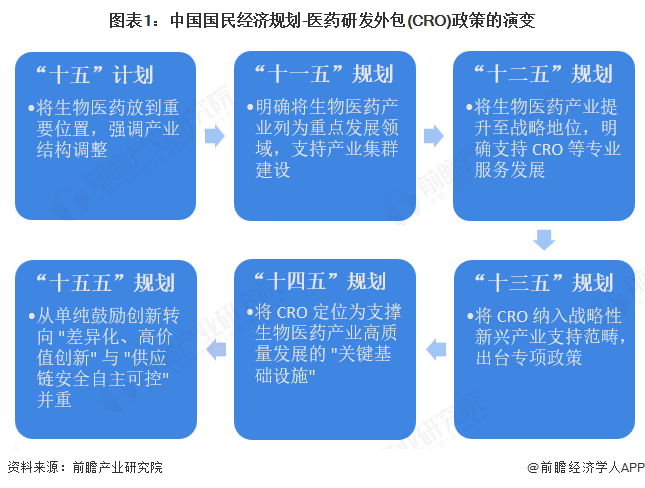
Core Viewpoint - The report highlights the significant growth and development of China's Contract Research Organization (CRO) industry, driven by a comprehensive policy framework and regulatory reforms that enhance innovation and operational efficiency in the pharmaceutical sector [1][3][9]. Group 1: Industry Overview - The main listed companies in China's CRO industry include WuXi AppTec (603259.SH), Kanglong Chemical (300759.SZ), Tigermed (300347.SZ), Kelaiying (002821.SZ), Zhaoyan New Drug (603127.SH), Jiuzhou Pharmaceutical (603456.SH), Haoyuan Pharmaceutical (688131.SH), Boteng Co., Ltd. (300363.SZ), Chengdu XianDao (688222.SH), and Yaoshi Technology (300725.SZ) [1]. - The CRO industry is recognized as a strategic emerging industry that supports pharmaceutical innovation, transitioning China from a major pharmaceutical market to a strong one [1]. Group 2: Policy Framework - The policy framework for the CRO industry is centered around the National Medical Products Administration (NMPA) and includes collaboration with other regulatory bodies such as the National Health Commission (NHC) and the Drug Administration (CDR) [3]. - Key regulatory measures include the Marketing Authorization Holder (MAH) system, implicit licensing for clinical trials, Good Laboratory Practice (GLP) and Good Clinical Practice (GCP) certifications, and priority review and approval processes [3]. Group 3: Industry Support Policies - National policies provide financial support through initiatives like the "Major New Drug Creation" program, tax reductions for high-tech enterprises, and increased deductions for R&D expenses, which lower operational costs for the industry [6]. - Local governments implement differentiated policies that align with regional industrial characteristics, including subsidies for innovative drug development and funding for CRO platform construction [6]. Group 4: Drug Review Reforms - Recent reforms in drug review processes have significantly improved approval efficiency, reducing the average clinical trial review time from 420 days to 30 days in pilot areas, and addressing a backlog of 22,000 cases [9][12]. - The definition of new drugs has shifted from "China New" to "Global New," aligning with international standards and enhancing the quality of innovation [12]. Group 5: Future Trends - The future of the CRO industry in China is expected to be driven by a robust policy framework, with trends including deeper collaboration in service models, increased application of AI and digital platforms, and a focus on specialized market segments [13]. - The competitive landscape is anticipated to evolve with the rise of domestic leaders and accelerated internationalization, benefiting from improved mechanisms for mutual recognition of clinical trial data [13].



医疗服务板块1月23日涨1.19%,诺禾致源领涨,主力资金净流入9.91亿元
Zheng Xing Xing Ye Ri Bao· 2026-01-23 09:04
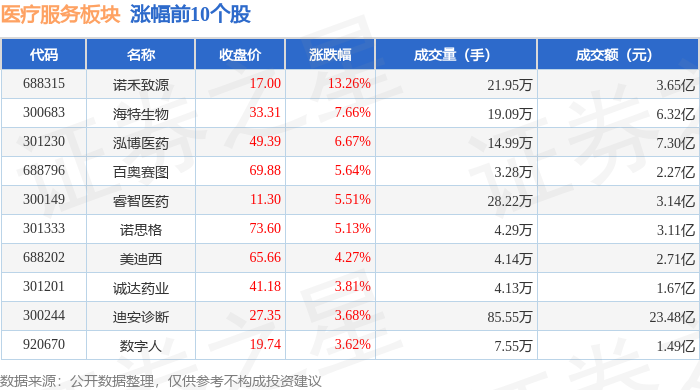
Core Viewpoint - The medical services sector experienced a rise of 1.19% on January 23, with notable gains from companies like Nuohua Zhiyuan, which led the sector's performance [1]. Group 1: Market Performance - The Shanghai Composite Index closed at 4136.16, up 0.33%, while the Shenzhen Component Index closed at 14439.66, up 0.79% [1]. - The medical services sector saw significant individual stock movements, with Nuohua Zhiyuan (688315) closing at 17.00, up 13.26%, and Hai Te Biological (300683) closing at 33.31, up 7.66% [1]. Group 2: Trading Volume and Value - Nuohua Zhiyuan had a trading volume of 219,500 shares and a transaction value of 365 million yuan [1]. - Hai Te Biological recorded a trading volume of 190,900 shares with a transaction value of 632 million yuan [1]. Group 3: Capital Flow - The medical services sector saw a net inflow of 999.1 million yuan from institutional investors, while retail investors experienced a net outflow of 1.069 billion yuan [2]. - The capital flow data indicates that major stocks like Diyan Diagnosis (300244) had a net inflow of 288 million yuan from institutional investors [3].





中欧基金葛兰:一季度医药板块有望延续结构性行情,看好创新药械产业链出海、消费医疗等投资机会
Sou Hu Cai Jing· 2026-01-23 06:53
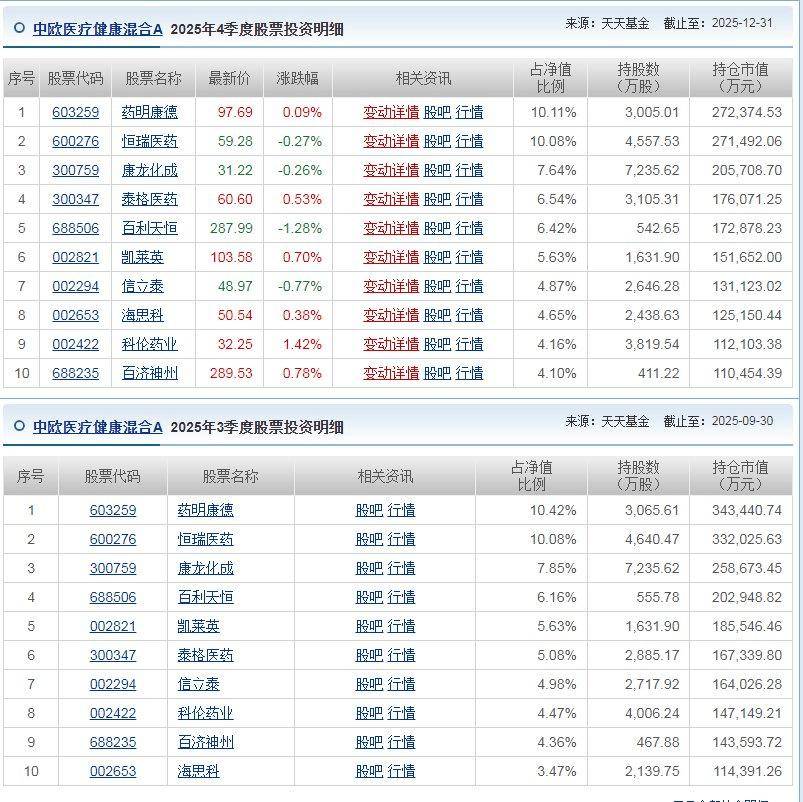
Core Viewpoint - The report highlights the performance of the China Europe Medical Health Mixed Fund managed by Ge Lan and Zhao Lei, indicating a decline in total fund size and negative returns compared to benchmarks [1][4]. Fund Performance - As of December 31, 2025, the total size of the funds managed by Ge Lan decreased from 43.544 billion to 35.389 billion yuan [1]. - The A-class share of the China Europe Medical Health Mixed Fund recorded a net value growth rate of -14.81%, while the C-class share saw a decline of -14.98%, both underperforming the benchmark return of -8.21% [1][3]. Holdings Overview - The top ten holdings of the China Europe Medical Health Fund include WuXi AppTec, Heng Rui Medicine, and Kanglong Chemical, with notable increases in holdings for Hai Si Ke and Tai Ge Medicine, while reductions were seen in stocks like Ke Lun Pharmaceutical and Xin Li Tai [1][2]. Market Context - In Q4 2025, the CSI Pharmaceutical Index fell by 12.7%, underperforming the CSI 300 Index, which declined by only 0.2%. The report notes significant differentiation within sub-sectors, with innovative industries experiencing corrections while traditional Chinese medicine and pharmaceutical commerce remained relatively stable [3]. Future Outlook - Looking ahead to Q1 2026, improvements in global liquidity are expected to boost investment and financing in innovative pharmaceuticals, supported by domestic policy enhancements. The innovative drug and device industry is anticipated to maintain a high level of activity, with several key domestic drugs approaching critical data readouts [4][5]. - The report suggests that the pharmaceutical sector may continue to experience structural trends due to macroeconomic improvements, supportive industry policies, and ongoing innovation, with investment opportunities focusing on the progress of innovative drug and device exports, domestic substitution in equipment, and recovery in consumer healthcare demand [5].