微软

Search documents
微软电话会:订单激增,Azure供不应求,数据中心紧张预计持续到2026年
Hua Er Jie Jian Wen· 2025-10-30 02:35
Core Insights - Microsoft achieved double-digit revenue and profit growth in Q1 FY2026, but Azure's capacity constraints are becoming a key growth limitation [1][2] - Azure and other cloud services revenue grew by 39%, matching the highest growth rate in two and a half years, but still fell short of some optimistic buyer expectations [1][2] - The company plans to double its data center footprint in the next two years to alleviate capacity pressure [2][3] Financial Performance - Q1 revenue reached $77.7 billion, with an 18% year-over-year growth [21] - Gross margin was 69%, slightly down year-over-year due to increased AI infrastructure investments [21] - Operating income grew by 24% year-over-year, with an operating margin of 49% [21] Capital Expenditure - Capital expenditures reached $34.9 billion, a 74% increase year-over-year, with about half allocated for short-term assets like GPUs and CPUs [4][22] - The company is investing heavily to meet unprecedented demand, particularly in AI and cloud services [4][22] Azure and Cloud Services - Azure's revenue exceeded $49 billion, growing 26% year-over-year, with a significant increase in remaining performance obligations (RPO) by over 50% to nearly $400 billion [3][24] - Azure AI customer count reached 80,000, including 80% of Fortune 500 companies [3][11] - Despite strong demand, Azure's capacity constraints are impacting revenue, particularly for high-priority services like Microsoft 365 Copilot [5][24] Strategic Partnerships - Microsoft signed a new agreement with OpenAI, valued at $250 billion, enhancing its strategic position in AI [3][7] - The partnership is expected to provide more certainty regarding intellectual property rights and further solidify Microsoft's market position [7][9] Market Dynamics and Risks - Concerns about an "AI bubble" and investment risks have emerged among investors, but Microsoft emphasizes the strong demand reflected in its RPO [6][34] - The company is focused on sustainable, balanced long-term growth rather than short-term expansion [6][34] Future Outlook - Microsoft anticipates that data center constraints will persist until 2026, but is actively working to expand capacity and optimize existing data centers [2][3] - The company expects continued strong growth in cloud and AI products, with Azure revenue projected to grow approximately 37% [27]

迭创市值纪录 英伟达算力地平线一骑绝尘
2 1 Shi Ji Jing Ji Bao Dao· 2025-10-30 02:17
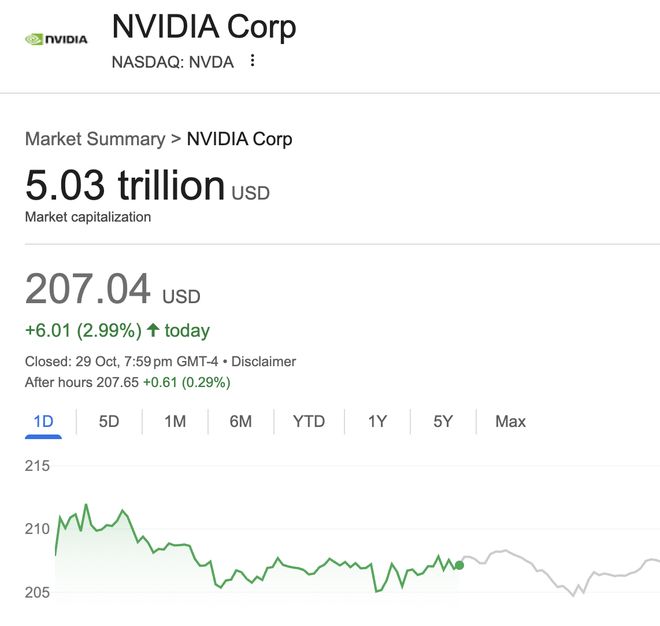
Core Insights - Nvidia has become the first company to reach a market capitalization of $5 trillion, closing at $5.03 trillion on October 29, 2023, with a stock price of $207 per share [3][4] - The company's market value has increased dramatically, surpassing $1 trillion in June 2023, $2 trillion in March 2024, and reaching $3 trillion in just three months [3][4] - Nvidia's CEO Jensen Huang has seen his wealth rise significantly, ranking eighth on the Forbes billionaire list as of October 29, 2023 [3] Market Performance - Nvidia's revenue growth rate for 2023-2024 is projected at 125%, significantly higher than the 20% growth seen by other fabless companies [6] - The demand for Nvidia's Blackwell and Rubin GPU chips is strong, with expected revenues exceeding $500 billion over the next five quarters and an order volume of 20 million units [6][7] - Major cloud service providers are projected to increase their capital expenditures to approximately $1.4 trillion from 2025 to 2027, nearly tripling from the $485 billion spent from 2022 to 2024 [7] Industry Impact - Nvidia's success has positively influenced the AI server and related markets, with companies like Industrial Fulian reporting significant revenue growth due to the expanding AI server market [8] - Industrial Fulian's revenue for the first three quarters of 2023 reached 603.93 billion yuan, a 38.4% year-over-year increase, with net profit growing by 48.52% [7][8] - The AI industry is experiencing a new industrial revolution, with Nvidia positioned as a key player in providing the necessary computational infrastructure [10][11] Future Outlook - Nvidia's market leadership is expected to continue, with analysts projecting a target price increase to $275, which would correspond to a market cap of $6.68 trillion [10] - The company faces challenges in AI implementation, including algorithm ecosystems, energy consumption, and regulatory boundaries, but remains focused on innovation and leadership in the tech industry [11]


凌晨!美联储降息25个基点!
新华网财经· 2025-10-30 02:05
Core Viewpoint - The Federal Reserve has lowered the federal funds rate by 25 basis points to a target range of 3.75% to 4.00%, marking the second consecutive rate cut, while also announcing the end of its balance sheet reduction plan starting December 1. However, uncertainty remains regarding future monetary policy due to a lack of economic data caused by the government shutdown, with Chairman Powell indicating that a December rate cut is not guaranteed [2][4][6]. Group 1: Federal Reserve Actions - The Federal Reserve has cut the federal funds rate by 25 basis points, aligning with market expectations [4]. - The Fed will end its balance sheet reduction plan on December 1, with reinvestments of mortgage-backed securities' principal into short-term Treasury bonds [6]. - There is a notable division within the Fed regarding future rate cuts, with some members advocating for a more aggressive approach while others prefer to maintain current rates [6][7]. Group 2: Economic Indicators and Market Reactions - Economic activity is expanding at a moderate pace, with job gains slowing and the unemployment rate slightly increasing but remaining low [5]. - Inflation has risen since earlier in the year and remains somewhat elevated, contributing to the Fed's cautious stance [5][6]. - Following Powell's comments, major assets experienced significant volatility, with the Dow Jones falling by 0.16% and the Nasdaq rising by 0.55% [9][11].

微软将继续增加在人工智能方面投资,科创板人工智能ETF(588930)昨日“吸金”近千万元
2 1 Shi Ji Jing Ji Bao Dao· 2025-10-30 01:58
Core Viewpoint - The article highlights the performance of the AI-focused ETF on the STAR Market, emphasizing its potential growth driven by increasing investments in artificial intelligence and supportive policies in China [1]. Group 1: ETF Performance - The STAR Market AI ETF (588930) opened lower on October 30, with a decline of 0.73% and a premium trading rate of 0.07, while experiencing a net inflow of over 9.8 million yuan the previous day [1]. - Among the ETF's constituent stocks, Foxit Software rose over 6%, with notable gains from Daotong Technology, Lanke Technology, and Optics Valley [1]. Group 2: Market Trends and Insights - The STAR Market AI ETF closely tracks the Shanghai Stock Exchange STAR Market AI Index (950180.CSI), which selects 30 large-cap companies involved in providing foundational resources, technology, and application support for AI [1]. - Microsoft’s CEO announced plans to continue increasing investments in AI, both in capital and talent, to seize significant opportunities ahead [1]. - Haitong International noted that AI is a crucial driver of the new technological revolution and industrial transformation, benefiting from ongoing technological advancements and policy support [1]. - Huaxi Securities pointed out that with the increasing domestic AI policies and global macroeconomic fluctuations, AI has become one of the most certain investment directions, with leading tech companies continuously enhancing their computing power investments [1].
全文|微软Q1业绩会实录:对与OpenAI的合作充满信心
Xin Lang Ke Ji· 2025-10-30 01:28
Core Insights - Microsoft reported Q1 FY2026 revenue of $77.673 billion, an 18% increase year-over-year, and net profit of $27.747 billion, a 12% increase year-over-year [1] - The company has seen a significant growth in commercial bookings, with a 111% increase, indicating strong demand for its services [2] - Despite strong financial performance, Microsoft's stock has underperformed compared to the market, raising concerns about potential risks related to artificial general intelligence (AGI) and competition [2][3] Financial Performance - Q1 FY2026 revenue reached $77.673 billion, up from $65.585 billion in the same quarter last year, reflecting an 18% growth [1] - Net profit for the quarter was $27.747 billion, compared to $24.667 billion a year earlier, marking a 12% increase [1] - The remaining performance obligations (RPO) balance is nearing $400 billion, with a weighted average duration of 2 years, indicating a robust pipeline of future revenue [5][6] AI and Technology Strategy - Microsoft emphasizes the need for a comprehensive system to address the uneven performance of AI models, highlighting products like GitHub Agent HQ and Microsoft 365 Copilot [3][4] - The company is optimistic about the long-term potential of AI, despite acknowledging that AGI is not achievable in the short term [4] - Microsoft is focusing on building a flexible and scalable computing infrastructure to support various AI applications and services [10][11] Market Position and Competitive Landscape - Microsoft is strategically balancing its third-party and first-party business models to mitigate risks associated with customer concentration [13][14] - The company is committed to investing in high-value AI systems and ensuring that its infrastructure can support diverse customer needs [11][15] - Microsoft is cautious about taking on contracts that do not align with its long-term strategic goals, ensuring that it maintains a balanced portfolio [17][18] Operational Challenges - Azure's revenue has been impacted by a shortage of computing power, which has prioritized resource allocation to core business areas like M365 Copilot and security features [16] - The company is actively expanding its infrastructure to meet the growing demand for computing resources, particularly in AI and cloud services [8][9] - Microsoft is focused on modernizing its computing clusters and ensuring that its investments align with customer contract timelines [10][12]
黄仁勋称美国AI芯片需要向中国出口,外交部回应;美国宣布新一轮对俄制裁,重点针对两家石油公司
Di Yi Cai Jing Zi Xun· 2025-10-30 01:16
Market Overview - The Federal Reserve lowered the overnight benchmark interest rate by 25 basis points to a range of 3.75% to 4.00%, marking the second rate cut of the year [2] - Fed Chairman Jerome Powell indicated that a further rate cut in December is not guaranteed, highlighting strong internal disagreements among committee members regarding future policy direction [2] - The market reacted negatively to Powell's comments, leading to fluctuations in major stock indices, with the Dow Jones falling by 74.37 points and the Nasdaq rising by 0.55% [1][2] Company Highlights - Nvidia's stock surged by 3.0%, pushing its market capitalization above $500 billion, making it the first U.S. company to reach this milestone [3] - Nvidia announced a $1 billion investment in Nokia, contributing to its stock price increase of over 50% this year, which has driven a rally in AI-related stocks [3] - Seagate Technology's stock rose by 19.1% after reporting Q3 revenue of $2.63 billion, a 21% year-over-year increase, and providing better-than-expected guidance for Q4 [3] Sector Performance - The storage sector showed strength, with Seagate's performance positively impacting Western Digital and SanDisk, which also saw stock price increases of over 8% [3] - The consumer goods sector faced challenges, with Mondelez International's stock dropping by 3.9% due to a decline in gross margin and a lowered full-year earnings outlook [4] International Developments - The Nasdaq Golden Dragon China Index experienced a slight decline of 0.03%, with Alibaba and Baidu seeing gains while JD.com and NetEase faced losses [5] - International oil prices saw a modest increase, with WTI crude oil rising by 0.55% to $60.48 per barrel and Brent crude oil up by 0.81% to $64.92 per barrel [5]

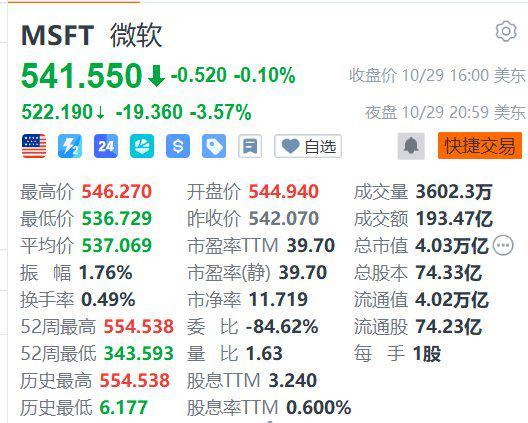
美股异动丨微软夜盘跌3.5%,Azure及其他云端收入低于买方预期,AI开支急增
Xin Lang Cai Jing· 2025-10-30 01:12
期内,经营收入776.7亿美元,同比增长18%,优于分析员预期的755.5亿美元,与前一季所创一年半最 高增速持平。其中,云端收入491亿美元,预期为486亿美元;智能云端收入309亿美元,预期为301.8亿 美元;剔除汇率因素,Azure及其他云端收入增长39%,高于分析师平均预期的增长37.1%,但仍低于一 些买方的乐观预期。 首个财季资本支出349亿美元,高于预期的300.6亿美元,并再创新高,较前一季的前纪录增长超过 60%,同比急增74.5%,前一季增幅为27%。由于投资OpenAI,面临31亿美元冲击。 来源:格隆汇APP 格隆汇10月30日|微软(MSFT.US)在目前的夜盘交易中跌3.5%,报522.19美元。 公司公布截至今年9月30日的2026年首个财政季度,经营利润379.6亿美元,同比增长24%,高于预期的 351亿美元,略高逾前一季23%的增幅;纯利277.5亿美元,同比增长12%,远低于前一季24%的增长; 经稀释后每股盈余3.72美元,增长放缓至13%,仍强于分析员预期。 ...
再创历史!英伟达市值一夜突破5万亿美元,今年涨幅56%,黄仁勋晋升全球第八富豪
量子位· 2025-10-30 01:06
Core Viewpoint - Nvidia has become the first company in history to surpass a market capitalization of $5 trillion, marking a significant milestone in the tech industry [1][10]. Group 1: Market Performance - On October 29, Nvidia's stock price rose by 5.44%, reaching an intraday high of $212.19 per share, and closing at $207.04 per share, resulting in a market cap of $5.03 trillion [2][10]. - Since the beginning of 2025, Nvidia's stock has surged by 56%, showcasing its rapid growth compared to other major companies [5][39]. - Nvidia's market cap now exceeds the combined total of several major tech companies, including AMD, Intel, and TSMC, as well as entire sectors within the S&P 500 [5][6]. Group 2: Growth Trajectory - Nvidia's market value has skyrocketed from $1 trillion to $5 trillion in just two and a half years, a feat unmatched by other tech giants [9][23]. - The company achieved its first $1 trillion valuation in May 2023, followed by $3 trillion in June 2024, and then $4 trillion in just over a year [22][23]. - The growth from $4 trillion to $5 trillion took only three months, highlighting Nvidia's exceptional market performance [23][24]. Group 3: Key Drivers of Growth - The recent surge in Nvidia's market cap is attributed to announcements made during the GTC developer conference, where CEO Jensen Huang unveiled several technological innovations and partnerships [25][39]. - Key highlights from the conference included plans to collaborate with the U.S. Department of Energy to build new supercomputers and the introduction of the Blackwell chip series, which is expected to significantly increase production [26][27][31]. - Nvidia's anticipated revenue from the new products is projected to reach $500 billion by the end of next year, reflecting a major shift in global computing infrastructure towards Nvidia's accelerated computing model [31][33]. Group 4: Competitive Landscape - Nvidia's rapid ascent has created a substantial gap between it and its closest competitor, Microsoft, which has a market cap of $4.03 trillion, and Apple at $4.00 trillion [13][14]. - The company has positioned itself as a key player in the AI boom, with its GPUs being integral to the infrastructure of leading AI companies like OpenAI and Google DeepMind [39][40]. - Nvidia's strategic investments and partnerships, including a potential $100 billion investment in AI data centers, further solidify its leadership in the AI sector [40][41].

投资OpenAI已获10倍回报,微软押注AI资本支出超预期
Di Yi Cai Jing· 2025-10-30 01:04
Core Insights - Microsoft reported a return of approximately 10 times on its investment in OpenAI [9] - The company's market capitalization reached $4 trillion, despite a nearly 4% drop in stock price after earnings release [1] Financial Performance - For the first quarter of fiscal year 2026, Microsoft reported revenue of $77.7 billion, an 18% year-over-year increase [2] - Net profit for the same period was $27.7 billion, reflecting a 12% year-over-year growth [2] - The gross margin for the first quarter was 69%, showing a decline attributed to investments in artificial intelligence [3] Capital Expenditure - Microsoft’s capital expenditure reached a record $34.9 billion, exceeding previous expectations of over $30 billion [3] - Approximately half of the capital expenditure was allocated to short-term assets, primarily for GPU and CPU procurement to support Azure platform demand and AI solutions [3] - The remaining expenditure was directed towards long-term assets, including $11.1 billion in financing leases for large data centers [3] Business Segment Performance - The Intelligent Cloud segment generated $30.9 billion in revenue, a 28% year-over-year increase, with Azure and other cloud services revenue growing by 40% [4] - The More Personal Computing segment reported revenue of $13.8 billion, up 4%, with Windows OEM and device revenue increasing by 6% [5] - The Productivity and Business Processes segment achieved revenue of $33 billion, a 17% year-over-year increase, with LinkedIn revenue growing by 10% [6] Investment in OpenAI - Microsoft disclosed a $3.1 billion reduction in net profit due to losses from its investment in OpenAI during the first quarter of fiscal year 2026 [7] - A new agreement was signed with OpenAI, which includes a purchase of $250 billion worth of Azure services [9] Workforce and Legal Issues - Microsoft has undergone multiple rounds of layoffs this year, including 6,000 in May and 9,000 in July, affecting nearly 4% of its total workforce [9] - The Australian Competition and Consumer Commission (ACCC) has filed a lawsuit against Microsoft, alleging misleading practices related to the bundling of Microsoft 365 software with AI tools [9]
AI全面加速:Celestica上调指引,微软与OpenAI深入合作,GTC大会亮眼 | 投研报告
Zhong Guo Neng Yuan Wang· 2025-10-30 01:02
Group 1 - Celestica reported Q3 2025 revenue of $3.19 billion, a 28% year-over-year increase, exceeding the company's guidance upper limit [1][2] - The adjusted operating profit margin for Celestica reached 7.6%, up 0.8 percentage points year-over-year [1][2] - GAAP earnings per share were $2.31, while adjusted earnings per share were $1.58, both surpassing expectations [1][2] Group 2 - Celestica raised its full-year 2025 revenue guidance to $12.2 billion from the previous $11.55 billion, an increase of $650 million, while maintaining an adjusted operating profit margin forecast of 7.4% [1][2] - The company provided its first outlook for 2026, projecting revenue of $16 billion and an adjusted operating profit margin of 7.8%, reflecting confidence in the sustainability of AI infrastructure demand [2] Group 3 - NVIDIA is accelerating its full-stack AI layout, with the Rubin GPU expected to enter mass production in Q3 or Q4 of 2026 [3] - The performance of the Vera Rubin NVL144 platform is projected to achieve 3.6 Exaflops for FP4 inference and 1.2 Eflops for FP8 training, a 3.3 times improvement over the previous generation [3] - NVIDIA anticipates combined GPU sales of $500 billion over five quarters from Blackwell and Rubin chips, reinforcing its leading position in the global AI computing supply chain [3] Group 4 - Microsoft and OpenAI reached an agreement for OpenAI to purchase an additional $250 billion in Azure services, with Microsoft holding a 27% stake in OpenAI valued at approximately $135 billion [4] Group 5 - The industry is optimistic about three core themes: optical communication, liquid cooling, and domestic computing power, with a notable focus on AI's "siphoning effect" [5] - Recommended stocks include Zhongji Xuchuang, Xinyi Sheng, Yingweike, Yuanjie Technology, Tianfu Communication, ZTE, Shengke Communication, Oulu Tong, Guanghuan New Network, Aofei Data, Xinyi Network Group, Unisplendour, Guanghetong, Zhongtian Technology, and Hengtong Optic-Electric [5]