软银集团

Search documents
1.5万亿美元投资是“画大饼”?OpenAI CEO怒斥:够了!
Sou Hu Cai Jing· 2025-11-04 05:44
Core Insights - OpenAI has committed to invest over $1.5 trillion in the coming years, addressing skepticism regarding its financial capabilities and growth potential [2][5] - The company has raised approximately $47 billion through venture capital in the past year, with a valuation reaching around $500 billion [2] - OpenAI has signed over $1 trillion in agreements this year, partnering with major companies like AMD, NVIDIA, Oracle, CoreWeave, Broadcom, Microsoft, and Amazon AWS [2][5] Investment Agreements - Oracle signed a $300 billion cloud services agreement with OpenAI as part of the $500 billion "Stargate" initiative, with SoftBank also participating in the funding [2] - OpenAI and CoreWeave established a partnership worth $6.5 billion, building on previous agreements totaling $22 billion [2][3] - A strategic partnership with NVIDIA involves an investment of up to $100 billion to support the deployment of at least 10 gigawatts of NVIDIA systems [2] Infrastructure Development - OpenAI and AMD reached a $300 billion agreement for a 6-gigawatt infrastructure powered by AMD Instinct GPUs, with AMD expected to receive over $100 billion in chip orders [3] - OpenAI and Broadcom are collaborating to develop custom AI accelerators for a 10-gigawatt data center, with total investment projected at $500 billion [3] - OpenAI has signed a new agreement with Microsoft, granting Microsoft a 27% stake in OpenAI valued at approximately $135 billion, while OpenAI commits to purchasing $250 billion in Azure services [4] Market Position and Future Outlook - OpenAI's annual revenue is approximately $13 billion, leading to questions about its ability to sustain such large investments, which CEO Sam Altman addressed with confidence in the company's growth [5] - The company is diversifying its revenue streams through various products, including ChatGPT, enterprise API services, and cloud business [5] - Speculation about OpenAI's potential IPO is increasing, with reports suggesting a valuation of around $1 trillion [5][6]






告别“免费资金”时代!日企海外借贷狂飙至1320亿美元,创纪录浪潮撼动全球市场
智通财经网· 2025-11-04 02:53
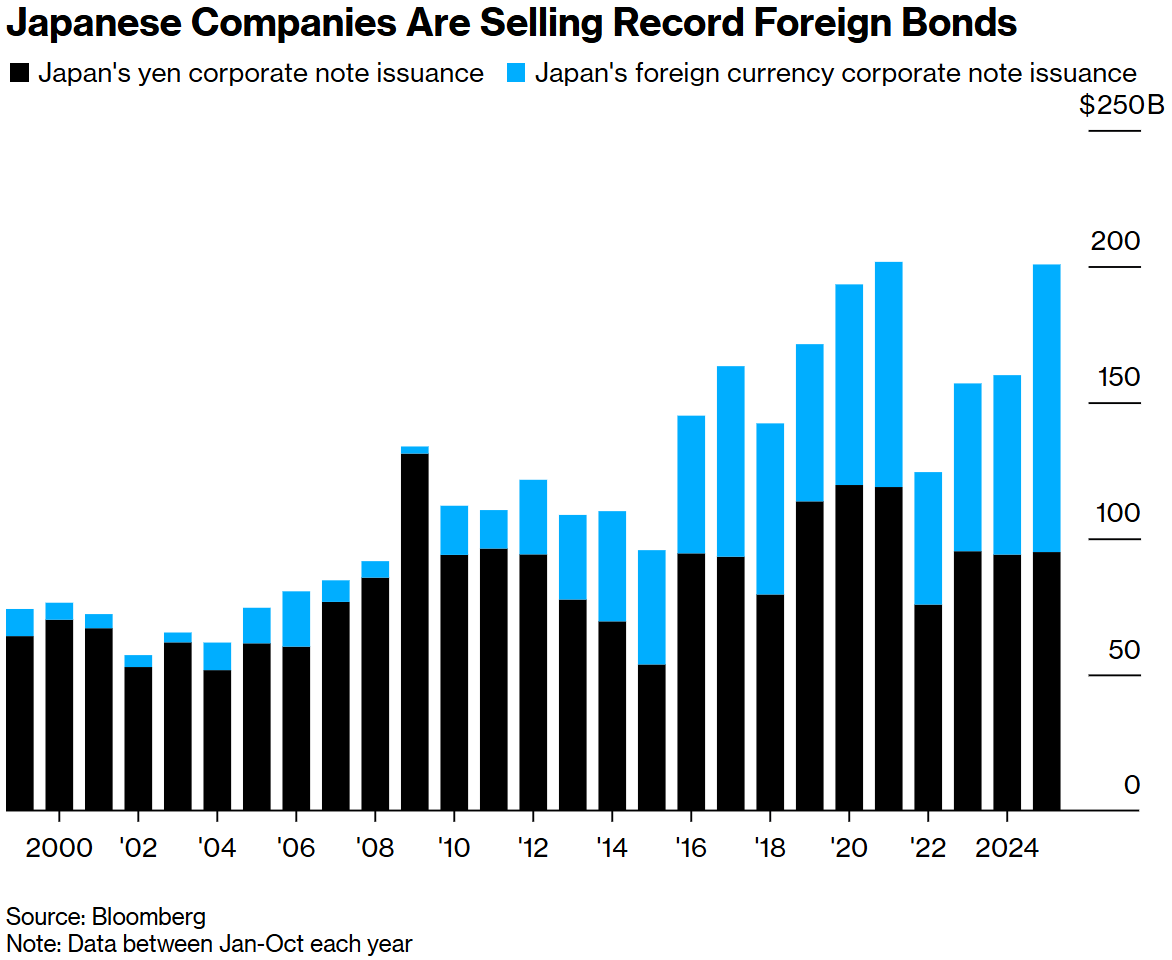
Core Insights - The era of "free money" in Japan is ending, leading to a surge in overseas borrowing by Japanese companies, reaching a record level of $132 billion in 2025, a 56% increase year-on-year [1] - Japanese companies are increasingly favoring foreign currency bonds over yen bonds, with annual overseas bond issuance expected to surpass yen bonds for the first time in history [1] - The revival of Japanese companies is reshaping global financial markets, with significant increases in spending and acquisitions, making Japan one of the most active players in global transactions this year [1] Group 1: Overseas Borrowing Trends - Japanese companies have raised $132 billion through foreign currency bonds and loans in 2025, marking a 56% increase compared to the previous year [1] - The cost of borrowing in yen has risen to its highest level since the late 2000s, making overseas financing more attractive [4] - Japan has become the largest source of dollar bonds in the Asia-Pacific region, a position previously held by China [4] Group 2: Mergers and Acquisitions - The total value of mergers and acquisitions by Japanese companies has increased by 129% in 2025, reaching $262 billion, with significant investments in AI and privatizations [7] - Many of these acquisitions are driven by the need for growth outside Japan due to a declining population [7] - Japanese companies are now leading the issuance of foreign currency junk bonds, with approximately $14 billion issued in 2025 [7] Group 3: Investment Grade Bonds - Over 70% of Japan's overseas bond issuances this year have an investment grade rating of A or higher, improving the average rating of Asian dollar bonds [10] - The issuance of investment-grade bonds is transforming the perception of Asian dollar bonds from emerging market investments to a more stable asset class [10] - NTT Inc. issued $17.7 billion in bonds, the largest global issuance by an Asian company, to fund its AI division's privatization [11] Group 4: Market Dynamics - Japanese borrowers accounted for approximately 28% of the $386 billion in dollar and euro bonds issued in the Asia-Pacific region this year, a record high [14] - Investors are increasingly favoring Japanese foreign currency bonds over yen bonds due to better performance, with yen corporate bonds down 0.5% this year [14] - The diversity of issuers in Japan is attracting attention from investors in the Asia-Pacific region [14]
微软CEO掀开美国AI遮羞布?GPU堆仓库,没有电力供应,就是废铁
Sou Hu Cai Jing· 2025-11-04 01:47
Group 1 - The core argument is that the competition in AI is fundamentally about energy supply rather than just advanced AI chips, with the U.S. facing significant challenges in electricity generation and distribution compared to China [10] - The U.S. has restricted companies like NVIDIA from selling advanced AI chips to China to maintain its competitive edge in AI technology [1] - Major projects like the Stargate initiative, which aims to invest $500 billion in AI infrastructure over four years, highlight the U.S. commitment to advancing AI [1] Group 2 - Microsoft CEO Satya Nadella pointed out that the AI industry is currently hindered by a lack of sufficient electricity to power GPUs, leading to many GPUs being unused [3] - Experts emphasize that the ultimate competition in AI will revolve around energy resources, as both AI chips and intelligent systems require vast amounts of power [5] - The U.S. electricity grid is aging and unable to meet increasing demands, while China's electricity generation capacity is more than double that of the U.S. and is rapidly improving [7][8]

详解美国数据中心狂潮:45GW,2.5万亿美元投资,谁在建设,谁在掏钱?
华尔街见闻· 2025-11-03 11:01
Core Insights - A significant infrastructure race driven by artificial intelligence is unfolding in the United States, with planned large data center projects exceeding 45 GW and attracting over $2.5 trillion in investments [1][3]. Group 1: Major Players and Projects - The expansion is primarily driven by major companies such as OpenAI, Amazon, Meta, Microsoft, and xAI, which are rapidly planning and constructing computing clusters to support increasingly complex AI models [1][3]. - Key projects include OpenAI's Stargate (1.2-1.6 GW), Frontier (1.4 GW), Lighthouse (1 GW), Project Jupiter (1.5 GW), and additional projects in Ohio and Texas, with Stargate alone representing a commitment of over $400 billion for 7 GW of capacity [4][5]. Group 2: Power Supply Challenges - The surge in power demand is creating unprecedented challenges for the U.S. electrical infrastructure, leading to a "power wall" scenario where existing grid capacity is insufficient [1][5]. - Companies are increasingly adopting a "Bring-Your-Own-Power" strategy, with many opting to build on-site power generation facilities to ensure reliable electricity supply and expedite project timelines [1][6]. Group 3: Investment and Financing Structures - The construction costs for data centers have escalated, with costs exceeding $1,700 million per MW, and OpenAI's Stargate project reflecting a staggering $5,700 million per MW when including IT equipment [4][8]. - Private equity firms and specialized infrastructure funds are playing a crucial role in financing these projects, exemplified by Blue Owl Capital's $15 billion joint venture with Crusoe for the Stargate 1 project [8]. Group 4: Energy as a Service (EaaS) Model - The rise of the "Energy as a Service" (EaaS) model is evident, with energy companies like Williams entering long-term power purchase agreements with data center operators, investing billions in dedicated power generation facilities [9]. Group 5: Supply Chain and Labor Challenges - The explosive demand is straining the power equipment supply chain, with heavy gas turbine prices rising by 50% in less than two years and extended delivery times [10][11]. - Equipment manufacturers are facing challenges related to component shortages and labor, prompting some companies to acquire second-hand or unused equipment to meet their needs [11].


2900亿,孙正义又开赌了
创业家· 2025-11-03 10:10
Group 1 - OpenAI has completed a capital restructuring, transforming from a non-profit to a profit-oriented entity, with a new non-profit foundation retaining control [10][11] - The restructuring allows the non-profit OpenAI Foundation to hold 26% of the equity, valued at approximately $130 billion based on OpenAI's estimated valuation of $500 billion [11] - Microsoft has secured about 27% equity in OpenAI, valued at around $135 billion, confirming OpenAI's significant valuation and indicating a nearly tenfold increase in Microsoft's initial investment of $13.8 billion [11][12] Group 2 - The new agreement between Microsoft and OpenAI extends their collaboration until 2032, granting Microsoft priority access to OpenAI's latest AI models and products [12] - OpenAI has committed to purchasing $250 billion worth of Azure cloud services from Microsoft, while also entering a significant partnership with Oracle for $300 billion in cloud services over five years [13][30] - The restructuring has led to a 2% increase in Microsoft's stock price, bringing its market capitalization back to $4 trillion, reflecting positive market sentiment regarding the partnership [14] Group 3 - SoftBank's investment in OpenAI amounts to approximately $30 billion, with a total financing round led by SoftBank reaching $41 billion, marking a historic investment in the AI sector [19][20] - SoftBank aims to secure a strategic position within OpenAI, participating in the entire development and deployment process of AI technologies [20] - The "Stargate" initiative, announced by Trump, involves a $500 billion investment over four years to build next-generation AI supercomputing infrastructure across the U.S., with SoftBank playing a key role [20] Group 4 - OpenAI's transformation from a non-profit to a profit-driven entity raises concerns about its commitment to its original mission of benefiting humanity, as it faces pressure to deliver financial returns [24][25] - The restructuring has sparked criticism from AI ethics organizations and co-founder Elon Musk, who argues that OpenAI has deviated from its altruistic goals [25][26] - The balance between profit motives and ethical considerations remains a challenge for OpenAI's leadership, as they navigate the complexities of commercialization while maintaining their foundational principles [26][28] Group 5 - The U.S. AI industry is evolving into a collaborative ecosystem where major players like NVIDIA, Microsoft, and Oracle are interlinked through investments and partnerships, creating a closed-loop system [29][30] - Companies are increasingly investing in each other to secure resources and capabilities, with OpenAI acting as a central node in this ecosystem, influencing the pace of technological advancement [32] - The integration of capital, hardware, software, and data within the AI sector has led to a rapid accumulation of market value and production capacity, highlighting the interconnected nature of the industry [33][34]


英伟达推出NVQLink,量子GPU计算时代来临
Tianfeng Securities· 2025-11-03 09:46
Investment Rating - Industry Rating: Outperform the market (maintained rating) [6] Core Views - The report maintains a positive outlook on the computing power industry chain, particularly in overseas markets, which remain robust despite challenges from DeepSeek and trade frictions. The domestic AI industry and AIDC chain are also expected to maintain high growth, with 2025 potentially being a pivotal year for AI infrastructure in China [3][22]. - The report emphasizes the importance of "AI + overseas expansion + satellites" as key investment opportunities, recommending focus on core sectors such as optical modules, liquid cooling, and domestic computing power lines [3][22]. Summary by Sections 1. Artificial Intelligence and Digital Economy - Key recommendations include: - Optical modules & optical devices: Focus on companies like Zhongji Xuchuang, Xinyi Sheng, Tianfu Communication, and Yuanjie Technology [4][26]. - Switch server PCBs: Recommended companies include Hudian Co., ZTE, and Unisplendour [4][26]. - Low valuation, high dividend companies: China Mobile, China Telecom, and China Unicom are highlighted for resource revaluation [4][26]. - AIDC & cooling: Key recommendations include Yingweike and Runze Technology [4][26]. - AIGC applications/edge computing: Focus on companies like Guohua Communication and Meg Intelligent [4][26]. 2. Offshore Wind and Submarine Cables & Intelligent Driving - Offshore wind and submarine cables: Recommended companies include Hengtong Optic-Electric, Zhongtian Technology, and Oriental Cable [5][27]. - Offshore recovery & concentration: Key recommendations include Huace Navigation and Weisheng Information [5][27]. - Intelligent driving: Suggested focus on modules & terminals, sensors, connectors, and structural components [5][27]. 3. Satellite Internet & Low Altitude Economy - The report highlights the rapid development of low-orbit satellites and the low-altitude economy, recommending companies like Huace Navigation and Haige Communication [6][29]. 4. Market Performance Review - The communication sector experienced a decline of 3.47% in the week of October 27-31, underperforming against the CSI 300 index [30][32].
详解美国数据中心狂潮:45GW,2.5万亿美元投资,谁在建设,谁在掏钱?
硬AI· 2025-11-03 09:20
Core Insights - A significant infrastructure race driven by artificial intelligence is unfolding in the United States, with planned data center projects exceeding 45 GW and attracting over $2.5 trillion in investments [1][2] Group 1: Major Players - The expansion is primarily led by major tech companies such as OpenAI, Amazon, Meta, Microsoft, and xAI, which are rapidly planning and constructing computing clusters to train and run increasingly complex AI models [1][2][4] - OpenAI's Stargate project aims for a capacity of 10 GW and an investment of $500 billion by the end of 2025, with approximately 7 GW already committed [6][10] - Meta is advancing multiple Titan clusters, including a 1 GW project in Ohio and a planned 5 GW expansion in Louisiana [6] - Amazon has added 3.8 GW of capacity globally in the past year and is expected to double its capacity by 2027, potentially increasing by about 13 GW in the U.S. between 2026 and 2027 [6] - Microsoft is constructing a 900 MW AI facility in Wisconsin and has plans for several similar projects across the U.S. [6] - xAI is expanding its data center in Memphis, Tennessee, to 1.4 GW for training its Grok model [6] Group 2: Investment and Costs - The construction cost of data centers has surpassed $17 million per MW, with OpenAI's Stargate project reflecting a cost of $57 million per MW, highlighting the high capital density of AI infrastructure [7][11] - The financing structure for these massive investments is complex, involving not only the tech giants' capital expenditures but also private equity firms and specialized infrastructure funds [11][12] - The "Energy as a Service" (EaaS) model is emerging, with energy companies like Williams signing long-term power purchase agreements to invest billions in dedicated power facilities for data center operators [12] Group 3: Power Supply Challenges - The existing power grid poses significant challenges for data center construction, leading companies to adopt on-site power generation strategies to ensure reliability and accelerate project timelines [9][10] - For instance, the Stargate 1 project plans to deploy approximately 350 MW of on-site natural gas generation despite having grid access approval for 1.2 GW [9] Group 4: Supply Chain Issues - The explosive demand for power equipment has strained the supply chain, with heavy gas turbine prices rising by 50% in less than two years and extended delivery times [14] - Companies are resorting to acquiring second-hand or "off-the-shelf" new equipment to circumvent long order queues, as seen with Fermi America acquiring a Siemens gas turbine from an unused LNG project [14]

巴克莱:详解美国数据中心狂潮,45GW,2.5万亿美元投资,谁在建设,谁在掏钱?
美股IPO· 2025-11-03 04:39
Core Insights - The article highlights a significant surge in data center projects in the U.S., with a total capacity exceeding 45 GW and projected investments surpassing $2.5 trillion, driven by major tech companies like OpenAI, Amazon, Meta, Microsoft, and xAI [4][14]. Group 1: Investment and Capacity - The current wave of data center construction is primarily fueled by the need for advanced AI model training and operation, leading to unprecedented demand for computational power [4][5]. - OpenAI's Stargate project aims for a capacity of 10 GW with an investment of $500 billion by the end of 2025, having already committed approximately 7 GW across various states [8][13]. - Amazon has added 3.8 GW of capacity globally in the past year and is expected to double its capacity by 2027, potentially increasing by about 13 GW in the U.S. alone during 2026-2027 [8][14]. Group 2: Power Infrastructure Challenges - The rapid increase in power demand from data centers is creating significant challenges for the existing U.S. electrical grid, leading to a phenomenon referred to as the "power wall" [4][12]. - Companies are increasingly adopting a "Bring-Your-Own-Power" strategy, opting to build on-site power generation facilities to ensure reliable electricity supply and expedite project timelines [12][14]. - For instance, the Stargate 1 project plans to deploy approximately 350 MW of on-site natural gas generation capacity despite having grid access approval for 1.2 GW [12][13]. Group 3: Financing and Cost Structures - The financing landscape for these massive investments is complex, involving not only the capital expenditures of tech giants but also significant contributions from private equity firms and specialized infrastructure funds [14]. - The construction cost for data centers has escalated, with reports indicating costs exceeding $17 million per MW, and OpenAI's Stargate project reflecting a staggering $5,700 million per MW when including IT equipment [11][14]. - The "Energy as a Service" (EaaS) model is emerging, with energy companies entering long-term power purchase agreements to support data center operations, exemplified by Williams' $2 billion investment in Meta's Prometheus project [14]. Group 4: Supply Chain and Labor Challenges - The explosive demand for power generation equipment is straining supply chains, with heavy gas turbine prices rising by 50% in less than two years and extended delivery times [15]. - Companies are facing challenges in sourcing components and labor, prompting some to acquire second-hand or unused equipment to mitigate long wait times [15].
微软财报披露OpenAI单季亏115亿美元
Bei Jing Shang Bao· 2025-11-02 15:54
Core Insights - OpenAI reported a significant quarterly loss of over $11.5 billion, exceeding market expectations and highlighting the high cash burn rate in the AI sector [1][3] - Microsoft disclosed a $3.1 billion reduction in net income due to its equity investment in OpenAI, reflecting the financial burden large tech companies face to maintain AI competitiveness [1][2] Financial Performance - OpenAI's quarterly net loss of approximately $11.5 billion contrasts sharply with its revenue of only $4.3 billion for the first half of the year, indicating a loss nearly three times its semi-annual revenue [3] - Microsoft's total investment in OpenAI amounts to $11.6 billion out of a committed $13 billion, with the investment accounting for a significant portion of its financial strategy [2][4] Accounting Treatment - Microsoft employs equity method accounting for its investment in OpenAI, meaning OpenAI's losses directly impact Microsoft's net income [1][2] - The actual pre-tax loss for OpenAI could exceed $12 billion when considering Microsoft's higher ownership percentage of 32.5% during the quarter [3] Investment Context - OpenAI has attracted substantial funding from various investors, including a recent $40 billion round led by SoftBank, indicating strong investor interest despite the high losses [4] - The financial disclosures provide a rare glimpse into the fiscal health of a leading AI unicorn, underscoring the ongoing financial commitments from major tech firms [1][4]
AI资本潮来袭!OpenAI冲刺万亿估值,中美企业扎堆上市迎爆发期!
Sou Hu Cai Jing· 2025-11-02 12:56
Core Insights - OpenAI is preparing for a potential IPO with a valuation target of $1 trillion, aiming to raise at least $60 billion, which would make it one of the largest IPOs in history [3][5][10] - The company plans to submit its IPO application as early as the second half of 2026, with a goal to complete the listing by 2027 [3][5] - OpenAI's CFO has indicated that the company is facing unprecedented demands for computing power and infrastructure, making an IPO a viable financing option [5][7] Financial Performance - OpenAI's projected annual revenue is expected to reach $20 billion by the end of 2025, driven by products like ChatGPT Enterprise and API services [8] - Despite the revenue growth, the company is experiencing significant losses, indicating a high-investment, high-loss business model typical in the AI sector [14][16] Market Context - The AI sector is witnessing a capital frenzy, with companies like Nvidia reaching a market cap of $5 trillion, and CoreWeave's stock tripling post-IPO [10][11] - In China, there is a surge in AI companies seeking to go public, with 48 AI firms having submitted applications to the Hong Kong Stock Exchange as of July 2025 [11] Governance and Challenges - OpenAI's governance structure includes a non-profit foundation that retains control over significant decisions, ensuring the focus remains on safe and beneficial AI development [24][30] - The IPO process poses challenges for AI companies, including the need for robust governance and the ability to withstand market scrutiny [28][29] Future Outlook - The IPO for OpenAI represents a significant transition from private innovation to public accountability, marking a pivotal moment for AI technology in the global economy [30][33] - The success of AI companies will depend on their ability to deliver real value and solve practical problems, as the market becomes increasingly competitive [34]