
OPPO

Search documents
IDC:预计2025年全球折叠屏手机市场出货量约1983万台 同比增长6%
智通财经网· 2025-08-26 05:53
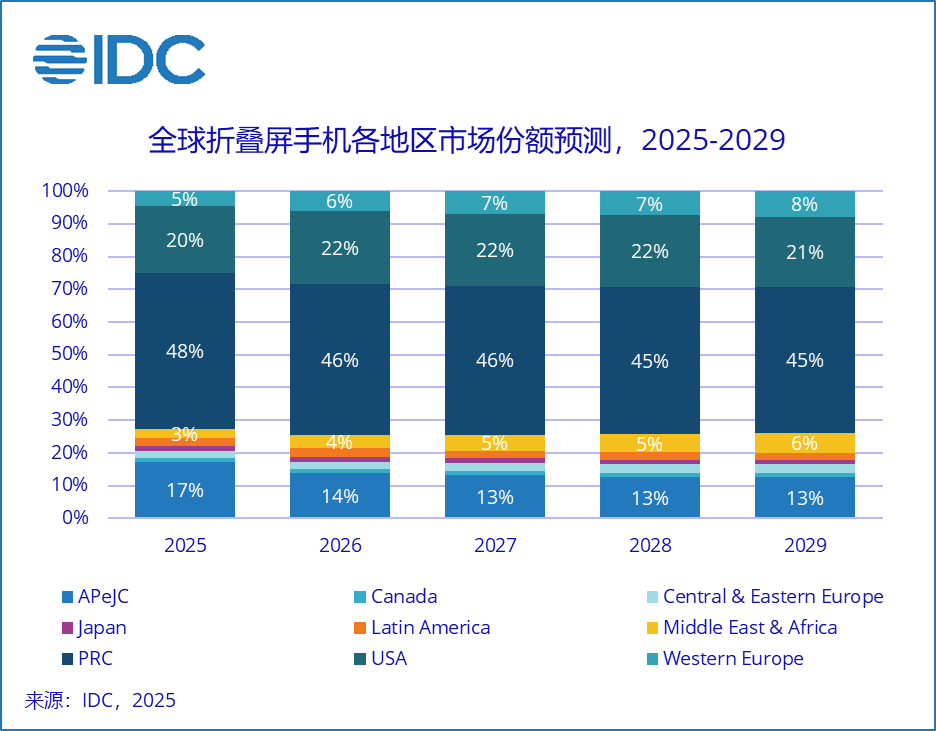
Group 1 - The global foldable smartphone market is expected to reach approximately 19.83 million units in 2025, with a year-on-year growth of 6.0%, and is projected to approach 27.29 million units by 2029, achieving a five-year compound annual growth rate (CAGR) of 7.8% [1] - China has officially surpassed other markets to become the largest foldable smartphone market globally, with a stable market share of over 40% expected in the next five years [1][6] - The first half of 2025 saw China's foldable smartphone shipments reach 4.98 million units, marking a year-on-year increase of 12.6%, despite a slowdown compared to previous years [3] Group 2 - Huawei maintained its leading position in the foldable smartphone market in the first half of 2025, with a shipment of 3.74 million units, capturing 75% of the market share, marking a historical high [5] - Honor, despite not launching new products in the first half of 2025, held an 8.4% market share, demonstrating strong user loyalty [5] - The introduction of new foldable designs, including tri-fold and wide-fold models, has invigorated the market, with the first tri-fold product nearing 500,000 units shipped in the first half of 2025 [3][5] Group 3 - The foldable smartphone market is entering a phase where software upgrades will become the core competitive factor, as hardware innovation is expected to slow down [6] - The development of a robust software ecosystem and collaboration with developers will be crucial for enhancing user experience and productivity in foldable devices [6] - The integration of AI technology with software applications is anticipated to unlock the productivity potential of foldable smartphones in various scenarios [6]

Omdia:2025第二季度全球智能手机市场微跌0.1% 下半年市场不确定性仍然持续
智通财经网· 2025-08-26 05:53
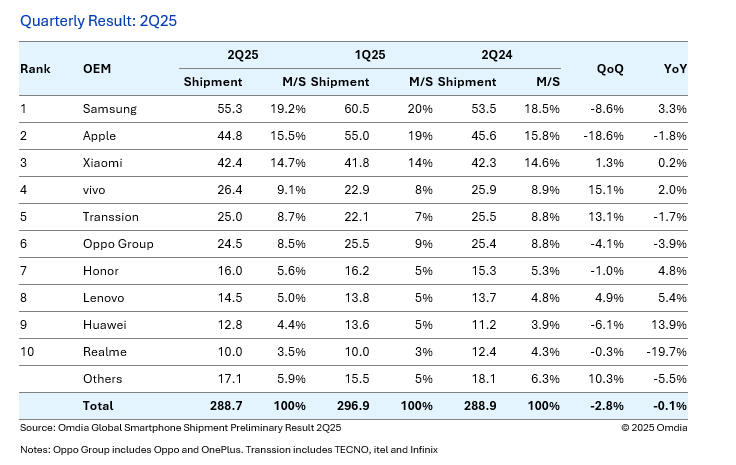
Core Insights - Global smartphone shipments are projected to decline to 288.7 million units in Q2 2025, a decrease of over 8 million units or 2.8% quarter-on-quarter, and a slight year-on-year decrease of 20,000 units or less than 0.1% [1][2] Company Performance - Samsung remains the market leader with shipments of 55.3 million units, holding a market share of 19.2%, despite a quarter-on-quarter decline of 8.6% and a year-on-year increase of 3.3% [2][4] - Apple ranks second with shipments of 44.8 million units and a market share of 15.5%, experiencing a significant quarter-on-quarter decline of 18.6% and a slight year-on-year decrease of 1.8% [2][4] - Xiaomi holds the third position with 42.4 million units shipped, reflecting a minor quarter-on-quarter increase of 1.3% and a year-on-year increase of 0.2% [2][4] - Vivo and Transsion are tied for fifth place, each with a market share of 9%, with Vivo showing a strong quarter-on-quarter growth of 15.1% [2][5] - Honor, Lenovo, and Huawei have shown strong growth, with Huawei achieving a year-on-year increase of 16.0%, reclaiming its position in the Chinese market [5] Market Trends - The smartphone market is facing significant macroeconomic challenges, with a decline in consumer demand post-pandemic and a shift in purchasing behavior [1][5] - Many manufacturers have had to lower production targets to avoid excess inventory, particularly in the U.S. market due to uncertainties surrounding tariffs [1][4] - The introduction of innovative hardware, such as silicon-carbon anode batteries and ultra-thin smartphone designs, is being leveraged to stimulate replacement demand among existing users [6]




苹果、vivo、荣耀接连入局!手机厂商为何看好这一新赛道?
Zheng Quan Shi Bao Wang· 2025-08-26 04:42
Core Insights - The mixed reality (MR) market is still in its early stages, with various companies like vivo, Honor, Xiaomi, Huawei, and OPPO entering the field, but facing challenges in sales and product acceptance [1][4][5] - Vivo has launched its first MR headset, the vivo Vision Exploration Edition, which is the lightest in the market at 398g, but it is currently only available for reservation and has not disclosed a price [2][4] - Apple's Vision Pro headset, launched in 2024, initially saw high demand but has since struggled with sales, leading to its production halt due to high pricing and a lack of ecosystem [3][4] Industry Trends - The consumer-grade XR device market in China saw a retail volume of 307,000 units in the first half of 2025, a 17.6% year-on-year increase, but the VR/MR segment experienced a 25.6% decline [3] - Analysts attribute the decline in VR device sales to a "content drought," with most products focusing on entertainment without compelling applications for broader audiences [3][4] - The MR market is expected to mature over the next 5 to 10 years, requiring advancements in hardware design, display quality, application ecosystems, and pricing [4][5] Company Strategies - Vivo's MR team has grown to 500 members, with a focus on bridging the physical and digital worlds, aiming to integrate MR into future household robotics [2][5] - Companies are leveraging their existing supply chain and technological expertise in smartphones to expand into the MR market, which is seen as a response to the saturation of the smartphone market [6][7] - Xiaomi has adjusted its smartphone sales target to approximately 175 million units, reflecting a broader industry trend of declining growth expectations [7] Technological Challenges - Experts highlight several bottlenecks in the MR and robotics integration, including the need for high-performance sensors, real-time data processing, low-latency communication, and mature AI algorithms [8][9] - The relationship between MR and robotics is emphasized, with MR providing enhanced environmental perception and interaction capabilities for robots, while robots can improve MR's physical interaction [8][9] Market Outlook - Global VR/MR shipments are projected to reach 5.6 million units in 2025, potentially increasing to 14.4 million units by 2030 [6] - The smartphone market in China has seen a decline in shipments, with a 4% year-on-year drop in the second quarter of 2025, indicating a shift in focus towards MR technologies [6]
机械行业周报2025年第34周:宇树发布新款人形机器人预告,看好液冷行业发展趋势-20250826
EBSCN· 2025-08-26 03:13
Investment Rating - The report maintains a "Buy" rating for the mechanical industry [1] Core Viewpoints - The humanoid robot sector is experiencing significant advancements, with companies like Unitree and Zhiwei Robotics making strides in product development and partnerships, indicating a robust growth trajectory for the industry [4][5][6] - The liquid cooling technology is becoming increasingly essential due to the rising power consumption of data center servers, with a projected increase in adoption as standards are established and high-power chips become more common [7][8] - The engineering machinery sector is expected to benefit from increased infrastructure investment, particularly with major projects like the Yarlung Zangbo River hydropower project, which will drive demand for machinery [13][14] Summary by Relevant Sections Humanoid Robots - Unitree Technology announced a new humanoid robot with enhanced flexibility, featuring 31 joints, a 19% increase from its previous model [4] - The humanoid robot industry is poised for a breakthrough in 2025, with mass production expected to address data scarcity issues and enhance practical applications [6] Liquid Cooling - The establishment of national standards for immersion liquid cooling power supplies is underway, which will guide the design and application of liquid cooling systems in data centers [7] - The shift towards liquid cooling is driven by the limitations of traditional air cooling systems in managing the heat generated by high-power chips [8] Engineering Machinery - The engineering machinery sector is witnessing a recovery in domestic sales, with excavator sales in July 2025 showing a year-on-year increase of 25.2% [14] - Major infrastructure projects, such as the Yarlung Zangbo River hydropower project, are expected to significantly boost demand for engineering machinery [13] Forklifts - Forklift sales have shown strong growth, with a total of 118,605 units sold in July 2025, reflecting a 14.4% year-on-year increase [15] - The rise of autonomous forklifts is anticipated to further enhance market growth, with a projected 39.3% increase in sales by 2025 [15] Rail Transit Equipment - The rail transit equipment sector is benefiting from increased investment in railway infrastructure, with significant growth in orders for high-speed train maintenance [16] Semiconductor Equipment - The push for domestic semiconductor equipment manufacturing is accelerating due to geopolitical tensions and trade restrictions, with a focus on critical equipment like photolithography machines [17][18] New Energy Equipment - The solid-state battery sector is expected to see rapid growth, with new equipment needs arising from the transition to solid-state production lines [21] - The market for photovoltaic equipment is also anticipated to recover as competition stabilizes and prices begin to rise [21]
8.26犀牛财经早报:ETF规模达5.07万亿元再创新高 车企高管称新能源汽车行业利润率5%
Xi Niu Cai Jing· 2025-08-26 02:17
Group 1: ETF Market in China - The scale of China's ETF market has reached a historical high of 5.07 trillion yuan, marking the entry into the 5 trillion yuan era [1] - The number of ETFs in the market is currently 1,271, with 101 ETFs exceeding 10 billion yuan in scale and 6 exceeding 100 billion yuan [1] - The equity ETF market has seen a year-to-date growth of over 24%, with a total scale of 41,170.94 billion yuan as of August 25, 2023 [1] Group 2: Public Fundraising Trends - Several fund companies are engaging in "second launches" for high-performing funds, which allows for more efficient fundraising and quicker market entry [2] - As of August 25, 2023, 127 public fund institutions have initiated self-purchases of their equity funds, with stock and mixed funds making up nearly half of these purchases [2] Group 3: A-Share Company Performance - By August 25, 2023, 1,688 A-share companies reported a total revenue of 9.5 trillion yuan for the first half of the year, with a slight year-on-year decrease of 0.1% [3] - The net profit attributable to shareholders reached 615.198 billion yuan, showing a year-on-year increase of 3.98% [3] - In the second quarter, these companies achieved a revenue of 4.87 trillion yuan, reflecting a quarter-on-quarter growth of 6.72% [3] Group 4: Lithium Industry Insights - The lithium price recovery is expected to improve the supply-demand relationship in the lithium mining industry, despite some companies reporting losses due to previous price drops [4] - The price of carbonate lithium has recently surged above 80,000 yuan per ton, which may positively impact miner profits and supply responses [4] Group 5: Automotive Industry Challenges - The COO of Lantu Automotive indicated that the electric vehicle industry is facing intense competition, with profit margins around 5% [5] - The need for stable cash flow and reasonable profit margins for supply chain companies is emphasized to ensure high-quality development in the automotive sector [5] Group 6: Company Announcements - Dongfeng Motor Group has acquired a 55% stake in Dongfeng Motor Co., with no change in the actual controller [7] - Beijing Junzheng is planning to issue H-shares and list on the Hong Kong Stock Exchange [8] - Hunan Gold's subsidiary has temporarily suspended operations due to a fatal accident, which may impact production and operations [9] - Yangfan New Materials announced that its controlling shareholder is under investigation, but control of the company remains unchanged [10] - Dazhu Laser reported a net profit of 488 million yuan for the first half of the year, a decline of 60.15% year-on-year [11] - Jianghuai Automobile reported a net loss of 773 million yuan for the first half of 2023 [12]
四大证券报精华摘要:8月26日
Zhong Guo Jin Rong Xin Xi Wang· 2025-08-26 00:21
Group 1 - The rare earth industry is experiencing positive mid-year performance due to policy support and growing demand, with the Wande Rare Earth Concept Index rising by 19.41% since August 18 [1] - Analysts believe the rare earth sector will benefit from increasing demand in applications such as electric vehicles and robotics, highlighting the scarcity of resources and potential price increases [1] - The Central Committee and State Council's recent opinions support the development of a national carbon market, aiming for comprehensive coverage of major industrial sectors by 2027 and a robust carbon pricing mechanism by 2030 [1] Group 2 - During the 14th Five-Year Plan period, China's customs will manage an average of 5.2 billion tons of imports and exports annually, with a total value of 41.5 trillion yuan, making it the largest globally [2] - The customs authority, in collaboration with over 20 ministries, has launched annual cross-border trade facilitation initiatives, expanding participation to 25 cities across 17 provinces [2] Group 3 - Over 1600 listed companies reported their mid-year results, with insurance funds entering the top ten shareholders of over 120 companies, particularly favoring sectors like chemicals, machinery, and electrical equipment [3] - The onshore RMB strengthened against the USD, closing at 7.1517, a rise of 288 basis points, influenced by a decline in the dollar index and improved market sentiment [3] Group 4 - The bond market is under pressure, with rising yields leading to capital losses, and traditional investment logic failing, prompting a shift towards a risk preference-driven pricing state [4] - Analysts suggest that the most pessimistic phase for the bond market may be over, indicating potential trading and allocation opportunities [4] Group 5 - Agricultural Bank of China announced a tender for AI quality inspection capabilities, reflecting the banking sector's active engagement in AI development [5] - The white liquor market faces challenges due to a lack of unified standards for vintage liquor, leading to issues of trust and quality [6] Group 6 - The implementation of personal consumption loan interest subsidies is set for September 1, with banks preparing to assist customers despite pending policy details [7] - Public fund institutions have been actively purchasing their own products, with equity funds making up a significant portion of these purchases [7] - The total scale of equity ETFs in China reached a historical high of 4.117 trillion yuan, marking a 24.05% increase since the beginning of the year [7]
手机厂商纷纷押注新赛道 竞逐人机交互下半场
Zheng Quan Shi Bao Wang· 2025-08-25 23:12
Core Viewpoint - The mobile industry is increasingly investing in mixed reality (MR) and augmented reality (AR) technologies, reflecting a strategic shift to explore new opportunities in human-computer interaction, driven by growth anxieties in the traditional smartphone market [1] Group 1: Industry Developments - Following Apple's launch of its MR headset, companies like Vivo and Honor are entering the MR space, while Xiaomi has recently introduced its first AI glasses [1] - Huawei and OPPO have also ventured into AR and AI glasses, indicating a broader trend among smartphone manufacturers to diversify their product offerings [1] Group 2: Market Challenges - Apple's initial MR headset faced poor sales and has since been discontinued, highlighting potential market challenges for new entrants [1] - Xiaomi's AI glasses experienced a wave of returns, suggesting consumer hesitance or dissatisfaction with new technology [1] Group 3: Strategic Implications - The push into MR and AR technologies by these companies is seen as a proactive measure to capitalize on future human-computer interaction opportunities, rather than a mere reaction to current market conditions [1] - This trend also reflects the overall anxiety within the industry regarding growth prospects in the traditional smartphone segment [1]
手机厂商涌入新赛道 竞逐人机交互下半场
Zheng Quan Shi Bao· 2025-08-25 18:16
Core Insights - The mixed reality (MR) market is still in its early stages, with various smartphone manufacturers like vivo, Honor, Xiaomi, Huawei, and OPPO entering the space, reflecting a broader industry anxiety about growth opportunities beyond traditional smartphone sales [1][2][4] - Vivo has launched its first MR headset, the vivo Vision Exploration Edition, which is currently the lightest MR headset on the market at 398g, but it has not yet disclosed pricing [2][3] - Apple's Vision Pro headset, launched in 2024, initially saw high demand but faced challenges due to high pricing and a lack of ecosystem, leading to disappointing sales figures of less than 500,000 units by the end of 2024 [2][3] Market Trends - The retail volume of China's consumer-grade XR devices, including VR, MR, and AR, reached 307,000 units in the first half of 2025, marking a 17.6% year-on-year increase, while the VR/MR segment saw a decline of 25.6% [3] - Analysts attribute the decline in VR device sales to a "content drought," with most products focusing on entertainment without compelling applications for broader audiences [3] - The global VR/MR shipment is expected to reach 5.6 million units by 2025, potentially growing to 14.4 million units by 2030 [4] Industry Dynamics - Smartphone manufacturers are leveraging their supply chain advantages and experience in hardware-software integration to enter the MR market, which is seen as a way to expand business boundaries amid a saturated smartphone market [4][5] - The demand for immersive and interactive experiences is increasing, with MR applications expected to grow in sectors like education, healthcare, entertainment, and industry [5] - The shift towards MR is viewed as a response to "second curve" anxiety, as hardware sales plateau, prompting companies to explore new growth avenues [5][6] Technological Challenges - Experts highlight several bottlenecks in the MR and robotics integration, including the need for high-performance sensors, real-time data processing, low-latency communication, and mature AI algorithms [6][7] - MR technology is seen as a crucial interface for robotic control, providing enhanced environmental perception and interaction capabilities [6][7] - Companies venturing into robotics from the MR space must overcome challenges related to supply chain reliability, real-world data collection, and system integration [7]
月薪2.8万刀华裔工程师盗密投奔OPPO?美国硅谷陷窃密风暴
凤凰网财经· 2025-08-25 10:50
Core Viewpoint - The article discusses the ongoing talent war in Silicon Valley, particularly focusing on Apple's allegations against OPPO for poaching a key engineer and stealing trade secrets related to health sensor technology [3][4][7][8]. Group 1: Talent War in Silicon Valley - The competition for AI talent has intensified in Silicon Valley, with major companies like Apple, Meta, and Microsoft aggressively recruiting top engineers [3]. - Apple's AI team has seen significant turnover, with core members leaving for competitors, highlighting the fierce battle for skilled professionals in the tech industry [3]. Group 2: Allegations Against OPPO - Apple has filed a lawsuit against OPPO, accusing the company of enticing former Apple Watch sensor architect Chen Shi to steal trade secrets before his departure [4][12]. - Chen Shi allegedly downloaded 63 confidential documents related to health monitoring technologies just before leaving Apple, which Apple claims constitutes systematic theft of trade secrets [9][14][19]. Group 3: Legal Proceedings and Evidence - The lawsuit includes evidence of Chen Shi's communications with OPPO executives, indicating premeditated plans to share proprietary information [18]. - Apple is seeking an injunction to prevent Chen Shi and OPPO from using its confidential health sensor technology in their products, arguing that such actions would undermine Apple's innovation and competitive edge [20][25]. Group 4: Industry Context and Implications - The case reflects broader concerns in the tech industry regarding the protection of trade secrets and the implications of employee mobility on competitive dynamics [31][32]. - Recent high-profile legal disputes over trade secrets in the tech sector have raised awareness about the need for robust protections against corporate espionage [31][36].

遭台企起诉侵权,印度禁售荣耀200手机
Guan Cha Zhe Wang· 2025-08-25 08:07
Group 1 - The Indian court issued a temporary injunction prohibiting the sale of Honor's 200 series smartphones in India due to patent infringement claims by Taiwan's Largan Precision [1] - The court found that Honor's 200 series smartphones infringed on three patents related to lens technology, specifically the 5P lens technology [1] - The injunction was a result of Honor's failure to appear in court despite being notified in advance, leading to a unilateral decision by the court [1] Group 2 - Honor may have potential solutions to address the injunction, as the responsibility for intellectual property risks is typically outlined in agreements with suppliers [2] - The lens components in Honor's smartphones are primarily sourced from multiple suppliers, with mainland Chinese suppliers being dominant [2] - The Honor 200 series was launched in May of the previous year, with a starting price of 2,699 yuan [2]
