易方达基金

Search documents
越跌越买,抄底来了
Zhong Guo Ji Jin Bao· 2025-11-21 05:51
Core Insights - The overall net inflow of stock ETFs reached 9 billion yuan on November 20, with a total inflow of nearly 28.5 billion yuan for the week from November 17 to November 20 [1][3]. Fund Inflows - The top five sectors for net inflow included Hang Seng Technology (2.35 billion yuan), Semiconductors (1.15 billion yuan), Sci-Tech 50 Index (1.08 billion yuan), Hong Kong Internet (890 million yuan), and Gold (870 million yuan) [3]. - The leading fund company, E Fund, reported a total ETF size of 810.53 billion yuan, with a net inflow of 1.57 billion yuan on November 20, and an increase of 209.88 billion yuan since 2025 [3]. Fund Outflows - The top five sectors for net outflow included the CSI 300 Index (1.2 billion yuan), New Energy (910 million yuan), Banks (600 million yuan), Computers (250 million yuan), and Media (250 million yuan) [3][8]. - The Securities ETF, Bank ETF, and Battery ETF were among the largest outflow products, with the CSI 300 ETFs experiencing significant net outflows [8]. Market Trends - The current A-share market is experiencing a technology-led structural market, with a strong long-term outlook for sectors such as semiconductors, innovative technology products, and innovative pharmaceuticals [8][9]. - The market is expected to focus more on the 2026 economic outlook as year-end approaches, with technology sectors showing clearer investment opportunities [9].

红利板块成资金“避风港”,恒生红利低波ETF(159545)月内吸金逾12亿元,规模创新高
Mei Ri Jing Ji Xin Wen· 2025-11-21 05:50
Core Viewpoint - The A-share market is experiencing a downward adjustment, with the dual innovation sector leading the declines, while the dividend sector is acting as a "safe haven" for funds amid market fluctuations [1] Market Performance - The Hang Seng High Dividend Low Volatility Index fell over 1%, and the Hang Seng Dividend Low Volatility ETF (159545) saw net subscriptions exceeding 17 million units during the session [1] - As of November 20, the Hang Seng Dividend Low Volatility ETF (159545) has received a cumulative net inflow of over 1.2 billion yuan since the beginning of November, reaching a product scale of 5.43 billion yuan, marking a historical high [1] Market Trends - Following a peak in trading activity in the computing power sector in early September, the market has entered a consolidation phase characterized by high capital rotation, index stagnation, and reduced trading volume [1] - Despite the current adjustments, the overall bull market logic remains intact, supported by deepening capital market reforms and structural prosperity, with ample liquidity suggesting limited downside potential [1] Investment Strategy - A style shift has begun in mid-term allocations, with short-term focus on "countermeasures + risk aversion," and a recommendation to pay attention to dividend styles towards the end of the year [1] - E Fund is noted as the only fund company offering low fee rates for all dividend ETFs, with management fees for products like the Hang Seng Dividend Low Volatility ETF (159545) set at 0.15% per year, facilitating low-cost investments in high-dividend assets [1]
越跌越买!抄底来了
Zhong Guo Ji Jin Bao· 2025-11-21 05:40
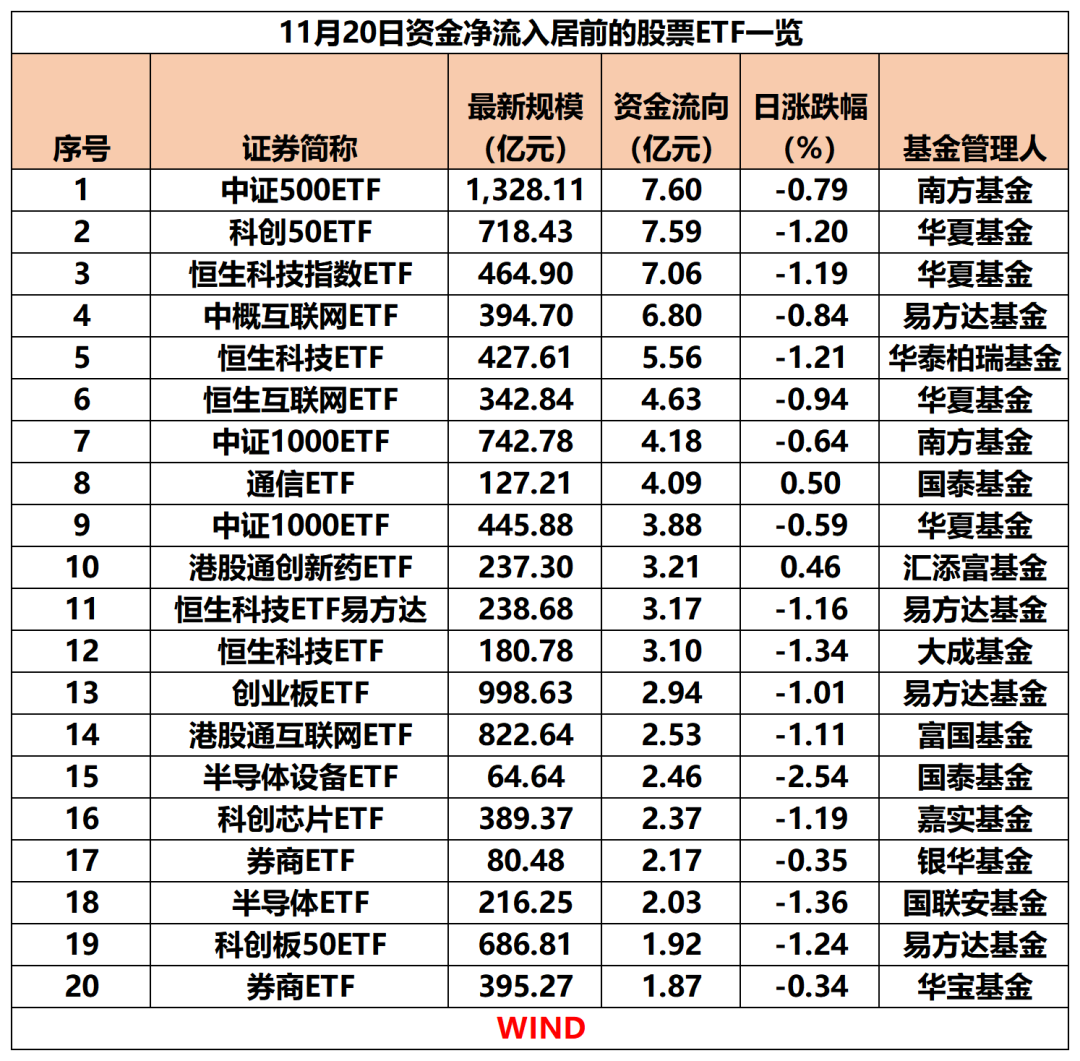
Group 1 - On November 20, the overall net inflow of stock ETFs reached 9 billion yuan, with a total inflow of nearly 28.5 billion yuan since November 17 [1][2] - The top five sectors for inflow included Hang Seng Technology (2.35 billion yuan), Semiconductors (1.15 billion yuan), and the Sci-Tech 50 Index (1.08 billion yuan) [2] - The top five sectors for outflow were the CSI 300 Index (1.2 billion yuan), New Energy (910 million yuan), and Banking (600 million yuan) [2] Group 2 - As of November 20, the latest scale of E Fund's ETF reached 810.53 billion yuan, with a net inflow of 1.57 billion yuan on the previous day [2] - The net inflow for E Fund's China Concept Internet ETF was 680 million yuan, while the Hang Seng Technology ETF saw a net inflow of 320 million yuan [2] - Huaxia Fund's Sci-Tech 50 ETF and Hang Seng Technology Index ETF had the highest net inflows of 759 million yuan and 706 million yuan, respectively [3] Group 3 - The leading ETFs for net inflow included the CSI 500 ETF, Sci-Tech 50 ETF, and CSI 1000 ETF, while popular thematic ETFs like Securities ETF and Banking ETF experienced significant outflows [4][6] - The net outflow from the Securities ETF was 505 million yuan, and the Banking ETF saw a net outflow of 433 million yuan [6] - Market analysts suggest that the current A-share market is experiencing a technology-led structural market, with a strong long-term outlook for sectors like semiconductors and innovative technologies [6][7]
中国公募基金的最大外资买家在买什么?
Sou Hu Cai Jing· 2025-11-21 05:40
Core Insights - The article discusses the increasing interest of foreign institutional investors, particularly Barclays Bank, in Chinese public funds and their global asset allocation strategies [2][4][8]. Group 1: Investment Trends - Barclays Bank has become the largest foreign institutional buyer in the Chinese public fund market, holding over 200 products and creating a vast investment portfolio across four continents [2][4]. - The issuance of two Brazil ETFs by Chinese fund companies marks the first time domestic funds have entered the South American capital market, indicating an expansion of public fund cross-border ETF offerings [3][4]. - Foreign capital is continuously flowing into Chinese public products, with UBS increasing its holdings in Chinese ETFs from 57 to 141 within a year [2][4]. Group 2: Barclays' Investment Strategy - Barclays invested approximately 1.4 billion yuan in the two Brazil ETFs, becoming the largest holder with over 30% of the shares in one fund and nearly 25% in the other [4][6]. - The bank's investment strategy reflects a diversified approach, utilizing Chinese public funds to access global markets, including significant holdings in Hong Kong and U.S. ETFs [6][10]. - Barclays' asset allocation framework consists of 45% in Hong Kong stocks, 27% in U.S. stocks, and smaller allocations in other regions, showcasing a balanced global investment strategy [13]. Group 3: Market Performance and Risks - The Brazil IBOVESPA index, which the ETFs track, has shown a 10-year annualized return of over 12% and a current P/E ratio of 10.37, indicating potential investment value despite some risks associated with domestic political and currency fluctuations [4][5]. - Barclays has demonstrated a proactive investment approach, increasing holdings in key ETFs during market downturns, which has led to significant valuation recovery [14]. - Despite a diversified strategy, Barclays has faced challenges with individual stock selections, highlighting the complexities of investing in emerging markets [15].

越跌越买!抄底来了
中国基金报· 2025-11-21 05:34
Core Viewpoint - The stock ETF market in China has seen significant inflows, with a total of 90 billion yuan on November 20, and nearly 285 billion yuan since November 17, indicating a trend of "buying on dips" in the market [2][3][4]. Fund Inflows - On November 20, the overall net inflow for stock ETFs (including cross-border ETFs) reached 90 billion yuan, bringing the total scale to 4.57 trillion yuan [5]. - The top five sectors for inflows included Hang Seng Technology (23.5 billion yuan), Semiconductors (11.5 billion yuan), Sci-Tech 50 Index (10.8 billion yuan), Hong Kong Internet (8.9 billion yuan), and Gold (8.7 billion yuan) [5]. - The leading fund companies included E Fund, with a total ETF scale of 810.53 billion yuan and a net inflow of 15.7 billion yuan on November 20 [5]. Fund Outflows - The top five sectors for outflows were the CSI 300 Index (-12.0 billion yuan), New Energy (-9.1 billion yuan), Banks (-6.0 billion yuan), Computers (-2.5 billion yuan), and Media (-2.5 billion yuan) [5]. - Popular theme ETFs such as Securities ETFs, Bank ETFs, and Battery ETFs experienced significant outflows, with multiple CSI 300 ETFs leading the outflow rankings [10]. Investment Trends - The current A-share market is undergoing a technology-led structural market, with a strong long-term outlook for sectors like semiconductors, innovative technology products, and innovative pharmaceuticals [12]. - The "anti-involution" trend is creating structural opportunities in sectors like new energy and is expected to reshape the overall manufacturing ecosystem, with a focus on semiconductors, new energy smart vehicles, and biopharmaceuticals [12]. - As the year-end approaches, institutional funds are expected to focus more on the 2026 economic outlook, with a clearer investment direction in the technology sector and traditional manufacturing with improving profit expectations [12].

红利板块集体调整,恒生红利低波ETF(159545)获资金持续布局
Sou Hu Cai Jing· 2025-11-21 05:18
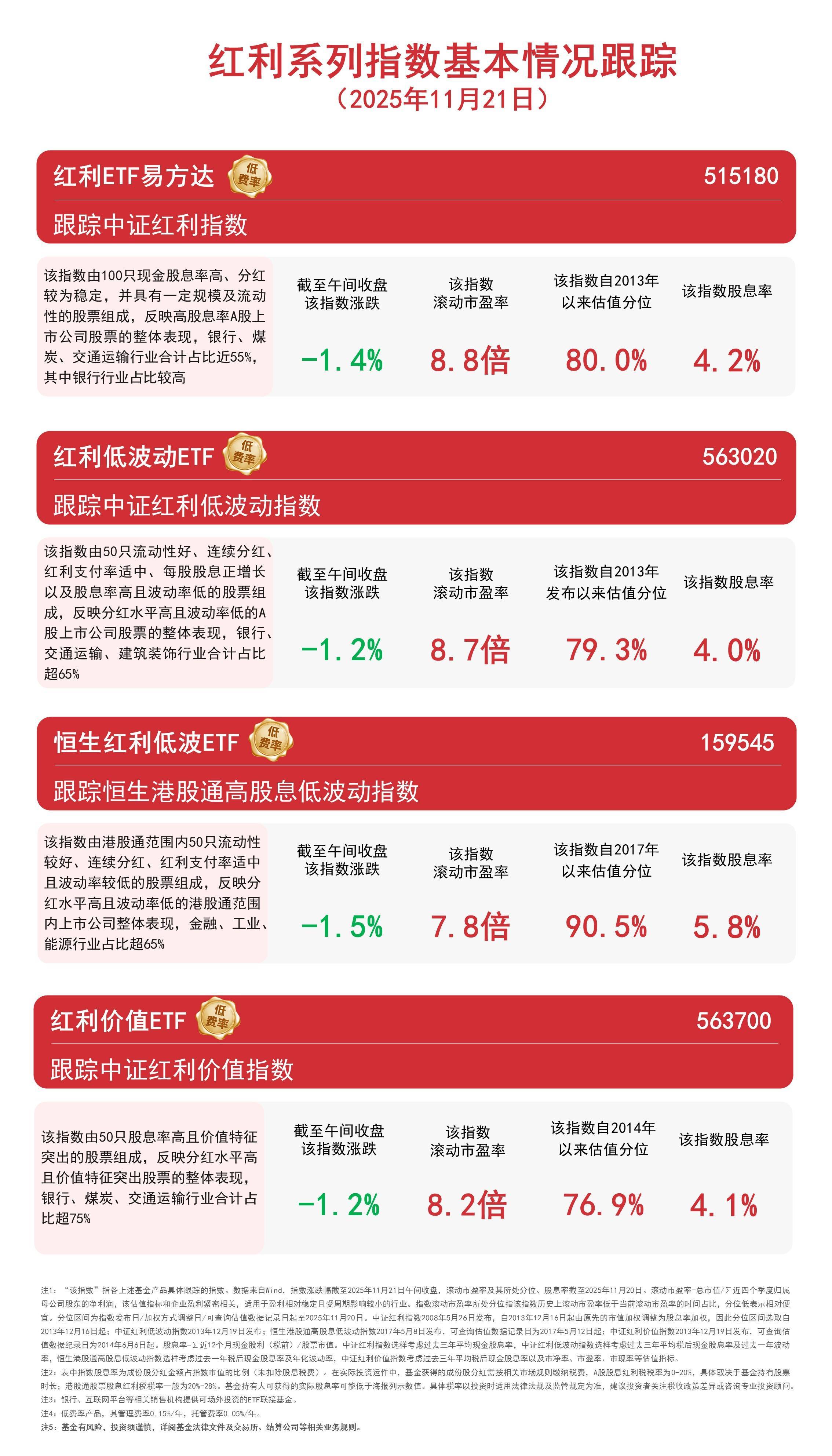
Core Viewpoint - The market is experiencing a downturn, with high dividend assets showing relatively smaller declines, indicating a potential shift in investor preference towards lower volatility investments [1][4]. Group 1: Market Performance - As of the midday close, the CSI Dividend Low Volatility Index and CSI Dividend Value Index both fell by 1.2%, while the CSI Dividend Index decreased by 1.4% [1]. - The Hang Seng High Dividend Low Volatility Index dropped by 1.5%, with the Hang Seng Dividend Low Volatility ETF (159545) seeing a net subscription of approximately 20 million units for the half-day [1]. - The Hang Seng Dividend Low Volatility ETF has experienced a cumulative net inflow of over 1.2 billion yuan this month [1]. Group 2: Fund Management - E Fund is currently the only fund company that implements low fee rates for all its dividend ETFs, with management fees set at 0.15% per year for products such as the Hang Seng Dividend Low Volatility ETF (159545) and others [1]. - This low-cost structure is designed to assist investors in building positions in high dividend assets [1]. Group 3: Index Composition - The indices consist of 50 stocks with good liquidity, continuous dividends, moderate dividend payout ratios, positive growth in earnings per share, and high dividend yields with low volatility [4][6]. - The banking, transportation, and construction industries collectively account for over 65% of the composition of the CSI Dividend Low Volatility Index [4]. - In the case of the Hang Seng Dividend Low Volatility Index, the financial, industrial, and energy sectors also represent over 65% of its composition [6].
爆发式增长!突破2500亿元
Zhong Guo Zheng Quan Bao· 2025-11-21 04:25
Core Insights - Domestic index investment has experienced explosive growth this year, with ETF product issuance entering a "fast lane" [1] - As of November 20, the number of newly established domestic ETFs and the total issuance scale have reached historical highs, surpassing 250 billion yuan, representing a doubling compared to 2024 [2] Group 1: ETF Product Growth - A total of 328 new ETFs have been established this year, with a combined issuance scale exceeding 250 billion yuan, marking a historical high [2] - The newly launched bond ETFs include 24 and 8 public fund institutions participating in the Sci-Tech Bond ETF and Benchmark Market Credit Bond ETF, with issuance scales of 69.773 billion yuan and 21.710 billion yuan respectively [2] - Equity ETFs focusing on themes such as "Double Innovation" and Hong Kong technology have gained popularity among public fund institutions, leading to significant increases in related index product allocations [2] Group 2: Performance of Newly Established ETFs - Newly established ETFs tracking themes like "Double Innovation," cash flow, and Hong Kong innovative pharmaceuticals have generally seen scale growth, with new scales exceeding 5 billion yuan for several products [3] - ETFs tracking the Sci-Tech Composite Index and the CSI A500 have seen a reduction in scale, with decreases of over 12 billion yuan and 7 billion yuan respectively [3] Group 3: Market Dynamics and New Entrants - The "Matthew Effect" continues in the ETF business, with major index firms actively expanding their ETF product lines while other public fund institutions explore differentiated and specialized strategies [4] - Major fund companies like E Fund, Fortune Fund, and Huaxia Fund have established over 20 new ETFs this year, with issuance scales of 18.828 billion yuan, 15.994 billion yuan, and 15.581 billion yuan respectively [4] - Smaller public fund institutions are also entering the ETF market, with companies like Changjin Heixin and Great Wall Fund launching their first ETFs this year [6]
上海新阳股价涨5.01%,易方达基金旗下1只基金重仓,持有3.4万股浮盈赚取9.62万元
Xin Lang Cai Jing· 2025-11-21 03:49
Group 1 - Shanghai Xinyang's stock price increased by 5.01% to 59.32 CNY per share, with a trading volume of 820 million CNY and a turnover rate of 5.08%, resulting in a total market capitalization of 18.59 billion CNY [1] - The stock has risen for three consecutive days, with a cumulative increase of 6.18% during this period [1] - Shanghai Xinyang Semiconductor Materials Co., Ltd. specializes in the research, production, sales, and service of key process materials and supporting equipment for integrated circuit manufacturing and advanced packaging, as well as environmentally friendly functional coatings [1] Group 2 - The main business revenue composition includes integrated circuit materials (74.93%), coatings (20.86%), supporting equipment and accessories for integrated circuit materials (2.76%), integrated circuit plating processing (1.34%), and others (0.11%) [1] - E Fund's ETF, which focuses on semiconductor materials and equipment, holds 34,000 shares of Shanghai Xinyang, accounting for 0.18% of the fund's net value, ranking as the sixth-largest holding [2] - The fund has generated a floating profit of approximately 96,200 CNY today and 111,900 CNY during the three-day increase [2] Group 3 - The fund manager of E Fund's ETF is Li Shujian, who has been in the position for 2 years and 75 days, with a total asset scale of 20.057 billion CNY [3] - During Li's tenure, the best fund return was 98.06%, while the worst return was -7.78% [3]

易方达基金陈逸来:破解“资产荒”,被动投资有三大优势
2 1 Shi Ji Jing Ji Bao Dao· 2025-11-21 03:49
陈逸来认为,一是成本优势。ETF等指数产品的运作成本更低,这在低利率环境下至关重要。成本端的节省成为低收益环境中 增厚回报的关键因素。 二是提供相对具有确定性的β机会,目前市场上的ETF覆盖了绝大多数行业及主题赛道,无论是机构投资者还是个人投资者,都 能在丰富的ETF标的中找到适配需求的选择,拓宽资产配置边界。 21世纪经济报道记者 庞成 深圳报道 当前,全球已进入降息大周期,"资产荒"成为资管行业热议的核心问题,不少资管机构正在从被动投资策略中寻找破局之道。 11月20日,以"立足湾区投资全球"为主题的2025湾区财富大会在深圳会展中心举行。在20日下午举行"市场前瞻:量化策略和被 动投资趋势"主题讨论环节上,易方达基金指数高级研究员陈逸来表示,在低利率环境下,优质高收益资产愈发稀缺。而此时, 被动投资的优势愈发凸显,尤其ETF产品,凭借三大核心特质,成为破解"资产荒"的重要配置方案。 三是天然具备分散化特征,ETF通过跟踪一篮子标的实现投资,天生具有分散风险的属性。在市场波动放大的背景下,这种分 散化配置能帮助投资者平滑收益波动,获取更稳健的投资回报。 2025湾区财富大会由21世纪经济报道、深圳金博会运 ...

两市ETF两融余额减少28.21亿元丨ETF融资融券日报
2 1 Shi Ji Jing Ji Bao Dao· 2025-11-21 03:15
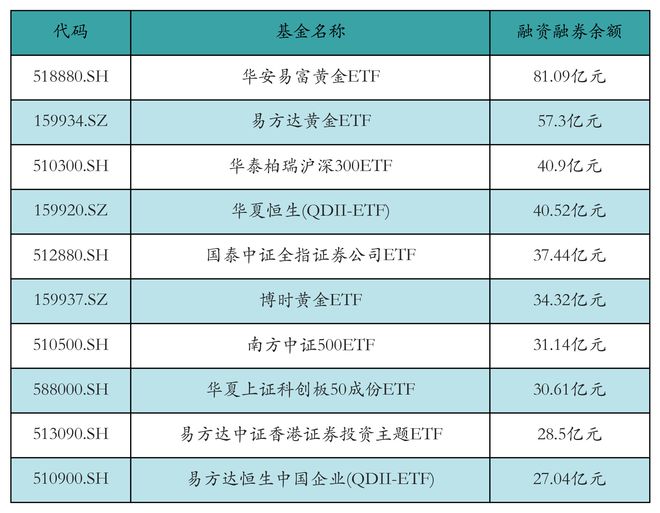
Market Overview - As of November 20, the total ETF margin balance in the two markets is 120.919 billion, a decrease of 2.821 billion from the previous trading day [1] - The financing balance is 113.28 billion, down by 2.566 billion, while the margin short balance is 7.639 billion, decreasing by 0.255 billion [1] - In the Shanghai market, the ETF margin balance is 84.407 billion, down by 2.443 billion, with a financing balance of 77.726 billion, decreasing by 2.172 billion [1] - The Shenzhen market's ETF margin balance is 36.512 billion, down by 0.379 billion, with a financing balance of 35.553 billion, decreasing by 0.394 billion [1] ETF Margin Balance - The top three ETFs by margin balance on November 20 are: - Huaan Yifu Gold ETF (8.109 billion) - E Fund Gold ETF (5.73 billion) - Huatai-PB CSI 300 ETF (4.09 billion) [2] - The detailed top 10 ETFs by margin balance are provided in the table [2] ETF Financing Amount - The top three ETFs by financing amount on November 20 are: - Huatai-PB Southbound Hang Seng Technology Index (1.467 billion) - E Fund CSI Hong Kong Investment Theme ETF (1.241 billion) - Bosera CSI Convertible Bonds and Exchangeable Bonds ETF (0.951 billion) [3] - The detailed top 10 ETFs by financing amount are provided in the table [4] ETF Net Financing Amount - The top three ETFs by net financing amount on November 20 are: - Huaxia Shanghai Stock Exchange Sci-Tech Innovation Board 50 ETF (88.5893 million) - Huatai-PB Southbound Hang Seng Technology Index (58.9784 million) - Southern CSI 500 ETF (58.7087 million) [5] - The detailed top 10 ETFs by net financing amount are provided in the table [6] ETF Margin Short Selling Amount - The top three ETFs by margin short selling amount on November 20 are: - Southern CSI 500 ETF (37.8834 million) - Huatai-PB CSI 300 ETF (37.877 million) - Huaxia CSI A500 ETF (25.0182 million) [7] - The detailed top 10 ETFs by margin short selling amount are provided in the table [8]