
大疆

Search documents
军工早参|天舟九号开启太空征程,重要会议今日召开
Mei Ri Jing Ji Xin Wen· 2025-07-16 01:52
Core Viewpoint - The military industry is expected to experience a turning point in orders as the "centenary goal of military building" enters its second half, with new technologies and products driving market directions and potential growth [4]. Group 1: Market Performance - On July 15, the three major indices showed mixed results, with the Shanghai Composite Index down 0.42%, while the Shenzhen Component Index rose by 0.56% and the ChiNext Index increased by 1.73% [1]. - The aerospace sector experienced a short-term correction, with the National Aerospace Index declining by 0.70%, where 11 stocks rose and 39 fell [1]. - The Aviation and Aerospace ETF (159227) fell by 0.82%, closing at 1.091 yuan, with a trading volume of 99.83 million yuan and a total scale of 570 million yuan, ranking first among ETFs [1]. Group 2: Industry Events - The 12th Aviation Power and Gas Turbine Conference is scheduled to take place in Shanghai from July 16 to 18 [2]. - The Tianzhou-9 cargo spacecraft successfully completed its launch on July 15, marking a significant achievement in China's space endeavors [2]. - Uzbekistan is reportedly finalizing a deal to purchase the JF-17 "Thunder" fighter jets, which would make it the fourth export customer for this aircraft, enhancing China's military trade system [2]. - A space-themed park is set to be constructed in Shanghai, integrating aerospace technology with cultural tourism [2]. Group 3: Institutional Insights - Zhongyou Securities anticipates that the military industry will see a turning point in orders, driven by new technologies and market directions [4]. - Northeast Securities notes that the military industry is experiencing a recovery in downstream demand, with clear long-term goals set for 2035 and 2050, indicating a positive outlook for the defense sector [4]. Group 4: Related Products - The Aviation and Aerospace ETF (159227) closely tracks the National Aerospace Index, focusing on core military aerospace sectors, with a high concentration of 98.2% in the primary military industry [5]. - The ETF is considered an efficient tool for investing in leading "fighter jet stocks," with a significant weight of 66.5% in aerospace equipment within its constituent stocks [5].
中金2025下半年展望 | 消费电子:AI重构创新边界
中金点睛· 2025-07-15 23:49
Core Viewpoint - The consumer electronics industry is expected to grow in the second half of 2025, driven by the gradual implementation of edge AI across multiple terminals, hardware upgrades in AI smartphones, innovations in AI wearable devices, and a revival in the optical industry [1]. Group 1: Mobile & Optical Market - The smartphone market demand is expected to remain stable in the second half of 2025, with IDC projecting a global smartphone shipment growth rate of 0.6% for 2025 and a CAGR of 1.4% over the next five years [4]. - The trend of optical upgrades in smartphones is anticipated to continue, leading to double-digit market growth, with a focus on innovations such as larger sensors, hybrid glass-plastic lenses, and module structure upgrades [4]. - The optical industry is expected to see improved profitability due to capacity utilization recovery and rational price competition [26][31]. Group 2: Edge AI Hardware - The penetration of AI smartphones into mid-range price segments is expected to accelerate, with Canalys forecasting a global AI smartphone penetration rate of 34% by 2025, increasing to 50% by 2027 [5]. - Innovations in AI wearable devices, particularly AR/MR products, are expected to enhance user interaction and experience, with lightweight designs becoming a trend in 2024 [5]. - The emergence of new terminal forms, such as panoramic cameras, is anticipated to meet the growing demand for "recording life" [5]. Group 3: Edge AI Software - The rapid development of AI Agent technology is expected to reshape human-computer interaction and create new ecological models, with AI Agents likely to become new traffic entry points on mobile devices [5]. - The introduction of innovative AI Agents, such as Manus, demonstrates the potential for multi-agent models to facilitate the widespread adoption of AI in consumer applications [50][51]. Group 4: Market Review and Outlook - The consumer electronics sector in A-shares has seen a decline in valuation due to tariff uncertainties, with the overall PE ratio for the sector at 29.2 times as of July 4 [9]. - The Hong Kong stock market for consumer electronics has experienced significant valuation fluctuations, with the PE ratio recovering to 17.1 times, slightly above the historical median [12]. - The smartphone market is expected to maintain stable demand, with a focus on innovations in edge AI and foldable screens [13]. Group 5: Performance and Growth - The consumer electronics sector reported a revenue growth of 21% and a net profit growth of 2% in the first quarter of 2025, driven by the launch of new iPhone models and expansion into new business areas [23]. - The global smartphone camera module market is projected to see a mild recovery, with shipments expected to reach 45.6 billion units in 2025, reflecting a 2.2% year-on-year growth [27]. Group 6: AI and Innovation - The integration of AI into smartphones is expected to drive upgrades in components such as chips, thermal management, and battery technology, enhancing user upgrade intentions [39][40]. - The rise of consumer-grade 3D printing is anticipated to support the growth of the consumer electronics supply chain, with significant increases in production and sales volumes [42][44]. - The demand for handheld smart imaging devices is projected to grow, with the market size expected to reach 600 billion yuan by 2027 [45].


中金 | 手持智能影像设备:全景拓界,运动引航
中金点睛· 2025-07-15 23:49
Core Viewpoint - The handheld smart imaging device market is rapidly growing, driven by differentiated innovations from brands like GoPro, Insta360, and DJI, as well as the increasing consumer demand for "recording life" experiences [1][3]. Market Overview - The global handheld smart imaging device market is approaching a scale of 60 billion yuan, with GoPro, Insta360, and DJI dominating the market. The market is characterized by portability, diverse shooting methods, and low usage barriers, primarily divided into action cameras and panoramic cameras [3][7]. - In 2023, the global smart action camera market is valued at 31.4 billion yuan, while the mobile panoramic camera market is at 5 billion yuan. By 2027, these figures are expected to reach 51.4 billion yuan and 7.9 billion yuan, respectively [3][13][19]. Industry Dynamics - The emergence of the "recording life" demand and the expansion of application scenarios are key to manufacturers' differentiation. Handheld smart imaging devices are expected to become essential accessories for smartphones, similar to smartwatches and TWS earbuds [3][31]. - The market is projected to see a shipment volume exceeding 100 million units in the long term, driven by both outdoor sports enthusiasts and vlog users [34][35]. Competitive Landscape - The action camera market is led by GoPro and DJI in the mid-to-high-end segment, while the entry-level market is dominated by white-label manufacturers. Insta360 holds a significant share in the panoramic camera market [3][16][21]. - GoPro's decline is attributed to internal factors such as a shift in focus and slowed innovation, as well as external competition from brands like DJI and Insta360 [39][40][44]. Supply Chain Insights - The supply chain for handheld smart imaging devices primarily consists of SoC/DSP and optical modules, with software developed in-house by manufacturers. The cost structure indicates that SoC/DSP accounts for approximately 33% and optical modules for 27% of the total material costs [4][55]. - The optical module market is expected to maintain higher profit margins compared to the smartphone sector, with key suppliers including domestic companies [59]. Future Outlook - The market for handheld smart imaging devices is anticipated to grow significantly, with a potential shipment volume of 140 million units in the long term. This growth is supported by the increasing number of outdoor sports enthusiasts and the rising popularity of short video content creation [34][35][36]. - The industry is characterized as a "shallow sea market," where differentiation can help maintain high profit margins despite increasing competition [49].



为关税铺路?美国商务部调查无人机、多晶硅,专家:对美自身影响也较大
Huan Qiu Shi Bao· 2025-07-15 22:54
Group 1 - The U.S. Department of Commerce has initiated two investigations related to drone systems and their components, as well as a national security investigation into polysilicon and its derivatives used in solar panels and semiconductors, potentially paving the way for higher tariffs on these imports [1][2] - The investigations were launched under Section 232 of the Trade Expansion Act, with results expected within 270 days, and public comments due by August 6 [1] - The investigations may lead to additional tariffs if deemed necessary for national security, following previous actions against imports of steel and aluminum [1][3] Group 2 - The U.S. aims to localize its drone supply chain to a "national security" level, but this may disrupt the global drone supply chain and could lead to inefficiencies in producing high-quality drones domestically [2] - China dominates the market for commercial drones, producing 70% to 80% of the global supply, and holds an 80% market share in polysilicon production [2] - U.S. efforts to impose targeted tariffs and restrictions on Chinese imports reflect a strategic shift in trade policy, focusing on specific sectors rather than broad technology restrictions [3]
中企出海如何构建“能力矩阵”
经济观察报· 2025-07-15 10:29
Core Viewpoint - The article emphasizes that Chinese companies are entering a new wave of globalization, facing both opportunities and challenges. The key to success lies in capability building, long-term strategic focus, and leveraging existing advantages to achieve higher goals and global capabilities [2][37]. Existing Advantages - Chinese companies currently possess strong advantages in technological innovation, large-scale manufacturing, and supply chain organization, which are crucial for transforming these strengths into core competitiveness in international markets [4]. - In emerging fields like new energy and artificial intelligence, Chinese companies have reached a leading global position. For instance, BYD's blade battery technology and DJI's drone control systems are benchmarks in their respective markets [5]. - The speed of technological iteration is vital for maintaining competitive advantage. Companies like Huawei and CATL are heavily investing in R&D to ensure continuous innovation and market leadership [6][8]. High-Level Goals - Chinese companies need to invest in brand value, standard-setting, and industry influence to gradually move upstream in the value chain and lead the future direction of industries globally [10]. - The ultimate goal for Chinese companies should be to build globally recognized and reputable brands, moving from OEM reliance to establishing their own brand identities [11][12]. - Mastering technical standards is essential for controlling industry ecosystems and value chain distribution. The case of Chinese electric vehicles in Indonesia illustrates the importance of aligning with local standards to avoid competitive disadvantages [13][14]. Global Capabilities - Compliance capability, cross-cultural management, and understanding international dynamics are essential elements for Chinese companies throughout their globalization process [21]. - Initially, companies may struggle with compliance due to a lack of understanding of local laws and regulations. As they mature, they must develop a comprehensive compliance system to manage risks effectively [22][24]. - Cross-cultural management is crucial for building trust and integrating local practices. Companies should focus on cultural sensitivity and flexible management to navigate cultural differences [27][28]. - Understanding international dynamics is vital for risk management. Companies need to establish local information networks and resilient supply chains to mitigate geopolitical risks [29][30]. Conclusion - The essence of globalization for Chinese companies is a race between capability evolution and environmental complexity. Companies must maintain a long-term perspective and continuously enhance their global capabilities to thrive in the new era of globalization [35][37].

全球独角兽何以深圳最快 超万家潜力股蓄势待发
2 1 Shi Ji Jing Ji Bao Dao· 2025-07-15 04:02
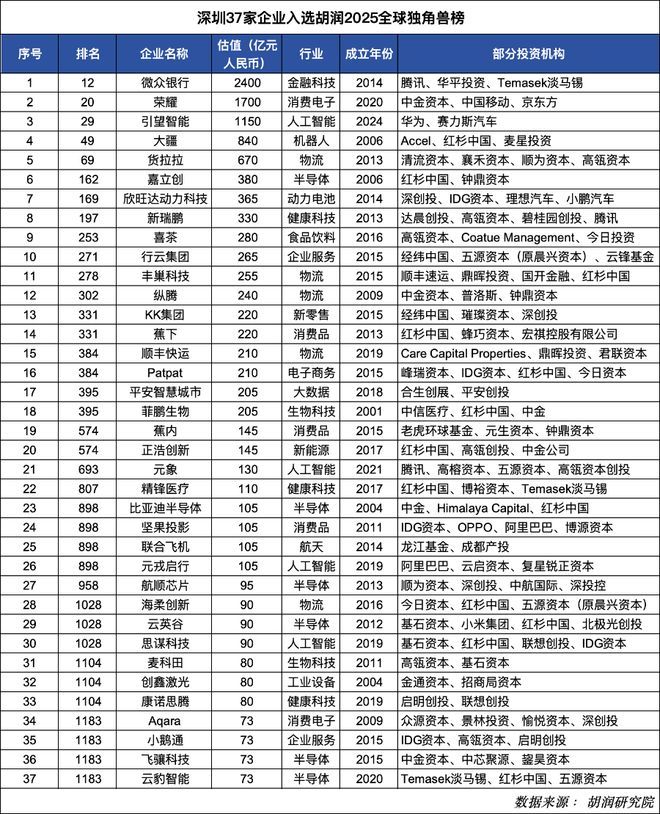
Core Insights - The recent Hurun Global Unicorn List indicates that Shenzhen is home to 37 unicorn companies, making it the fastest-growing city for unicorns in China and ranking third nationally and sixth globally [2][7] - Over 80% of these unicorns focus on "hard technology," with significant representation from the semiconductor and artificial intelligence sectors [3][7] - Shenzhen's robust industrial ecosystem and innovation collaboration are key factors in nurturing these unicorns, with many emerging from established large enterprises [8] Industry Overview - Shenzhen's industrial strategy emphasizes the "20+8" layout, promoting sectors like robotics, semiconductors, and renewable energy, which are experiencing explosive growth [3][7] - The semiconductor industry leads with six unicorns, while artificial intelligence follows with four [3] - The presence of over 10,000 specialized and innovative SMEs in Shenzhen positions the city as a strong contender for future unicorns [7][8] Company Highlights - Notable unicorns include WeBank (valued at 240 billion RMB), Honor (170 billion RMB), and DJI (84 billion RMB), with their valuations reflecting their market positions and growth potential [6] - Honor is undergoing an AI transformation and plans to invest over 10 billion USD in building an AI ecosystem over the next five years [4] - WeBank leads in the global digital banking sector, with nearly half of its customers from lower-tier cities, while Lalamove leverages big data and AI for logistics solutions [5][6]
印度生产基地成形,伯恩光学会否重启IPO计划?
BambooWorks· 2025-07-15 02:07
Core Viewpoint - The article discusses the potential for Bern Optical, a glass supplier for smartphones, to restart its IPO plans in Hong Kong, driven by strong recent performance in the Hong Kong IPO market and the company's expansion efforts in India and Vietnam [1][3]. Group 1: IPO Market Performance - The year 2025 is projected to be one of the strongest years for IPOs in Hong Kong in the last decade, potentially dubbed the "Year of Glass" [3]. - A competitor of Bern Optical recently raised HKD 4.8 billion (USD 611 million) in Hong Kong, leading to speculation that Bern Optical may seek a higher amount for its IPO [3]. - Bern Optical's previous attempt to go public in Hong Kong was in 2022, with plans to raise up to USD 2 billion, significantly more than its competitor [3][9]. Group 2: Company Expansion and Strategy - Bern Optical is establishing a new production base in India and expanding in Vietnam to diversify its manufacturing footprint in response to customer demand [2]. - The company is a key supplier for Apple, Samsung, Honor, and Xiaomi, and its partnership with Apple is driving its entry into the Indian market [5][6]. - Apple currently produces about 20% of its iPhones in India and plans to increase this to one-third in the next two years, encouraging suppliers like Bern Optical to establish local production [6]. Group 3: Financial and Operational Insights - Bern Optical has a total investment of HKD 40 billion globally, with a combined annual production capacity of 1.85 billion units from its factories in China and Vietnam [6]. - The company is expected to generate approximately USD 1 billion in revenue from its joint venture in India over the first four to five years [7]. - As a non-listed company, Bern Optical's financial information is limited, but its revenue was approximately HKD 30 billion as of the fiscal year ending March 2021 [8]. Group 4: Competitive Landscape - Compared to its competitor, Lens Technology, which has most of its production in China, Bern Optical's move into India may provide a competitive advantage by better serving clients shifting production to India [7]. - Bern Optical's higher gross margins may allow it to achieve a valuation premium compared to competitors with lower profit margins [8]. Group 5: Market Context - The Hong Kong IPO market has seen a resurgence with 44 new listings and USD 13.6 billion raised, marking a return to the top of the global rankings [9]. - Bern Optical's potential IPO could enhance its international visibility and attract global investors, similar to other companies that have pursued dual listings [9].

影石创新(688775):深度报告:高速成长的全景相机全球龙头
Guoxin Securities· 2025-07-14 12:21
Investment Rating - The report assigns an "Outperform" rating to the company for the first time, with a reasonable valuation range of 183.47 to 207.93 CNY per share [4][6]. Core Insights - The company, Yingshi Innovation, is a global leader in panoramic cameras and ranks among the top three in the action camera market, driven by technological advancements in smart imaging devices [1][12]. - The company has experienced rapid revenue growth, with a compound annual growth rate (CAGR) of 66.2% from 2017 to 2024, reaching 5.57 billion CNY in revenue and a net profit of 9.9 billion CNY in 2024, reflecting a CAGR of 106.5% [1][19]. - The smart portable imaging device industry is in an upward product cycle, with expected sales growth in China at a CAGR of 41% from 2024 to 2027, and overseas markets projected to grow at 35% during the same period [2][30]. Company Overview - Yingshi Innovation specializes in the research, production, and sales of smart imaging devices, including panoramic and action cameras, with over 86% of its revenue coming from consumer-grade cameras in 2024 [1][21]. - The company generates nearly 80% of its revenue from overseas markets, with significant contributions from North America, Europe, and other regions [22]. Competitive Advantages - The company has established strong competitive advantages through technological innovation, product development, and a comprehensive marketing system, including features like AI smart editing and advanced stabilization technology [3][19]. - Yingshi Innovation's market share in the global consumer panoramic camera market is 67.2%, and it ranks among the top three in the action camera sector [2][12]. Financial Performance - The company is expected to maintain robust growth, with projected net profits of 11.5 billion CNY, 16.5 billion CNY, and 23.4 billion CNY from 2025 to 2027, corresponding to earnings per share (EPS) of 2.87, 4.12, and 5.84 CNY [4][5]. - The company's revenue is primarily driven by consumer-grade imaging devices, which accounted for 86.6% of its main business revenue in 2024 [21][22]. Market Dynamics - The smart portable imaging device market is characterized by a concentration of major players, with Yingshi Innovation, DJI, and GoPro dominating the action camera segment [2][30]. - The industry is witnessing a shift towards higher sales volumes, with domestic sales expected to exceed 314 million units by 2024, driven by increasing demand from social media creators [32][39].
美关税重锤砸向加墨:北美产业链的裂变与重构
Sou Hu Cai Jing· 2025-07-14 11:31
Group 1: Automotive Manufacturing Chain Risks - The U.S. plans to tighten local content rules, increasing the domestic parts localization rate from 75% to 80%, creating a dilemma for Chinese auto parts manufacturers in Mexico [1] - In Mexico, there is a significant investment surge with $1.45 billion in Q1 2025, a 134% year-on-year increase, but hidden costs are becoming apparent [3] - The cost structure comparison shows that labor costs in the nearshore model in Mexico are 180% of traditional models, while compliance costs are higher due to USMCA origin verification requirements [3] Group 2: Energy Alliance Restructuring - The U.S. imposes a 10% tariff on imported mineral fuels, which constitutes 51.9% of U.S. imports, pressuring Chinese energy companies to accelerate LNG terminal construction and shift focus to Japan and South Korea, despite a 25% increase in transportation costs [2] - Chinese companies are also looking to process shale gas in Mexico, utilizing the tax-free zone at the U.S.-Mexico border to shift production capacity [2] - U.S. supply chain scrutiny is increasing, requiring rare earth companies to prepare comprehensive production evidence [2] Group 3: Export Strategies for U.S. Exporters - Tax base optimization strategies include using offshore companies for multi-layer transactions and splitting vehicle exports into parts to benefit from lower tariffs on intermediate goods [5] - Market access strategies involve leveraging Kazakhstan's auto parts park and utilizing UAE free trade zones for re-labeling to obtain "Arabian-made" certificates [5] - Technology-intensive companies are converting tariff costs into R&D investments and obtaining EU carbon footprint certifications to avoid carbon tariffs while achieving a 15% premium [5] Group 4: Broader Implications - The conflict illustrates the harsh reality that in the "G0 era" of de-globalization, supply chain resilience is no longer based on tight interdependence but rather on redundant backups to withstand turmoil [7] - The North American free trade ideal is being fragmented by zero-sum games, as Mexico finds itself caught between U.S. tariff wars and nearshore outsourcing opportunities [7]

关税阻碍进口,大疆无人机在美国售罄
Guan Cha Zhe Wang· 2025-07-14 08:39
Core Insights - The impact of U.S. tariffs on imports is causing DJI's drones to disappear from U.S. e-commerce platforms [1][3] - DJI's entire drone series, including Mavic, Air, and Mini, is sold out in its online store due to market conditions and tariff policies [3] - The company is considering solutions to maintain its presence in the U.S. market but has not set a specific timeline [3] Market Dynamics - As of January 2024, the FAA reported 863,728 registered drones in the U.S., with 352,222 for commercial use and 506,635 for recreational purposes [4] - The North American drone market is projected to grow from $14.29 billion in 2025 to $27.16 billion by 2030, with a CAGR of 13.70% [4] Competitive Landscape - DJI holds a 90% market share in the U.S. commercial drone market, which is expected to remain stable due to increasing demand in agriculture, construction, maritime, and industrial sectors [5] - Despite previous bans on Chinese drones, DJI maintained a 76.1% market share as of July 2020 [5] - Concerns have been raised about the implications for U.S. public safety agencies if DJI is banned, as no U.S. company can match DJI's production capacity [8]
