中信保诚基金

Search documents
2026公募投资展望:这些方向被看好
Zhong Guo Zheng Quan Bao· 2026-02-19 10:53
Group 1 - A-shares are presenting structural opportunities amidst fluctuations, with public funds initiating a new round of investments in sectors like artificial intelligence, semiconductors, and consumption due to moderate economic recovery and accelerated industrial upgrades [1] - The manufacturing investment and A-share capital expenditure contraction are driving supply-demand rebalancing, providing support for corporate profits, while fiscal changes in special bonds will impact A-share pricing [2] - The market is expected to continue attracting significant incremental capital inflows in 2026, with major contributions from insurance funds and financing, while individual investors are primarily high-net-worth individuals with high-risk preferences [2] Group 2 - The AI sector is a focal point for public fund strategies, with expectations for continued strong performance in the AI industry chain in the first half of 2026, driven by breakthroughs in AI model capabilities and significant growth in annual recurring revenue from AI-native applications [4] - The semiconductor industry is experiencing rapid changes driven by AI large models, with a focus on domestic production and R&D, while non-AI semiconductor sectors may face pressure [5] - The consumption sector is anticipated to see a resurgence in investment opportunities in 2026, driven by the release of wealth effects and an upgrade in high-end and service consumption demands [5]
券商一年少近8000人,公募却九次刷新纪录:金融人正“用脚投票”
Xin Lang Cai Jing· 2026-02-15 14:47
Core Viewpoint - The financial industry is experiencing a significant migration trend, with professionals moving from brokerage firms to public funds, indicating a shift in resource allocation within the wealth management sector [3][17][24]. Group 1: Migration Trends - A notable number of brokerage employees have changed their careers to join public funds, exemplified by individuals like Zhao Binghao moving from CITIC Securities to Huazhang Fund [3][17]. - As of the end of 2025, the number of employees in securities companies is projected to decrease to 327,800, reflecting a net loss of nearly 8,000 in one year, while public fund assets are expected to reach 37.71 trillion yuan, marking an increase of nearly 5 trillion yuan [5][19]. Group 2: Reasons for Migration - The decline in commission rates and shrinking investment banking projects have led to reduced income for brokerage employees, making the once lucrative positions less attractive [7][20]. - In contrast, public funds are experiencing rapid growth, with a significant demand for investment research talent, as evidenced by the average management scale per employee exceeding 1.1 billion yuan [20][25]. Group 3: Characteristics of Migrating Professionals - Two main groups are migrating: experienced professionals returning to their roots in public funds and investment managers transferring their product management rights as part of a business transition [9][22]. - The migration is not merely a job change but reflects a strategic realignment in response to market demands and opportunities [24][26]. Group 4: Industry Dynamics - The surge in public fund assets is driven by a shift in consumer investment preferences, as traditional wealth management products face challenges, leading to increased inflows into public funds [11][25]. - The current trend signifies a structural transformation in China's wealth management industry, moving from a focus on brokerage services to a greater emphasis on product management and research capabilities [14][26].



成长价值基金池202602:持仓以周期为主
Guolian Minsheng Securities· 2026-02-14 13:21
1. Report Industry Investment Rating - Not provided in the report. 2. Core Viewpoints of the Report - The report aims to select the current growth - value funds in the market for investors with allocation needs. The growth - value strategy focuses on buying companies with competitive advantages at a reasonable price to earn compound growth. The growth - value fund pool shows both stability and offensiveness, with an annualized return of 18.30% from February 2, 2015, to February 6, 2026, and an excess return of 9.31% relative to the partial - stock fund index. The excess return mainly comes from stock selection, and the new portfolio has increased its position in the cyclical sector [1][2][12]. 3. Summaries According to the Directory 3.1 Growth Value Fund Pool Concept Introduction and Historical Performance - **Growth Value Investment Concept Introduction**: The growth - value strategy, popularized by Buffett, prefers companies with excellent business models and strong financials. The current PB_ROE factor return is rising, and the dispersion remains at a high level, indicating that the PB_ROE strategy still has investment advantages [10]. - **Growth Value Fund Pool: High Annual Win Rate**: From February 2, 2015, to February 6, 2026, the growth - value fund pool has an annualized return of 18.3%, an excess return of 9.31% relative to the partial - stock fund index, an annualized volatility of 20.74%, and an annualized Sharpe ratio of 0.88. It can obtain excess returns in bull markets and control drawdowns in market declines. Stock selection is the main source of excess returns, and the portfolio can outperform the partial - stock fund index in most years. In the new adjustment, the portfolio shows high - momentum and high - elasticity attributes, with a significant increase in the cyclical sector [12][14][16]. 3.2 Growth Value Fund Pool Definition and Screening - **Definition of Growth Value Funds**: Growth - value funds are defined by the relatively low - valuation characteristics of their holdings. The research objects are active equity funds, with specific requirements for sample capacity, concentrated holdings, and value exposure. Funds with negative average factor exposures in the PB_ROE factor during the management period and in the past year, ranking in the top 1/3, are defined as growth - value funds [23]. - **Selection of Growth Value Fund Pool**: The selected growth - value funds are those with high and stable industry + stock - selection + dynamic returns. Based on the comprehensive ranking of the momentum and IR of industry + stock - selection + dynamic returns in the past 12 months, the top 10 funds are selected equally weighted. The new portfolio includes 10 funds such as嘉实资源精选 A and银河价值成长 A [24]. 3.3 Multidimensional Analysis of Portfolio Funds - **嘉实资源精选 A**: It believes that resource stocks are not traditional cyclical stocks but have growth attributes. The investment logic focuses on "supply vulnerability constraints + structural growth in demand" [26]. - **银河价值成长 A**: It balances value and growth factors in investment, selects companies with both value and growth potential, and aims for long - term and stable appreciation of fund assets [28]. - **东方兴瑞趋势领航 A**: It focuses on in - depth research on corporate fundamentals, selects high - quality companies with reasonable prices, and pursues sustainable and stable returns [31]. - **华商上游产业 A**: The fund manager takes the industry life cycle as the core clue for investment decisions, focuses on the "cyclical + manufacturing" fields, combines a stable and flexible strategy, pursues absolute returns and risk control, and pays attention to macro and policy guidance [33]. - **中欧周期优选 A**: It analyzes from multiple perspectives of macro, meso, and micro to capture the long - term value of enterprises [35]. - **景顺长城周期优选 A**: Its investment style focuses on multiple indicators such as macro - economy, policy, and liquidity, prefers cyclical industries like non - ferrous metals and energy, and adjusts investment strategies based on historical data analysis [37]. - **融通产业趋势精选 A**: It deeply studies industry development trends, combines macro and micro analyses, pursues balanced and flexible asset allocation, emphasizes the balance between fundamentals and valuation, and adheres to a long - term investment concept [39]. - **新华行业周期轮换 A**: It combines top - down and bottom - up analysis methods, with a thinking mode of "macro - determining the direction, industry - seeking prosperity, and micro - screening companies" [42]. - **华夏景气驱动 A**: It emphasizes in - depth research on industry fundamentals, focuses on marginal changes in individual stocks and industries, and constructs an investment portfolio by selecting high - quality stocks with upward - trending industries and growth space [45]. - **中信保诚周期优选 A**: No specific analysis content is provided in the report.
绝对收益产品及策略周报(260202-260206):上周161只固收+基金创新高-20260211
GUOTAI HAITONG SECURITIES· 2026-02-11 08:35
绝对收益产品及策略周报(260202-260206) [Table_Authors] 郑雅斌(分析师) 上周 161 只固收+基金创新高 本报告导读: 股票端采用小盘价值组合+不择时的股债 10/90 和 20/80 月度再平衡策略,2026 年累 计收益分别为 1.36%和 2.53%。 投资要点: 金 融 工 程 周 报 固收+产品业绩跟踪。截至 2026 年 02 月 06 日,全市场固收+基金 规模 23568.03 亿元,产品数量 1166 只,其中 161 只上周净值创历 史新高。上周(20260202-20260206,下同)共新发 15 只产品,各 类型基金业绩中位数表现分化:混合债券型一级(0.07%)、二级(- 0.15%)、偏债混合型(-0.26%)、灵活配置型(-0.19%)、债券型 FOF (-0.29%)及混合型 FOF(-0.53%)。按风险等级划分,保守型、稳 健型、激进型基金中位数收益分别为 0.04%、-0.17%、-0.27%。 请务必阅读正文之后的免责条款部分 大类资产配置和行业 ETF 轮动策略跟踪。1)大类资产择时观点。 2026Q1 逆周期配置模型给出的宏观环境预 ...
雄塑科技股价连续4天下跌累计跌幅12.68%,中信保诚基金旗下1只基金持55.78万股,浮亏损失79.21万元
Xin Lang Cai Jing· 2026-02-11 07:21
Group 1 - The core point of the news is that Xiong Su Technology's stock has experienced a decline of 12.68% over the past four days, with a current price of 9.77 yuan per share and a market capitalization of 3.499 billion yuan [1] - Xiong Su Technology, established on November 1, 2004, and listed on January 23, 2017, specializes in the research, production, and sales of "environmental protection, safety, hygiene, and high-performance" plastic pipes [1] - The company's main business revenue composition includes PVC series pipes at 62.02%, PE series pipes at 28.23%, PPR series pipes at 9.00%, and other supplementary products at 0.75% [1] Group 2 - Citic Prudential Fund holds a significant position in Xiong Su Technology, with its fund, Citic Prudential Prosperity Selected Mixed A (020151), owning 557,800 shares, accounting for 0.45% of the fund's net value [2] - The fund has incurred a floating loss of approximately 79,210 yuan during the four-day decline, with a current estimated floating loss of about 133,900 yuan [2] - Citic Prudential Prosperity Selected Mixed A (020151) has a total scale of 188 million yuan, with a year-to-date return of 13.33% and a one-year return of 56.98% [2]

三星新材股价连续3天下跌累计跌幅8.57%,中信保诚基金旗下1只基金持69.02万股,浮亏损失95.94万元
Xin Lang Cai Jing· 2026-02-11 07:13
Group 1 - Samsung New Materials' stock price fell by 2.11% on February 11, closing at 14.83 yuan per share, with a trading volume of 139 million yuan and a turnover rate of 5.11%, resulting in a total market capitalization of 2.675 billion yuan [1] - The stock has experienced a continuous decline over three days, with a cumulative drop of 8.57% during this period [1] - The company, Zhejiang Samsung New Materials Co., Ltd., was established on June 24, 1999, and went public on March 6, 2017, focusing on the design, research and development, production, and sales of low-temperature storage equipment glass doors and deep-processed glass products [1] Group 2 - The main revenue composition of Samsung New Materials includes glass doors (58.63%), photovoltaic glass (35.43%), plastic products (2.47%), deep-processed glass (1.83%), and others (1.65%) [1] - Among the top ten circulating shareholders, CITIC Prudential Fund has a fund that entered the list, holding 690,200 shares, which accounts for 0.38% of the circulating shares [2] - The CITIC Prudential Multi-Strategy Mixed Fund (LOF) A has a current scale of 996 million yuan, with a year-to-date return of 11.94% and a one-year return of 50.56% [2]

标准股份股价连续4天下跌累计跌幅8.13%,中信保诚基金旗下1只基金持133.14万股,浮亏损失149.12万元
Xin Lang Cai Jing· 2026-02-11 07:10
Group 1 - Standard Shares experienced a decline of 3.21% on February 11, with a stock price of 12.66 CNY per share, a trading volume of 162 million CNY, a turnover rate of 3.65%, and a total market capitalization of 4.38 billion CNY [1] - The stock price of Standard Shares has fallen for four consecutive days, with a cumulative decline of 8.13% during this period [1] - Xi'an Standard Industrial Co., Ltd. was established on May 28, 1999, and listed on December 13, 2000, primarily engaged in the research, production, and sales of sewing equipment, with 96.62% of its revenue coming from sewing machinery products [1] Group 2 - CITIC Prudential Fund has a fund that ranks among the top ten circulating shareholders of Standard Shares, specifically the CITIC Prudential Multi-Strategy Mixed (LOF) A (165531), which entered the top ten in the third quarter with 1.3314 million shares, representing 0.38% of circulating shares [2] - The estimated floating loss for CITIC Prudential Multi-Strategy Mixed (LOF) A during the four-day decline is approximately 149.12 thousand CNY, with a current floating loss of about 55.92 thousand CNY [2] - The fund was established on June 16, 2017, with a latest scale of 996 million CNY, and has achieved a year-to-date return of 11.94%, ranking 966 out of 8,884 in its category [2]

149只权益基金净值创新高!押注AI者与稳健派谁更胜一筹?
2 1 Shi Ji Jing Ji Bao Dao· 2026-02-10 14:36
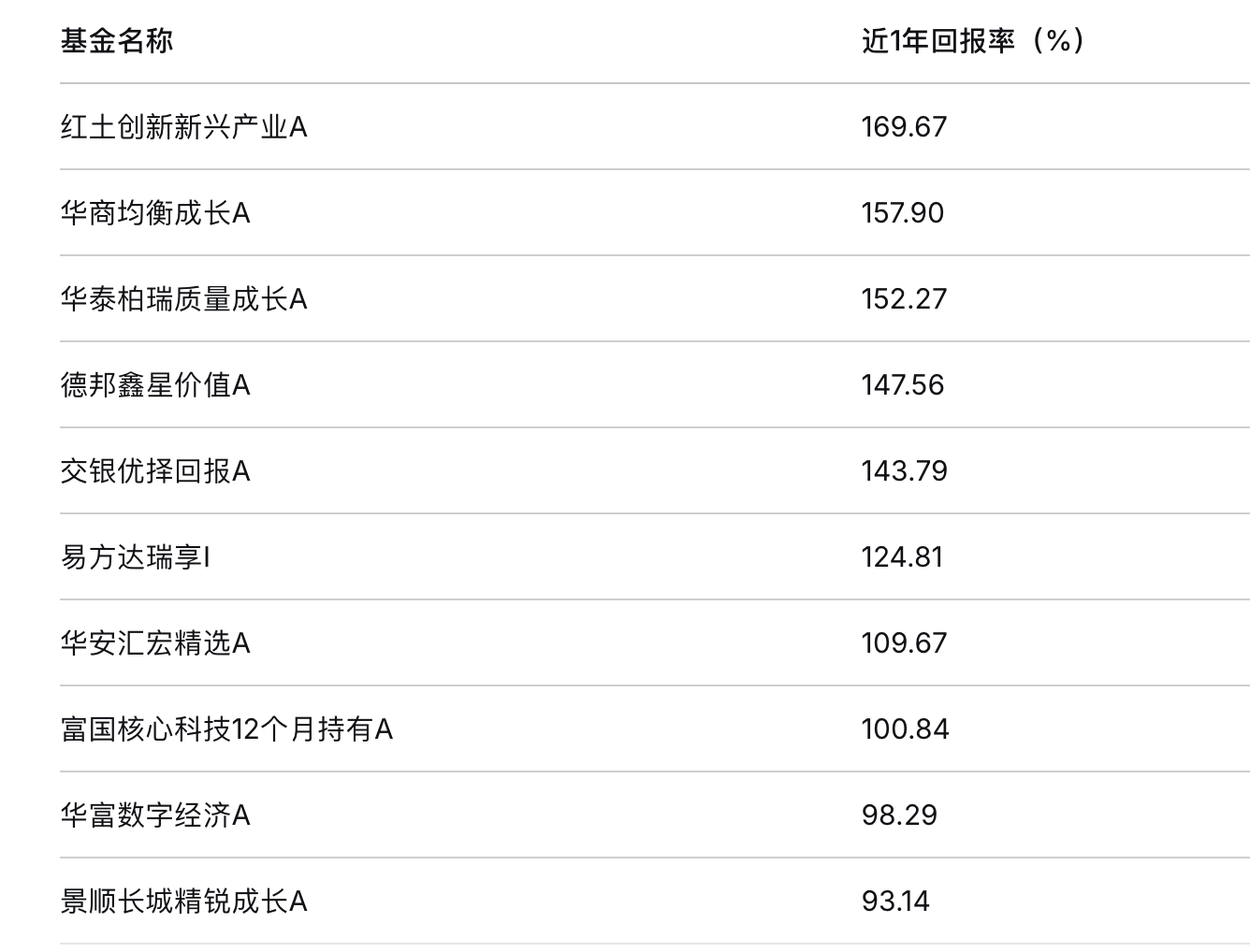
Core Viewpoint - The active equity funds in the A-share market have regained attention as 149 funds reached new net asset value highs, with some achieving over 100% returns in the past year, reflecting a structural market trend [1][3][8]. Fund Performance - As of February 9, 2026, 191 active equity funds recorded new highs in net asset value since inception, including 113 equity mixed funds, 56 flexible allocation funds, 20 active stock funds, and 2 balanced mixed funds [2]. - Excluding funds established for less than one year, 149 active equity funds achieved record highs in net asset value [3]. Investment Styles - The funds that reached new highs exhibit diverse investment styles, with some focusing on concentrated positions in AI-related sectors, leading to high returns but also significant volatility [4][5]. - Conversely, other funds prefer diversified holdings to mitigate risks, with examples showing low concentration in top holdings across various sectors [7]. Sector Preferences - Among the 149 funds, some have concentrated holdings in specific industries, resulting in notable performance when market conditions align. For instance, 7 funds had daily returns exceeding 7%, primarily those heavily invested in AI computing and applications [5][6]. - Funds like Jianxin Flexible Allocation and Huaxia Industry Prosperity have diversified their top holdings across multiple sectors, maintaining lower concentration ratios [7]. Long-term Performance - Several funds have consistently generated excess returns, particularly those heavily invested in the AI sector, with some achieving over 100% returns in the past year [8]. - Notable funds include Red Soil Innovation Emerging Industry A and Huashang Balanced Growth A, which have shown strong long-term performance [9]. Future Outlook - Fund managers express differing investment strategies moving forward. Some focus on the AI industry's expansion, while others emphasize balanced allocations across technology growth and manufacturing recovery [10][11]. - Specific strategies include targeting opportunities in AI applications, undervalued small-cap growth stocks, and the global manufacturing recovery linked to industrial metals [10][11].
短期波动不改长期逻辑,化工新叙事正徐徐展开
Xin Lang Cai Jing· 2026-02-06 08:40
Core Viewpoint - The chemical industry is experiencing a pivotal moment driven by supply-side reforms, which may lead to improved profitability and valuation recovery for leading companies in the sector [4][28][38]. Group 1: Industry Overview - The chemical industry has faced significant challenges over the past four years, including excess production capacity and declining profits due to weak domestic demand and increased exports [4][5][24]. - The industry is closely linked to global economic conditions, with periods of opportunity often followed by prolonged downturns [4][24]. Group 2: Supply-Side Reforms - Recent government policies aim to eliminate low-price competition and encourage quality improvements, leading to the exit of outdated production capacities [6][7][24]. - The tightening of new capacity approvals is expected to fundamentally change the industry's landscape, reducing excess supply both domestically and globally [7][27]. Group 3: Profitability and Valuation Recovery - The chemical sector may witness a "Davis Double Play" scenario, where both profitability and valuations improve simultaneously [28]. - Current valuations for leading chemical companies remain low, not reflecting their asset scale or market position, indicating potential for significant upward revaluation [29][30]. Group 4: Market Consensus - There is a growing consensus among institutional investors regarding the chemical sector, driven by confidence in policy execution, recognition of bottoming profitability, and acknowledgment of low valuations [31]. Group 5: Short-Term Adjustments and Long-Term Trends - Recent fluctuations in the chemical sector are viewed as short-term disturbances, with the long-term positive trend and core logic remaining intact [32]. - The industry is expected to benefit from a tightening supply environment and ongoing policy support, which may lead to a positive shift in price expectations for chemical products [32][34]. Group 6: Investment Strategies - Investment opportunities in the chemical sector can be captured through a professional framework that focuses on identifying businesses with clear pricing power and potential for profit recovery [35][36]. - Key strategies include investing in sectors with stable pricing capabilities, capturing price rebounds during market pessimism, and identifying advanced production capacities that can yield significant profits [36][37].