亚钾国际

Search documents
工业级碳酸锂、电池级碳酸锂等涨幅居前,建议关注进口替代、纯内需、高股息等方向
Zhong Guo Neng Yuan Wang· 2026-02-25 01:13
Group 1 - The core viewpoint of the report highlights significant price increases in industrial-grade and battery-grade lithium carbonate, while other products like liquid chlorine and nitric acid experienced substantial declines [2][4] - The report indicates that industrial-grade lithium carbonate rose by 7.58%, and battery-grade lithium carbonate increased by 7.46%, with PVC and ammonium chloride also showing notable gains [2][4] - Conversely, products such as liquefied gas and liquid chlorine saw significant price drops, with liquid chlorine decreasing by 46.95% [2][4] Group 2 - The chemical industry is currently facing a weak overall performance, with mixed results across different sub-sectors due to past capacity expansions and weak demand [4] - The report suggests focusing on investment opportunities in glyphosate, fertilizers, and sectors benefiting from domestic demand and high dividend yields [4] - Specific recommendations include companies like Jiangshan Co., Xingfa Group, and Yangnong Chemical in the glyphosate sector, and China National Chemical Fertilizer as a key recommendation in the fertilizer industry [4]
上市公司回购潮是利好吗?关键看这三个信号
Sou Hu Cai Jing· 2026-02-24 01:08
回购股份的处置方式,直接决定对公司价值、股东权益的影响。 注销是"减法",减少总股本增厚股东 收益;库存股是"暂时存放",股份仍在体系内,后续用途直接影响利好成色。 1. 股份注销:最纯粹的利好,直接增厚股东权益 股份注销后,公司总股本永久减少,在净利润不变的情况下,每股收益会直接提升。 这相当于把公司 闲置资金返还给股东,既提升股东持股比例,又向市场传递对自身发展的信心,是实打实的价值提振。 尤其对有超募资金的公司而言,用闲置资金回购注销性价比更高。 超募资金若长期闲置无法创造价 值,反而可能滋生管理风险,而回购注销能让资金精准赋能股东,优化资源配置。 数据显示,披露"回 购并注销"计划的公司,后续3个月股价平均涨幅比单纯回购的高2.3个百分点。 A股回购潮持续升温,仅2026年1月前两周,就有超50家公司披露回购计划,涵盖中国中冶、亚钾国际 等多家龙头企业。 消息一出,不少个股应声上涨,但也有公司回购公告后股价冲高回落。 市场分歧的核心的不是回购本身,而是回购股份的处置方式。 同样是回购,注销股份与转为库存股的 影响天差地别,前者是实打实的利好,后者可能暗藏隐患。 分清这两种路径,才能判断回购潮是机会 还 ...

化工行业2026年投资策略:周期破晓,材料乘风
Southwest Securities· 2026-02-13 23:30
Core Insights - The chemical industry is at the beginning of a new prosperity cycle globally, with Chinese chemical companies showing stronger profit foundations and elasticity due to past expansions and capital expenditures [5][11][29] - Focus on cyclical chemical products, particularly those with resource attributes and potential in the real estate chain [4][5] - The demand from major economies like China and the US is expected to improve, with China's GDP projected to exceed 140 trillion yuan, growing at 5.0% year-on-year [5][22] Group 1: Global and Domestic Chemical Landscape - The global chemical landscape is improving, with China's chemical sector becoming more resilient [9][12] - China's share of the global chemical market has significantly increased from 13% in 2004 to 47% in 2024, indicating its growing importance in the global chemical industry [14][29] - The capital expenditure in the global chemical sector has paused, with many overseas chemical companies reducing production, which may benefit Chinese companies [14][16] Group 2: Resource Attributes in Chemical Products - Three main resource directions are emphasized: mineral resources (like phosphate and potash), indicator resources (such as pesticides and refrigerants), and channel resources (like compound fertilizers) [5][33] - China's phosphate reserves rank second globally, with a steady increase in demand driven by both traditional fertilizer needs and emerging sectors like lithium iron phosphate for batteries [33][36] - The supply of fertilizers is expected to contract in 2025, with production of monoammonium phosphate and diammonium phosphate projected to decrease by 6.73% and 6.86% respectively [39] Group 3: Real Estate Chain Chemical Products - The market currently has low expectations for the recovery of demand in the real estate chain, but there is potential for significant improvement due to government stimulus policies [5][22] - The supply concentration of chemical products related to the real estate chain is gradually increasing, which may lead to faster and easier supply-demand improvements [5] Group 4: New Materials and Domestic Substitution - The report highlights the importance of domestic substitution and the development of new materials in line with China's strategic plans for emerging industries [7][8] - Key areas of focus include lubricating oil additives, semiconductor materials, and bio-based materials [7] Group 5: Investment Recommendations - Suggested companies for investment include Hualu Chemical, Xin Fengming, Yuntianhua, and others, focusing on those with strong market positions and innovative capabilities [7][8]





大宗-强供给逻辑下的底部反转机会
2026-02-13 02:17
Summary of Key Points from Conference Call Industry Overview - **Electronic Fabric Market**: The electronic fabric market is experiencing a supply-demand imbalance due to a shortage of weaving machines, leading to price increases for LCT and second-generation fabrics expected in 2025-2026. Ordinary electronic fabrics also face supply constraints, with a projected shortage lasting until 2027, potentially driving prices significantly higher. China National Glass's market value could reach 140 billion [2][4]. - **Consumer Building Materials**: The consumer building materials sector has seen a decline since 2021, but leading companies like Oriental Yuhong and Sankeshu have significantly increased their market share, indicating a potential turning point. With supportive real estate policies, it is recommended to increase allocations to quality leading companies such as Sankeshu, Henkel Group, Yuhong, and Tubao [2][4]. - **Electricity Market Reform**: The reform in the electricity market is promoting green electricity consumption, with the State Council emphasizing the green certificate system. High-energy-consuming industries may face mandatory assessments of green certificate ratios. Clean energy operators like Longyuan Power and New天绿色能源 are worth monitoring [2][6]. - **Global Metal Resource Pricing**: The pricing model for global metal resources has shifted from a just-in-time supply chain to a stockpiling approach, leading to a tighter supply of strategic metals and increased price volatility. Copper inventories are moving from Asia to North America, complicating price stability due to geopolitical tensions [2][7]. Core Insights and Arguments - **Supply Situation in 2026**: The supply situation in the building materials industry, particularly in electronic fabrics and consumer building materials, is expected to be tight. The electronic fabric sector, especially AI electronic fabrics, is facing significant shortages due to machine supply constraints. Even with new capacities from China National Glass and Jianfa, the existing gap is unlikely to be filled [3][4]. - **Chemical Industry Pricing Logic**: Future price increases in the chemical industry are expected to be driven by changes in competitive dynamics and carbon emission restrictions. Products in the textile chain, such as nylon and organic silicon, are likely to see price increases through self-regulation [3][17]. - **Coal Industry Trends**: After four years of decline, the coal industry is expected to see a supply contraction due to policy shifts towards price stabilization and external factors like the U.S. coal revival plan. Companies with stable earnings, such as Yancoal and Power Development, are recommended for investment [3][25]. Additional Important Insights - **Investment Strategies in Power Sources**: Different power sources exhibit significant differences in stability and cleanliness, which will influence future investment strategies. The emphasis on green energy and carbon reduction will be crucial [5][6]. - **Impact of U.S. Midterm Elections**: The U.S. midterm elections are expected to significantly impact economic data, which in turn will affect metal prices. Key economic indicators will be closely monitored during this period [12]. - **Challenges for China's Export and Domestic Demand**: In 2026, China's export and domestic demand chains may face challenges due to rising raw material prices and currency appreciation, potentially leading to a shift back to domestic demand chains [13]. - **Future of the Dye Industry**: The dye industry is seeing a shift towards self-regulation among leading companies to avoid destructive competition, with expectations of price increases continuing into peak seasons [18]. - **PVC Industry Changes**: Recent price increases in the PVC market are attributed to the cancellation of export tax rebates, with long-term supply constraints expected due to environmental regulations [20][21]. - **Outlook for Refrigerants and Potash Fertilizers**: The refrigerant market is expected to see price increases due to seasonal demand, while potash fertilizers are projected to remain stable with growth potential [22]. - **Opportunities in Petrochemical and Oil & Gas Sectors**: The petrochemical sector is poised for growth due to reduced competition and favorable market conditions, while the oil and gas sector is expected to benefit from rising oil prices [23][24]. - **Coal Supply and Price Expectations**: Domestic coal supply is expected to decrease in 2026, leading to potential price increases due to reduced imports from Indonesia and domestic production cuts [26][27]. - **Geopolitical Impact on Oil Transportation**: U.S. geopolitical actions may boost oil transportation demand, particularly in light of sanctions against countries like Venezuela and Iran [16]. - **Investment Recommendations**: Companies with stable earnings and growth potential in the coal sector are recommended for investment, particularly those with reasonable valuations at higher price levels [30].
再再推大化工-双登共振系列
2026-02-11 15:40
Summary of Key Points from the Conference Call Industry Overview - The chemical industry is benefiting from capital inflows and carbon emission policies, with a potential reshaping of valuation systems for leading companies [1] - The 2026 carbon peak assessment will accelerate industry consolidation, enhancing profitability for leading firms and creating investment opportunities for licensed companies [1] Key Insights and Arguments - The potassium fertilizer market is stable with limited price correction potential; the government's ability to control prices is relatively weak, and import companies are less affected by policies [1][6] - Imported methanol is performing strongly in the domestic market, with prices following market trends and leading companies' quotes; companies like Baofeng and Hualu have strong competitive advantages and solid growth expectations [1][7][8] - The refrigerant industry shows clear upward price trends and optimistic valuation sentiment, suggesting it is a sector worth monitoring [1][9] - Wanhua Chemical is a benchmark in the chemical sector, with a projected net profit of approximately 16 billion in 2026, corresponding to a valuation of about 17 times its current market value [1][10] Cash Flow and Valuation Changes - Recent capital flows are increasingly directed towards cyclical sectors, including non-ferrous metals and chemicals, leading to a change in overall cash flow structures [3] - The rubber industry is experiencing short-term supply tightness, but long-term supply issues are manageable; demand is supported by the growth of all-steel tires [3][11] Impact of Carbon Emission Policies - The 2026 carbon peak assessment year will have multiple impacts on high-energy-consuming industries, including the exit of outdated capacities and the steepening of cost curves, which will widen the profitability gap between leading and lagging companies [5] Market Dynamics for Specific Products - The organic silicon market is expected to see price increases due to the exit of overseas capacities and support from carbon policies, with companies like Dongyue and Xin'an showing good elasticity [3][12] - The titanium dioxide and PVC industries are at cyclical bottoms, with potential for improvement in supply-demand relationships, although many companies are currently facing profitability pressures [13][18] Future Capacity and Demand Trends - Future capacity additions in the PVC industry are limited, indicating that capital expenditures are nearing the end of the cycle [15] - The demand for titanium dioxide is expected to stabilize, with exports potentially recovering after the removal of anti-dumping duties by India [17] Industry Outlook - The spandex industry is showing significant improvement in fundamentals, with leading companies like Huafeng Chemical and Xinjiang Chemical Fiber expected to benefit from cost advantages and price increases [19]
2月石化化工月度策略电话会议
2026-02-11 05:58
Summary of the Petrochemical and Chemical Industry Conference Call Industry Overview - The petrochemical and chemical industry has shown strong performance since January, with many stocks experiencing significant gains, confirming previous expectations of industry recovery in 2023 [2] - The outlook for February remains positive, with expectations of continued upward momentum in the industry [2] Key Points by Sector Oil and Gas Sector - International oil prices have risen over 10% since January, driven by factors such as extreme cold weather in the U.S., production halts in Kazakhstan, and tensions in the Middle East [2] - February is expected to see strong oil prices, with a reduction in the degree of supply surplus providing bottom support [2] Refining and Chemical Sector - The refining and chemical sector is projected to perform well in the long term, with domestic refining capacity nearing its ceiling due to government restrictions on new capacity [3][11] - The exit of some ethylene refining capacity in Japan, South Korea, and Europe has enhanced China's global competitiveness [3] - The aromatics industry has shown significant recovery, and the ethylene chain is expected to rebound [3] Potash Fertilizer Market - The potash fertilizer market is viewed positively, with prices stable at approximately 3,300 RMB/ton, reflecting a 50 RMB increase since the beginning of the year [4] - Spring farming demand is expected to drive both demand and prices upward, with a potential supply gap anticipated [5] - Recommended investment in Yara International, which is expected to benefit from rising potash prices in 2026 and 2027 [5] Phosphate Chemical Sector - The phosphate chemical sector is driven by increasing demand for new energy materials, with a re-evaluation of the energy value of phosphate rock [6] - Supply constraints and the scarcity of resources are expected to maintain a tight balance in supply and demand over the next two years [6] Polyester Sector - The polyester supply-demand situation is optimistic, with moderate domestic consumption growth and increased exports [7] - As of February 5, the weekly operating rate for polyester filament was 74.6%, indicating strong demand potential [7] Dye Industry - Dye prices have been rising, particularly due to increases in intermediate prices, with disperse dyes seeing significant price hikes [8][9] - Companies like Longsheng and Runtu, which have production advantages, are expected to benefit from these trends [9] Sulfur Market - Sulfur prices have increased by 60% since October, currently around 4,000 RMB, benefiting large refineries due to fixed costs and tight supply [14] Fluorochemical Sector - The fluorochemical sector is recommended for refrigerants and fluorinated polymers, with strong demand from the global air conditioning and automotive markets [15] - Companies like Juhua, Sanmei, and Dongyue Group are highlighted as key players in the refrigerant market [15] Additional Insights - The refining sector is facing structural changes in product demand, with a shift towards chemical products due to the gradual decrease in fuel demand [12] - The sustainable aviation fuel (SAF) market is identified as a new growth point in emerging markets [12] - The aromatics sector, particularly paraxylene (PX), is experiencing a price increase due to tight supply and steady demand growth of 4%-5% annually [13] This summary encapsulates the key insights and trends discussed in the conference call, providing a comprehensive overview of the current state and future outlook of the petrochemical and chemical industry.
农牧ETF建信(159616)开盘涨0.43%,重仓股藏格矿业涨0.37%,盐湖股份跌0.12%
Xin Lang Cai Jing· 2026-02-10 06:02
Group 1 - The core viewpoint of the article highlights the performance of the Agricultural and Animal Husbandry ETF managed by Jianxin Fund, which opened at 0.932 yuan with a slight increase of 0.43% [1] - The ETF's major holdings include companies such as Cangge Mining, which rose by 0.37%, and others like Salt Lake Co. and Muyuan Foods, which saw declines of 0.12% and 0.41% respectively [1] - Since its establishment on July 21, 2022, the ETF has reported a return of -7.10%, while its performance over the past month has improved by 2.50% [1] Group 2 - The ETF's performance benchmark is the CSI Agricultural and Animal Husbandry Theme Index, indicating its focus on this specific sector [1] - The fund manager is Jianxin Fund Management Co., Ltd., with the fund manager being Gong Jiajia [1]

股票行情快报:亚钾国际(000893)2月9日主力资金净买入133.60万元
Sou Hu Cai Jing· 2026-02-09 12:58
Core Viewpoint - As of February 9, 2026, Yara International (000893) closed at 54.29 yuan, marking a 1.31% increase, with a trading volume of 9.78 million shares and a total transaction value of 530 million yuan [1]. Financial Performance - For the first three quarters of 2025, Yara International reported a main revenue of 3.867 billion yuan, a year-on-year increase of 55.76% [2]. - The net profit attributable to shareholders reached 1.363 billion yuan, reflecting a year-on-year growth of 163.01% [2]. - The net profit excluding non-recurring items was 1.362 billion yuan, up 164.56% year-on-year [2]. - In Q3 2025 alone, the company achieved a main revenue of 134.5 million yuan, a 71.37% increase compared to the same quarter last year [2]. - The single-quarter net profit attributable to shareholders was 508 million yuan, showing a 104.69% year-on-year increase [2]. - The single-quarter net profit excluding non-recurring items was 506 million yuan, up 105.0% year-on-year [2]. - The company's debt ratio stands at 32.61%, with investment income of 44.8025 million yuan and financial expenses of 65.2958 million yuan [2]. - The gross profit margin is reported at 58.91% [2]. Market Sentiment - Over the last 90 days, seven institutions have provided ratings for the stock, with five giving a "buy" rating and two an "accumulate" rating [3].


关注“金三银四”化肥链与化纤链
Guotou Securities· 2026-02-08 13:27
Investment Rating - The report maintains an investment rating of "Outperform the Market" [3] Core Insights - The fertilizer market is entering a traditional demand peak with structural price increases expected due to the spring farming season, which accounts for approximately 45%-50% of annual fertilizer usage [1][7] - The chemical fiber industry is approaching its peak demand season, with low inventory varieties likely to show price elasticity [9][11] Summary by Sections Fertilizer Sector - Urea prices are expected to stabilize and potentially rise due to increased demand from delayed planting and government policies aimed at boosting grain yields [7] - Phosphate fertilizer prices are supported by strong cost factors, with a forecast of continued high prices due to supply constraints and stable demand [8] - Potash fertilizer prices are anticipated to rise as supply remains tight, with a contract price of $348 per ton for 2026, reflecting a slight increase from the previous year [8] Chemical Fiber Sector - The "golden March and silver April" period is a traditional peak for the chemical fiber industry, with downstream textile companies expected to increase procurement to meet seasonal demand [9] - Polyester filament production is being managed through coordinated reductions to improve profitability, with current inventory levels at historical lows [11] - Viscose staple fiber is experiencing high operating rates and low inventory, suggesting strong upward price potential [11] Overall Chemical Industry Performance - The chemical sector has seen a significant increase in attention due to a rebound in PPI and capital expenditure trends, with the industry valuation at a historical low [18][19] - The report suggests focusing on four main investment themes, including upstream resource assets, supply-side optimization, low valuation leading companies, and new productivity investments [19][20][21][22]
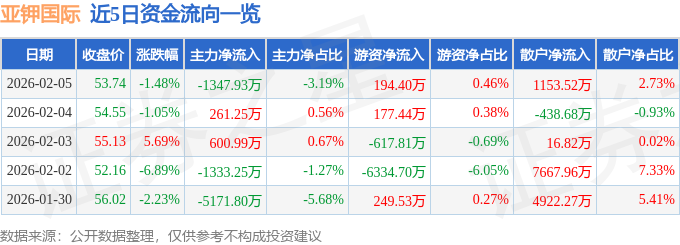
股票行情快报:亚钾国际(000893)2月5日主力资金净卖出1347.93万元
Sou Hu Cai Jing· 2026-02-05 12:47
Core Viewpoint - The stock of Yara International (000893) has shown a decline in price and mixed capital flow, indicating potential volatility in investor sentiment and market performance [1]. Group 1: Stock Performance - As of February 5, 2026, Yara International closed at 53.74 yuan, down 1.48% with a turnover rate of 0.96% and a trading volume of 78,300 hands, amounting to a transaction value of 423 million yuan [1]. - On February 5, 2026, the net outflow of main funds was 13.48 million yuan, accounting for 3.19% of the total transaction value, while retail investors saw a net inflow of 11.54 million yuan, representing 2.73% of the total [1]. Group 2: Financial Metrics and Industry Ranking - Yara International's total market value is 49.66 billion yuan, significantly higher than the industry average of 24.77 billion yuan, ranking 4th among 27 companies in the fertilizer industry [2]. - The company reported a net profit of 1.36 billion yuan for the first three quarters of 2025, reflecting a year-on-year increase of 163.01%, with a gross margin of 58.91%, which is substantially above the industry average of 19.95% [2]. - The company's earnings per share (EPS) and return on equity (ROE) are also strong, with a PE ratio of 27.33 and an ROE of 10.97%, ranking 12th and 10th respectively in the industry [2]. Group 3: Analyst Ratings - In the last 90 days, 7 institutions have provided ratings for Yara International, with 5 buy ratings and 2 hold ratings, indicating a generally positive outlook from analysts [3].