比亚迪股份有限公司

Search documents
固态电池资本开支加速,上海洗霸透露硫化锂项目正在推进中
2 1 Shi Ji Jing Ji Bao Dao· 2025-10-20 10:45
Core Insights - Solid-state batteries are a highly focused sector in technology growth this year, with expectations for practical implementation advancing to around 2026 [1] - The solid-state battery industry is characterized by a shift from liquid electrolytes to solid electrolytes, with various types such as sulfide, oxide, and polymer being explored [1] - Major companies like CATL, Guoxuan High-Tech, and BYD are focusing on sulfide routes, while startups prefer oxide routes due to mature processes [1] Industry Trends - Upstream material companies are increasingly adopting a full-route layout for solid-state batteries, as seen with Shanghai Washba, which entered the solid-state battery sector in 2022 [2] - In 2025, among 53 A-share listed companies related to solid-state batteries, only 33 reported positive net profits, but 44 companies showed positive growth in fixed investment, and 30 increased R&D expenses year-on-year [2] Demand Drivers - Strong capital expenditure in solid-state batteries is driven by downstream demand, with major automakers and battery leaders announcing timelines for industrialization [3] - Toyota plans to achieve small-scale trial production of solid-state batteries by 2026 and large-scale production post-2030, while BYD aims for demonstration vehicle applications by 2027 [3] Equipment and Market Response - Leading solid-state battery equipment manufacturer, Xian Dao Intelligent, reported significant growth in revenue and net profit, with a 61.19% increase in net profit year-on-year [4] - Xian Dao's solid-state battery equipment has entered supply chains of major battery companies and automakers globally, leading to a surge in stock prices following their positive earnings report [4] Company Developments - Shanghai Washba's solid-state battery materials business is becoming a more significant factor in its valuation despite a 15.85% decline in overall revenue in the first half of the year [5] - The company has made strategic moves, including acquiring patents from the Dalian Institute of Chemical Physics and establishing joint ventures to enhance its competitive edge in silicon-carbon anode materials [7][8] New Energy Initiatives - Shanghai Washba has launched subsidiaries focused on advanced materials for solid-state batteries, targeting applications in consumer electronics, drones, and smart grid energy storage [8] - The company has developed a novel water-resistant oxide solid-state electrolyte material and achieved a production capacity of 50 tons per year [8]

行情震荡还看哑铃策略?一手抓科技+红利“520560”上市4日获资金坚定加仓!
Xin Lang Ji Jin· 2025-10-17 05:34
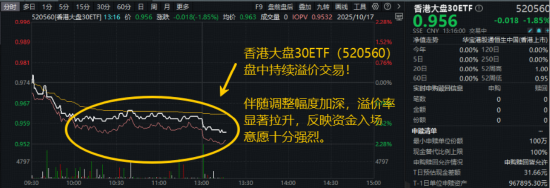
香港大盘30ETF(520560)紧密跟踪恒生中国(香港上市)30指数,该指数持仓30只成份股,自带哑铃 策略,融合高弹性科技+高股息红利标的!集中互联网、金融、电子、消费等行业龙头,均为港股通高 流通性大盘股,前十大重仓股合计权重超74%,集中度高,资金容纳能力较强,大额交易冲击成本较 低。 值得注意的是,自10月13日上市以来,近4个交易日,香港大盘30ETF(520560)资金面呈现出坚定的 连续加仓态势,累计净买入超1800万元,净流率达2.7%! 10月17日,港股大市维持震荡表现,自带"哑铃策略"的香港大盘30ETF(520560)随市调整,截至发稿 场内价格跌1.85%,但盘中持续呈现溢价交易状态!分时图可见伴随调整幅度加深,溢价率显著拉升, 一度突破0.4%,反映资金入场意愿十分强烈。 成份股方面,农业银行、建设银行等高股息红利标的呈涨势,中芯国际、阿里巴巴-W和小米集团-W则 表现相对较弱。 国信证券指出,恒生中国30指数近期表现分化,估值小幅回调。必选消费行业如食品饮料和农林牧渔估 值性价比凸显,科技板块PE下挫超过1x,估值修复空间较大。 MACD金叉信号形成,这些股涨势不错! 责任编辑 ...

企业竞争图谱:2025年新能源车轻量化材料,头豹词条报告系列
Tou Bao Yan Jiu Yuan· 2025-10-16 13:59
Investment Rating - The report indicates a strong investment outlook for the lightweight materials industry in the new energy vehicle sector, driven by robust policy support and increasing market demand [4][5]. Core Insights - The lightweight materials industry for new energy vehicles focuses on developing and applying lightweight, high-strength materials to enhance vehicle performance and reduce energy consumption [4][6]. - The industry is experiencing rapid growth due to the increasing demand for new energy vehicles, with the market size expected to expand significantly [30][32]. - The report highlights the importance of collaboration across the supply chain to address challenges such as performance bottlenecks and cost pressures [4][6]. Industry Definition - Lightweight materials for new energy vehicles are defined as materials that significantly reduce weight while meeting structural strength, safety, and durability requirements [6]. - The industry faces challenges including range anxiety, performance limitations, and environmental impact, making lightweight solutions essential for sustainable development [6][10]. Industry Classification - The lightweight materials are categorized into metal materials, plastics, and non-metal composites, each with specific properties and applications [8][9]. Industry Characteristics - The industry is characterized by high technical requirements, significant innovation, and diverse competition, with strong policy guidance shaping its development [10][12]. - Continuous technological advancements are crucial for meeting the high performance demands of new energy vehicles [10][11]. Development History - The industry has evolved through three stages: nascent, development, and rapid growth, with significant policy support since the early 2000s [13][16]. - The rise of new energy vehicles has accelerated the demand for lightweight materials, leading to a focus on high-performance and sustainable solutions [16][30]. Industry Chain Analysis - The industry chain consists of upstream raw material extraction, midstream processing and manufacturing, and downstream vehicle manufacturing and sales [17][18]. - Price fluctuations in upstream raw materials significantly impact the profitability and production strategies of midstream manufacturers [18][21]. Market Size - The market size for lightweight materials in the new energy vehicle sector was approximately 163.06 billion yuan in 2024, with an expected growth of 69% in 2025 [30][32]. - The rapid growth of the new energy vehicle market is a primary driver for the increasing demand for lightweight materials [31][33]. Policy Overview - Various policies, including the "14th Five-Year Plan for Industrial Green Development," encourage the application of lightweight materials in the automotive sector [40]. - The "New Energy Vehicle Industry Development Plan (2021-2035)" emphasizes lightweight materials as a core technology area, driving collaboration between vehicle manufacturers and material suppliers [40][41]. Competitive Landscape - The competitive landscape is characterized by a tiered structure, with leading companies leveraging technological advantages and deep partnerships with major automakers [42][43]. - The industry is witnessing increased competition due to policy support and technological advancements, leading to a more diverse market [44][45].



中国股票策略:美国降息周期的影响-China Equity Strategy _Implication of a US rate cut cycle_ Wang_ Implication of a US rate cut cycle
2025-09-29 03:06
ab 26 September 2025 Global Research China Equity Strategy Implication of a US rate cut cycle Lower US rates and weaker US dollar supportive for EM and Chinese equities The US Fed resumed the rate cutting cycle for the first time in nine months on 17 Sep 2025. UBS economists expect additional 25bps and 50bps cut in the upcoming Oct and Dec FOMC meetings respectively. Furthermore our FX team forecasts a weaker US dollar by year-end with USDCNY reaching 7.10. Historically EM and Chinese equities returns exhib ...
第一大权重股赛力斯10cm涨停,赴港上市获备案!汽车ETF(159512)早盘冲高涨近3%
Xin Lang Cai Jing· 2025-09-26 03:08
Group 1 - Company Sairus has received approval from the China Securities Regulatory Commission for its overseas listing, planning to issue up to 331,477,235 shares on the Hong Kong Stock Exchange [1] - The automotive sector in China is experiencing significant transformation, with increasing acceptance of pure electric vehicles due to advancements in range, charging infrastructure, and user experience [1] - The automotive ETF has shown strong performance, with a 2.51% increase as of September 26, 2025, and a cumulative rise of 8.46% over the past three months [1] Group 2 - Global automotive industry is undergoing a restructuring phase, with China expected to accelerate its export expansion by 2025 [2] - Non-Chinese markets are anticipated to see a rapid increase in new energy vehicle penetration, driven by established consumer recognition of electric and intelligent technologies [2] - BYD is intensifying its efforts in the German market by appointing new executives to boost sales in Europe [2] Group 3 - Chinese auto parts companies are poised for historic opportunities in the era of smart electric vehicles, leveraging high cost-performance and rapid response capabilities [3] - The investment focus in the automotive industry for 2025 should be on strong domestic brands and opportunities within the smart driving and robotics supply chain [3] - The automotive ETF closely tracks the CSI Automotive Index, covering both traditional and emerging companies in the automotive sector [3]

新华财经早报:8月29日
Zhong Guo Jin Rong Xin Xi Wang· 2025-08-28 23:48
Group 1: Urban Development and Economic Policies - The "Opinions on Promoting High-Quality Urban Development" were published, aiming for significant progress in modern urban construction by 2030 and basic completion by 2035, with a focus on optimizing urban structure and enhancing quality [1] - The Ministry of Commerce plans to expand inbound consumption and improve the implementation of the tax refund policy for outbound tourists, including building international consumption centers and enhancing service levels [1] - The State Council Tariff Commission decided to continue imposing anti-dumping duties on imported phenol from the US, EU, South Korea, Japan, and Thailand starting August 29, 2025, for five years [1] Group 2: Company Financial Performance - As of June 30, five A-share listed insurance companies held stock assets exceeding 1.8 trillion yuan, a year-on-year increase of over 400 billion yuan, with a growth rate of 28.7% [1] - Cambricon Technologies issued a risk warning regarding its stock, projecting annual revenue for 2025 to be between 5 billion and 7 billion yuan, with no new product releases planned [1] - CITIC Securities reported a record half-year revenue of 33.039 billion yuan, a year-on-year increase of 20.44%, and a net profit of 13.719 billion yuan, up 29.80% [1] - Gree Electric Appliances reported a revenue of 97.325 billion yuan for the first half of the year, a decrease of 2.46%, while net profit increased by 1.95% to 14.412 billion yuan [1] Group 3: Market Trends and Predictions - The "2025 China Top 500 Private Enterprises" list was released, with JD Group, Alibaba, Hengli Group, Huawei, and BYD ranking in the top five, and the total revenue of these enterprises reaching 4.305 trillion yuan [1] - The stock market showed significant gains, with the Shanghai Composite Index rising by 1.14% and the Shenzhen Component Index increasing by 2.25% [3] - The insurance sector's stock and fund allocation ratios for major companies like China Life and Ping An have increased, indicating a faster entry into the market [1]

研判2025!中国氧化钴行业生产流程、产量及价格分析:产量激增与政策赋能共驱需求,地缘博弈与回收体系重构价格[图]
Chan Ye Xin Xi Wang· 2025-08-14 01:26
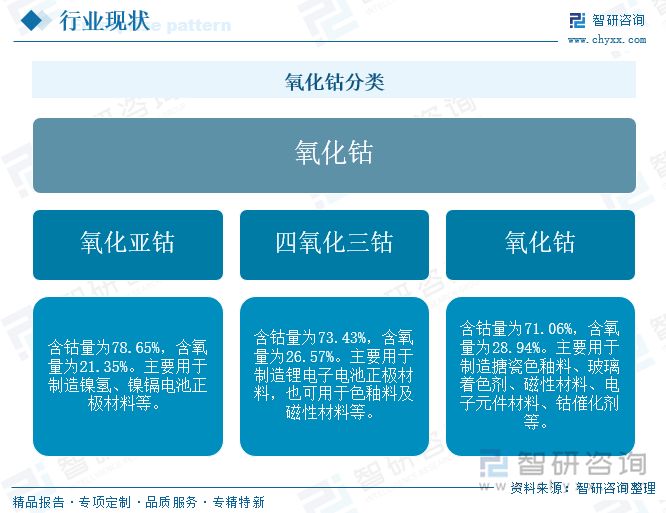
Industry Overview - China is the largest producer and consumer of cobalt oxide globally, with a production of 9,500 tons in the first half of 2025, representing a year-on-year growth of 40.69% [1][10] - The global demand for cobalt oxide is driven by the expected sales of over 18 million electric vehicles in 2025, with significant demand for high-purity cobalt oxide in the power battery sector, particularly for lithium cobalt oxide cathode materials [1][10] - The energy storage market is accelerating due to carbon neutrality goals, further increasing the demand for cobalt oxide [1][10] - Emerging consumer electronics, such as foldable smartphones and AR/VR devices, have increased the cobalt content per device by 40% compared to traditional models, creating additional demand [1][10] - Government policies, including the State Council's action plan for large-scale equipment updates and local support for new energy materials, provide long-term benefits for cobalt oxide applications in power batteries [1][10] Industry Chain - The upstream of the cobalt oxide industry chain includes cobalt mines, recycled materials, ammonium carbonate solution, and sulfuric acid, along with various production equipment [6] - The midstream involves the production and manufacturing of cobalt oxide, while the downstream applications include battery materials, pigments, ceramics, magnetic materials, catalysts, and consumer electronics [6] Market Dynamics - The global cobalt reserves are estimated at 11 million tons, with the Democratic Republic of Congo (DRC) holding 6 million tons, accounting for 55% of the total [8] - In 2024, global cobalt production is projected to reach approximately 291,300 tons, a year-on-year increase of 22.39%, with the DRC contributing 75.86% of the total production [8] - The DRC's export ban on cobalt has been extended, potentially leading to a supply shortage and increased cobalt prices, although Chinese companies are expected to maintain normal operations in the short term [8][12] Key Companies - Huayou Cobalt is a leading player in the industry, achieving a 40% self-sufficiency rate in raw materials through its control of six cobalt mines in the DRC [14] - Jinchuan Group holds a significant position in the cobalt oxide market due to its rich mineral resources and stable production capacity [14] - Greeenme has established a closed-loop business model for resource recovery, achieving over 99% cobalt recovery rates [14] Price Trends - Cobalt oxide prices in China have remained low due to declining cobalt prices and increasing production, but a rebound in cobalt prices following the DRC's export ban has led to a doubling of cobalt oxide prices [12] - As of June 2025, the price of cobalt oxide in China was 190,000 yuan per ton, reflecting a year-on-year increase of 51.39% [12] Industry Development Trends 1. Resource security and global layout are crucial for building a diversified supply system, with Chinese companies enhancing supply stability through overseas investments [19] 2. Technological breakthroughs are necessary to capture high-end markets, with innovations in cobalt oxide production processes and product purity requirements [20] 3. The industry is moving towards a low-carbon economy, emphasizing environmentally friendly production processes and recycling systems, particularly in response to stricter regulations [21]




彻底爆发!利器来了 韩国押注中国AI
Zhong Guo Ji Jin Bao· 2025-08-06 14:55
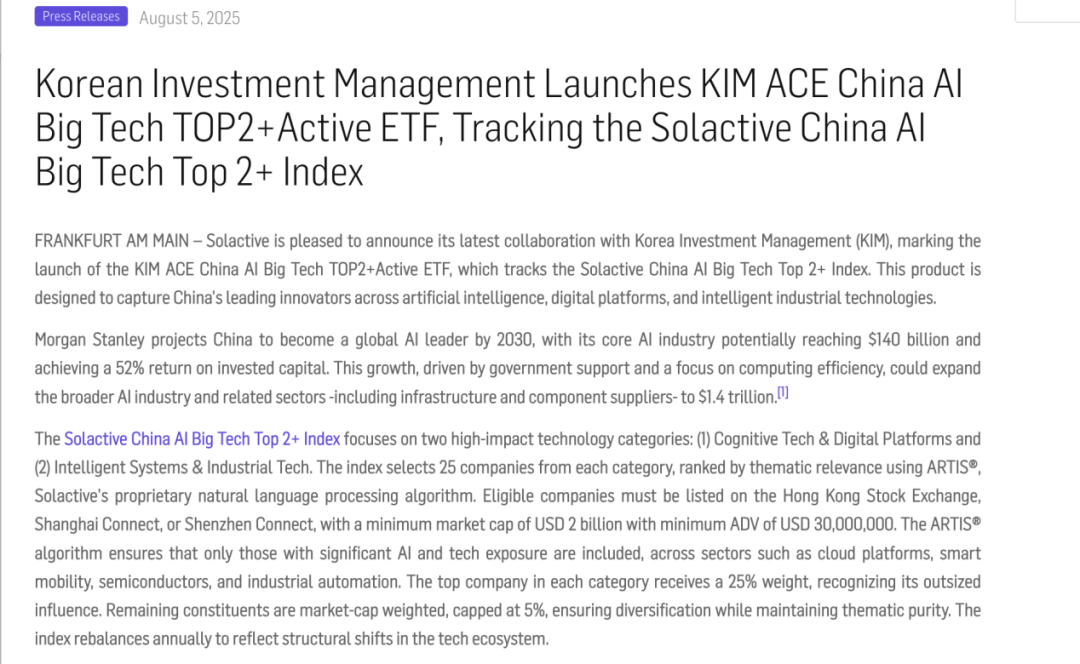
Group 1 - KIM launched the KIM ACE China AI Big Tech TOP2+ Active ETF, which tracks the Solactive China AI Big Tech Top 2+ Index, aiming to capture opportunities in AI, digital platforms, and smart industrial technologies in China [1][3] - The Solactive China AI Big Tech Top 2+ Index focuses on two main areas: cognitive technology and digital platforms, and smart systems and industrial technology, selecting 50 companies based on thematic relevance [3] - The index includes companies listed on the Hong Kong Stock Exchange or those eligible for the Shanghai-Hong Kong and Shenzhen-Hong Kong Stock Connect, with a minimum market capitalization of $2 billion and an average daily trading volume of $30 million [3] Group 2 - The top ten holdings of the index include Alibaba, Xiaomi, Tencent, Contemporary Amperex Technology, Meituan, BYD, Foxconn, NetEase, Semiconductor Manufacturing International Corp., and JD.com, with Alibaba and Xiaomi accounting for over 46% of the total weight [5][6] - Korean investors have shown a strong preference for Chinese tech stocks, with Xiaomi being the most net purchased stock by Korean investors this year [5][7] - As of August 5, 2025, Korean investors' net purchases of Chinese stocks (including Hong Kong and A-shares) reached $6.158 billion, surpassing the total for the previous year, making China the second-largest overseas market for Korean investors after the U.S. [7][8]

彻底爆发!利器来了,韩国押注中国AI
中国基金报· 2025-08-06 14:10
Core Viewpoint - KIM has launched the KIM ACE China AI Big Tech TOP2+ Active ETF, aiming to capture opportunities in China's AI, digital platforms, and smart industrial technology sectors [2][3]. Group 1: ETF Overview - The ETF tracks the Solactive China AI Big Tech Top 2+ Index, which focuses on cognitive technology, digital platforms, smart systems, and industrial technology [3]. - The index includes 50 companies, selecting 25 from each category, and ranks them based on thematic relevance using natural language processing algorithms [3]. - Eligible companies must be listed on the Hong Kong Stock Exchange or included in the Stock Connect programs, with a minimum market capitalization of $2 billion and an average daily trading volume of $30 million [3]. - The index emphasizes companies with a significant portion of their business in AI or technology, covering sectors like cloud platforms, smart mobility, semiconductors, and industrial automation [3]. Group 2: Market Insights - Morgan Stanley predicts that China will become a global leader in the AI industry by 2030, with the core AI industry potentially reaching $140 billion and the broader AI-related sectors reaching $1.4 trillion [3]. - The ETF was listed on July 29 on the Korea Stock Exchange under the code 0087F0.KS [5]. Group 3: Top Holdings - As of August 5, 2025, the top holdings in the index include Alibaba Group (24.23%), Xiaomi Corp (21.94%), and Tencent Holdings (5.70%), with Alibaba and Xiaomi together accounting for over 46% of the index [6][7]. Group 4: Korean Investor Behavior - Korean investors have shown a strong preference for Chinese tech stocks, with Xiaomi being the most net purchased stock among Korean investors this year [8]. - The net purchase amounts for the top Chinese stocks by Korean investors include $170.39 million for Xiaomi, $81.46 million for Alibaba, and $55.87 million for Contemporary Amperex Technology [9][10]. - From January 1 to August 5, 2025, the total transaction amount for Chinese stocks by Korean investors reached $6.158 billion, surpassing the total for the previous year [10].

研判2025!中国电子电路铜箔行业产业链、市场规模及重点企业分析:需求激增与技术突破并行,高端国产替代加速[图]
Chan Ye Xin Xi Wang· 2025-07-02 01:26
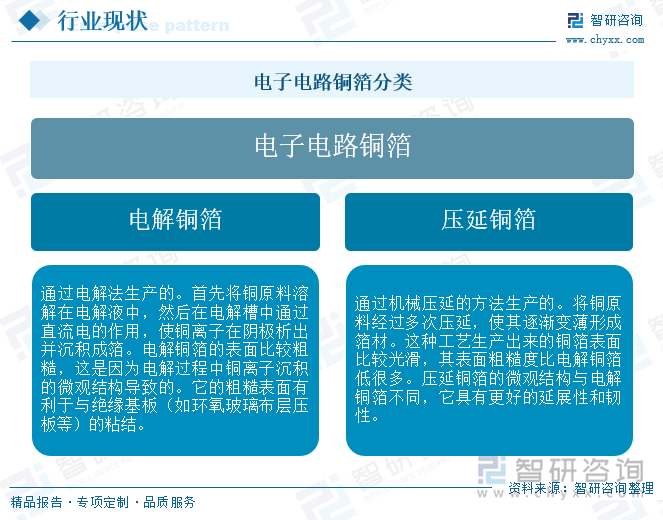
Core Viewpoint - The Chinese electronic circuit copper foil industry is experiencing rapid development and transformation, driven by the growth of emerging industries such as 5G communication, new energy vehicles, and the Internet of Things, with a projected sales volume of 440,000 tons in 2024, representing a year-on-year increase of 7.32% [1][12]. Industry Overview - Electronic circuit copper foil is a cathodic electrolytic material used as a core conductor in printed circuit boards (PCBs), facilitating electrical connections between electronic components [2]. - The industry can be categorized into electrolytic copper foil and rolled copper foil based on production processes [2]. Industry Development History - The industry has evolved through four stages: 1. Initial stage (1950s-1970s) focused on manual production with low product variety and quality [4]. 2. Localization stage (1980s-1990s) marked by increased demand and technology imports, leading to improved production techniques [4]. 3. Rapid development stage (2000s-2010s) where China became the largest producer globally, emphasizing technological innovation [5]. 4. High-end transformation stage (2010s-present) driven by new industries, with a focus on high-performance materials like ultra-thin copper foil [6]. Industry Supply Chain - The supply chain includes raw materials such as copper and sulfuric acid, production equipment like cathode rollers and foil machines, and downstream applications in communication devices, consumer electronics, and automotive electronics [8]. Market Size - The demand for electronic circuit copper foil is on the rise, with a projected sales volume of 440,000 tons in 2024, reflecting a 7.32% increase year-on-year [12]. Key Companies' Performance - The industry features leading companies such as Jiantao Copper Foil, Nanya Copper Foil, and Copper Crown Copper Foil, with 14 companies reporting sales over 10,000 tons, and five exceeding 20,000 tons [14][16]. - Notable companies include: - Jiantao Copper Foil: Largest domestic producer with advanced technology and a complete supply chain [16]. - Nanya Copper Foil: Strong in high-end copper foil technology [16]. - Copper Crown Copper Foil: Leader in RTF copper foil production, with significant revenue growth [16][18]. Industry Development Trends 1. **Technological Upgrades and High-end Development** - The industry is focusing on high-frequency, high-speed copper foil and ultra-thin products, with domestic companies achieving significant breakthroughs [20]. 2. **Market Demand Changes and New Application Areas** - The growth of 5G communication and new energy vehicles is driving demand for electronic circuit copper foil, particularly in high-performance applications [21][22]. 3. **Industry Chain Collaboration and Global Layout** - Companies are increasingly collaborating within the supply chain and expanding globally to enhance competitiveness and market presence [23].