
太阳纸业

Search documents
研判2025!中国废纸回收行业发展背景、市场现状、企业格局及发展趋势分析:回收量与交易额均呈增长态势,价格进一步下滑,企业竞争格局分散[图]
Chan Ye Xin Xi Wang· 2025-12-24 01:13
Core Insights - The recycling of waste paper is crucial for China's paper industry, serving as the primary raw material source and supporting green, high-quality development [1][4] - The waste paper recycling market is expected to rebound in 2024, with a projected recovery volume of 67.97 million tons, a 9.1% increase from 2023, and a market transaction value of 105.52 billion yuan, up 6.4% year-on-year [4][5] - The industry faces challenges such as low profit margins and a fragmented competitive landscape, with the average net profit margin of the top 20 companies in the waste paper recycling sector at only 1.13% [6][7] Waste Paper Recycling Industry Overview - Waste paper recycling involves the collection, classification, processing, and reuse of discarded paper products, contributing to environmental protection and resource efficiency [1][2] - The industry is supported by various policies aimed at promoting circular economy practices, with significant government backing for waste paper recycling initiatives [3][4] Market Status - In 2024, the waste paper recycling volume is expected to reach a new high since 2020, with 67.97 million tons collected, reflecting a recovery from previous downturns [4][5] - The average price of recycled paper in 2024 is projected to be 1,552.4 yuan per ton, a decrease of 898.6 yuan per ton compared to 2021, indicating a U-shaped recovery pattern in pricing [5][6] Competitive Landscape - The waste paper recycling industry is characterized by a large number of small to medium-sized enterprises, with a total of 81 large-scale recycling plants (over 100 tons/day) in 2024, a decrease of 30.2% from 2023 [6][7] - The number of medium-sized plants (50-100 tons/day) has slightly increased by 5.0%, while smaller plants (30-50 tons/day) have seen a minor decline of 2.1% [6][7] Development Trends - The industry is expected to transition towards high-quality and high-value development through smart upgrades, full industry chain collaboration, and enhanced standards [8] - The introduction of AI technology in sorting centers is anticipated to improve operational efficiency and product quality, shifting the industry from labor-intensive to technology-intensive [8]


造纸轻工周报:扩内需提消费下关注个护、潮玩、宠物等赛道;关注永艺股份报告-20251223
Shenwan Hongyuan Securities· 2025-12-23 11:31
Investment Rating - The report indicates a positive outlook on various sectors, particularly focusing on domestic consumption, export opportunities, AI glasses, paper industry recovery, and home furnishings [5][11][18][20]. Core Insights - The report emphasizes structural consumption opportunities driven by domestic demand expansion, highlighting sectors such as personal care, pet products, and IP-driven consumer goods [5][6]. - Export dynamics are shifting positively with reduced external disturbances and potential boosts from U.S. interest rate cuts, suggesting a new phase for Chinese companies in overseas operations [11][12]. - The AI glasses market is experiencing rapid product iterations, with major players like Meta and Alibaba leading the way, indicating a growing market for augmented reality glasses [16][17]. - The paper industry is expected to see demand recovery and price stabilization, with a focus on key players benefiting from this trend [18][19]. - The home furnishings sector is undergoing consolidation, with improved valuations anticipated as real estate policies stabilize, benefiting companies with strong dividend margins [20][21]. Summary by Sections Domestic Consumption - The report highlights the rise of domestic brands in personal care, recommending companies like Baiya and Dengkang for their strong offline channel competitiveness and product upgrades [6][7]. - In the pet products sector, companies like Yiyi and Yuanfei are noted for their robust growth and global expansion strategies [7][8]. - The IP-driven consumer goods market is gaining traction, with companies like Chuangyuan and Guangbo positioned to capitalize on emerging trends [8][9]. Export Opportunities - The report identifies key export players such as Yutong Technology and Yongyi, emphasizing their global supply chain advantages and potential for growth in overseas markets [11][12][13]. - Yongyi is particularly noted for its strategic overseas capacity expansion and the rising demand for ergonomic chairs driven by consumer trends [13][14]. AI Glasses - The report discusses the rapid development of AI glasses, with significant product launches from major brands, indicating a shift towards augmented reality applications [16][17]. - Companies like Kangnait Optical are highlighted for their potential benefits from the growing demand for integrated lens solutions in this market [16]. Paper Industry - The report anticipates a recovery in the paper industry, with key players like Sun Paper and Jiulong Paper expected to benefit from price stabilization and demand recovery [18][19]. Home Furnishings - The home furnishings sector is noted for its ongoing consolidation and potential valuation recovery, with companies like Gujia and Sophia highlighted for their strong market positions and dividend safety [20][21][22]. - The report emphasizes the importance of real estate policy stabilization in driving demand for home furnishings, with a focus on companies that can leverage this trend [21][22].
造纸轻工周报:扩内需提消费下关注个护、潮玩、宠物等赛道,关注永艺股份报告-20251223
Shenwan Hongyuan Securities· 2025-12-23 07:44
Investment Rating - The report maintains a positive outlook on the industry, highlighting structural consumption opportunities and potential growth in various sectors [3][5][11]. Core Insights - The report emphasizes the importance of domestic consumption, particularly in personal care, pet products, and IP-driven trendy toys, as key areas for investment [3][5][6]. - Export opportunities are expected to improve as external disturbances diminish, with a focus on quality stocks in the export chain [3][11]. - The AI glasses segment is experiencing rapid development, with major players releasing new products that could benefit leading lens manufacturers [3][18]. - The paper industry is anticipated to see a recovery in demand and pricing, with a focus on companies like Sun Paper, Nine Dragons, and others [3][20][22]. - The home furnishing sector is undergoing consolidation, with a focus on companies that offer high dividend safety margins [3][23][25]. Summary by Sections Domestic Consumption - The report highlights the rise of domestic brands in personal care, recommending companies like Baiya and Dengkang for their strong offline channel competitiveness and product upgrades [6][7]. - In the pet products sector, companies like Yiyi and Yuanfei are recommended for their robust growth and global expansion strategies [7][8]. - The IP trendy toy market is driven by self-reward consumption, with companies like Chuangyuan and Guangbo positioned to benefit from this trend [8][9][10]. Export Opportunities - The report notes that external disturbances are lessening, with U.S. interest rate cuts expected to boost furniture consumption [11][13]. - Companies like Yutong Technology and Yongyi are highlighted for their strong global supply chain and potential for growth in overseas markets [13][14][15]. AI Glasses - The report discusses the transition from AI to AR glasses, with new products from Meta and others leading the market [18][19]. - Companies like Kangnait Optical are expected to benefit from the growing demand for integrated lens solutions [18]. Paper Industry - The report indicates a stabilization and potential rebound in paper prices, with companies like Sun Paper and Nine Dragons being key players to watch [20][22]. - The global market for pulp molding is also highlighted, with growth opportunities due to environmental considerations [16]. Home Furnishing - The report notes that the home furnishing industry is seeing accelerated consolidation, with companies like Gujia and Sophia being recommended for their strong market positions and dividend safety [23][25][27]. - The impact of real estate policies on the home furnishing market is discussed, with expectations for improved demand and valuation recovery [24][33].
研判2025!中国秸秆行业市场政策、产业链图谱、综合利用量、利用率、市场规模、竞争格局及发展趋势分析:市场格局较为分散[图]
Chan Ye Xin Xi Wang· 2025-12-23 01:36
Core Viewpoint - The straw industry in China is deeply integrated with agriculture, energy, chemicals, and building materials, forming various industrial chains that enhance rural employment and farmers' income while creating indirect economic value through the substitution of petrochemical and wood resources [1][12]. Market Policies - A series of national policies have been implemented to promote comprehensive utilization of straw, with local governments providing subsidies, market construction, and incentive measures to support the development of the entire straw recycling, processing, and utilization industry chain [8][9]. Industry Chain - The straw industry chain consists of upstream resource supply and equipment manufacturing, midstream processing, and downstream diversified applications, evolving towards scale, high value, and intelligence [9][10]. Development Status - The comprehensive utilization of straw in China is projected to increase from 555 million tons in 2024 to 647 million tons, with a utilization rate rising from 77.7% to 88.3% and market size expanding from 147.63 billion yuan to 205.10 billion yuan [1][13]. Competitive Landscape - The straw comprehensive utilization market is characterized by a fragmented structure with many small-scale enterprises, including those focused on fertilizer, feed, and energy applications [13][14]. Development Trends - The future of straw utilization will shift towards high-value applications, including biodegradable tableware and bio-based composite materials, while also enhancing collaboration across the industry chain [16][17]. - Technological innovations will focus on key processes such as straw pretreatment and conversion, improving efficiency and reducing costs [19][20].

“停机潮”与“涨价潮”同步上演,造纸行业盈利修复可期
Xuan Gu Bao· 2025-12-22 23:41
Industry Overview - The paper industry is experiencing a simultaneous "shutdown wave" and "price increase wave" from late 2025 to early 2026, with major packaging paper companies like Nine Dragons, Shanying, Lee & Man, and Rongcheng initiating large-scale maintenance and capacity reduction [1] - Major white card and cultural paper manufacturers, including Bohui, APP, and Universal Paper, have collectively announced price increases, highlighting differences in cost structures and supply-demand relationships among various paper types [1] Production and Pricing Dynamics - Nine Dragons Paper is expected to reduce production by approximately 310,000 tons in the first quarter, while Shanying International will halt 12 corrugated paper machines for 5-10 days in January [1] - Lee & Man Paper will conduct maintenance on five paper machines in Guangdong for 15-22 days in February, driven by a decline in waste paper prices, which have dropped by 260-400 RMB/ton since December [1] - Bohui Paper and APP will raise industrial paper prices by 200 RMB/ton starting January 1, 2026, while Universal Paper will increase prices for white and food card paper by the same amount in mid-December, due to high costs of wood pulp and energy [1] Currency Impact - The appreciation of the RMB is seen as an additional benefit for the industry, as it will lower the import costs of pulp, thereby enhancing company profits [1] Market Sentiment and Future Outlook - Datong Securities indicates that the paper industry is benefiting from a "price increase bonus, supply contraction, and policy regulation," which strengthens the supply-demand balance [2] - CICC anticipates a moderate recovery in consumer demand by 2026, with the capacity expansion of boxboard and corrugated paper nearing completion, potentially leading to a recovery in capacity utilization and price levels [2] - CITIC Securities notes that the appreciation of the RMB will decrease import costs for raw materials like pulp, improving gross margins in processing and trading sectors [2] Company Developments - Bohui Paper announced a price increase of 200 RMB/ton for industrial paper starting January 1, 2026, and plans to expand its chemical pulp production capacity from 95,000 tons to 320,000 tons with a total investment of 1.70066 billion RMB [3] - Sun Paper, a leading player in the domestic paper industry, is accelerating the construction of several projects, including a 400,000-ton specialty paper project and a 300,000-ton living paper project, expected to enter trial production in Q3-Q4 of 2025 [3]


人民币升值受益板块12月22日涨2.37%,中国中免领涨,主力资金净流入8.42亿元
Sou Hu Cai Jing· 2025-12-22 09:25
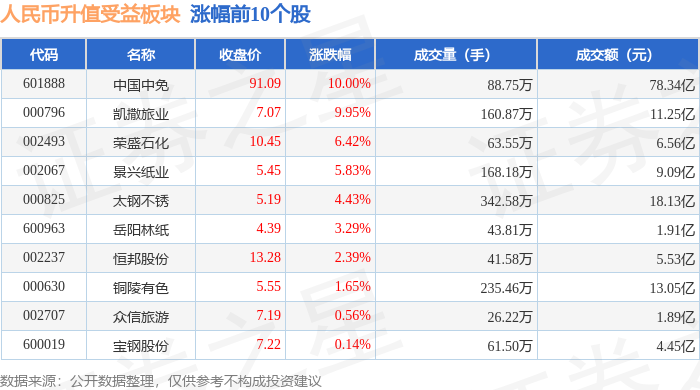
Core Viewpoint - The appreciation of the Renminbi has positively impacted certain sectors, leading to a 2.37% increase in the Renminbi appreciation beneficiary sector compared to the previous trading day, with China Duty Free Group leading the gains [1]. Market Performance - The Shanghai Composite Index closed at 3917.36, up 0.69% - The Shenzhen Component Index closed at 13332.73, up 1.47% [1]. Top Gainers in Renminbi Appreciation Beneficiary Sector - China Duty Free Group (601888) closed at 91.09, up 10.00% with a trading volume of 887,500 shares and a transaction value of 7.834 billion - Caesar Industry (000796) closed at 7.07, up 9.95% with a trading volume of 1,608,700 shares and a transaction value of 112.5 million - Rongsheng Petrochemical (002493) closed at 10.45, up 6.42% with a trading volume of 635,500 shares and a transaction value of 656 million [1]. Fund Flow Analysis - The Renminbi appreciation beneficiary sector saw a net inflow of 842 million from main funds, while retail funds experienced a net outflow of 227 million [2]. - The main funds' net inflow and outflow for key stocks in the sector indicate varying investor sentiment, with China Duty Free Group receiving a significant net inflow of 7.57 billion [3].
深度解析泉果刚登峰,为何这时更需要关注他?
Xin Lang Cai Jing· 2025-12-22 06:29
Core Viewpoint - The article emphasizes the importance of time in investment, highlighting the growth of a fund manager's credibility and trustworthiness over a longer career span [1][2]. Group 1: Background of the Fund Manager - The fund manager, Gang Dengfeng, has 16 years of experience in the securities industry and 11 years in investment management, evolving from a novice to a seasoned professional [2]. - Gang Dengfeng's early career was shaped by his exposure to value investing principles at Dongfang Securities, which laid a strong foundation for his investment philosophy [4][5]. - The investment philosophy of Gang Dengfeng is influenced by his early experiences and the quality of the team he worked with at Dongfang Securities [4][5]. Group 2: Investment Philosophy and Framework - Gang Dengfeng's investment framework is characterized by a focus on quality growth with a mid-level industry perspective, aiming for sustainable opportunities rather than speculative gains [8][31]. - The investment strategy prioritizes holding high-quality companies with strong financial metrics and competent management, leading to a low turnover rate in his portfolio [13][35]. - The concentration of holdings has increased over time, with the top ten holdings' concentration rising from 36.40% at the end of 2023 to 58.67% by the end of Q3 2025 [35]. Group 3: Performance Metrics - The fund managed by Gang Dengfeng, Quan Guo Si Yuan, has shown a net value growth rate of 32.28% over the past year, significantly outperforming the benchmark [21]. - The fund's turnover rates were recorded at 66.87% for 2023, 96.65% for 2024, and 115.48% for the first half of 2025, indicating a strategy focused on long-term holdings [31][32]. - The fund's maximum drawdown was -13.76% over the past year, compared to -21.04% for the CSI 300 index, demonstrating better risk management [16][37]. Group 4: Market Context and Future Outlook - The current market environment is seen as favorable for active equity funds, with a shift towards shareholder returns and dividends in the A-share market [19]. - The article suggests that the quality investment style may see a resurgence after a prolonged downturn, as high-quality companies are expected to perform better in a recovering economic environment [21]. - The increasing demand for equity investments among residents is noted, as traditional low-risk assets have become less attractive [19].

深度解析泉果刚登峰,为何这时更需要关注他?
点拾投资· 2025-12-22 06:19
Core Viewpoint - The article emphasizes the importance of time in investment, highlighting that the longer the investment horizon, the greater the power of compound interest. It also discusses the evolution of fund manager Gang Dengfeng, showcasing his growth and investment philosophy over the years [1][2]. Group 1: Investment Philosophy - Gang Dengfeng's investment framework is characterized by a focus on quality growth with a mid-level industry perspective. He aims for sustainable growth rather than short-term speculative gains, emphasizing the importance of investing in companies with strong fundamentals and management [10][14]. - The investment approach includes a low turnover rate, indicating a long holding period for stocks. For instance, the turnover rates for the fund managed by Gang Dengfeng were 66.87% in 2023, 96.65% in 2024, and 115.48% in the first half of 2025, reflecting a strategy of holding quality stocks for extended periods [11][14]. Group 2: Stock Selection Criteria - Gang Dengfeng focuses on a limited number of high-quality companies, defined by strong financial metrics such as high Return on Equity (ROE) and excellent management teams. This selective approach aims to minimize trading losses and enhance overall returns [14][16]. - The concentration of holdings has increased over time, with the top ten holdings in his fund rising from 36.40% at the end of 2023 to 58.67% by the third quarter of 2025, indicating a strategy of focusing on fewer, high-quality investments [14][16]. Group 3: Market Context and Timing - The article suggests that the current market environment is favorable for actively managed equity funds, as historical data indicates that active management tends to outperform broad market indices during periods of structural growth opportunities. For example, the active equity index returned 28.06% in 2025, significantly outperforming the 14.30% return of the CSI 300 index [22][23]. - The shift in the Chinese capital market towards shareholder returns and dividends is highlighted, with total dividends reaching nearly 2.5 trillion yuan in 2025, indicating a growing demand for equity investments among retail investors [23]. Group 4: Industry Diversification - Gang Dengfeng's portfolio is diversified across various industries, including electric vehicles, internet, consumer electronics, and industrial metals. This broad industry coverage is designed to create multiple sources of excess returns and reduce maximum drawdowns for investors [17][23]. - The article notes that the fund's maximum drawdown was -13.76% over the past year, compared to -21.04% for the CSI 300 index, demonstrating the benefits of industry diversification in mitigating risks [17][23].

人民币升值浪潮下,中小企业如何破局?
Sou Hu Cai Jing· 2025-12-22 06:01
Core Viewpoint - The appreciation of the RMB is becoming increasingly evident, with predictions that the exchange rate against the USD will rise from 7.0 to around 6.0 over the next decade, presenting both opportunities and challenges for small and medium-sized enterprises (SMEs) in China [1]. Group 1: Impact of RMB Appreciation on SMEs - The impact of RMB appreciation varies significantly among different types of SMEs. Import-dependent companies, such as those in the paper industry, will benefit as their raw material costs decrease by 0.8-1.2 percentage points for every 1% appreciation of the RMB [3]. - Conversely, export-oriented companies, like those in the textile and apparel sector, will face challenges, with a 1% appreciation leading to a 0.5-0.8 percentage point decrease in price competitiveness [3]. - Cross-border e-commerce firms may emerge as the biggest winners, with RMB appreciation expected to lower overseas procurement costs by 10-15% by 2030, significantly enhancing profit margins for SMEs in this sector [3]. Group 2: Strategies for SMEs to Adapt - SMEs need to establish systematic risk management mechanisms to cope with exchange rate fluctuations. Basic tools like forward foreign exchange contracts can help mitigate unexpected losses, as demonstrated by a stationery export company that avoided losses through a 12-month forward contract [4]. - A proactive strategy involves adjusting business structures. For instance, a lighting company shifted from OEM to self-branded exports, reducing the impact of exchange rate fluctuations on profits from 8% to below 3% [4]. - Digital transformation is crucial, with SMEs leveraging big data to predict demand changes in different currency zones, leading to a 37% year-on-year increase in exports to ASEAN markets [4]. Group 3: Policy Opportunities for SMEs - The internationalization of the RMB offers significant advantages, with over 80 countries incorporating it into their foreign exchange reserves. SMEs can reduce exchange costs and avoid third-party currency risks through cross-border RMB settlements, as seen in an electronic components company that cut its exchange costs from 3.2% to 0.5% [5]. - Policy adjustments in the consumer sector, such as raising minimum wage standards and implementing paid leave, may increase labor costs but also stimulate consumption upgrades. A home furnishings company capitalized on this trend by transitioning to smart home solutions, resulting in a 210% increase in average transaction value [5]. - Financial support for innovation is also noteworthy, with some export tax refund resources being redirected to innovation. A biotechnology company successfully increased its R&D investment from 5% to 12% by applying for innovation funds, leading to three core technology patents [5]. Group 4: Economic Significance of RMB Appreciation - The appreciation of the RMB signifies a critical transition in China's economic development stage. SMEs are encouraged to proactively adapt to this trend, transforming challenges into opportunities for upgrading and enhancing product value and trade structure [6].

国金证券:期待两片罐提价落地 关注纸浆价格回暖进程
智通财经网· 2025-12-22 02:47
Core Viewpoint - The report from Guojin Securities indicates a differentiated performance in the light industry manufacturing sector, with home furnishings and paper sectors stabilizing at the bottom, while new tobacco and packaging sectors show a steady upward trend. The trendy toy sector is showing positive signals of recovery, whereas the light consumer goods sector is under pressure [1]. Group 1: Home Furnishings - The central economic work conference continues to focus on "boosting consumption and expanding domestic demand," with upcoming actions to stimulate consumption, benefiting home furnishings demand recovery [2]. - In November, China's furniture export value decreased by 8.83% year-on-year, but the decline has narrowed to single digits. Exports to Southeast Asia are steadily increasing, while exports to the U.S. are showing a mild downward trend [2]. - The report suggests that while domestic demand remains weak in the short term, it is expected to recover steadily due to supportive consumption policies. Companies with strong brand attributes and operational advantages are recommended [2]. Group 2: New Tobacco - In the vaping sector, 18 states in the U.S. have implemented regulations, covering about 50% of the industry's tracked channel sales, which is expected to support sales recovery for compliant brands like Vuse [3]. - The report highlights that as enforcement against illegal vaping products strengthens, the compliant market is likely to expand, benefiting leading brands [3]. - The FDA has approved ON!Plus nicotine pouches, marking a significant regulatory milestone for the nicotine pouch market [3]. Group 3: Paper and Packaging - As of December 18, domestic prices for needle and broadleaf pulp were 5542 and 4633 yuan per ton, respectively, with a slight increase from the previous week. The report notes a continuous decline in inventory levels, indicating tightening supply and rising prices [4]. - The report indicates that downstream packaging demand is steadily recovering, which is expected to support the performance of packaging companies [4]. - The acquisition of Zhongliang Packaging by Aorijin has significantly increased market concentration in the two-piece can industry, enhancing overall pricing power [4]. Group 4: Light Consumer Goods - The light consumer goods sector is experiencing heightened competition, with a clear demand-driven focus and increasing brand concentration. The report highlights top brands in the toothpaste market, indicating a shift towards efficacy and e-commerce adaptability [5]. - Companies with strong new product capabilities and robust offline channel growth logic are recommended for investment [5]. Group 5: Trendy Toys - The trendy toy industry is transitioning from rapid IP growth to a phase of deep cultivation and international expansion. Leading companies like Pop Mart are actively launching new products and expanding their market presence [7]. - The report emphasizes the importance of focusing on leading companies and traditional firms that are successfully transforming their IP development strategies [7]. Group 6: Investment Recommendations - Recommended companies in the home furnishings sector include Oppein Home, Sophia, and Mousse Holdings. In the new tobacco sector, recommended companies include Smoore International and China Tobacco Hong Kong [8]. - For light consumer goods, companies like Pop Mart and Morning Glory are highlighted, while in the paper and packaging sector, Yutong Technology and Sun Paper are recommended [8].
