
新城控股

Search documents
新城控股跌2.02%,成交额4958.36万元,主力资金净流出425.16万元
Xin Lang Zheng Quan· 2026-01-16 02:26
Core Viewpoint - New City Holdings has experienced a decline in stock price and financial performance, with significant decreases in revenue and net profit year-over-year, indicating potential challenges in the real estate sector [1][2]. Group 1: Stock Performance - On January 16, New City Holdings' stock fell by 2.02%, trading at 14.52 yuan per share, with a total market capitalization of 32.752 billion yuan [1]. - The stock has increased by 4.09% year-to-date but has seen a decline of 3.26% over the last five trading days and 60 days [1]. - The net outflow of main funds was 4.2516 million yuan, with large orders accounting for 13.63% of purchases and 22.20% of sales [1]. Group 2: Financial Performance - For the period from January to September 2025, New City Holdings reported a revenue of 34.371 billion yuan, a year-over-year decrease of 33.34%, and a net profit attributable to shareholders of 0.974 billion yuan, down 33.05% [2]. - Cumulative cash dividends since the A-share listing amount to 14.595 billion yuan, with no dividends paid in the last three years [3]. Group 3: Shareholder Structure - As of September 30, 2025, the number of shareholders decreased by 12.34% to 43,200, with an average of 52,155 circulating shares per person, an increase of 14.07% [2]. - The fourth largest circulating shareholder is Hong Kong Central Clearing Limited, holding 16.6308 million shares, a decrease of 701,400 shares from the previous period [3]. - New shareholders include ICBC Value Selection Mixed A, holding 15.7412 million shares, while several other funds have exited the top ten circulating shareholders list [3].

百强房企争相涌入代建市场 不打“价格战”锚定“好房子”
Zheng Quan Shi Bao· 2026-01-15 18:19
Core Insights - The real estate industry is rapidly exploring new development models, with top 100 real estate companies showing strong enthusiasm for the construction agency market, leading to further industry growth and a new competitive landscape [1] - The focus has shifted from a "scale race" to a "value revolution," with companies engaging in differentiated competition, emphasizing quality over price [1] Group 1: Market Trends - In 2025, the new scale of construction agency reversed the slowdown seen in 2024, with the top 20 companies signing contracts for 22,007 million square meters, a year-on-year increase of 16%, and a growth rate improvement of 6 percentage points compared to 2024 [2] - The competitive structure of the construction agency market has fundamentally changed, showing an "olive-shaped" competition structure typical of a mature industry with high concentration [2] - Over 100 companies have entered the construction agency business, primarily from the top real estate sales companies, indicating a highly competitive environment [3] Group 2: Competitive Dynamics - Despite high market concentration among leading companies, the competitive landscape is still evolving, with ongoing reshuffling among top-tier and mid-tier companies [3] - The construction agency sector is characterized by light assets, high profit margins, and resistance to economic cycles, making it attractive for real estate companies amid significant market pressures [3] Group 3: Pricing and Value Competition - The management fee rates for construction agency projects have decreased from an early average of 3% to a range of 1%-3%, with 81.7% of projects falling within this range [4] - Industry leaders are advocating for a shift from price competition to value competition, emphasizing the importance of value creation over low pricing [4][5] - Many companies are consciously maintaining price floors and focusing on quality service rather than engaging in price wars [5] Group 4: Differentiated Competition Strategies - Companies are actively enhancing their capabilities and creating value through various means, including focusing on "good housing," urban renewal, and revitalizing existing assets [6] - Successful examples include projects that integrate comprehensive management and cost control, such as the Chengdu Xijingtai project, which achieved over 90% sales in a previously stalled development [7] - The industry is recognizing the need for higher service standards and a healthier evaluation system to guide companies towards enhancing their professional capabilities [5][6] Group 5: Future Outlook - The construction agency market still holds potential for residential and affordable housing, as well as opportunities in urban renewal and village renovations [8] - Future strategies suggest that leading companies should focus on improving service capabilities and management efficiency, while smaller firms should deepen their expertise in niche areas to build competitive advantages [8]
房地产开发板块1月15日涨0.53%,光明地产领涨,主力资金净流入3.95亿元
Zheng Xing Xing Ye Ri Bao· 2026-01-15 08:59
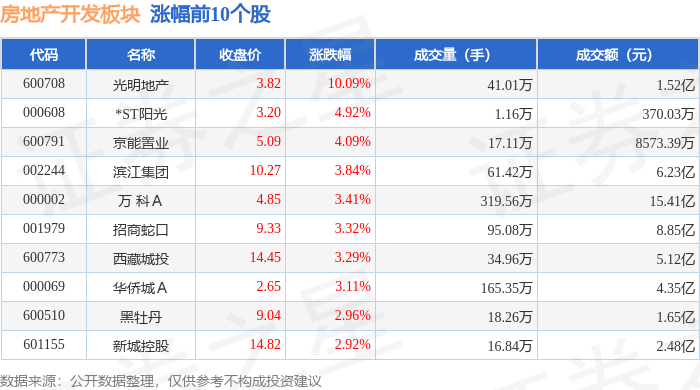
Group 1 - The real estate development sector increased by 0.53% on January 15, with Bright Real Estate leading the gains [1] - The Shanghai Composite Index closed at 4112.6, down 0.33%, while the Shenzhen Component Index closed at 14306.73, up 0.41% [1] - Bright Real Estate's stock price rose by 10.09% to 3.82, with a trading volume of 410,100 shares and a transaction value of 152 million yuan [1] Group 2 - The real estate development sector experienced a net inflow of 395 million yuan from institutional investors, while retail investors saw a net outflow of 275 million yuan [2] - Major stocks in the sector showed varied performance, with Vanke A experiencing a net inflow of 235 million yuan from institutional investors, but a net outflow of 151 million yuan from retail investors [3] - Poly Development had a net inflow of 128 million yuan from institutional investors, while retail investors had a net outflow of 104 million yuan [3]





中国地产 - 住房升级退税的边际助力-China Property-Marginal Help from Tax Refund on Housing Upgrade
2026-01-15 02:51
Summary of Key Points from the Conference Call Industry Overview - **Industry**: China Property - **Market Outlook**: The industry view is categorized as "In-Line" with expectations of continued challenges in the physical market for 2026, as indicated by related reports from December 2025 and January 2026 [3][5]. Core Insights - **Tax Refund Announcement**: The Finance Ministry announced a tax refund on income tax for homeowners who sell their homes and purchase new ones within a year, applicable for 2026-27. This is expected to provide marginal assistance to home sales [5]. - **Market Conditions**: - A significant portion of homeowners are "underwater," facing over a 35% correction in home prices from the peak nationwide [5]. - There is a bearish sentiment among residents regarding home prices, leading to a low appetite for taking on additional leverage in the current macroeconomic environment [5]. - **Need for Stimulus**: Restoring resident confidence in income and home prices through proactive fiscal-backed stimulus is deemed essential for reversing the ongoing housing decline [5]. - **Investment Recommendations**: Analysts suggest focusing on quality "alpha" names with self-help stories, specifically recommending companies like CR Land, Seazen A, and C&D [5]. Company Valuations - **China Resources Land Ltd. (1109.HK)**: - Estimated NAV of HK$56.20/share, with components including HK$20.83 from development properties and HK$42.67 from investment properties. A 30% discount is applied based on a developers' scorecard [6]. - **C&D International Investment Group Ltd (1908.HK)**: - Estimated NAV of HK$36.17/share, with HK$43.78/share from development properties and a 35% discount applied based on a developers' scorecard [7]. - **Seazen Holdings Company Ltd. (601155.SS)**: - Estimated NAV of Rmb32.80/share, with Rmb12.64 from development properties and a 40% discount applied based on a developers' scorecard [8]. Risks and Opportunities - **Upside Risks**: - Stronger-than-expected contracted sales and accelerated openings of new malls could positively impact the companies [10][11][12]. - **Downside Risks**: - Weaker-than-expected contracted sales and slower-than-expected openings of new shopping malls pose risks to the companies [10][11][12][13]. Additional Insights - **Analyst Ratings**: The report includes a list of companies with their respective ratings, indicating a mix of "Overweight," "Equal-weight," and "Underweight" designations, reflecting varying levels of confidence in their performance [68]. - **Market Sentiment**: The overall sentiment remains cautious, with analysts advising investors to be selective and focus on companies with strong fundamentals and growth potential [5][68]. This summary encapsulates the critical insights and data points from the conference call, providing a comprehensive overview of the current state and outlook of the China property market.
新城控股涨2.08%,成交额7359.35万元,主力资金净流出317.27万元
Xin Lang Zheng Quan· 2026-01-15 02:43
Group 1 - The core viewpoint of the news is that New城控股 has experienced fluctuations in stock price and financial performance, with a notable decrease in revenue and net profit year-on-year [1][2]. - As of January 15, the stock price of New城控股 increased by 2.08% to 14.70 CNY per share, with a total market capitalization of 33.158 billion CNY [1]. - The company has seen a 5.38% increase in stock price year-to-date, but a decline of 3.54% over the last five trading days [1]. Group 2 - For the period from January to September 2025, New城控股 reported a revenue of 34.371 billion CNY, a year-on-year decrease of 33.34%, and a net profit attributable to shareholders of 0.974 billion CNY, also down by 33.05% [2]. - The company has cumulatively distributed dividends of 14.595 billion CNY since its A-share listing, with no dividends paid in the last three years [3]. - As of September 30, 2025, the number of shareholders decreased by 12.34% to 43,200, while the average circulating shares per person increased by 14.07% to 52,155 shares [2][3].
2026年浙江要开42个新项目,恒隆、嘉里、香港置地顶级对决!
3 6 Ke· 2026-01-15 02:23
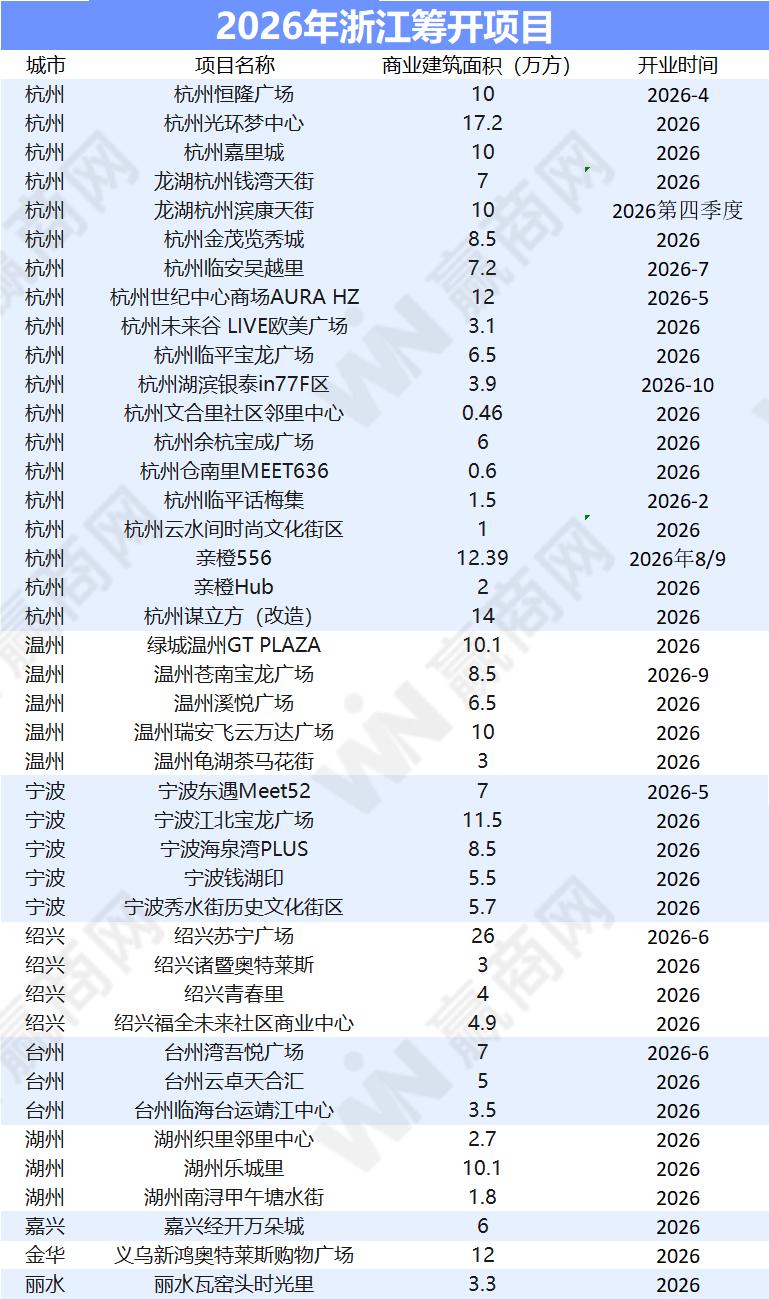
Core Insights - In 2026, Zhejiang's commercial market is set to experience a new wave of supply with 42 planned commercial projects totaling approximately 3 million square meters, a 6% decrease compared to 2025 [1] - Major operators such as Hang Lung, Kerry, Hongkong Land, and Longfor are competing fiercely, pushing Zhejiang into a new phase of "quality improvement" and "structural optimization" [1] Project Overview - The 42 commercial projects are distributed across cities including Hangzhou, Wenzhou, Ningbo, Jinhua, Huzhou, Taizhou, and Jiaxing, with Hangzhou contributing nearly half of the projects at 45.2% [4] - Notable projects in Hangzhou include: - Hangzhou Hang Lung Plaza (100,000 sqm) opening in April 2026 [16] - Hangzhou Aura HZ (26,000 sqm) opening in May 2026 [29] - Hangzhou Kerry City (254,000 sqm) focusing on a mixed-use urban complex [13] - Hangzhou Guanghuan Dream Center (172,000 sqm) emphasizing a nature-themed shopping experience [9] Market Dynamics - 27 of the projects are shopping centers and malls, accounting for 64% of the market, indicating a trend towards specialized commercial developments [5] - The introduction of new players such as Alibaba's "Qing Cheng 556" and ByteDance's "Cangnan Li MEET636" reflects a diversification in the commercial landscape [5] Size and Scale - Projects larger than 50,000 sqm dominate the market, with 27 such projects making up 64.2% of the total [6] - The largest project, the Su Ning Plaza in Shaoxing, will cover 260,000 sqm, setting a record for the region [38] Competitive Landscape - The competition is characterized by a "pyramid" structure, with numerous leading projects at the top and fewer smaller non-standard commercial offerings [6] - The focus on asset operation and content creation in smaller projects highlights a long-term competitive strategy [6] Notable Projects - Wenzhou GT Plaza (100,000 sqm) aims to create a park-style social commercial complex [32] - Taizhou Bay Wuyue Plaza (70,000 sqm) is designed as a central leisure living area [35] - Ningbo's Haiquan Bay PLUS and Xiushui Street historical cultural district are set to enhance the city's cultural tourism [4]



华源晨会精粹20260114-20260114
Hua Yuan Zheng Quan· 2026-01-14 12:16
Group 1: Transportation Industry - The geopolitical situation may usher in an "oil transportation era," driven by U.S. sanctions on Venezuela and Iran, which have significantly reduced oil exports from these countries [2][7][10] - In the short term, Venezuela's oil exports are expected to be limited due to transportation blockades, translating to a demand equivalent to 19 VLCCs (Very Large Crude Carriers) [8] - If U.S. sanctions are lifted, Venezuela's oil exports could reach a historical peak of 2.4 million barrels per day, requiring 141 VLCCs [8] - For Iran, if domestic unrest escalates, oil trade demand may shift to compliant suppliers, equating to a need for 38 VLCCs [9] - The shadow fleet has allowed Russia to maintain oil exports despite sanctions, with potential increases in demand for VLCCs depending on geopolitical developments [10] Group 2: Agriculture and Livestock Industry - The pig farming sector is experiencing a slight recovery, with prices stabilizing around 12.7 yuan/kg, although production capacity is still under pressure [12][13] - The industry is seeing a shift towards protecting farmers' rights and encouraging innovation, which may lead to a more favorable pricing environment for pigs [13] - The chicken industry faces ongoing challenges with high production and weak consumption, but leading companies may gain market share [14] - The feed sector is witnessing price increases, particularly for special water fish, indicating potential growth opportunities for companies like Haida Group [15][16] Group 3: Real Estate Industry - The real estate sector has seen a 5.1% increase, with new housing transactions in 42 key cities totaling 137 million square meters, a 46.7% decrease from the previous period [23][24] - The government is expanding public rental housing and relaxing housing fund policies to stimulate demand [25] - The market sentiment is improving, with potential for a new wave of value reassessment among Hong Kong developers [27]

【招银研究|行业深度】经营性不动产之零售物业——全景透视与评价模型,解码优质现金流资产
招商银行研究· 2026-01-14 09:05
Core Viewpoint - Retail properties are essential for providing a one-stop shopping experience and are favored by financial institutions due to their ability to generate stable cash flows, especially in a period of real estate inventory [4][6] Group 1: Market Characteristics - The retail property market has entered a phase of deepening inventory, with over 50% of properties now in a mature stage, characterized by a significant reduction in new supply since 2020 [4][36] - Rental levels for retail properties are on a downward trend, while vacancy rates remain relatively controllable as operators adjust rents to maintain occupancy [4][39] Group 2: Key Determinants of Performance - Location, management capabilities, and product types are critical to the operational performance of retail properties [5][57] - High-quality retail properties are concentrated in first- and second-tier cities, with 60% located in these areas, indicating a trend towards high-capacity urban centers [59][61] Group 3: Financial Aspects - Retail properties exhibit high financial intervention potential due to their heavy asset characteristics and the ability to generate stable cash flows during the operational phase [8][13] - The development of a multi-tiered REITs market is enhancing the financial attributes and investment value of retail properties, with a notable increase in interest from institutional investors [12][14] Group 4: Operational Trends - The operational model of retail properties is shifting towards a focus on experience and social interaction, with shopping centers increasingly integrating dining and entertainment options [27][30] - The rental income structure is evolving, with a growing preference for leasing models that include fixed rents and performance-based components [52][54] Group 5: Competitive Landscape - The competitive landscape is intensifying in high-capacity cities, leading to potential oversupply risks in certain markets, particularly where retail space is concentrated [61][62] - The operational management landscape is characterized by a concentration of a few large operators, while many smaller firms struggle to compete effectively [66]
房地产行业周报:国常会扩大公租房保障范围 多地公积金继续放宽
Chan Ye Xin Xi Wang· 2026-01-14 02:29
Market Performance - The Shanghai Composite Index rose by 3.8%, the Shenzhen Component Index increased by 4.4%, and the ChiNext Index went up by 3.9% this week [1] - The real estate sector (Shenwan) saw a rise of 5.1% [1] - The top five stocks by percentage increase were Chengjian Development (+34.5%), Yingxin Development (+22.0%), Shangshi Development (+20.8%), *ST Rongkong (+19.7%), and *ST Yangguang (+16.0%) [1] - The bottom five stocks by percentage decrease included Hainan Airport (-7.9%), Guangming Real Estate (-7.2%), Hezhan Energy (-5.5%), Shoukai Shares (-5.0%), and China Wuyi (-2.0%) [1] Real Estate Data Tracking - New homes: In the week of January 3-9, 42 key cities recorded a total transaction of 1.37 million square meters, a month-on-month decrease of 46.7% [1] - For January up to the week of January 9, new home transactions totaled 1.55 million square meters, down 30.1% month-on-month and 46.6% year-on-year [1] - Second-hand homes: In the week of January 3-9, 21 key cities saw a total transaction of 2.06 million square meters, a month-on-month increase of 25.4% [1] - For January up to the week of January 9, second-hand home transactions totaled 2.14 million square meters, down 16.1% month-on-month and 23.9% year-on-year [1] Industry News - The State Council, led by Premier Li Qiang, held a meeting to implement a package of fiscal and financial policies to boost domestic demand, including expanding the scope of public rental housing [2] - The central bank emphasized the continuation of a moderately loose monetary policy and the integration of incremental and stock policy effects [2] - Local policies include Shanghai's efforts to improve fair competition review mechanisms and Henan's support for local governments to issue special bonds for purchasing existing homes for affordable housing [2] - In Shenyang, the down payment for housing has been reduced to 15% until the end of 2026, while Chengdu extended its housing mutual assistance policy until the end of 2026 [2] Company Announcements - In December 2025, the sales figures for major real estate companies were as follows: Poly Development at 12.16 billion yuan (-18.9%), China Merchants Shekou at 25.84 billion yuan (-14.5%), and New Town Holdings at 1.35 billion yuan (-57.8%) [2] - China Overseas Development issued bonds with a 3-year term at an interest rate of 1.60%-2.60% and a 5-year term at 1.80%-2.80% [2] Personnel Changes - Vanke A's Yu Liang retired due to age, resigning from his positions as director and executive vice president [3] Investment Analysis - The real estate sector remains a crucial asset allocation and investment direction for Chinese households, with stable housing prices being significant for economic circulation [3] - The 20th Central Committee's emphasis on promoting high-quality development in real estate suggests potential policy support [3] - High-quality residential properties may see a development wave due to policy guidance and changes in supply-demand structure [3] - The Hong Kong private residential market sentiment is gradually recovering, indicating a potential revaluation for Hong Kong developers [3] - The sector is rated "positive," with recommended companies including China Resources Land, China Merchants Shekou, New Town Holdings, and others [3]




房地产行业周报(26/1/3-26/1/9):国常会扩大公租房保障范围,多地公积金继续放宽-20260113
Hua Yuan Zheng Quan· 2026-01-13 14:01
Investment Rating - The investment rating for the real estate industry is "Positive" (maintained) [4] Core Viewpoints - The report emphasizes that real estate is a crucial asset allocation and investment direction for Chinese households, and stabilizing housing prices is significant for facilitating economic circulation. The policy environment is expected to strengthen further, promoting high-quality development in the real estate sector. The report suggests that high-quality residential properties may experience a development wave due to policy guidance and changes in supply-demand structure [5][49]. - The report highlights that multiple favorable factors are driving a gradual recovery in the sentiment of the Hong Kong private residential market, indicating that Hong Kong developers may face a new round of value reassessment [5]. Market Performance - The Shanghai Composite Index rose by 3.8%, the Shenzhen Component Index by 4.4%, the ChiNext Index by 3.9%, and the CSI 300 by 2.8%. The real estate sector (Shenwan) increased by 5.1% during the week [5][8]. - The top five stocks in terms of growth were Chengjian Development (+34.5%), Yingxin Development (+22.0%), Shangshi Development (+20.8%), *ST Rong Control (+19.7%), and *ST Sunshine (+16.0%) [5][8]. Data Tracking New Housing Transactions - In the week of January 3-9, new housing transactions in 42 key cities totaled 1.37 million square meters, a week-on-week decrease of 46.7% and a year-on-year decrease of 41.3% [13]. - For January up to the week of January 9, new housing transactions totaled 1.55 million square meters, a month-on-month decrease of 30.1% and a year-on-year decrease of 46.6% [19]. Second-Hand Housing Transactions - In the week of January 3-9, second-hand housing transactions in 21 key cities totaled 2.06 million square meters, a week-on-week increase of 25.4% but a year-on-year decrease of 13.2% [33]. - For January up to the week of January 9, second-hand housing transactions totaled 2.14 million square meters, a month-on-month decrease of 16.1% and a year-on-year decrease of 23.9% [37]. Industry News - The State Council, led by Premier Li Qiang, held a meeting to implement a package of policies to promote domestic demand, including expanding the scope of public rental housing guarantees [49]. - The People's Bank of China emphasized the continuation of a moderately loose monetary policy and the integration of incremental and stock policies to enhance financial services for the real economy [49]. - Local policies include the extension of the down payment ratio in Shenyang to 15% until the end of 2026 and the increase of the public loan limit from 60% to 80% [49].
