特步国际

Search documents
港股异动 | 体育用品股集体走高 11月纺织服装出口环比好转 机构指运动鞋服板块经营韧性强
智通财经网· 2025-12-15 02:28
Core Viewpoint - The sportswear sector is experiencing a collective rise in stock prices, driven by improved export conditions and positive market sentiment towards key players in the industry [1] Group 1: Stock Performance - Yue Yuen Industrial Holdings (00551) increased by 4.46%, reaching HKD 17.35 [1] - Li Ning (02331) rose by 4.58%, trading at HKD 18.49 [1] - 361 Degrees (01361) saw a 3.07% increase, priced at HKD 6.05 [1] - Xtep International (01368) gained 2.98%, with a share price of HKD 5.53 [1] Group 2: Market Analysis - Shenwan Hongyuan reported that the optimization of China-US tariff policies has led to a month-on-month improvement in textile and apparel exports in November, boosting the overall export chain's performance [1] - Recent revenue tracking for November shows that Feng Tai, Yue Yuen (footwear business), and Ju Yang experienced year-on-year revenue changes of -11.8%, -2.4%, and +0.5% respectively, with Yue Yuen and Ju Yang showing month-on-month improvements [1] - The report highlights ongoing optimism regarding the recovery of the Nike supply chain, presenting opportunities in the sports manufacturing sector [1] Group 3: Investment Recommendations - Guosheng Securities emphasizes the importance of focusing on high-quality stocks with stable growth or reversal potential in the branded apparel sector [1] - The report recommends Tmall, a Nike retailer in Greater China, as a key player with reversal potential [1] - It also highlights the resilience of the sports footwear and apparel sector amid market volatility, recommending quality stocks such as Anta Sports and Li Ning for long-term growth [1]

体育用品股集体走高 11月纺织服装出口环比好转 机构指运动鞋服板块经营韧性强
Zhi Tong Cai Jing· 2025-12-15 02:26
Core Viewpoint - The sportswear stocks have collectively risen, driven by improved export conditions and positive market sentiment in the textile and apparel sector due to optimized US-China tariff policies [1] Group 1: Stock Performance - Yue Yuen Industrial Holdings (00551) increased by 4.46%, trading at HKD 17.35 [1] - Li Ning (02331) rose by 4.58%, trading at HKD 18.49 [1] - 361 Degrees (01361) saw a 3.07% increase, trading at HKD 6.05 [1] - Xtep International (01368) gained 2.98%, trading at HKD 5.53 [1] Group 2: Market Analysis - Shenwan Hongyuan's report indicates that textile and apparel exports improved month-on-month in November, contributing to a recovery in the export chain's prosperity [1] - Recent revenue tracking shows that in November, Feng Tai's revenue decreased by 11.8%, Yue Yuen's shoemaking business by 2.4%, while Ju Yang's revenue increased by 0.5% year-on-year [1] - Both Yue Yuen and Ju Yang showed month-on-month improvement, with a positive outlook on the opportunities arising from the recovery of the Nike supply chain in the sports manufacturing sector [1] Group 3: Investment Recommendations - Guosheng Securities emphasizes the importance of focusing on quality stocks with stable growth or reversal logic in the branded apparel sector [1] - The report highlights the recommendation of Tmall, a Nike retailer in Greater China, as a stock with reversal potential [1] - The resilience of the sports footwear and apparel sector in a volatile environment is noted, with long-term growth potential, recommending quality stocks such as Anta Sports and Li Ning [1]
中央经济工作会议点评:政策定调强信心,服装消费预期向好
Yin He Zheng Quan· 2025-12-14 03:17
Investment Rating - The report maintains a "Recommended" rating for the textile and apparel industry [1] Core Insights - The central economic work conference emphasizes the importance of domestic demand, which is expected to boost consumer confidence in the textile and apparel sector. The retail sales of clothing showed a cumulative year-on-year growth of 3.5% from January to October 2025, with a notable increase of 6.3% in October alone, indicating a potential shift from "moderate recovery" to "accelerated warming" in 2026 [3] - Despite challenges such as tariff fluctuations and overseas inventory cycles, textile exports maintained a positive growth of 1.2% year-on-year from January to November 2025. However, apparel exports faced a decline of 3.7% during the same period, highlighting the pressure on finished garment exports [3] - The report highlights the significance of innovation and technological advancement in the industry, with leading companies focusing on product innovation and digital transformation to enhance competitiveness and meet evolving consumer demands for high-quality and sustainable products [3] - Investment suggestions include focusing on high-demand outdoor sports brands and textile manufacturers with overseas production capabilities. Recommended companies include Anta Sports, Li Ning, and Shenzhou International, among others [3]
纺织服装 12 月投资策略:10 月服装社零同比增长 6%,11 月越南中国纺服出口持续承压
Guoxin Securities· 2025-12-13 09:17
Market Overview - The textile and apparel sector in A-shares has underperformed the broader market since December, with textile manufacturing showing better performance than branded apparel, declining by -3.3% and -4.4% respectively [1][13] - The Hong Kong textile and apparel index rose by 2.9% in November but has since turned negative in December [1] Brand Apparel Insights - Retail sales of clothing in October grew by 6.3% year-on-year, with a stable growth rate compared to the previous month, increasing by 1.6 percentage points [2] - E-commerce performance varied significantly between categories from October to November, with outdoor leisure leading, while home textiles and personal care faced declines. Year-on-year growth rates for various categories were: outdoor (+20%), sportswear (0%), leisurewear (+8%), home textiles (-9%), and personal care (-2%) [2] - Notable brands with strong growth included Descente (74%), Lululemon (69%), and Asics (8%) in sportswear; and brands like Atour Planet (43%) and Luolai Home Textile (26%) in home textiles [2] Textile Manufacturing Insights - In November, Vietnam's textile and footwear exports faced a high base effect from the previous year, resulting in a decline of -2.6% and -3.8% respectively. China's textile exports showed a slight recovery at +1.0%, while apparel and footwear exports fell by -10.9% and -17.2% respectively [3] - The macroeconomic environment remains challenging, with fluctuations in cotton prices and a slight increase in wool prices by +4.8% month-on-month and +32.0% year-on-year in November [3] - Taiwanese manufacturers reported improved revenue in November, driven by World Cup-related orders and a return to normalcy in brand ordering rhythms [3] Investment Recommendations - The report suggests focusing on the recovery of consumer spending and the rebound in textile manufacturing. It highlights the potential for high-end consumer recovery and the strong outlook for the light luxury outdoor segment [5][6] - Key brands recommended for investment include Anta Sports, Li Ning, and Xtep International, which are expected to benefit from the ongoing trends in high-end consumption and outdoor sports [6] - In textile manufacturing, companies like Shenzhou International and Huayi Group are highlighted as beneficiaries of tariff reductions and Nike's recovery, while New Australia and Weixing Holdings are noted for their potential gains from rising wool prices and improved order visibility [7]


中国银河证券:消费行业需要重视“十五五”规划 对消费行业2026年海外业务的发展持乐观观点
智通财经网· 2025-12-12 03:36
Core Viewpoint - The report from China Galaxy Securities emphasizes the importance of the "14th Five-Year Plan" for the consumption industry, highlighting the need to focus on medium- to long-term consumption goals and the specific policies related to consumption expected to be implemented by 2026 [1][2]. Group 1: Policy Developments - The Central Economic Work Conference held on December 10-11, 2025, underscored the need to prioritize domestic demand and build a strong domestic market, implementing actions to boost consumption and develop plans for increasing urban and rural residents' income [2][4]. - The government has been actively promoting various policies to stimulate consumption, including the introduction of a special fund of 150 billion yuan for consumption upgrades and an additional 300 billion yuan in 2025 for similar initiatives [3][4]. Group 2: Consumption Trends - The report anticipates significant changes in service consumption by 2026, with a more favorable outlook compared to goods consumption, driven by recent policies aimed at enhancing service consumption and removing unreasonable restrictions in the consumption sector [1][3]. - The retail sales growth rate showed a year-on-year increase of 2.9% in October 2025, although it experienced a slight month-on-month decline of 0.1 percentage points, indicating ongoing challenges in the consumption market [3]. Group 3: Investment Recommendations - The report suggests focusing on high-dividend quality companies during market style shifts, as well as companies with alpha potential in various segments, including new consumption in the social service sector and food and beverage industries [5]. - Specific recommendations include companies like Gu Ming and Da Mai Entertainment in the new consumption sector, and Midea Group and Haier Smart Home in the home appliance sector, which are noted for their high dividend yields [5].

纺服行业2026年度策略:看好上游订单恢复,关注“应变求新”品牌
Soochow Securities· 2025-12-11 14:22
Core Insights - The report is optimistic about the recovery of upstream orders and emphasizes the importance of brands that can adapt and innovate in response to consumer needs [2][19]. Brand Apparel - The domestic brand apparel industry has entered a phase of stock competition, with limited growth opportunities. The performance of leading brands is increasingly reliant on their ability to attract consumers rather than on channel expansion [2][19]. - Three key areas for growth are identified: new home textiles, functional apparel, and strongly differentiated brands. Notable recommendations include: - New Home Textiles: Driven by the sleep economy and self-care consumption, brands like Mercury Home Textiles and Luolai Life are expected to perform well [2]. - Functional Apparel: Brands such as Anta Sports, Li Ning, and Bosideng are positioned to benefit from the growing health and outdoor lifestyle trends [2]. - Strongly Differentiated Brands: Companies like Cotton Era, focusing on 100% cotton products, are experiencing rapid growth [2]. - High dividend stocks recommended include Hailan Home, Luolai Life, and Semir Apparel [2]. Textile Manufacturing - The report notes a decrease in uncertainty regarding tariff policies, stabilization in European and American retail, and low inventory levels among international brands, suggesting a potential recovery in upstream orders [2][19]. - Recommendations for textile manufacturing companies include Shenzhou International, Weixing Co., and Huali Group, with a focus on high dividend stocks like Yuyuan Group and Jingyuan International [2]. Market Performance Review - The textile and apparel sector has seen a slight underperformance compared to the broader market, with a year-to-date increase of 12.45% as of December 9, 2025, compared to a 16.84% increase in the CSI 300 index [7][10]. - The apparel and home textile segments have shown similar performance, while the accessories segment has outperformed, with a 17.1% increase [13][14]. Consumer Environment - The domestic consumption environment remains weak, with apparel retail performance lagging behind overall retail growth. For instance, the cumulative year-on-year growth for apparel retail was only 2.9% from January to October 2025 [27][23]. - The consumer confidence index has shown a slight recovery but remains at historical low levels, indicating ongoing challenges in consumer spending [25][27]. Company Performance - The report highlights that many key apparel companies have experienced revenue declines, while a few have maintained growth. For example, companies like Anta, Li Ning, and Bosideng have shown consistent revenue expansion [30][32]. - The profitability of the brand apparel sector has been under pressure, with net profits not keeping pace with revenue growth in many cases [28][32].



运动品牌2025:更替在加剧,迭代在提速,裂变在发生
3 6 Ke· 2025-12-11 11:39
Core Insights - The article discusses the competitive landscape of the Chinese sports brand market as it approaches the end of 2025, highlighting the strategies of key players like Li Ning and Anta in the context of the new Olympic cycle and evolving consumer trends [2][3][5]. Group 1: Olympic Cycle and Sponsorships - 2025 marks the beginning of a new Olympic cycle, with Li Ning becoming the top partner for the Chinese Olympic Committee, replacing Anta after 20 years [3]. - Li Ning's strategy includes aligning marketing resources with major events like the 2028 Olympics and the 2026 Winter Olympics, showcasing its commitment to national representation [3]. - Anta, despite losing the Olympic partnership, is focusing on long-term marketing strategies, including renewing sponsorships with various national teams and expanding into new sports [5][8]. Group 2: Brand Competition in Marathons - The marathon market has seen intensified competition, particularly with the release of new regulations by the Chinese Athletics Association, which has heightened the focus on major events like the Beijing and Shanghai marathons [9]. - Adidas remains a dominant player in the Beijing Marathon, while Nike took the lead in the Shanghai Marathon, showcasing the fierce rivalry among brands [11][13]. - Brands are increasingly investing in elite runner recruitment and marketing strategies to enhance visibility and engagement with consumers [11][14]. Group 3: Outdoor Market Trends - Contrary to expectations of a decline, the outdoor market continues to show strong growth, with both established and emerging brands increasing their investments [15][16]. - International outdoor brands are actively entering the Chinese market, with notable partnerships and product launches, indicating a robust demand for outdoor products [15][19]. - Domestic brands like 伯希和 and 坦博尔 are expanding rapidly, focusing on the mid-range market and capitalizing on the growing outdoor consumer base [19].


安踏、李宁、特步集体撞上“中年墙”
Sou Hu Cai Jing· 2025-12-11 09:43
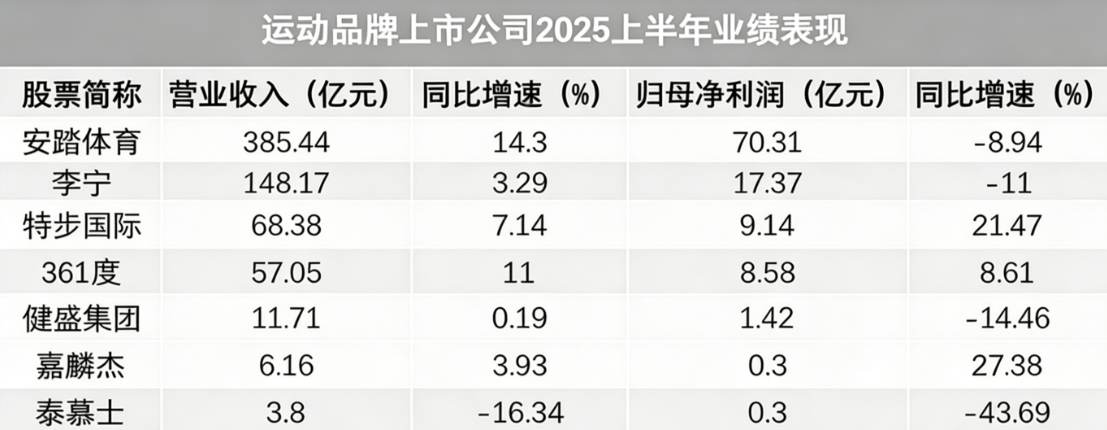
Core Insights - The Chinese sportswear brands Anta, Li Ning, and Xtep are experiencing a significant shift from rapid expansion to a phase of contraction, indicating a response to market saturation and growth bottlenecks [1][2] - The industry is transitioning from a focus on store quantity and channel leverage to a deeper transformation centered on brand value, product innovation, and operational efficiency [2] Anta - Anta's success is attributed to its "single focus, multi-brand" strategy, which has allowed it to build a diverse brand portfolio through strategic acquisitions [3] - Despite a revenue increase of 14.3% to RMB 38.544 billion in the first half of 2025, Anta's core brand revenue grew only 5.4%, indicating a slowdown in growth [5] - The company is facing a "revenue growth without profit" dilemma, with net profit declining by 8.94% due to increased competition and the need for discounts to maintain market share [6][7] Li Ning - Li Ning has established a unique position in the market through a single-brand focus, leveraging technology and brand assets, but is now facing growth challenges as market conditions change [8][9] - The company's revenue grew only 3.29% in the first half of 2025, with net profit declining by 11%, highlighting the limitations of its single-brand strategy [9][11] - Li Ning's brand positioning conflicts with consumer perceptions of value, leading to discounting practices that undermine its premium branding efforts [9][11] Xtep - Xtep has focused on becoming the "first choice for Chinese runners," establishing a strong reputation in the running segment through technology and event sponsorship [12] - However, its heavy reliance on the running category has created a "category dependency syndrome," limiting its growth potential in other sports segments [12][14] - The company's market value has been declining, reflecting investor concerns about its narrow growth narrative and limited expansion opportunities [14] Industry Trends - The collective challenges faced by Anta, Li Ning, and Xtep signify a broader industry trend where brands must transition from growth driven by store expansion to creating value and recognition [15] - The future of the industry lies in establishing a brand moat based on core technological advantages and unique cultural expressions, moving beyond cost advantages associated with "Made in China" [15]
价值研究所|即时零售迎“奇点”,巨头激战正酣
Zhong Guo Ji Jin Bao· 2025-12-11 08:31
Core Insights - The instant retail market in China is projected to reach 971.4 billion yuan by 2025, with a year-on-year growth of 24.4%, nearing the trillion yuan mark [2][3] - Major e-commerce platforms are heavily investing in instant retail, with Alibaba, JD, and Meituan collectively spending nearly 60 billion yuan in the third quarter of this year [3] - The business model of instant retail, which focuses on rapid delivery from local warehouses, has evolved over the past decade and is now gaining traction among consumers, particularly the younger demographic [4][5] Market Expansion - The instant retail sector is expanding rapidly, with expectations to reach 2 trillion yuan by 2030, maintaining a compound annual growth rate of 25% [3] - Instant retail has transitioned from a focus on fresh produce to a broader range of products, including beauty and apparel, which are well-suited for quick delivery due to their high demand for timeliness [5][7] Consumer Behavior - The younger generation, particularly those born after 1995, prioritize delivery speed, with over 50% expecting same-day or even half-day delivery [3][4] - Instant retail aligns with the "immediate purchase and delivery" mindset of younger consumers, enhancing their shopping experience and brand loyalty [4] Channel Transformation - The shift towards instant retail is prompting a re-evaluation of market shares, with brands that embrace new channels likely to stand out [5] - Beauty products are among the fastest-growing categories in instant retail due to their high price points and urgent demand scenarios [5][7] Operational Innovations - Companies like Qingdao Beer have adapted their operations to leverage instant retail, achieving a nearly tenfold increase in gross merchandise volume (GMV) from 2 billion yuan to approximately 20 billion yuan over five years [8] - Instant retail is also enabling traditional retail businesses to transition from a "goods and venue" mindset to an "instant service" model, opening new growth avenues [8][10] Competitive Landscape - Despite the rapid growth, the instant retail sector is still in its early stages, with major players engaged in a subsidy war that raises questions about long-term profitability [10][11] - Retail brands face challenges from high platform fees and competition from e-commerce platforms that are also developing their own private label products, which can undermine traditional brands [11] Future Outlook - The future of retail is expected to be multi-faceted, with no single model completely replacing the others, as companies strive to find business models that fit the instant retail paradigm [11] - Companies that can enhance their supply chain responsiveness through digital transformation are likely to thrive in the instant retail era [11]

价值研究所|即时零售迎“奇点”,巨头激战正酣
中国基金报· 2025-12-11 08:21
Core Viewpoint - The instant retail market in China is expected to reach 971.4 billion yuan in 2025, with a year-on-year growth of 24.4%, indicating a significant shift in consumer behavior towards faster delivery services [2][5]. Market Expansion - The instant retail industry is expanding rapidly, with projections indicating a market size of 2 trillion yuan by 2030 and a compound annual growth rate of 25% [5]. - Major e-commerce platforms like Alibaba, JD, and Meituan have invested nearly 60 billion yuan in instant retail in Q3 this year, highlighting the high investment and growth potential in this sector [5]. Consumer Behavior - The "post-95" generation values delivery speed more than previous generations, with over 50% preferring same-day or even two-hour delivery [5][6]. - Instant retail meets the demand for immediate gratification, reshaping consumer experiences and brand connections [6]. Channel Transformation - The beauty and personal care sector is experiencing significant growth in instant retail, with brands like Betaini and Proya quickly adapting to this model due to the high demand for timely delivery [8]. - Sportswear brands such as Li Ning and Anta are also entering the instant retail space, enhancing consumer convenience through local store fulfillment [10]. Operational Innovations - Qingdao Beer has successfully integrated instant retail, achieving a tenfold increase in GMV from 2 billion yuan to nearly 20 billion yuan in five years, with a compound annual growth rate exceeding 50% [11]. - Instant retail allows for cold chain delivery, ensuring product quality for sensitive items like fresh beer and frozen foods [10]. Market Dynamics - Instant retail is creating new growth avenues for retail companies, shifting from traditional "goods and space" models to "instant service" approaches [11]. - The "Good Idea Snack Paradise" brand has seen a 200% increase in order volume over three months, with over 90% of new customers coming from online channels [12]. Competitive Landscape - Despite the rapid growth, major players are currently in a "burning cash" phase, with significant cash flow losses reported by Meituan, Alibaba, and JD [13]. - Retail brands face challenges from aggressive platform subsidies and competition from private label products, necessitating a reevaluation of their business models [14]. - Companies that can enhance supply chain efficiency through digital transformation are likely to thrive in the instant retail era [14].