
九号公司

Search documents
国泰海通|机械:CES 2026:定义AI物理边界,加速具身智能规模化落地
国泰海通证券研究· 2026-01-11 13:54
Core Insights - The CES 2026 highlighted the trend of embodied intelligence scaling, showcasing the strength of Chinese enterprises [1] - Future focus will be on the application of embodied intelligence, particularly in the "perception-decision-execution" closed loop, with humanoid robots as a key carrier [2] - The shift from "digital intelligence" to "embodied intelligence" emphasizes AI's tangible outcomes, with a focus on hardware integration and deployment [3] Industry Trends - The CES featured over 4,100 exhibitors, with 1,141 from China, indicating a significant presence of Chinese tech companies [4] - Leading companies like Lenovo, TCL, and Ninebot are transitioning from technology users to ecosystem rule-makers, showcasing AI-native capabilities [4] - In the humanoid robot sector, Chinese exhibitors accounted for over 55%, with companies focusing on core component self-research and commercialization [4] Hardware Development - The path for embodied intelligence hardware is becoming clear, with key supply chain segments emerging, although the industry is still in its early commercialization phase [5] - Key validation points include the mass production and cost control of humanoid robots like Tesla's Optimus and the ability of AI-enabled terminal products to drive consumer demand [5] - Companies with core component technology advantages and involvement in leading customer product development will benefit first from industry trends [5]


机器人行业跟踪报告:CES 2026:定义 AI 物理边界,加速具身智能规模化落地
GUOTAI HAITONG SECURITIES· 2026-01-11 12:58
Investment Rating - The report assigns an "Accumulate" rating for the robotics industry [3][4]. Core Insights - The CES 2026 highlighted the trend of embodied intelligence scaling, showcasing the strength of Chinese enterprises in this field [2]. - The focus for future investments is on the application of embodied intelligence, particularly in the "perception-decision-execution" loop, which is expected to create new hardware demands [3]. - Human-shaped robots are identified as a key carrier of embodied intelligence, with companies achieving technological breakthroughs and domestic replacements poised for significant growth potential [3]. - The shift from "digital intelligence" to "embodied intelligence" emphasizes the tangible results of AI, with CES 2026 themed "AI Inside Every Hardware" indicating a transition towards physical AI applications [3]. - Major semiconductor companies like NVIDIA, AMD, and Intel showcased new products, indicating a competitive focus on the deployment of edge AI and large-scale AI infrastructure [3]. - The report notes that human-shaped robots have demonstrated operational capabilities in unstructured environments and are beginning to be utilized in factory settings [3]. - The competition landscape is evolving, with over 4,100 exhibitors at CES, including 1,141 from China, highlighting the significant role of Chinese tech companies [3]. - Key players in the human-shaped robot sector, such as Yushun and Zhiyuan, are focusing on self-research and commercialization of core components [3]. - The hardware pathway for embodied intelligence is becoming clearer, with core supply chain segments starting to benefit, although the industry remains in the early stages of commercialization [3]. Summary by Sections Investment Recommendations - The report recommends focusing on companies like Hengli Hydraulic and Changying Precision, which are expected to benefit from the trends in embodied intelligence [3][4]. Market Dynamics - The report emphasizes the importance of two key validation points: the mass production progress and cost control of human-shaped robots like Tesla's Optimus, and whether AI-enabled terminal products can drive consumer demand for upgrades [3]. Financial Projections - Financial forecasts for recommended companies include: - Changying Precision: EPS of 0.48 in 2025E, increasing to 1.22 in 2027E, with a PE ratio decreasing from 92.67 in 2025E to 36.46 in 2027E [4]. - Hengli Hydraulic: EPS of 2.09 in 2025E, increasing to 2.86 in 2027E, with a PE ratio decreasing from 55.12 in 2025E to 40.28 in 2027E [4].


家用电器行业周度跟踪:消费机器人向具身智能迈进,供应链国产替代下降本可期-20260111
Western Securities· 2026-01-11 10:52
Investment Rating - The industry investment rating is "Overweight" [5][9] Core Insights - The report highlights Midea's acquisition of Carestream Health's global business, which is expected to create synergies with Midea's existing medical business in terms of channels and equipment resources [5][6] - The consumer robotics sector is advancing towards embodied intelligence, with a notable decline in domestic supply chain substitution expected [2][4] - The report emphasizes the performance of major brands in the vacuum cleaner market, noting a significant sales decline for some brands while others, like Roborock, have shown growth [2][3] Summary by Sections White Goods - Midea's acquisition of Carestream Medical's global business is expected to enhance its existing medical operations through effective resource synergy [5][6] Consumer Robotics - December sales data shows a year-on-year decline of 29% for the overall market, with leading brands like Ecovacs and Roborock experiencing varying sales changes [2] - New product launches at CES include Roborock's G-Rover, which is the world's first stair-climbing vacuum robot, and Ecovacs' T90 pro omni, which features upgraded roller lengths and new pre-spray functions [3] Laser Technology in Robotics - Hesai Technology announced that it will lead the market in 3D LiDAR shipments for lawn mowing robots by 2025, showcasing its new models at CES 2026 [4] - The integration of digital all-solid-state LiDAR in new lawn mowing robots was highlighted by Ninebot and other companies [4] Investment Recommendations - The report recommends focusing on white goods, particularly Haier, Midea, and Gree, due to their strong market positions and potential benefits from the current economic environment [7] - It also suggests selecting consumer technology stocks like Ecovacs and others, while keeping an eye on companies like TCL Electronics for overseas growth opportunities [7]





行业“老二”爱玛裁员,国际和高端业务双重承压
Jing Ji Guan Cha Wang· 2026-01-11 10:07
Core Viewpoint - Aima Technology (603529.SH) is undergoing layoffs across multiple departments, including its international and high-end brand divisions, despite reporting strong revenue growth in recent quarters [1][2]. Group 1: Layoffs and Company Response - Aima has initiated layoffs affecting various departments, with reports indicating that the international and high-end brand divisions have seen reductions exceeding 50% [1]. - Aima's investor hotline stated that personnel adjustments are normal during corporate development, denying any significant workforce reduction and asserting that the international and high-end departments are still operational [1]. Group 2: Financial Performance - In the first three quarters of 2025, Aima achieved a revenue of 21.09 billion yuan, a year-on-year increase of 20.78%, and a net profit of 1.907 billion yuan, up 22.78%, marking the best performance in its history for this period [2]. - Despite stable growth, Aima faces increasing competition from industry leaders like Yadea and emerging players, which are growing at a faster pace [2][3]. Group 3: Competitive Landscape - Yadea reported a revenue of 19.19 billion yuan in the first half of 2025, with a year-on-year growth of 33.11%, while its net profit increased by 59.50% [3]. - New entrants like Ninebot have shown even more rapid growth, with a revenue of 18.39 billion yuan in the first three quarters of 2025, reflecting a year-on-year increase of 68.63% [3]. Group 4: International Expansion and Challenges - Aima has been pursuing international expansion since 2015, with significant investments in Southeast Asia, including operational factories in Vietnam and Indonesia [4][5]. - However, Aima's international business remains underwhelming, with revenue from international operations accounting for only 0.69% of total revenue in the first half of 2025, down from around 1% previously [4][5]. Group 5: High-End Market Strategy - Aima launched a new high-end electric motorcycle brand, Zeroji, targeting urban youth, with plans to open experience centers in major cities by mid-2026 [6]. - The company faces challenges in penetrating the high-end market, requiring significant investment in understanding consumer preferences and developing new technologies [6]. Group 6: Regulatory Pressures - Aima must comply with new national standards for electric bicycles effective December 1, 2025, which impose stricter requirements on speed limits, materials, and safety features, necessitating investment in production line upgrades [7].

2026美国消费电子展上的“中国智造”
Xin Hua She· 2026-01-10 06:56
Group 1 - The 2026 Consumer Electronics Show (CES) in Las Vegas will take place from January 6 to 9, showcasing "Chinese manufacturing" with higher innovation density and clearer technological pathways, advancing towards international competition [1] - Visitors at CES are interacting with various robotic technologies, highlighting the growing presence of robotics in consumer electronics [3] - Shenzhen Zhongqing Robot Technology Co., as well as other companies, are exhibiting their robotic innovations at the event, indicating a strong focus on automation and robotics in the industry [5][7] Group 2 - Attendees are experiencing various products, including ice cream robots and smart glasses, which reflect the diversity of technological advancements being presented at CES [9][11] - Companies like TCL and Hisense are showcasing their latest innovations, such as smart glasses and RGB-Mini LED large screen televisions, emphasizing the trend towards enhanced visual technology [11][13] - The presence of electric bicycles at the event indicates a growing interest in sustainable transportation solutions within the consumer electronics sector [15]


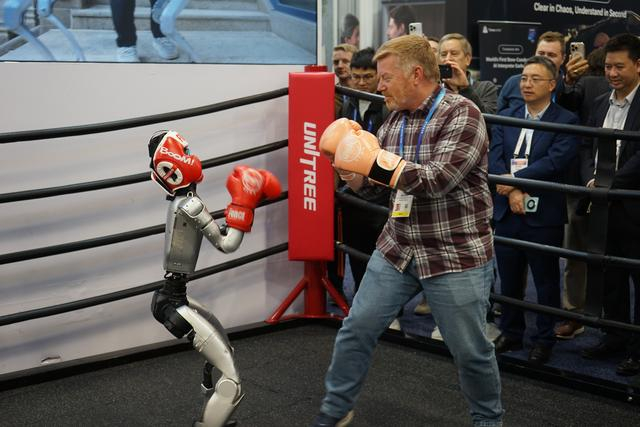
环球直击美国CES展:更少和更强大的中国企业正在重新定义AI竞争的规则
Huan Qiu Wang Zi Xun· 2026-01-10 05:33
Core Insights - The CES 2026 showcased AI as the central theme, emphasizing human-centric applications and the integration of AI into various sectors [1][3][6] - The competition in the chip industry was highlighted, with major players like NVIDIA, AMD, Intel, and Qualcomm presenting their advancements in AI infrastructure [3][9] - The exhibition marked a shift from hardware-centric displays to a focus on ecosystem definition and strategic collaboration among companies [4][16] AI and Robotics - CES 2026 introduced a dedicated area for AI and quantum innovation, showcasing practical applications of embodied intelligence and advancements in autonomous driving [3][4] - The event demonstrated a transition from conceptual robot designs to practical solutions addressing real-world challenges in home services and industrial logistics [3][11] - Chinese companies showcased significant advancements in robotics, with a focus on self-developed core components and solutions for logistics and manufacturing [11][13] Chinese Companies' Participation - The number of Chinese exhibitors in the core professional pavilion decreased to 207 from 1,475 in 2025, indicating a structural adjustment in participation [4][5] - The remaining Chinese companies at CES were required to demonstrate AI-related functionalities, reflecting a shift towards more innovative and integrated product offerings [5][6] - Major Chinese firms like Lenovo showcased their global influence by hosting large-scale events, indicating a strategic focus on ecosystem development [6][16] Competitive Landscape - The competition is evolving from hardware specifications to a comprehensive narrative that includes both foundational technology and application capabilities [7][16] - The contrasting approaches of Chinese and American tech companies in building AI ecosystems highlight differences in strategic thinking and resource allocation [8][15] - Chinese automotive companies emphasize full-stack self-research and vertical integration, while Western firms focus on open software ecosystems and long-term evolution [15][16] Future Implications - The CES 2026 signals a shift in global tech competition towards defining future technology ecosystems and industry standards [16][17] - Companies that can navigate the complexities of AI and contribute to ecosystem building are likely to remain at the forefront of technological advancement [17]



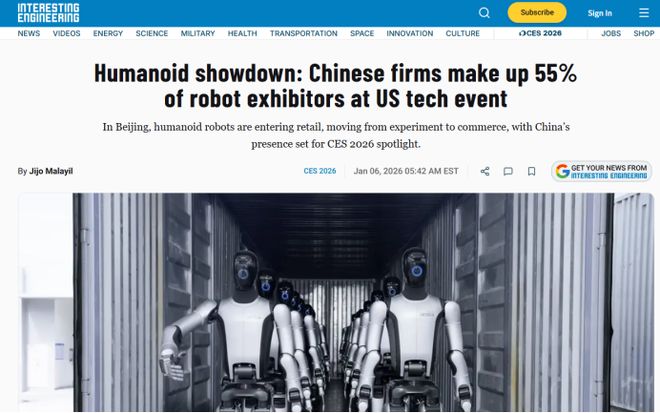
中国科技企业闪耀CES,以创新和品牌力突围
2 1 Shi Ji Jing Ji Bao Dao· 2026-01-10 00:10
Group 1 - The core viewpoint of the articles highlights the increasing presence and competitiveness of Chinese technology companies at the CES 2026, showcasing a shift from traditional manufacturing roles to a more diversified global strategy that emphasizes technology, design, and localized operations [1][4]. - Chinese companies are exhibiting a strong focus on AI integration, with nearly all exhibitors emphasizing AI in their presentations, indicating a trend towards practical applications rather than just theoretical concepts [2][3]. - The number of Chinese humanoid robot exhibitors at CES 2026 exceeds 20, surpassing the total from the US, Japan, South Korea, and Europe combined, demonstrating a significant cluster effect in this sector [2]. Group 2 - In the first three quarters of 2025, China's export of high-tech products reached 37.5 trillion yuan, marking an 11.9% increase and contributing over 30% to the overall export growth during the same period [1]. - The global market for robotic vacuum cleaners is dominated by Chinese brands, which accounted for over 60% of the market share in terms of shipment volume in 2025 [5]. - Chinese technology companies are increasingly focusing on brand building after achieving significant sales milestones, with many adopting interactive marketing strategies to enhance brand visibility and consumer engagement [6][7]. Group 3 - The CES serves as a window into technological trends and reflects the journey of Chinese companies expanding into overseas markets, with a notable increase in brand recognition and a shift away from the "low-price label" to a "technology leader" image [4][6]. - The rapid iteration cycles of Chinese companies, averaging six months to a year for product updates, contrast with European companies that typically require two to three years, allowing for quicker market responsiveness [4][6]. - Challenges remain for Chinese companies in navigating diverse market environments, including varying consumer preferences, regulatory requirements, and external uncertainties, which necessitate comprehensive long-term strategic planning [7][8].
九号有限公司员工认股期权计划第五次行权限售存托凭证上市流通公告
Shang Hai Zheng Quan Bao· 2026-01-09 21:23
重要内容提示: ● 本次存托凭证上市类型为股权激励存托凭证;存托凭证认购方式为网下,上市存托凭证数量为 1,460,510份。 本次存托凭证上市流通总数为1,460,510份,占公司存托凭证总数的比例为0.20%,限售期为自行权之日 起三年。 ● 本次存托凭证上市流通日期为2026年1月19日。 一、本次境内限售存托凭证上市类型 2015年1月27日,九号有限公司(以下简称"公司")召开了董事会和股东大会,决议通过了2015年员工 股票期权计划(简称"2015年期权计划")。2019年4月2日,公司召开了董事会和股东大会,决议通过了 2019年员工股票期权计划(简称"2019年期权计划")和创始人期权计划。 证券代码:689009 证券简称:九号公司公告编号:2026-001 九号有限公司员工认股期权计划第五次行权限售存托凭证上市流通公告 本公司董事会及全体董事保证本公告内容不存在任何虚假记载、误导性陈述或者重大遗漏,并对其内容 的真实性、准确性和完整性依法承担法律责任。 截至2019年4月2日,2015年期权计划、2019年期权计划、创始人期权计划已全部授予完毕,目前尚未行 权完毕。其中2015年期权计划和 ...
中国科技企业闪耀CES:撕下低价标签 以创新和品牌力突围
2 1 Shi Ji Jing Ji Bao Dao· 2026-01-09 09:38
Core Insights - The presence of Chinese technology companies at CES 2026 has significantly increased, showcasing a shift from traditional supply chain roles to a more diversified global strategy focused on technology, design, and localized operations [1][4]. Group 1: Chinese Companies at CES - A total of 207 Chinese companies participated in CES 2026, occupying over 4,900 square meters of exhibition space, marking a strong presence in the global tech landscape [1]. - The focus of the exhibition has shifted towards AI-driven technologies, with nearly all exhibitors highlighting AI as a core component of their offerings [2]. Group 2: AI and Robotics - Chinese companies are leading in the robotics sector, with over 20 humanoid robot exhibitors, surpassing the total from the US, Japan, South Korea, and Europe combined [2]. - Innovations in practical applications of AI are evident, with products like delivery robots and advanced cleaning robots demonstrating significant functional capabilities [3]. Group 3: Market Position and Product Competitiveness - By the first three quarters of 2025, Chinese brands accounted for over 60% of the global market share in robotic vacuum cleaners, indicating a strong competitive position [5]. - Chinese technology firms are increasingly recognized for their technological advancements and design quality, allowing them to command a price premium in overseas markets [5]. Group 4: Brand Development and Market Expansion - As Chinese tech companies achieve significant sales milestones, they are increasingly focusing on brand building, utilizing interactive marketing strategies to enhance consumer engagement [6]. - The transition to brand-focused strategies is expected to further boost sales, particularly in high-value product categories [6]. Group 5: Challenges and Strategic Considerations - Companies face challenges related to varying market conditions, cultural differences, and regulatory requirements across different regions [7]. - The external environment's uncertainty poses risks, but stabilizing conditions could enhance the competitive advantages of Chinese tech firms [7].
中国科技企业闪耀CES:撕下低价标签,以创新和品牌力突围
2 1 Shi Ji Jing Ji Bao Dao· 2026-01-09 09:35
Group 1 - The core viewpoint of the articles highlights the increasing presence and influence of Chinese technology companies at the CES 2026, showcasing a shift from traditional manufacturing roles to a more diversified global strategy that emphasizes technology, design, and localized operations [1][2][4] - Chinese companies are exhibiting a strong focus on AI integration, with nearly all exhibitors emphasizing AI in their presentations, indicating a trend towards practical applications rather than just theoretical concepts [2][3] - The number of Chinese humanoid robot exhibitors at CES 2026 exceeds 20, surpassing the total from the US, Japan, South Korea, and Europe combined, demonstrating a significant cluster effect in this sector [2] Group 2 - The export of high-tech products from China reached 37.5 trillion yuan in the first three quarters of 2025, marking an 11.9% increase and contributing over 30% to the overall export growth during the same period [1] - Chinese brands are shedding the "low-price label" and establishing a reputation for "technological leadership," supported by initiatives like the Belt and Road and favorable cross-border e-commerce policies [4][5] - In the robot sector, Chinese brands dominate the global market for vacuum robots, holding over 60% of the market share, with prices in overseas markets being 20%-30% higher than in China, indicating a willingness among consumers to pay a premium for perceived quality [5] Group 3 - The trend of enhancing brand power is becoming evident as Chinese tech companies invest in brand building after achieving significant sales milestones, with a focus on interactive marketing methods to engage consumers [6][7] - Challenges remain for Chinese companies as they navigate different market environments, cultural preferences, and regulatory requirements, which necessitate a comprehensive and resilient long-term strategy for overseas expansion [7] - The ability of Chinese tech firms to overcome core technological challenges while successfully integrating into diverse cultural and regulatory landscapes will determine their long-term success in global markets [7]