中国电信

Search documents
高股息策略配置性价比进一步提升,港股通红利ETF广发(520900)涨1.34%
Xin Lang Cai Jing· 2026-02-03 08:04
Group 1 - The core viewpoint of the articles emphasizes the increasing interest in high dividend yield stocks, particularly in the context of declining bond yields and the need for investors to seek higher returns in equity investments [1][2][3] - Long-term value in dividend investing is shifting from merely seeking high dividend rates to focusing on sustainable dividend capabilities, with a recommended expected return rate of over 3%-5% and a strong safety margin [1][2] - The performance of high dividend sectors has shown recovery, driven by strong demand for insurance funds and favorable pricing logic in cyclical high dividend sectors such as oil, steel, and coal [1][2] Group 2 - The market is experiencing challenges in restoring risk premiums, with significant volatility in cyclical products affecting market profitability, leading to a potential "small platform period" for investor risk appetite [2][3] - The insurance sector is seeing robust growth in new business, particularly in dividend insurance sales, which is increasing the allocation of investment funds towards long-duration assets [2][3] - The dividend strategy remains a key focus for equity investments, with pressures on cash investment returns expected to increase by 2026, reinforcing the importance of dividend strategies for companies [2][3] Group 3 - Looking ahead to 2026, dividend strategies are expected to continue serving as a stabilizing force in investment portfolios, with dividend assets showing lower valuation levels and volatility compared to other asset classes [3][9] - The Hong Kong Stock Connect Dividend ETF (520900) closely tracks the CSI National New Hong Kong Stock Connect Central Enterprise Dividend Index, which selects stable dividend-paying companies from the central state-owned enterprises [3][9] - The top five industries in the CSI National New Hong Kong Stock Connect Central Enterprise Dividend Index include oil and petrochemicals (28.63%), telecommunications (21.75%), coal (11.80%), transportation (10.47%), and public utilities (7.94%), indicating a strong value and defensive characteristic [4][10]



突发三大利空压顶!黄金闪崩,茅台却涨价,周末三大消息炸锅,但这个方向被马斯克点燃了
Sou Hu Cai Jing· 2026-02-03 07:55
这个周末,市场消息面可谓是冰火两重天,让人心跳加速。 一边是国际黄金白银价格上演"高台跳水",一夜之间暴跌超过10%,让持有资源股的投资者心头 一紧。 另一边,飞天茅台的批发价却悄悄实现了"三连涨",每瓶价格反弹了100元,给冰冷的大消费板块带来了一丝暖意。 12 and manufa 3 113 still be berger read An 0 更引人关注的是,特斯拉的老板埃隆·马斯克又扔下了一个重磅炸弹:他的SpaceX公司正在申请发射一个由多达100万颗卫星组成的超级星座。 与此同时, 国内也有三件大事需要面对:最新的制造业PMI数据不及市场预期,显示经济复苏的根基仍需夯实;中国移动、中国联通、中国电信三大运营商集体发布公 告,自2026年起,部分业务的增值税税率将从6%上调至9%;而距离农历春节,只剩下最后的10个交易日。 这一连串的消息,究竟哪个影响最大? 它们是把市场推向更深的调整,还是在恐慌中埋下了新的机会? 我们梳理了每一个关键信息,试图为你呈现一个清 晰的节前市场图景。 上周五,纽约商品交易所的黄金期货价格跌破了每盎司4800美元的重要关口。 这不仅仅是普通的下跌,单日跌幅超过了10%。 ...


游戏股集体反弹,加税传闻不实
Xin Lang Cai Jing· 2026-02-03 06:27
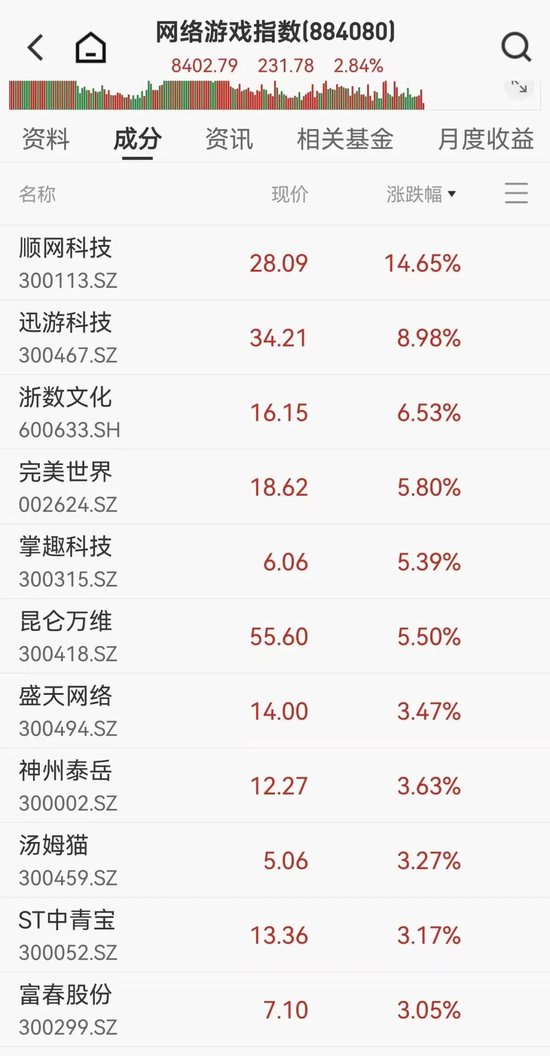
Core Viewpoint - The market reacted negatively to rumors suggesting that the financial and internet value-added services sectors, including gaming, might face tax rate adjustments similar to those applied to liquor, leading to a decline in stock prices for major companies like Tencent and others in the gaming sector [1][10]. Group 1: Market Reaction - On February 3, the A-share gaming sector experienced a significant drop, with Century Huatong's stock falling over 9%, and other major gaming stocks like Kaixin Network, Giant Network, and 37 Interactive Entertainment also declining [1][10]. - Following the initial drop, gaming stocks rebounded, with Shunwang Technology rising by 14.65%, and other companies like Xunyou Technology, Zhejiang Shuju, and Perfect World seeing increases of over 5% [1][10]. Group 2: Tax Rumors and Industry Response - Industry insiders have confirmed that there has been no official communication regarding tax rate adjustments, indicating that the rumors are likely unfounded [5][14]. - A representative from a leading gaming company stated that no formal documents or meetings regarding tax adjustments have been received, further supporting the notion that the rumors lack credibility [5][14]. - According to a report from Everbright Securities, the rumors are based on a misunderstanding of tax categories, as the proposed comparison between gaming and liquor tax rates is misleading [6][15]. Group 3: Tax Policy Context - The current tax rate for financial services and modern services, including gaming and advertising, is set at 6%, contrasting with the 9% rate applicable to basic telecommunications and construction sectors [6][15]. - The recent tax rate adjustment announced by the Ministry of Finance and the State Administration of Taxation only pertains to basic telecommunications services, not affecting financial or internet value-added services [6][15]. - The prevailing policy focus is on stabilizing growth and promoting innovation, suggesting that significant tax increases in key sectors would contradict current governmental objectives [7][16].






游戏股集体反弹,加税传闻不实
21世纪经济报道· 2026-02-03 06:26
Core Viewpoint - The article discusses rumors regarding potential tax rate adjustments for the financial and internet value-added services sectors, particularly gaming, which led to a decline in stock prices for major internet companies like Tencent. However, industry insiders have largely dismissed these rumors as unfounded and lacking credibility [1][6][7]. Group 1: Market Reactions - On February 3, market rumors about tax rate adjustments caused a significant drop in the A-share gaming sector, with Century Huatong's stock falling over 9%, and other major gaming stocks like Kaixin Network and Giant Network also experiencing declines [1]. - Despite the initial drop, gaming stocks rebounded later, with Shunwang Technology rising by 14.65% and other companies like Xunyou Technology and Zhejiang Shuju Culture seeing increases of over 5% [1][2]. Group 2: Tax Rate Rumors - The rumors suggested that the gaming tax rate might align with the 32% rate applied to liquor, which is a consumption tax, while gaming services are subject to a value-added tax (VAT) of 6% [6][7]. - Industry experts confirmed that there has been no official communication regarding tax rate changes, and the credibility of the rumors is considered low [6][7]. Group 3: Tax Policy Context - The current VAT law, effective from January 1, 2026, specifies three tax rates: 13%, 9%, and 6%, with financial and modern services, including gaming, falling under the 6% category [7]. - Recent adjustments in tax rates have only affected basic telecommunications services, and any changes to the tax structure would require rigorous legislative or administrative processes [7]. - The prevailing policy focus is on stabilizing growth and supporting innovation, making significant tax increases on key industries unlikely [7].






游戏行业税率向白酒看齐?多家游戏公司回应:不实消息
Xin Lang Cai Jing· 2026-02-03 05:59
Core Viewpoint - Recent rumors suggest that the financial and internet value-added services sectors, such as in-game purchases and advertising, may face tax rate adjustments due to their high profit margins and low tax burdens, similar to the liquor tax rate, leading to a decline in stock prices of companies like Tencent [1][4]. Group 1: Tax Rate Rumors - The three major telecom operators in China announced a tax rate increase from 6% to 9% for value-added tax, effective January 1, 2026, as per the recent announcement by the Ministry of Finance and the State Taxation Administration [5]. - Industry insiders have not received any official communication regarding tax rate adjustments, indicating that the rumors lack credibility [5][6]. - A public relations officer from a Shanghai gaming company confirmed that no formal documents or meetings regarding tax adjustments have been held recently [5]. Group 2: Analysis of the Rumors - A report from Everbright Securities stated that the rumors are fundamentally flawed in terms of tax types, legal, and policy logic, and investors should not overreact [2][6]. - The claim that "game tax rates will align with the 32% liquor tax" is misleading, as liquor tax is a consumption tax, while in-game purchases and advertising are subject to value-added tax, which are governed by different legal frameworks [2][6]. - The current tax rates are bound by legal constraints, making adjustments difficult; the new VAT law specifies three tax rates: 13%, 9%, and 6%, with financial and modern services subject to the 6% rate [2][6]. Group 3: Policy Direction - The current policy focus is on "stabilizing growth, promoting innovation, and supporting industrial upgrades," which contradicts the idea of a blanket tax increase on key industries [3][7]. - Discussions around financial sector tax burdens are more likely to lead to structural adjustments, such as optimizing deduction rules, rather than simply raising tax rates [3][7]. - Future tax regulations may involve reviewing and clearing tax incentives for certain companies, rather than directly increasing statutory tax rates, which would have limited and controllable impacts [3][7]. - The core drivers of stock prices for leading internet companies remain their business growth, AI commercialization progress, and profitability improvements, with short-term sentiment fluctuations not altering long-term fundamentals [3][7].
CPO等算力硬件股继续走强,“易中天”权重占比超25%的通信ETF广发(159507)盘中最高涨近4%
Xin Lang Cai Jing· 2026-02-03 05:17
2026年2月3日早盘,CPO等算力硬件股继续走强,罗博特科、天孚通信盘中涨超10%,股价均创历史新 高,太辰光、炬光科技、光库科技、天通股份等跟涨。 近期,光模块板块表现强劲,中际旭创与新易盛相继发布超预期业绩预告,印证全球算力基础设施建设 持续高景气。中际旭创预计2025年净利润98–118亿元,同比增长89.5%–128.2%,剔除汇兑损失及股权 激励等非经营性影响后实际经营更为扎实;新易盛预计2025年净利润94–99亿元,同比大增231.2%– 248.9%,高速率光模块需求放量成为核心驱动力。与此同时,Meta与康宁签署60亿美元长期光纤电缆 供货协议,订单规模远超康宁该业务历史营收水平,凸显北美数据中心对光通信底层硬件的刚性扩产需 求。 消息面方面,2026年起,部分电信服务增值税税率由6%上调至9%,涵盖手机流量、短信彩信及宽带接 入等基础通信服务。此次税制调整将加速运营商从传统通信服务商向"通信+算力+智能"综合信息服务 商转型,推动其优化资源配置、强化成本管控,并加快全栈创新节奏。中国移动首次提出打造通信、算 力、智能服务三大增长曲线;中国电信全面深化AI+行动;中国联通聚焦连接、算力、服 ...
南财V快评:你的话费要涨了吗?
2 1 Shi Ji Jing Ji Bao Dao· 2026-02-03 05:07
二,财政回补与战略导向。税收的增加,预示着国家对通信业的要求已从"普及化"转向"高质量产出"。 通过财税手段引导行业将有限的资金从市场营销流向算力网络、6G研发等战略高地。 是运营商赚太多了,国家才给他们提税么?哎还真不是,根据财报数据,三大运营商的营收增速已集体 回落至1%以内的临界点,且用户平均收入持续低迷。按目前行业营收结构测算,本次受税率波动影响 的业务收入规模接近1.2万亿元。在当前提速降费的政策背景下,含税套餐价格必须保持稳定,这意味 着新增的3%税收成本将完全由运营商内部消化,行业净收入将直接流失约250亿至300亿元。这意味着 全行业净利润将面临10%到15%的定向削减。对于利润率本就处于个位数的通信行业来说,这是一次极 具压力的利润重塑与成本挤压。 为什么既然他们越赚越少了,为什么还选择在此时给运营商加税呢?这是国家对治理逻辑的一次彻底转 换。从行业生命周期来看,运营商的发展已经从"爆发期"转向了"成熟期"。在"十五五"之前,6%的低税 率本质上是国家给予通信产业的战略扶持。通过政策性让利,驱动运营商大举投入基建、降低资费门 槛,培养用户习惯,以此孵化出规模巨大的短视频、直播及移动支付生态。 ...
重视供需反转下的光纤光缆板块
HTSC· 2026-02-03 04:30
证券研究报告 科技 重视供需反转下的光纤光缆板块 华泰研究 2026 年 2 月 02 日│中国内地 行业周报(第五周) 本周观点 市场方面,上周通信(申万)指数上涨 5.83%,同期上证综指下跌 0.44%, 深证成指下跌 1.62%。2026 年 1 月,中国 G.652.D 单模光纤价格创下近七 年来的新高,平均价格来到 35 元/芯公里以上。涨价主因行业供需格局发生 变化:1)需求端,全球 AI 数据中心与无人机对光纤需求高增,Meta 与康 宁新签 60 亿美金 AI 数据中心光缆大单;2)供给端,光纤上游关键物料光 纤预制棒产能或无法在短期内快速提升。综上,我们建议重点关注光纤光缆 板块的业绩增长与估值修复机遇。 周专题:全球下游需求高景气,重视光纤光缆板块 2026 年 1 月,中国市场 G.652.D 单模光纤价格创下近七年来的新高,平均 价格来到35元/芯公里以上。我们认为涨价主因行业供需格局发生重要变化: 1)需求端,全球 AI 数据中心对光纤需求高增,上周 Meta 与康宁签订 60 亿美金 AI 数据中心光缆大单,该订单体量与 25 年全年康宁光通信业务收入 相当,此外俄乌冲突影响下, ...
如何看待运营商增值税调整的影响?
HTSC· 2026-02-03 04:25
Investment Rating - The report maintains an "Overweight" rating for the telecommunications sector, indicating an expectation that the sector will outperform the benchmark index [6]. Core Viewpoints - The adjustment of the VAT category for telecommunications services from value-added telecommunications services to basic telecommunications services, with a corresponding increase in VAT rate from 6% to 9%, is expected to have a short-term impact on the revenue and profits of the three major telecom operators [1][4]. - Despite the VAT adjustment, the operators are actively pursuing technological transformation and upgrading, which is expected to optimize their revenue structure in the long term [1][3]. - The impact on profits may be less severe than initially calculated due to several factors, including past experiences with tax adjustments, the shift towards technology-driven services, and cost reductions through AI-driven operational efficiencies [3][22]. Revenue Impact - The estimated impact of the VAT adjustment on total revenue is approximately 1.3% to 1.4% for the three major operators, with specific estimates of 1.4% for China Mobile, 1.3% for China Telecom, and 1.3% for China Unicom [2][18]. - The affected services primarily include SMS, mobile data services, and internet broadband access, which account for 52%, 48%, and 46% of total revenues for China Mobile, China Telecom, and China Unicom, respectively [2][9]. Profit Impact - Direct calculations suggest that the absolute revenue impact for 2026 would be approximately 15.3 billion for China Telecom, 54 billion for China Unicom, and 153 billion for China Mobile, representing 8.2%, 15.3%, and 19.3% of their respective total profits [3][19]. - However, the report suggests that the final impact on profits may be lower than these direct estimates due to historical precedents and ongoing strategic shifts towards technology services [3][22]. Investment Conclusion - Overall, while the VAT adjustment will have some short-term effects on performance, the stable profitability and cash flow of the telecom operators, along with attractive dividends and the long-term growth potential of their digital businesses, remain intact [4][26]. - The report recommends focusing on China Mobile, China Telecom, and China Unicom as attractive investment opportunities [4][25].



大行评级丨小摩:维持三大电信运营商“增持”评级,预计中国移动受增值税调整影响最小
Ge Long Hui A P P· 2026-02-03 04:00
Core Viewpoint - Morgan Stanley's report indicates that the three major telecom operators in mainland China will adjust their value-added tax rates from 6% to 9%, which is expected to impact net profits for China Mobile, China Telecom, and China Unicom by 7.1%, 12.6%, and 11.9% respectively [1] Group 1: Tax Adjustment Impact - The tax adjustment will affect mobile data, SMS/MMS, and internet broadband services [1] - China Mobile is expected to experience the smallest impact among the three operators due to its higher gross margins [1] - The actual profit impact may be milder than estimated, as the telecom operators are undergoing state-owned enterprise reforms with financial KPIs set by authorities [1] Group 2: Mitigation Measures - Telecom operators are expected to offset the impact of the tax adjustment through various measures, including optimizing operating expenses, price increases, and controlling capital expenditures [1] Group 3: Market Performance and Dividend Yield - The stock prices of the three major telecom operators have significantly declined since the fourth quarter of last year, primarily due to capital rotation towards AI-themed stocks and concerns over slowing growth in traditional telecom services [1] - Expected dividend yields for China Mobile, China Telecom, and China Unicom in 2026 are 7%, 5.7%, and 6.8% respectively, which remain attractive compared to the Hang Seng Index [1] - The report maintains an "overweight" rating for all three telecom operators [1]