
手机流量

Search documents
中国电信增值税税率上调,AI业务获战略投资
Jing Ji Guan Cha Wang· 2026-02-14 02:54
Industry Policy Status - On February 1, 2026, China Telecom and other major operators announced a tax adjustment where the VAT rate for mobile data, SMS, MMS, and internet broadband services increased from 6% to 9%, effective January 1, 2026. This change may have a short-term impact on the company's revenue and profits [1] - An industry analysis on February 10, 2026, indicated that traditional voice and mobile data service revenues are under pressure, but emerging businesses such as intelligent computing, security, video networking, and quantum revenue are experiencing high growth, supported by the "AI+" policy [4] Business and Technical Development - On February 12, 2026, China Telecom's AI company completed its first round of financing, attracting strategic investors including the National Artificial Intelligence Fund. The company's strategy has been upgraded to "cloud transformation, data-driven intelligence," focusing on AI-driven growth. Intelligent revenue is projected to reach 8.9 billion yuan in 2024, with a year-on-year growth of 62.3% in the first three quarters of 2025 [2] Financial and Technical Aspects - As of February 11, 2026, China Telecom experienced continuous net outflows of main funds, with a net outflow of 31.9 million yuan on February 10, and a financing balance of 1.387 billion yuan, reflecting cautious short-term market sentiment. Technically, the stock price is positioned between support and resistance levels, necessitating attention to the breakout direction [3]

港股“春季躁动”遇上“解禁高峰” 投资者将如何应对?
Sou Hu Cai Jing· 2026-02-09 05:49
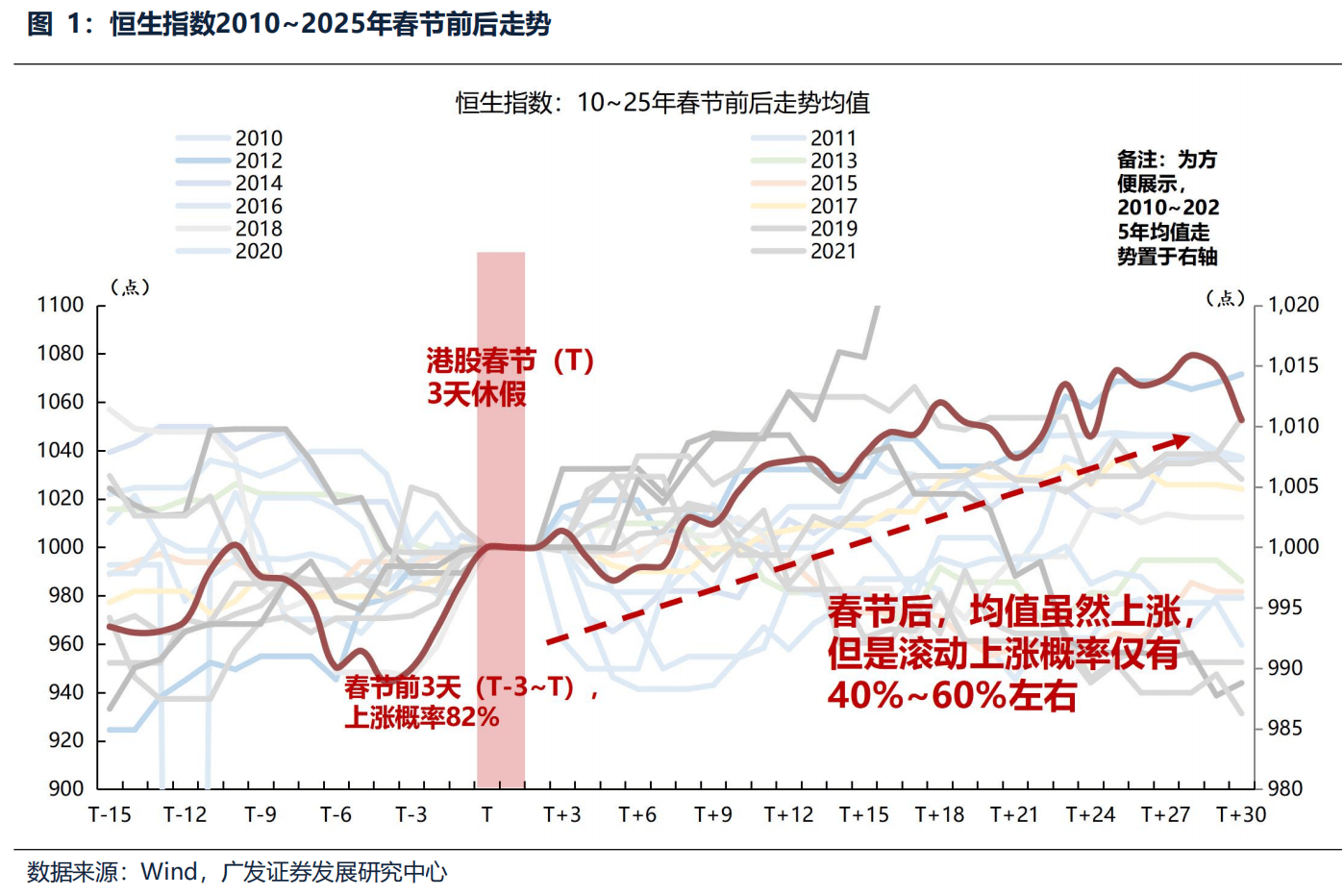
Group 1 - The core viewpoint of the article highlights the historical performance of the Hang Seng Index before and after the Chinese New Year, indicating a strong tendency for the index to rise before the holiday, with an 82% probability of increase in the three trading days leading up to the festival [1] - The data shows that the Hang Seng Index has a 40%-60% probability of rising in the month following the Chinese New Year, lacking a stable pattern similar to the "spring rally" observed in A-shares [7] - The correlation between the Hong Kong stock market and A-shares has increased, suggesting that when A-shares experience a "spring rally," the Hong Kong market may also follow suit [8] Group 2 - Recent changes in tax policies have raised concerns among investors, particularly regarding the potential for increased tax rates on dividend assets in the Hong Kong market, although the adjustments are more about reclassification rather than an actual tax hike [9] - The strengthening of the RMB against the HKD affects the holding experience of mainland investors, leading to potential exchange losses on Hong Kong stocks priced in RMB, although long-term significant appreciation of the RMB is not expected [10] - Changes in the Federal Reserve's leadership, particularly the nomination of a hawkish figure, may impact industries with strong foreign capital pricing power, such as internet and hardware sectors [11][12] Group 3 - The upcoming peak in IPO lock-up expirations poses a risk, as historical data shows that significant lock-up expirations have coincided with declines in the Hang Seng Index [16] - The next lock-up expiration peak in March 2026 is expected to involve significant amounts, particularly in sectors like non-ferrous metals and tea beverages, raising concerns for southbound capital [20] - Despite the short-term pressure from the lock-up expirations, historical trends suggest that the market often adjusts in advance, potentially leading to a bottoming out after the expirations [24][27] Group 4 - The liquidity environment is showing signs of marginal improvement, with recent foreign capital outflows largely absorbed by the market, indicating a stabilization in liquidity expectations [23] - The Hang Seng Technology Index has recently surpassed its annual line, suggesting that the suppression of market sentiment has been significantly alleviated, which could lead to a recovery in market sentiment and capital inflow [23] - The ongoing positive trends in industries, particularly in AI applications, are expected to provide fundamental support for the technology sector in 2026 [23]

每周股票复盘:中国联通(600050)税目调整致税率升至9%
Sou Hu Cai Jing· 2026-02-07 17:20
Group 1 - China Unicom's stock closed at 4.84 yuan on February 6, 2026, down 5.28% from 5.11 yuan the previous week, reaching a near one-year low [1] - The company's current market capitalization is 151.32 billion yuan, ranking 3rd in the telecommunications services sector and 119th among all A-shares [1] - The highest intraday price for the week was 5.0 yuan on February 2, and the lowest was 4.78 yuan on February 3 [1] Group 2 - The Ministry of Finance and the State Taxation Administration announced an adjustment in the VAT tax category for telecommunications services, increasing the tax rate from 6% to 9% effective January 1, 2026, which will impact the company's revenue and profits [1] - China Structural Adjustment Fund Co., Ltd. reduced its holdings by 336,542,934 shares, bringing its ownership down to 5.00% of the total shares outstanding [1][3]

未知机构:申万宏源海外策略税收法定原则的落地就近期部分行业涉税相关问题的探讨-20260204
未知机构· 2026-02-04 02:00
Summary of Key Points from the Conference Call Industry Overview - The discussion revolves around the implementation of the "Tax Law Principle" in China, particularly focusing on the new Value-Added Tax (VAT) Law effective from January 1, 2026, which impacts various industries, especially the service sectors like internet and finance [1][3]. Core Insights and Arguments - The new VAT Law has clarified certain tax arrangements, suggesting that the current tax structures for service industries, particularly internet and finance, are unlikely to change significantly in the short term [1][3]. - Historical context is provided regarding the tax rates for telecommunications services, indicating that the definition of "basic telecommunications services" and "value-added telecommunications services" has evolved over time. The tax rate for basic telecommunications services has decreased from 11% to 9% due to policy changes [2]. - The transition from administrative regulations to legal statutes allows for the redefinition of services like mobile data and broadband as "basic telecommunications services," which aligns with the current digital age [2]. Important but Overlooked Content - The recent publication of the VAT Law and its implementation details suggests a low probability of significant changes in the near future, with specific tax rates for financial and information technology services set at 6% [3]. - The definition of "intangible assets" in the new regulations includes various digital and virtual assets, which may have implications for businesses operating in the digital economy [3]. - There are risks associated with the interpretation of tax laws and regulations, as well as potential updates or replacements of these laws that could affect business operations [3].
未知机构:申万宏源海外策略税收法定原则的落地就近期部分行业涉税相关问题-20260204
未知机构· 2026-02-04 02:00
Summary of Key Points from Conference Call Records Industry or Company Involved - The discussion primarily revolves around the **taxation policies** affecting the **service industries**, particularly focusing on **internet** and **financial services** as well as **telecommunications**. Core Points and Arguments - The implementation of the **"Tax Law Principle"** starting January 1, 2026, has led to updates in certain tax arrangements, with a low probability of changes in the current tax arrangements for service industries like internet and finance in the short term due to clear regulations [1][3]. - Historical context is provided regarding the **tax rate changes** for telecommunications services, indicating that the definition of "basic telecommunications services" has evolved, with the VAT rate decreasing from 11% to 9% over time, reflecting the shift towards digital services [2]. - The recent regulations from the **Ministry of Finance and the State Taxation Administration** specify a **6% VAT rate** for services in finance and information technology, including intangible assets like "agency rights, membership rights, and virtual goods" [3]. - The current tax arrangements for service industries are expected to remain stable in the short term, pending any future updates from national policies and tax authorities [3]. Other Important but Possibly Overlooked Content - There is a risk associated with the understanding of tax laws and related regulations, as well as the potential for updates or replacements of existing laws and regulations, which could impact businesses in these sectors [3].
游戏加税至32%,腾讯大跌?别传谣了
Xin Lang Cai Jing· 2026-02-03 09:11
Core Viewpoint - The gaming industry may face potential tax increases, with rumors suggesting a rise from 6% to 32%, similar to the liquor industry, which has caused fluctuations in tech stocks and concerns among investors [2][12]. Group 1: Tax Rumors and Industry Reactions - The rumor about tax increases in the gaming industry is not new, with previous speculations arising from regulatory changes in advertising costs and telecommunications [4][14]. - Analysts express skepticism about the rumors, suggesting they may be attempts to manipulate stock prices for personal gain [2][13]. - A financial analyst noted that such rumors resurface every couple of years, indicating a pattern of speculation rather than concrete policy changes [4][14]. Group 2: Current Industry Landscape - The gaming industry is currently benefiting from supportive local policies in major cities like Beijing, Shanghai, and Guangzhou, recognizing its role in cultural output [5][15]. - Profit margins in the gaming sector are often overestimated; only a few blockbuster games generate significant profits, while many products struggle to break even or incur losses [6][16]. - The perception of high profitability is skewed by the visibility of successful titles, overshadowing the financial struggles of less successful games [7][16]. Group 3: Future Outlook - The Chinese gaming industry is at a critical growth phase, with a shift from traditional AAA game models to GaaS (Games as a Service) becoming more prevalent [9][18]. - Global competition in the gaming sector is intensifying, with European countries implementing policies to support their gaming industries, such as Germany's commitment to provide €125 million annually starting in 2026 [9][18]. - The future of the gaming industry will depend on comprehensive strength and the ability of Chinese companies to fulfill their social responsibilities amidst evolving market dynamics [9][18].

南财V快评:你的话费要涨了吗?
2 1 Shi Ji Jing Ji Bao Dao· 2026-02-03 05:07
Core Viewpoint - The announcement of increasing the VAT rate on mobile data and broadband services from 6% to 9% marks the end of the temporary tax relief for the telecom industry, indicating a shift in the government's approach to fiscal policy in the sector [1][2]. Group 1: Tax Rate Increase Impact - The increase in VAT will affect approximately 1.2 trillion yuan in business revenue, leading to a direct loss of net income for the industry estimated between 25 billion to 30 billion yuan, which translates to a 10% to 15% reduction in net profit for the telecom sector [1]. - The telecom operators are experiencing a revenue growth slowdown, with growth rates falling below 1%, and average revenue per user remaining low [1][2]. Group 2: Industry Lifecycle and Government Strategy - The telecom industry has transitioned from a "growth phase" to a "mature phase," where the previous low tax rate was a strategic support from the government to encourage infrastructure investment and lower service costs [2]. - The shift to a standard tax rate of 9% reflects a move towards a more refined fiscal governance approach, as the telecom services have become essential public utilities, similar to water and electricity [2]. Group 3: Supply-Side Reform and Market Dynamics - The tax increase is seen as a supply-side reform that aims to curb excessive competition among the three major operators, pushing them to focus on service quality rather than price wars [3]. - The government is redirecting the industry's focus from market expansion to high-quality output, encouraging investment in advanced technologies like AI and 6G [3]. - Telecom operators will need to transition from being mere "data pipelines" to offering higher-margin AI and digital services, seeking new growth avenues beyond traditional data services [3].
一财主播说 | 增值税率“升档”三大运营商早盘集体受挫
Di Yi Cai Jing· 2026-02-02 04:17
Core Viewpoint - The three major telecom operators in China experienced a decline of over 4% in their stock prices following the announcement of a tax rate increase from 6% to 9% for mobile data and SMS services, effective January 1, 2026. This adjustment is seen as a reclassification of tax categories rather than an additional tax burden, which will impact revenue and profits but is intended to clarify the public nature of basic telecom services [1] Group 1 - The tax adjustment will affect the revenue and profit of the telecom companies [1] - The change in tax classification is described as a "return to position" rather than an increase in tax burden [1] - The adjustment aims to enhance the focus of telecom operators on core areas such as network construction and service assurance [1] Group 2 - China Telecom and China Unicom stated they will concentrate on "connectivity," "computing power," "services," and "security" [1] - China Mobile expressed its commitment to strengthening and optimizing communication services, computing services, and intelligent services [1] - The tax rate adjustment does not directly affect consumer pricing for services [1]



A股剧烈分化!贵金属板块大跌超10%,电网设备板块逆势涨停潮,白酒股再度拉升
Jin Rong Jie· 2026-02-02 03:06
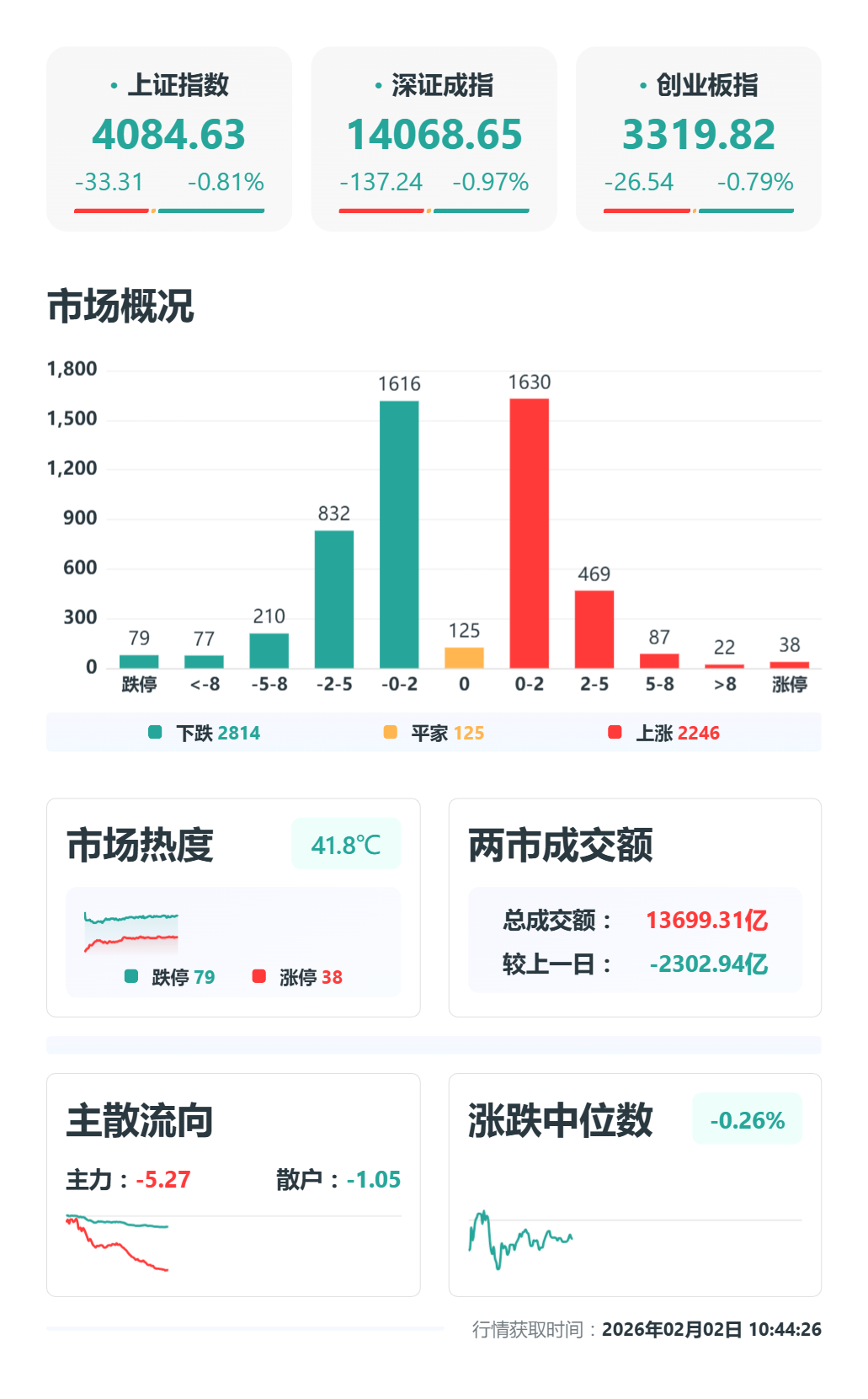
Market Overview - The market is experiencing a narrow fluctuation, with the Shanghai Composite Index down 0.81% at 4084.63 points, the Shenzhen Component Index down 0.97% at 14068.65 points, and the ChiNext Index down 0.79% at 3319.82 points. The total trading volume in both markets is 13699.31 billion yuan, a decrease of over 230 billion yuan compared to the same time the previous trading day, with more than 2800 stocks declining across the market [1]. Sector Performance - The performance of sectors shows a clear divergence, with the non-ferrous metals and oil & petrochemical sectors continuing to decline. In contrast, sectors such as high-voltage power transmission, liquor, beverages, and smart grids are performing actively. The non-ferrous metals sector has the most significant decline, with over 30 stocks hitting the daily limit down, and precious metals dropping over 10% [6][9]. - Specific stocks like Xiaocheng Technology hit the daily limit down at 15.08%, while major stocks like Shandong Gold and Jiangxi Copper also faced significant declines [6][7]. Precious Metals and Non-Ferrous Metals - The capital market is showing a linkage effect, with futures for precious and non-ferrous metals experiencing sharp declines. Silver futures dropped by 17%, gold by over 14%, and tin futures also hit the limit down. In the spot market, gold and silver initially rebounded but then fell again, with gold down over 6% and silver nearly 8% [7][8]. - Analysts from Huatai Securities suggest that the recent downturn may be triggered by the confirmation of a new Federal Reserve chairman, increased margin requirements by domestic and international futures exchanges, and concerns over the sustainability of AI tech stock revenues. They note that the crowded positions in the non-ferrous metals sector, particularly silver, have reached extreme historical levels [8]. Oil & Petrochemical Sector - The oil and petrochemical sector also saw declines, with companies like Zhongman Petroleum and Zhun Oil hitting the daily limit down. This is closely related to the significant drop in international crude oil prices due to geopolitical tensions involving Iran [9]. Telecommunications Sector - The three major telecommunications operators collectively declined over 4% in early trading. This follows an announcement from the Ministry of Finance and the State Taxation Administration regarding an increase in the VAT rate for certain telecommunications services from 6% to 9%, which will impact company revenues and profits [10]. Liquor Sector - In contrast to the declining cyclical stocks, the liquor sector saw a resurgence, with stocks like Shui Jing Fang and Huangtai Liquor hitting the daily limit up. Kweichow Moutai rose over 4%, reaching a peak of 1458.58 yuan per share. Analysts indicate that the liquor sector has adjusted for about five years and is currently at a historical low in terms of valuation and institutional positions [11][12]. Electric Power Equipment Sector - The electric power equipment sector is experiencing a surge, with stocks like Yinen Electric and Shuangjie Electric hitting the daily limit up. This is attributed to the global explosion in AI computing power infrastructure, with many transformer factories operating at full capacity [13][14].
新浪财经资讯AI速递:昨夜今晨财经热点一览 丨2026年2月2日
Sou Hu Cai Jing· 2026-02-01 22:52
Group 1: Gold and Silver Market Dynamics - Recent fluctuations in gold and silver prices have led to significant market reactions, with gold experiencing its largest single-day drop since 1983 and silver prices plummeting by as much as 36% in a single day [1] - The Shenzhen Shui Bei market has shown a split response, with some investors engaging in panic selling while others are seizing the opportunity to buy at lower prices, leading to a surge in gold purchases [1][2] - Many banks have issued risk warnings, advising investors to approach the market with caution and avoid impulsive trading behaviors [1] Group 2: Real Estate Sector Outlook - The A-share and Hong Kong real estate sectors have shown strong performance, with several brokerage firms indicating that despite ongoing profit pressures, positive signals are emerging in the market [2] - Factors contributing to this stabilization include a slight decrease in the number of second-hand homes listed in major cities, supportive policy measures, and historically low valuations in the sector [2] - Institutions like CITIC Securities and Shenwan Hongyuan suggest that the most challenging period for the real estate sector may be over, recommending a focus on high-quality companies with core resources and operational capabilities [2] Group 3: Telecommunications Tax Changes - Major Chinese telecom operators, including China Mobile, China Unicom, and China Telecom, announced a tax adjustment that will increase the VAT rate on mobile data, SMS, and broadband services from 6% to 9% starting January 1, 2026 [3] - This change is expected to have a direct impact on the revenue and profit margins of these telecom companies [3] Group 4: Federal Reserve Leadership Changes - The nomination of Kevin Warsh as the new Federal Reserve Chair by Trump has caused significant market turbulence and a reevaluation of the Fed's role [4] - Warsh's reformist stance is anticipated to lead to aggressive interest rate cuts and a reduction of the Fed's balance sheet, aiming to diminish the Fed's power and size [4] - However, his radical approach may heighten tensions within the Fed and the broader market, facing substantial resistance and uncertainty [4] Group 5: Shenzhen Economic Performance - Shenzhen's GDP reached 3.87 trillion yuan in 2025, marking a 5.5% year-on-year growth, the highest among the top five cities [5] - The city is recognized as a leader in industrial output and foreign trade, contributing 10% of the national total [5] - Shenzhen also excels in various key areas, including the total number of business entities, R&D investment intensity, international patent applications, and cross-border e-commerce scale [5] Group 6: Capital Market Regulation - Regulatory authorities have emphasized the need to consolidate the positive momentum in capital markets, focusing on risk prevention, enhanced regulation, and promoting high-quality development [6] - Plans to deepen reforms in the ChiNext board and implement measures to support new productive forces have been outlined [6] - The guidelines for strategic investors indicate a minimum holding ratio of 5%, encouraging long-term capital to engage more deeply in corporate governance [6] Group 7: Banking Sector Adjustments - Ningbo Bank has reduced its interest rate on demand deposits to 0%, with other banks also lowering rates on gold accounts due to increased market volatility [8] - This trend is part of a broader strategy to manage risks and lower funding costs, potentially paving the way for future reductions in loan interest rates [8] Group 8: Silver Market Auction - A silver building in Hunan, constructed with 2.5 tons of silver, is set to be auctioned at a valuation of only 6.88 yuan per gram, significantly below market prices, raising public interest in asset valuation methods [7] Group 9: Oracle's Financial Challenges - Oracle is facing significant financial pressure due to aggressive expansion in AI data centers, leading to considerations of layoffs affecting 20,000 to 30,000 employees and potential divestitures of its Cerner medical software division [10] - The company has seen its stock and bond prices under pressure as several banks have ceased lending to its data center projects, exacerbating its financing challenges [10]